

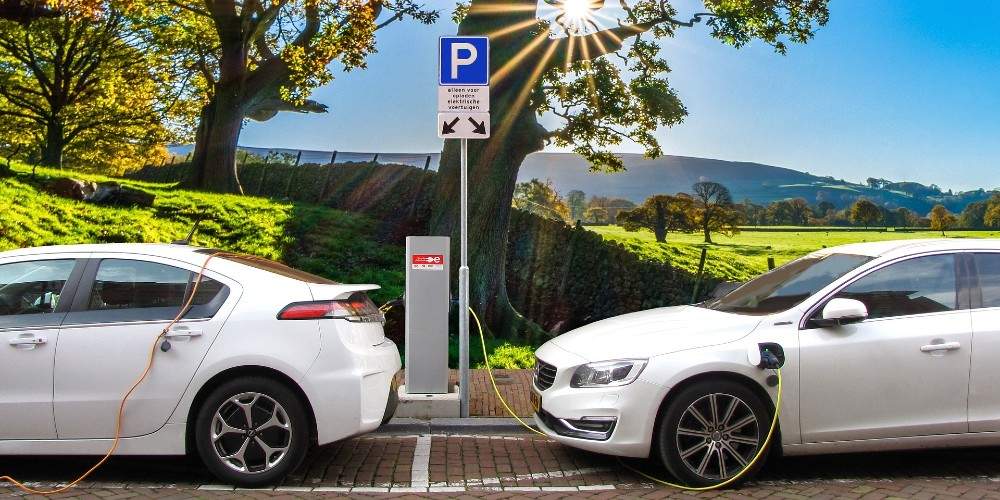
America’s big auto companies, less than 15 years since they were bailed out of bankruptcy following the Clinton-Bush recession of 2008, are betraying the American people out of their greed for government cash and favor. Their “net zero” plans – in conjunction with the globalist dictators and the Biden Administration – include eliminating huge numbers of jobs and devastating major segments of the U.S. economy.
The Democratic Congress has imposed taxes on the American people to subsidize electric vehicle purchases by wealthy, politically correct institutions, including rental car agencies, government bureaucracies, and other entities buying in bulk. Meanwhile, auto manufacturers are planning to virtually eliminate auto dealerships, ethanol producers, and auto parts dealers and vastly diminish the number of auto mechanics.
Insulting the vast majority of its member automobile owners, the American Automobile Association hypocritically reports that “vehicle ownership, whether electric or gas-powered, is a personal choice.” But does AAA forget(?) that our “choice” is rapidly being taken away by government in collusion with lenders and the auto industry itself?
The recently enacted (and ridiculously named) Inflation Reduction Act is a monstrous bribe to wealthy, mostly urban Americans with its $7,500 tax credit for purchasers of electric vehicles, plug-in hybrids, and hydrogen fuel cell vehicles ($4,000 for used vehicles) from January 2023 through December 2032. There are apparently no tax credits for battery replacement.
These credits are limited to vehicles “assembled” in the United States, and there are income and cost restrictions. But this abominable skewering of the marketplace cedes power to those who control access to electricity and away from individual choice. It also destroys ethanol manufacturing and sales, a major industry in the rural Midwest. There are no tax credits for farmers who will be losing a major source of their annual income.
Meanwhile, Ford Motor Co. has told its dealers that they will no longer be allowed to sell electric vehicles unless they agree to invest in regular training, install charging infrastructure, improve their physical and digital sales experiences, and publish non-negotiable pricing online. Ford would like to eliminate dealerships entirely but must wait until their lobbyists can overturn state laws that require vehicle sales to be through dealers.
Ford wants to move toward 100 percent online sales as they dismiss the direct sales partners that built the company brand over the past century. The goal is “no inventory … and 100 percent remote pickup and delivery.” Long-time dealers will be forced into repairs only. It is likely that the dwindling number of repair shops will not be allowed to have parts inventories, either.
If so, any repairs will have to wait for parts to arrive, increasing the downtime for vehicle owners and increasing the total cost (including rental cars) for repairs. Owners of internal combustion engine (ICE) vehicles are likely facing similar problems with parts and repairs. And it is not inconceivable that some new federal (or global) mandate will force all ICE vehicles off the road.
Ford is not the only culprit in this compulsory, undemocratic march toward utopia. While General Motors’ Cadillac and Buick divisions will be offering buyouts to dealers unwilling or unable to spend the money necessary to fully service electric vehicles, those dealers will do take the buyouts will only be allowed to sell Chevrolets. [We still miss Pontiac and Oldsmobile.]
Chevy committed to transition to an all-electric fleet back in 2017, though they recently announced they will continue selling some ICE vehicles for the time being. Similarly, Chrysler plans to be all-electric by 2028. Japan’s big automakers, too, are now looking to go electric within the next decade (except for Toyota, which must still believe buyers should have a choice).
None of this march away from reliable, proven ICE engines makes any sense to rural Americans, those who live in hurricane-prone areas, and anyone who drives cross-country. Farmers today can run their tractors off biodiesel made right down the road and drive to distant towns for groceries and supplies in their 20-year-old pickups. Hurricanes, earthquakes, and other natural and human-caused disruptive events can shut down electric power for days in large areas.
These decisions make even less sense to citizens of developing nations whose electric grids are spotty (if existent at all) and decades away from current First-World standards. How do you charge an EV is there is no electric power? Or if the power is on just a few hours a day? Or if there are only a few public outlets? Or if there are no EV-capable tow trucks or expensive, risky (due to fires and theft, for starters) repair facilities? Or maybe Africans should not have cars?
Is there no one alive who remembers the 1979 Arab oil embargo that exposed the weakness of relying on a sole source of energy to operate a major nation? After President Nixon’s price controls proved counterproductive, President Ford to little avail promoted expanding the use of coal and nuclear power and development of synfuels and oil shale.
The goal then was to reduce our national reliance on imported energy, but not until the Trump Administration did the U.S. achieve effective energy independence. And with a single stroke of a pen, President Biden began the process of forcing dependence on Chinese-made EV batteries, solar arrays, and even wind turbines while systematically working to destroy our nation’s oil and gas industry (following up on President Obama’s war on coal).

To date, there has been no national – or international — debate on the eagerness of the driving public (or those who long for a vehicle to drive) to submit to this expedited, forced transition (sic) to electric-only transportation. There is no discussion on the logistics of accomplishing this likely unwise mandatory restriction on human freedoms. It is not allowed, not in the Congress, the media, or even corporate boardrooms. It is all being done behind closed doors by fiat.
There are far too many questions that have yet to be asked, let alone answered, at the decision-making levels of government and industry for these globalists to force upon the entire world an unproven, uncertain technology the supply chains for which are already overextended and which rely on slave labor for many of its raw materials. There are no answers at all as to why – if EVs are so wonderful – there is any need for mandates and prohibitions at all.
It was not that long ago that truckers in Canada were attacked by the Trudeau government for daring to protest against draconian COVID-19 lockdowns and mandates. The mere relocation of 50 border crossers from Texas to Martha’s Vineyard via Florida has caused major meltdowns by formerly “sanctuary city” leaders.
Imagine if 200 million internal combustion engine vehicle owners (or even 2 million) decided to work together to fight against the outrageous, unworkable, antidemocratic, and bankrupting mandates to force everyone into electric vehicles most cannot afford and do not want and to effectively exclude billions from being allowed to drive at all!
But where to start?

Two Storms, One Harvest

Every food crisis in living memory has been a one-shock event. The 2008 price spike was a commodity bubble. The 2020 shortages were a logistics failure. The 2022 grain scare was a war on one exporter’s ports. Each time, the system bent, adjusted, and recovered, and each time the experts assured us afterward that global markets are simply too big and too diversified to fail.
What nobody in Washington seems eager to discuss is that 2026 is shaping up to be something the modern food system has never actually faced. Two independent shocks, one climatic and one geopolitical, are converging on the same harvest cycle at the same time. Not sequentially. Simultaneously.
Start with the weather. The Pacific Ocean is currently building toward what forecasters now openly call a record event. NOAA’s Climate Prediction Center puts the odds of at least a strong El Niño near 88 percent, with roughly two in three odds it reaches “very strong” status, the tier reserved for perhaps three or four events in the entire satellite era. Every major global model now projects a median peak in Super El Niño territory, and most of them project it exceeding the 2015-16 event, which until now held the modern record. Sea surface anomalies were already brushing the super threshold in mid-July, months before these events normally peak. The atmosphere has already shifted into El Niño mode, and the event is forecast to crest in late fall and early winter.
This is not about “climate change.” It’s about the standard cycles of weather, and the cycle we’re currently in is one that has likely devastated societies in the past. We’re better prepared as a society today, but not all Americans are equally prepared.
Serious households have started doing the quiet math on their own. Grocery bills tell part of the story, and the forecast maps tell the rest, which is why long-term food storage has moved from fringe hobby to mainstream line item in the family budget, with established suppliers like Heaven’s Harvest seeing demand from people who five years ago would have rolled their eyes at the idea. That instinct is not paranoia. It is pattern recognition, and the pattern is worth walking through carefully.
Editor’s Note: Heaven’s Harvest IS a sponsor, but the warnings of this article are real and would be written even if we didn’t have a survival food sponsor. With that said, those who take advantage of what they offer can use promo code “Patriot” for 15% off.
The Fertilizer Clock Is Already Running
While the Pacific warms, the second shock has been unfolding in the Strait of Hormuz. The conflict with Iran turned the world’s most important energy chokepoint into a contested waterway, and the consequences reach far beyond the gas pump. Roughly a third of global fertilizer trade moves through Hormuz, and the disruption sent urea prices up 86 percent year over year by March, with a 53 percent jump in a single month.
The World Bank projects energy prices rising about 24 percent in 2026 and fertilizer about 31 percent. By its own accounting, fertilizer prices ran 35 percent higher in the first five months of this year than the same period last year.
Here is the mechanism the nightly news will not explain. Fertilizer is not a grocery item. It is a time-delayed input. The nitrogen a farmer in Iowa or Punjab could not afford to apply this spring does not show up as a problem this spring. It shows up as a thinner harvest six to twelve months later.
The World Bank’s own food security brief concedes that the effects of reduced applications earlier this season “are likely to become visible only later in harvest outcomes.” Translate that from institutional language into plain English and it means this. The damage is already done, it is already in the ground, and we are simply waiting for it to arrive on the shelf.
Now check the calendar. Six to twelve months from the spring planting season lands us squarely in late 2026 and early 2027. Which is precisely when the strongest El Niño in the instrumental record is forecast to peak, bringing its signature droughts to Southeast Asia, Australia, southern Africa, northern Brazil, and South Asia, the very regions that grow the world’s rice, sugar, and oilseeds.
The World Bank warns openly that a strong El Niño “could disrupt multiple crop belts simultaneously” on top of the conflict-driven input costs. Their baseline projection assumes the Middle East disruptions ease by autumn. What in the last two years of Middle East history suggests that assumption is safe?
The System Has No Slack Left
The comfortable answer is that global markets always adjust. But adjustment requires slack, and the slack is gone. Global cereal production is expected to decline from last year’s records even before El Niño does its work. The UN World Food Programme, hardly a den of right-wing preppers, is calling this the most significant disruption to its supply chains since Covid and the invasion of Ukraine, and its supply chain director put the stakes bluntly.
Today’s supply chain challenges are tomorrow’s hunger crisis.
There is also a political dimension that markets cannot price. When food gets scarce, governments do not behave like economists. They behave like politicians. Export bans, hoarding mandates, and panic buying at the national level turned the modest rice shortfall of 2008 into a global crisis, and analysts are already warning that import-dependent nations are the first dominoes.
The 2015-16 Super El Niño, a far weaker event than what is now forecast, threw tens of millions into food stress across Africa and Asia. This one is projected to be stronger, and it arrives with fertilizer already rationed by price and shipping lanes already contested by missiles.
What Joseph Knew
Scripture does not treat preparation for lean years as faithlessness. It treats it as wisdom delivered in advance to those willing to act on it.
Behold, there come seven years of great plenty throughout all the land of Egypt: And there shall arise after them seven years of famine; and all the plenty shall be forgotten in the land of Egypt.
Joseph did not respond to that warning with a hashtag or a committee. He stored grain during the years of abundance, and when the famine came, Egypt stood while its neighbors begged. The lesson is not that famine is certain. It is that the time to prepare is precisely when preparation still looks optional.
Nobody who filled a pantry in a year of plenty has ever regretted it, and nobody standing in an empty aisle has ever been glad he waited for certainty.
None of this calls for panic, and panic is the enemy of sound judgment anyway. It calls for the same unglamorous prudence our grandparents considered ordinary. Keep some cash margin, know your local growers, and put real food in deep storage while it is cheap and available, because the entire arc of this story is that cheap and available is a closing window.
Families looking for a straightforward place to start can visit Heaven’s Harvest and use promo code Patriot for 15 percent off long-term storable food. The forecasts may yet soften, the strait may yet reopen, and we should pray they do. But hope is a fine thing to hold and a foolish thing to eat.
