

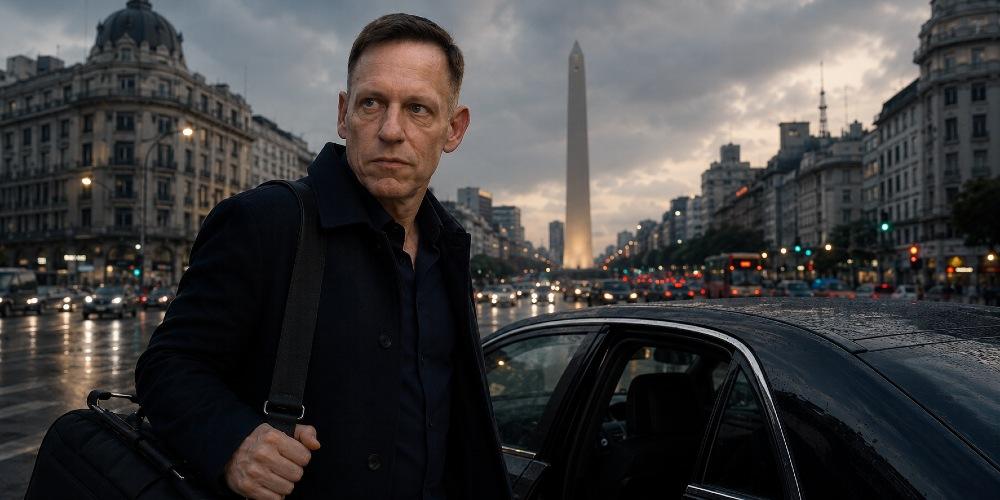
Billionaire investor and PayPal co-founder Peter Thiel has reportedly relocated his family to Buenos Aires, Argentina, purchasing a multimillion-dollar mansion and enrolling his children in local schools. While framed by some as a personal lifestyle choice, this move reveals deeper truths about the unraveling of the American experiment under decades of progressive governance, confiscatory taxation, and cultural drift.
Thiel, a longtime supporter of President Donald Trump and a voice for technological optimism tempered by realism, appears motivated by several converging factors: California’s looming billionaire tax ballot measure, broader anxieties over potential Northern Hemisphere conflicts, and unchecked artificial intelligence risks. His reported affinity for Argentine President Javier Milei’s libertarian reforms underscores a search for environments where bold ideas face fewer bureaucratic chains.
This is no ordinary relocation. Thiel has long warned about stagnation in the West, from his critiques of higher education to his calls for renewed innovation. Yet even he, with resources few possess, finds himself establishing a “Plan B” far south of the border. What does it say about the United States when one of its most forward-thinking minds hedges against its future?
According to detailed reporting, Thiel’s interest intensified as California’s Democrat-dominated politics pushed a significant wealth tax targeting high-net-worth individuals. Such policies rarely stay contained; they signal hostility to success itself, driving capital and talent elsewhere. Argentina, despite its own historical economic struggles, now offers a contrasting model under Milei—one of slashing regulations and confronting entrenched interests.
The Tax Trap and the Flight of Capital
Progressive taxation schemes sold as fairness measures have a predictable outcome: they punish productivity while failing to deliver promised social uplift. California’s proposal, set for voter consideration, exemplifies this pattern. Thiel’s response aligns with basic economic reality—individuals and families vote with their feet when the cost of staying exceeds the benefits.
This isn’t unique to Thiel. A quiet but steady exodus of high achievers from blue strongholds has accelerated in recent years. From tech hubs to entertainment capitals, the combination of high taxes, crime, homelessness, and ideological conformity repels those who build rather than redistribute. America’s founders understood that secure property rights form the bedrock of liberty; today’s policy class seems intent on eroding that foundation.
Thiel’s alignment with Milei’s “slash-and-burn” approach to governance highlights an irony. While American conservatives fight to restore constitutional principles at home, some look abroad for laboratories of liberty. Milei’s willingness to challenge socialist legacies offers a refreshing counterpoint to Washington’s endless expansion of state power.
Geopolitical and Technological Shadows
Beyond taxes, Thiel’s concerns extend to existential risks: nuclear tensions and runaway AI development. His private discussions, including references to apocalyptic themes, reflect a thinker grappling with humanity’s trajectory in an age of rapid change. Friends and associates note his view of Argentina’s geographic distance as a hedge against Northern Hemisphere instability.
These fears are not baseless. Global flashpoints from Eastern Europe to the Indo-Pacific demand clear-eyed realism, not wishful diplomacy. On AI, Thiel has consistently advocated for American leadership, warning against ceding ground to adversaries like China. His move raises pointed questions about whether domestic political dysfunction hampers the very innovation needed to navigate these challenges.
Most Americans lack the means to establish overseas footholds. For the average family, the solution lies not in flight but in reclaiming institutions and policies that once made this nation exceptional. Thiel’s choice spotlights the urgency: without course correction, more will follow his path.
“The moment China takes Taiwan or Russia takes Lithuania, I’m in Buenos Aires. It’s good to have a Plan B for civilization.”
That sentiment from one of Thiel’s associates captures the hedging mindset taking root among some elites. Yet true conservatism calls not for retreat but for renewal—defending the inheritance of faith, family, and freedom on these shores.
In the end, Thiel’s Argentine interlude serves as both symptom and signal. It indicts the failures of leftward drift while challenging patriots to build a society worth staying for, and fighting for.
The coming years will test whether the United States recommits to limited government, individual liberty, and moral clarity—or continues exporting its best minds to friendlier climes. Thiel’s move is a data point, not destiny. The response from those who remain will determine the outcome.

Two Storms, One Harvest

Every food crisis in living memory has been a one-shock event. The 2008 price spike was a commodity bubble. The 2020 shortages were a logistics failure. The 2022 grain scare was a war on one exporter’s ports. Each time, the system bent, adjusted, and recovered, and each time the experts assured us afterward that global markets are simply too big and too diversified to fail.
What nobody in Washington seems eager to discuss is that 2026 is shaping up to be something the modern food system has never actually faced. Two independent shocks, one climatic and one geopolitical, are converging on the same harvest cycle at the same time. Not sequentially. Simultaneously.
Start with the weather. The Pacific Ocean is currently building toward what forecasters now openly call a record event. NOAA’s Climate Prediction Center puts the odds of at least a strong El Niño near 88 percent, with roughly two in three odds it reaches “very strong” status, the tier reserved for perhaps three or four events in the entire satellite era. Every major global model now projects a median peak in Super El Niño territory, and most of them project it exceeding the 2015-16 event, which until now held the modern record. Sea surface anomalies were already brushing the super threshold in mid-July, months before these events normally peak. The atmosphere has already shifted into El Niño mode, and the event is forecast to crest in late fall and early winter.
This is not about “climate change.” It’s about the standard cycles of weather, and the cycle we’re currently in is one that has likely devastated societies in the past. We’re better prepared as a society today, but not all Americans are equally prepared.
Serious households have started doing the quiet math on their own. Grocery bills tell part of the story, and the forecast maps tell the rest, which is why long-term food storage has moved from fringe hobby to mainstream line item in the family budget, with established suppliers like Heaven’s Harvest seeing demand from people who five years ago would have rolled their eyes at the idea. That instinct is not paranoia. It is pattern recognition, and the pattern is worth walking through carefully.
Editor’s Note: Heaven’s Harvest IS a sponsor, but the warnings of this article are real and would be written even if we didn’t have a survival food sponsor. With that said, those who take advantage of what they offer can use promo code “Patriot” for 15% off.
The Fertilizer Clock Is Already Running
While the Pacific warms, the second shock has been unfolding in the Strait of Hormuz. The conflict with Iran turned the world’s most important energy chokepoint into a contested waterway, and the consequences reach far beyond the gas pump. Roughly a third of global fertilizer trade moves through Hormuz, and the disruption sent urea prices up 86 percent year over year by March, with a 53 percent jump in a single month.
The World Bank projects energy prices rising about 24 percent in 2026 and fertilizer about 31 percent. By its own accounting, fertilizer prices ran 35 percent higher in the first five months of this year than the same period last year.
Here is the mechanism the nightly news will not explain. Fertilizer is not a grocery item. It is a time-delayed input. The nitrogen a farmer in Iowa or Punjab could not afford to apply this spring does not show up as a problem this spring. It shows up as a thinner harvest six to twelve months later.
The World Bank’s own food security brief concedes that the effects of reduced applications earlier this season “are likely to become visible only later in harvest outcomes.” Translate that from institutional language into plain English and it means this. The damage is already done, it is already in the ground, and we are simply waiting for it to arrive on the shelf.
Now check the calendar. Six to twelve months from the spring planting season lands us squarely in late 2026 and early 2027. Which is precisely when the strongest El Niño in the instrumental record is forecast to peak, bringing its signature droughts to Southeast Asia, Australia, southern Africa, northern Brazil, and South Asia, the very regions that grow the world’s rice, sugar, and oilseeds.
The World Bank warns openly that a strong El Niño “could disrupt multiple crop belts simultaneously” on top of the conflict-driven input costs. Their baseline projection assumes the Middle East disruptions ease by autumn. What in the last two years of Middle East history suggests that assumption is safe?
The System Has No Slack Left
The comfortable answer is that global markets always adjust. But adjustment requires slack, and the slack is gone. Global cereal production is expected to decline from last year’s records even before El Niño does its work. The UN World Food Programme, hardly a den of right-wing preppers, is calling this the most significant disruption to its supply chains since Covid and the invasion of Ukraine, and its supply chain director put the stakes bluntly.
Today’s supply chain challenges are tomorrow’s hunger crisis.
There is also a political dimension that markets cannot price. When food gets scarce, governments do not behave like economists. They behave like politicians. Export bans, hoarding mandates, and panic buying at the national level turned the modest rice shortfall of 2008 into a global crisis, and analysts are already warning that import-dependent nations are the first dominoes.
The 2015-16 Super El Niño, a far weaker event than what is now forecast, threw tens of millions into food stress across Africa and Asia. This one is projected to be stronger, and it arrives with fertilizer already rationed by price and shipping lanes already contested by missiles.
What Joseph Knew
Scripture does not treat preparation for lean years as faithlessness. It treats it as wisdom delivered in advance to those willing to act on it.
Behold, there come seven years of great plenty throughout all the land of Egypt: And there shall arise after them seven years of famine; and all the plenty shall be forgotten in the land of Egypt.
Joseph did not respond to that warning with a hashtag or a committee. He stored grain during the years of abundance, and when the famine came, Egypt stood while its neighbors begged. The lesson is not that famine is certain. It is that the time to prepare is precisely when preparation still looks optional.
Nobody who filled a pantry in a year of plenty has ever regretted it, and nobody standing in an empty aisle has ever been glad he waited for certainty.
None of this calls for panic, and panic is the enemy of sound judgment anyway. It calls for the same unglamorous prudence our grandparents considered ordinary. Keep some cash margin, know your local growers, and put real food in deep storage while it is cheap and available, because the entire arc of this story is that cheap and available is a closing window.
Families looking for a straightforward place to start can visit Heaven’s Harvest and use promo code Patriot for 15 percent off long-term storable food. The forecasts may yet soften, the strait may yet reopen, and we should pray they do. But hope is a fine thing to hold and a foolish thing to eat.
