
(End of the American Dream)—For decades, we were told to ignore any of the strange reports that we were hearing about Antarctica. Experts assured us that nothing unusual was going on and that there wasn’t anything to be concerned about. Of course we couldn’t go investigate for ourselves, because as you will see below, there are 72 areas of Antarctica that only those with a special permit are allowed to enter. And if you try to fly to Antarctica without authorization, you will get into all sorts of trouble.
So why all the secrecy?
What are they trying to hide from all the rest of us?
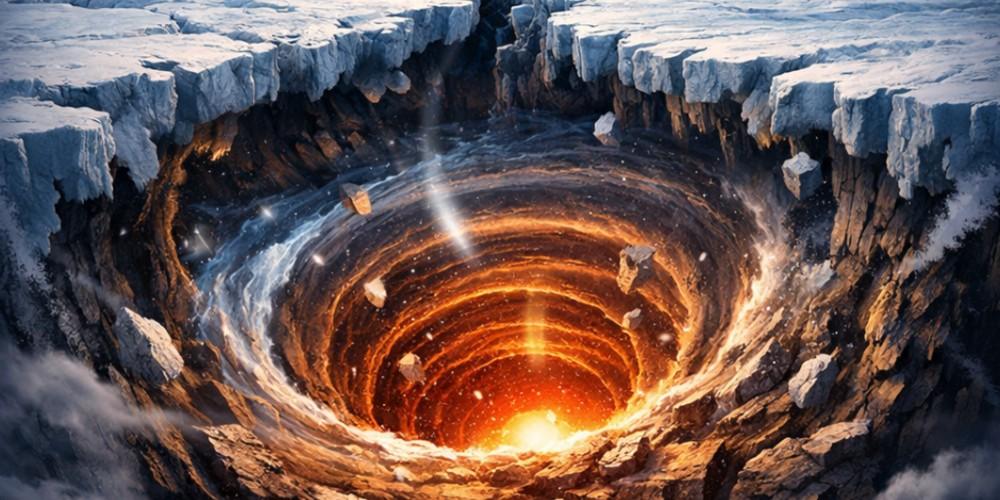
One thing that scientists are admitting about Antarctica is that it sits directly above the strongest “gravity hole” on the entire planet…
Earth may look like a smooth “blue marble” from space, but it’s better to imagine it as a slightly gnarled orange, with an inside that’s firm in parts, but squishier in others. Since the planet isn’t a perfect sphere and its internal density varies across the globe, gravitational pull changes from place to place. Where there’s less mass in the underlying geology, gravity is weaker, and vice versa.
These dips in the gravitational field are formally known as gravity anomalies, but they’re more commonly called “gravity holes”. The largest is found in the middle of the Indian Ocean, spanning over 3 million square kilometers (roughly 1,100,000 square miles), while the strongest is found in Antarctica.
Isn’t that interesting?
It turns out that there is a gigantic “hole” under Antarctica after all.
But the experts are insisting that there really isn’t anything particularly special about it. In fact, they try to make it sound as boring as possible…
A “gravity hole” beneath Antarctica sounds like the plot to a bad sci-fi movie, but it’s a very real situation deep beneath the Earth’s surface stretching back tens of millions of years. The phenomenon thankfully isn’t as apocalyptic as it sounds, either. In fact, researchers say these complex interactions between rock densities, gravitational pull, and sea levels are actually helping them understand how the southernmost continent’s ice sheets evolved, and what their influences mean for the planet’s climate.
Yawn.
That does sound pretty boring.
But could it be possible that there is a lot more to this than we are being told?
It is being reported that the team of researchers that mapped the colossal gravity hole directly under Antarctica was able to use a combination of methods to actually “reconstruct the three-dimensional structure” that exists underneath the continent…
In the study, published recently in Scientific Reports, Forte and Petar Glišović, Ph.D., of the Paris Institute of Earth Physics, mapped the Antarctic gravity hole and revealed how it developed over millions of years. They relied on an Earth-spanning scientific project that combined global earthquake recordings with physics-based modeling to reconstruct the three-dimensional structure inside Earth.
“Imagine doing a CT scan of the whole Earth, but we don’t have X-rays like we do in a medical office. We have earthquakes. Earthquake waves provide the ‘light’ that illuminates the interior of the planet,” Forte said.
It certainly appears that something is down there.
Could some of the reports that we have heard over the years actually be true?
I wouldn’t hold your breath waiting for the truth to come out.

Much of the continent is strictly off limits unless you have a special permit.
In fact, according to Wikipedia there are 72 sites that have been designated as Antarctic Specially Protected Areas…
An Antarctic Specially Protected Area (ASPA) is an area on the continent of Antarctica, or on nearby islands, which is protected by scientists and several different international bodies. The protected areas were established in 1961 under the Antarctic Treaty System, which governs all the land and water south of 60 latitude and protects against human development.[1] A permit is required for entry into any ASPA site.[2] The ASPA sites are protected by the governments of Australia, New Zealand, United States, United Kingdom, Chile, France, Argentina, Poland, Russia, Norway, Japan, India, Italy, and Republic of Korea. There are currently 72 sites.
They take security in Antarctica quite seriously.
When a 19-year-old American named Ethan Guo decided that he would fly down there without permission, he was immediately arrested…
A teenage pilot, who is attempting to fly all seven continents solo, hit a patch of rough air this weekend when Chilean authorities detained him for changing his flight plan without their permission and landing in Antarctica.
Chilean prosecutors say American influencer Ethan Guo, 19, broke “multiple national and international regulations” by changing his flight plans without prior notice, landing on a part of Antarctica where the South American country maintains a territorial claim.
CNN requested a comment from Guo, whose lawyer on Sunday said the young pilot had experienced “complications” while flying.
Yes, tourists can visit Antarctica.
But you must carefully obey the rules, and you must not wander away from the very limited areas that tourists are allowed to see.

Of course most of the good stuff is in areas where tourists are never allowed, and that includes the colossal pyramid that appears to have been man-made…

I have to admit, the symmetry of that structure is quite striking.
But even though it looks like an ancient Egyptian pyramid, the official story is that this is simply a naturally-occurring structure that was shaped by erosion…
In the vast, icy expanse of Antarctica, lies a mountain that, from an aerial view, resembles an ancient Egyptian pyramid. This striking formation, nestled in a sea of snow, has captured the imagination of internet users since it went viral in 2016. However, this pyramid-like mountain is no work of human or alien architects; it’s a product of nature’s slow and relentless erosion.
This unnamed mountain stands about 4,150 feet tall. It’s located in the southern part of the Ellsworth Mountains, a rugged range first glimpsed by American aviator Lincoln Ellsworth in 1935. The mountain’s pyramid shape is particularly notable because it has four steep sides, a feature that isn’t common among mountains.
I wish that I could go see it for myself.
But that certainly isn’t going to happen any time soon.
Interestingly, a “ring of fire” solar eclipse was visible in Antarctica on Tuesday…
A magnificent annular solar eclipse just swept over Antarctica, putting on an impressive display of orbital mechanics as the moon passed in front of the sun at the perfect distance from Earth to create a fiery halo in a darkened sky — at least for the few souls lucky enough to be in a position to see it.
Feb. 17’s annular solar eclipse occurred as the lunar disk slipped between the sun and Earth during its new moon phase. The alignment occurred as the moon travelled through a distant point in its elliptical orbit, making it appear smaller than usual in Earth’s sky.
Today’s eclipse got underway at 4:56 a.m. EST (0956 GMT), as the moon took an ever greater bite out of the solar disk, transforming its burning orb into a glowing crescent, before finally diving entirely within its fiery expanse. The moon — appearing fractionally smaller than usual — was unable to cover the entirety of the sun’s disk, leaving a thin sliver of its outer edge visible to surround Earth’s natural satellite to create a ring in the skies over Antarctica.
So many unusual things are happening in the heavens this year.
Next month there will be a spectacular blood moon eclipse, and the month after that an absolutely enormous comet may be visible to the naked eye during the daytime as it travels very close to the Sun.
We live in such interesting times, and I have a feeling that they will become even more interesting during the months ahead.
Michael’s new book entitled “10 Prophetic Events That Are Coming Next” is available in paperback and for the Kindle on Amazon.com, and you can subscribe to his Substack newsletter at michaeltsnyder.substack.com.

Two Storms, One Harvest

Every food crisis in living memory has been a one-shock event. The 2008 price spike was a commodity bubble. The 2020 shortages were a logistics failure. The 2022 grain scare was a war on one exporter’s ports. Each time, the system bent, adjusted, and recovered, and each time the experts assured us afterward that global markets are simply too big and too diversified to fail.
What nobody in Washington seems eager to discuss is that 2026 is shaping up to be something the modern food system has never actually faced. Two independent shocks, one climatic and one geopolitical, are converging on the same harvest cycle at the same time. Not sequentially. Simultaneously.
Start with the weather. The Pacific Ocean is currently building toward what forecasters now openly call a record event. NOAA’s Climate Prediction Center puts the odds of at least a strong El Niño near 88 percent, with roughly two in three odds it reaches “very strong” status, the tier reserved for perhaps three or four events in the entire satellite era. Every major global model now projects a median peak in Super El Niño territory, and most of them project it exceeding the 2015-16 event, which until now held the modern record. Sea surface anomalies were already brushing the super threshold in mid-July, months before these events normally peak. The atmosphere has already shifted into El Niño mode, and the event is forecast to crest in late fall and early winter.
This is not about “climate change.” It’s about the standard cycles of weather, and the cycle we’re currently in is one that has likely devastated societies in the past. We’re better prepared as a society today, but not all Americans are equally prepared.
Serious households have started doing the quiet math on their own. Grocery bills tell part of the story, and the forecast maps tell the rest, which is why long-term food storage has moved from fringe hobby to mainstream line item in the family budget, with established suppliers like Heaven’s Harvest seeing demand from people who five years ago would have rolled their eyes at the idea. That instinct is not paranoia. It is pattern recognition, and the pattern is worth walking through carefully.
Editor’s Note: Heaven’s Harvest IS a sponsor, but the warnings of this article are real and would be written even if we didn’t have a survival food sponsor. With that said, those who take advantage of what they offer can use promo code “Patriot” for 15% off.
The Fertilizer Clock Is Already Running
While the Pacific warms, the second shock has been unfolding in the Strait of Hormuz. The conflict with Iran turned the world’s most important energy chokepoint into a contested waterway, and the consequences reach far beyond the gas pump. Roughly a third of global fertilizer trade moves through Hormuz, and the disruption sent urea prices up 86 percent year over year by March, with a 53 percent jump in a single month.
The World Bank projects energy prices rising about 24 percent in 2026 and fertilizer about 31 percent. By its own accounting, fertilizer prices ran 35 percent higher in the first five months of this year than the same period last year.
Here is the mechanism the nightly news will not explain. Fertilizer is not a grocery item. It is a time-delayed input. The nitrogen a farmer in Iowa or Punjab could not afford to apply this spring does not show up as a problem this spring. It shows up as a thinner harvest six to twelve months later.
The World Bank’s own food security brief concedes that the effects of reduced applications earlier this season “are likely to become visible only later in harvest outcomes.” Translate that from institutional language into plain English and it means this. The damage is already done, it is already in the ground, and we are simply waiting for it to arrive on the shelf.
Now check the calendar. Six to twelve months from the spring planting season lands us squarely in late 2026 and early 2027. Which is precisely when the strongest El Niño in the instrumental record is forecast to peak, bringing its signature droughts to Southeast Asia, Australia, southern Africa, northern Brazil, and South Asia, the very regions that grow the world’s rice, sugar, and oilseeds.
The World Bank warns openly that a strong El Niño “could disrupt multiple crop belts simultaneously” on top of the conflict-driven input costs. Their baseline projection assumes the Middle East disruptions ease by autumn. What in the last two years of Middle East history suggests that assumption is safe?
The System Has No Slack Left
The comfortable answer is that global markets always adjust. But adjustment requires slack, and the slack is gone. Global cereal production is expected to decline from last year’s records even before El Niño does its work. The UN World Food Programme, hardly a den of right-wing preppers, is calling this the most significant disruption to its supply chains since Covid and the invasion of Ukraine, and its supply chain director put the stakes bluntly.
Today’s supply chain challenges are tomorrow’s hunger crisis.
There is also a political dimension that markets cannot price. When food gets scarce, governments do not behave like economists. They behave like politicians. Export bans, hoarding mandates, and panic buying at the national level turned the modest rice shortfall of 2008 into a global crisis, and analysts are already warning that import-dependent nations are the first dominoes.
The 2015-16 Super El Niño, a far weaker event than what is now forecast, threw tens of millions into food stress across Africa and Asia. This one is projected to be stronger, and it arrives with fertilizer already rationed by price and shipping lanes already contested by missiles.
What Joseph Knew
Scripture does not treat preparation for lean years as faithlessness. It treats it as wisdom delivered in advance to those willing to act on it.
Behold, there come seven years of great plenty throughout all the land of Egypt: And there shall arise after them seven years of famine; and all the plenty shall be forgotten in the land of Egypt.
Joseph did not respond to that warning with a hashtag or a committee. He stored grain during the years of abundance, and when the famine came, Egypt stood while its neighbors begged. The lesson is not that famine is certain. It is that the time to prepare is precisely when preparation still looks optional.
Nobody who filled a pantry in a year of plenty has ever regretted it, and nobody standing in an empty aisle has ever been glad he waited for certainty.
None of this calls for panic, and panic is the enemy of sound judgment anyway. It calls for the same unglamorous prudence our grandparents considered ordinary. Keep some cash margin, know your local growers, and put real food in deep storage while it is cheap and available, because the entire arc of this story is that cheap and available is a closing window.
Families looking for a straightforward place to start can visit Heaven’s Harvest and use promo code Patriot for 15 percent off long-term storable food. The forecasts may yet soften, the strait may yet reopen, and we should pray they do. But hope is a fine thing to hold and a foolish thing to eat.
