


The mounting evidence of severe health effects in humans following COVID-19 vaccination warrants additional investigation. To add to the pile of evidence, a new study has found that the nanoparticles in the mRNA vaccine change the immune system.
A recent preprint study sheds light on why adverse events were detected after a COVID-19 messenger RNA (mRNA) immunization.
The study (read below), coordinated by Thomas Jefferson University researchers, discovered that lipid nanoparticles (LNPs) used to carry mRNA in COVID-19 vaccinations might “inhibit” and “alter” immune responses in mice.
LNPs are lipid shells that surround mRNA to evade degradation and detection by our immune system.
LNPs are not mRNA; they are merely a covering for the mRNA cargo.
The mRNA COVID-19 vaccines from Pfizer and Moderna utilise LNPs to introduce mRNA spike protein sequences into human cells. Human cells will produce spike proteins after receiving the mRNA sequences, which will then cause an immunological response.
Initially, it was planned for the LNPs to covertly introduce mRNA sequences that would cause the cells to create spike proteins and therefore develop immunity to the COVID-19 virus.
However, numerous researches in mice have now discovered that the LNPs, despite being advertised as harmless and non-toxic, are instead very inflammatory.
These nanoparticles are extremely long-lasting and can stay in the body for 20 to 30 days. They are likely to stay in the body and continue to stimulate the immune system, which will eventually wear out and become non-responsive.
Similar conclusions were also reached by the Thomas Jefferson research. By injecting animals with the identical LNPs found in Pfizer’s vaccines—some mice even received two doses—researchers examined how LNPs influence the immune system.
Immune responses and inflammation in mice are not absolute indicators of what will occur in people. Nevertheless, mice have long been used to assess the efficacy and safety of medications intended for human use; symptoms of immunological dysfunction are a hint of potential health hazards in people.
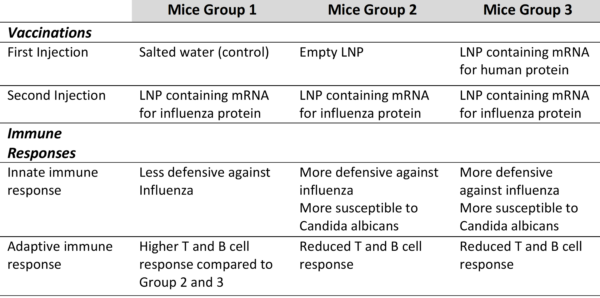
The researchers discovered that mice given two doses had a weaker immunological response to their second injection than mice given only one dosage.
“The mRNA-LNP (nanoparticle) vaccine platform induces long-term unexpected immunological changes affecting both adaptive immune responses and heterologous protection against infections,” the authors wrote.
Pre-Exposure to mRNA Nanoparticles Reduce Innate Cell Numbers
Mice that received two doses of LNP injections had less innate immune cells, which are the primary immune cells.

By injecting mice with various LNP variants, the authors hoped to learn how the mRNA-sealing LNPs affected the mice.
The mice were divided into three groups, each of which received two injections with various substances.
Most mice received an injection of LNP as the initial injection. The second half received empty LNPs with no mRNA while the first half received LNPs having mRNA sequences.
An injection of salty water was given to the leftover mice. Since injections of salted water are not meant to cause any alterations to the body, these mice serve as the baseline to compare.
Approximately two weeks later, all 3 groups received the same LNP injection carrying influenza protein mRNA sequences (HA). The second injection stimulated their cells to produce HA proteins, resulting in an immunological response. It was hoped that the immunological response would render the mice immune to the influenza virus.
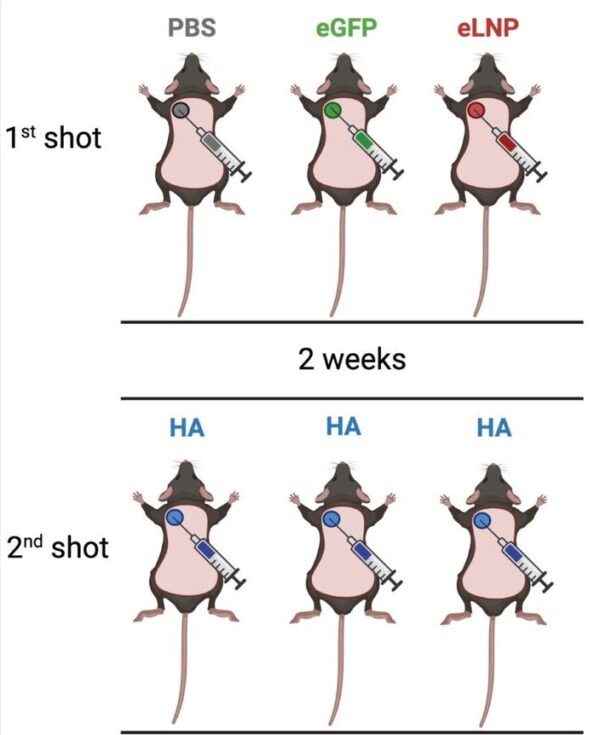
After the second injection, the researchers discovered that all mice had established immunological defenses against the influenza virus.

The researchers found that mice who received two doses of LNPs lost less weight and were more resistant to an influenza illness. Oddly enough, the same mice also responded to the flu vaccine with a less potent immunological response and less activation of immune cells.
According to the authors’ assumption, their “resistance” likely results from an alternate pathway that LNPs have activated rather than from a boosted immune system. This “resistance” may only be applicable to influenza and is not yet known if it will apply to other illnesses.
This is due to the study’s discovery that mice who appeared to be more “resistant” to the flu were in fact more prone to fungus infections.
When the mice were given two doses of the Candida albicans infection, the mice lost more weight and had less success fighting the illness, indicating a change in the innate immune response.
Additional research revealed that these mice had less neutrophils, the most prevalent type of first-responder immune cell.
Neutrophils are responsible for patrolling the body and indiscriminately attacking anything foreign they come across, thus having less of them increases the risk of infection.
The scientists hypothesized that decreased neutrophil counts may have contributed to the fungal outbreak since an unchecked fungal infection, particularly C. albicans, is frequently a symptom of compromised innate or first responder immune response.
LNPs trigger inflammation, and specific inflammatory pathways limit blood cell formation. The scientists hypothesized that the two dosages of LNPs given to these mice induced increased inflammation, resulting in a decrease in blood cell formation and low neutrophil numbers.
Though this is speculative, and it is unknown if the effects in mice would translate to humans, there have been instances of vaccinated people developing severe aplastic anemia, a condition in which the body can no longer produce enough blood cells, especially red blood cells.
There have also been instances of COVID-19 vaccine recipients acquiring rare fungal infections or aggravating pre-existing fungal disorders.
Though major fungal disease does not always indicate a weakened immune system, serious fungal infections “are most common among people with weak immune systems,” according to the Centers for Disease Control and Prevention (CDC).
Antigen Numbers Reduced in Mice with High Nanoparticle Exposure
There are two types of immune cells: first responders (innate immune cells) and second responders (adaptive immune cells).
When they come upon something strange, the first responders launch an immediate assault. However, their attacks are generic and frequently fail to completely remove illnesses.
As a result, adaptive immune cells, also known as T and B cells, act as our second line of defense.
They become active about a week into the infection and clear infections by launching powerful and targeted attacks.
T and B cells must be supplied with pathogen information in order to activate adaptive immune cells. It could be a portion of the spike protein in the case of Sars-Cov-2.
APCs (antigen-presenting cells), a kind of first-responding cell, deliver virus, bacterium, or infectious particle fragments to adaptive T or B cells. This activates T or B cells, resulting in an adaptive immunological response.
A dendritic cell (APC) activates a T cell by presenting it with an antigen, a harmful or foreign substance.
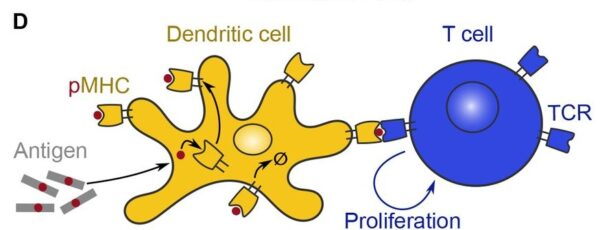
However, the researchers discovered that mice that received two doses of mRNA LNPs displayed less antigen than mice that received just one dose.
This suggests that less adaptive immune cell activation against influenza proteins was produced.
mRNA Nanoparticles Reduce T and B cell Responses
The T and B cell responses to the flu mRNA vaccination were shown to be less robust in mice that had received two injections of LNP compared to those who had only received one.
T and B cells are essential for our immune system’s capacity to eradicate infections since they are the last line of defense.
However, reduced T and B cell activation was observed in mice who received two doses of LNP.
The quantities of antibodies (B cells produce antibodies) against the influenza protein were likewise lower in the double-dosed groups.
The decreased adaptive immune response was systemic, impacting all organs and areas. According to the scientists, this reduction was considerably greater at the injection site, particularly if the mice were administered injections at the same location for both shots.
The group that received only one injection of LNP, on the other hand, exhibited stronger T and B cell responses, as well as more antibodies generated.
The authors discovered that LNP exposure reduced T progenitor cells. Because T progenitor cells mature into activated T cells, fewer progenitors imply fewer T cells and a lower response.
The scientists discovered that removing T progenitor cells before immunization and then reintroducing them after vaccination did not diminish the number of activated T cells. This shows that the LNP lowers the amount of T progenitor cells and, as a result, the T cell response.
“Pre-exposure to mRNA-LNP inhibits T cell responses,” the authors wrote.
The authors speculated that the lowered immunity ought not to be permanent.
They discovered that if an 8-week gap was introduced between the first and second dosages, B cell responses mostly rebounded.
Nonetheless, the authors did not confirm the time required for complete recovery, nor did they confirm whether the mice’s B cell response ever restored.
However, treating mice with adjuvants such aluminum salts or AddaVax reversed the suppressive effects of LNP injections on mice immune cells.
“Inhibition of the adaptive immune responses by pre-exposure to mRNA-LNPs is long-lasting but it is likely to wane with time.”
Immunity Changes from LNPs Can Be Inherited
As previously stated, mice given two doses of LNPs were more resistant to an influenza infection than mice given only one dosage of LNPs.
This was confirmed by the mice’s greater weight maintenance throughout infection, albeit it is unclear if the resistance was due to an immunological response or another mechanism initiated by the LNPs.
Surprisingly, this enhanced defensiveness may be handed down to their kids. The inheritance of influenza resistance is stronger when both parents are vaccinated, and less so when only one parent is inoculated, especially if only the male father is immunized.
The study did not address whether the kids also inherit immunological deficiency, such as a loss in immunity against C. albicans, which was observed in mice given two LNPs dosages.
Implication of the Study and Pressing Questions
The results of the mice study indicate that T and B cell functions temporarily decline in mice, which begs the issue of whether this also happens in people.
Clearing infections and preventing chronic illnesses like cancer depend on the adaptive immune response. According to the study, mice are more susceptible to infections and cancer for a few weeks following two vaccines with the mRNA LNPs.
Although there has not been a study conclusively proving a correlation, similar findings have also been made regarding human observations.
However, an increased prevalence of sickness reported to the Vaccine Adverse Event Reporting System (VAERS) following COVID-19 vaccination implies that patients have less immunity after vaccination.

There have been numerous cases of cancers developing as a result of COVID-19 vaccines.
In the VAERS database, 284 incidences of breast cancer were recorded following COVID-19 immunization, although only 350 cases had been reported in the VAERS database’s whole history.
There were 269 cases of leukemia reported following COVID-19 vaccination, compared to 432 cases throughout VAERS’s whole history.
Furthermore, there have been instances of new onset and recurring shingles following COVID-19 vaccinations. VAERS data shows that 7,559 incidences of shingles have been reported following COVID-19 vaccination.
Throughout the lifetime of VAERS, 28,180 cases of shingles have been documented following any immunization, implying that COVID-19 vaccination accounted for around a quarter of all shingles cases.
According to the CDC, a new diagnosis or recurrence of shingles occurs largely in patients with compromised immune systems and is a symptom of decreased immunity.
Though the mice study shows significant human health consequences, it is unknown whether all of the symptoms and effects reported in mice would occur in humans.
Nonetheless, mounting evidence of severe health effects in humans following COVID-19 vaccination warrants additional investigation. It is also necessary to investigate the overlaps between the health consequences for mice and people.
“Considering the broad exposure of a large proportion of human populations to vaccines based on this novel (mRNA) technology, more studies are warranted to fully understand its overall immunological and physiological effects. Determining this platform’s short and long-term impact on human health would help optimize it to decrease its potentially harmful effects,” the authors concluded.
Article cross-posted from Great Game India.

Two Storms, One Harvest

Every food crisis in living memory has been a one-shock event. The 2008 price spike was a commodity bubble. The 2020 shortages were a logistics failure. The 2022 grain scare was a war on one exporter’s ports. Each time, the system bent, adjusted, and recovered, and each time the experts assured us afterward that global markets are simply too big and too diversified to fail.
What nobody in Washington seems eager to discuss is that 2026 is shaping up to be something the modern food system has never actually faced. Two independent shocks, one climatic and one geopolitical, are converging on the same harvest cycle at the same time. Not sequentially. Simultaneously.
Start with the weather. The Pacific Ocean is currently building toward what forecasters now openly call a record event. NOAA’s Climate Prediction Center puts the odds of at least a strong El Niño near 88 percent, with roughly two in three odds it reaches “very strong” status, the tier reserved for perhaps three or four events in the entire satellite era. Every major global model now projects a median peak in Super El Niño territory, and most of them project it exceeding the 2015-16 event, which until now held the modern record. Sea surface anomalies were already brushing the super threshold in mid-July, months before these events normally peak. The atmosphere has already shifted into El Niño mode, and the event is forecast to crest in late fall and early winter.
This is not about “climate change.” It’s about the standard cycles of weather, and the cycle we’re currently in is one that has likely devastated societies in the past. We’re better prepared as a society today, but not all Americans are equally prepared.
Serious households have started doing the quiet math on their own. Grocery bills tell part of the story, and the forecast maps tell the rest, which is why long-term food storage has moved from fringe hobby to mainstream line item in the family budget, with established suppliers like Heaven’s Harvest seeing demand from people who five years ago would have rolled their eyes at the idea. That instinct is not paranoia. It is pattern recognition, and the pattern is worth walking through carefully.
Editor’s Note: Heaven’s Harvest IS a sponsor, but the warnings of this article are real and would be written even if we didn’t have a survival food sponsor. With that said, those who take advantage of what they offer can use promo code “Patriot” for 15% off.
The Fertilizer Clock Is Already Running
While the Pacific warms, the second shock has been unfolding in the Strait of Hormuz. The conflict with Iran turned the world’s most important energy chokepoint into a contested waterway, and the consequences reach far beyond the gas pump. Roughly a third of global fertilizer trade moves through Hormuz, and the disruption sent urea prices up 86 percent year over year by March, with a 53 percent jump in a single month.
The World Bank projects energy prices rising about 24 percent in 2026 and fertilizer about 31 percent. By its own accounting, fertilizer prices ran 35 percent higher in the first five months of this year than the same period last year.
Here is the mechanism the nightly news will not explain. Fertilizer is not a grocery item. It is a time-delayed input. The nitrogen a farmer in Iowa or Punjab could not afford to apply this spring does not show up as a problem this spring. It shows up as a thinner harvest six to twelve months later.
The World Bank’s own food security brief concedes that the effects of reduced applications earlier this season “are likely to become visible only later in harvest outcomes.” Translate that from institutional language into plain English and it means this. The damage is already done, it is already in the ground, and we are simply waiting for it to arrive on the shelf.
Now check the calendar. Six to twelve months from the spring planting season lands us squarely in late 2026 and early 2027. Which is precisely when the strongest El Niño in the instrumental record is forecast to peak, bringing its signature droughts to Southeast Asia, Australia, southern Africa, northern Brazil, and South Asia, the very regions that grow the world’s rice, sugar, and oilseeds.
The World Bank warns openly that a strong El Niño “could disrupt multiple crop belts simultaneously” on top of the conflict-driven input costs. Their baseline projection assumes the Middle East disruptions ease by autumn. What in the last two years of Middle East history suggests that assumption is safe?
The System Has No Slack Left
The comfortable answer is that global markets always adjust. But adjustment requires slack, and the slack is gone. Global cereal production is expected to decline from last year’s records even before El Niño does its work. The UN World Food Programme, hardly a den of right-wing preppers, is calling this the most significant disruption to its supply chains since Covid and the invasion of Ukraine, and its supply chain director put the stakes bluntly.
Today’s supply chain challenges are tomorrow’s hunger crisis.
There is also a political dimension that markets cannot price. When food gets scarce, governments do not behave like economists. They behave like politicians. Export bans, hoarding mandates, and panic buying at the national level turned the modest rice shortfall of 2008 into a global crisis, and analysts are already warning that import-dependent nations are the first dominoes.
The 2015-16 Super El Niño, a far weaker event than what is now forecast, threw tens of millions into food stress across Africa and Asia. This one is projected to be stronger, and it arrives with fertilizer already rationed by price and shipping lanes already contested by missiles.
What Joseph Knew
Scripture does not treat preparation for lean years as faithlessness. It treats it as wisdom delivered in advance to those willing to act on it.
Behold, there come seven years of great plenty throughout all the land of Egypt: And there shall arise after them seven years of famine; and all the plenty shall be forgotten in the land of Egypt.
Joseph did not respond to that warning with a hashtag or a committee. He stored grain during the years of abundance, and when the famine came, Egypt stood while its neighbors begged. The lesson is not that famine is certain. It is that the time to prepare is precisely when preparation still looks optional.
Nobody who filled a pantry in a year of plenty has ever regretted it, and nobody standing in an empty aisle has ever been glad he waited for certainty.
None of this calls for panic, and panic is the enemy of sound judgment anyway. It calls for the same unglamorous prudence our grandparents considered ordinary. Keep some cash margin, know your local growers, and put real food in deep storage while it is cheap and available, because the entire arc of this story is that cheap and available is a closing window.
Families looking for a straightforward place to start can visit Heaven’s Harvest and use promo code Patriot for 15 percent off long-term storable food. The forecasts may yet soften, the strait may yet reopen, and we should pray they do. But hope is a fine thing to hold and a foolish thing to eat.
