

JD’s manually curated links for God-fearing MAGA patriots
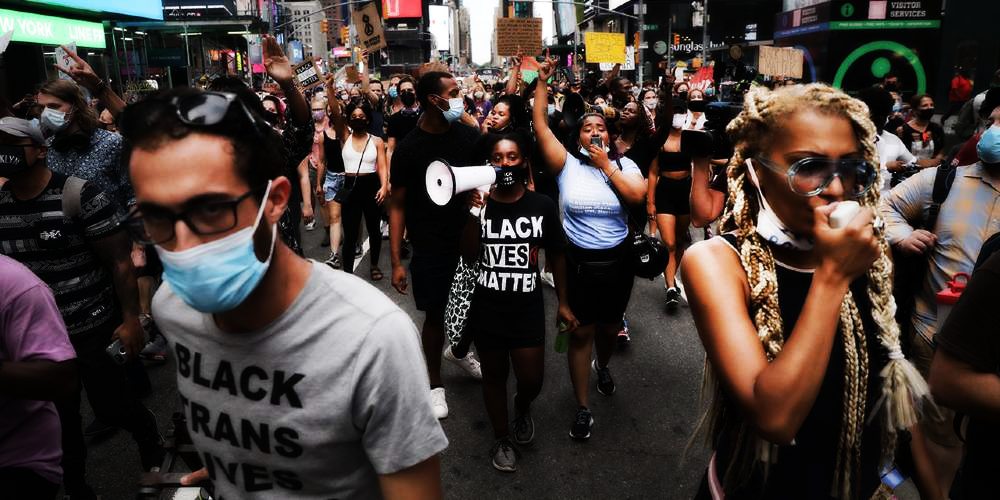
(The Daily Signal)—As students across the United States struggle to master basic reading and math skills coming out of the COVID-19 pandemic, some schools are dedicating the first week of February to “Black Lives Matter at School” in a “Week of Action.”
Tina Descovich, co-founder of Moms for Liberty, urges parents to see whether their school district is engaging in that program and to speak out against it if it is.
“I think most Americans are starting to tune in and understand that we are in a crisis in America in public education,” Descovich tells “The Daily Signal Podcast.”
“We have the lowest test scores since the 1980s in reading and the lowest-ever math scores,” she notes. “Yet we have organizations like Black Lives Matter in Schools that are setting aside a whole, entire week, the first week of February—[the] 5th through the 9th—to drive their ideology.”
“If you look at their 13 guiding principles and their four demands, one of them is to upset the nuclear family, to break down the nuclear family,” the Moms for Liberty co-founder notes. “They have other things like affirming transgenderism and focusing on globalism. Many things that I don’t agree with and don’t want my children learning, things that are divisive and will work to destroy our culture and our country.”
Black Lives Matter at School’s 13 guiding principles include “Restorative Justice,” “Globalism,” “Queer Affirming,” and “Transgender Affirming.” The 11th principle, “Black Villages,” states: “We disrupt the narrow Western prescribed nuclear family structure expectation. We support each other as extended families and villages that collectively care for one another, especially ‘our’ children.”
Descovich says schools push this divisive material as “a cover-up for public education failure,” citing poor proficiency levels in math and reading.
For example, she notes that only 5% of black fourth grade students in Milwaukee Public Schools—which celebrates the Black Lives Matter in School’s Week of Action—could read at grade level, according to the National Advancement of Educational Progress.
“Milwaukee Public Schools right now, they’ve put out information for their teachers on how to teach some of the 13 guiding principles that Black Lives Matter in Schools are promoting, and yet look at what’s going on in Milwaukee Public Schools,” Descovich says. “Tyler, 5% of black students in Milwaukee Public Schools are reading on grade level in the fourth grade. That means 95% of the black children in Milwaukee cannot read. That is sentencing them to a life of real struggle.”
“They’re not teaching kids to read or do math, and they’re spending time on things that cause division and break down the things that we do know work in society, like the nuclear family,” she adds.
Descovich urges parents not to be complacent. She recounts that, even though she served on the school board in a conservative county, the divisive racial ideas behind Black Lives Matter at School made their way into her county’s school system.
She urges parents to “go to your school or your school district’s website and just look.”
“Are they celebrating Black Lives Matter in School Week of Action? If they are loud and proud, it will be out there, front and center,” Descovich explains.
If parents see it on the website, they should contact a teacher, contact the principal or go to the school board. “If your district is hiding it, which is very possible, you can do a public records request,” she notes. Moms for Liberty has resources to help parents file those requests. Such a request may turn up race-based trainings, which parents should raise with the school board.

Descovich also encourages parents to check if there is a Moms for Liberty chapter in their county, and if there isn’t, to start one themselves.
She also takes the time to “set the record straight” on the Moms for Liberty chapter in Williamson County, Tennessee. That Moms for Liberty chapter criticized the “Wit and Wisdom” curriculum, which, among other things, assigned the autobiographical book “Ruby Bridges Goes to School: My True Story.”
She recalls that a second grade biracial child in that county told his mom “something about hating his white part” when he returned from school one day.
“Our chapter took the time; they spent a thousand hours,” she says. “They picked every book that has that set in the curriculum, every lesson plan. They even got a hold of the teachers manual, and they read every sentence, and they mapped it out, and you really had to do that to see the problem.”
“There were little things dropped in kindergarten, added on into first grade, and then in second grade. They actually had a nine-week social justice segment in their English language arts curriculum,” Descovich explains. The biracial boy had been in the middle of that program.
“You know, the curriculum included the book ‘Ruby Bridges Goes to School,’ and there’s absolutely nothing wrong in that book,” the Moms for Liberty co-founder says. “But there was a teachers manual that went along with that, that spent time with those second graders pointing out the ‘N-word’ and how it was in the background of one of the pictures in the book.”

“The teachers manual … didn’t direct the teacher to teach it in a way that showed Ruby Bridges as a hero, as brave, as what she did is amazing and she had courage. It taught it in a way that was divisive,” Descovich explains.
“I have children. If anyone would have taught them the ‘N-word’ in second grade, I would have been irate,” she says. “And if I had a biracial child sitting in that classroom, learning that Ruby Bridges was more of a victim than a hero, that’s very upsetting to me.”
Listen to the interview with Descovich below.
Have an opinion about this article? To sound off, please email [email protected], and we’ll consider publishing your edited remarks in our regular “We Hear You” feature. Remember to include the URL or headline of the article plus your name and town and/or state.


America is a communist nation under communist rule — these simpletons once wanted to argue about the pro–CCP Bush family being “conservative” —— does anyone still believe that?!?!
Quit sounding so eternally wishy washy! If one cannot use the familial terms of “mother” and “father” at the military service academies —- situation long ago went to DefCon 1!!!
Nonsense.
Why do our children need “a week of action”?? FOR GOD’S SAKE, MAKE A WEEK OF ACTION LEARNING HOW TO ADD, SUBTRACT, SPEAK ENGLISH AND LEARN ABOUT FREEDOM.
REMOVE YOUR CHILDREN FROM THE SCHOOLS
Our education system must be defunded,
Enough of the BLM, they only lie, cheat a steal.