

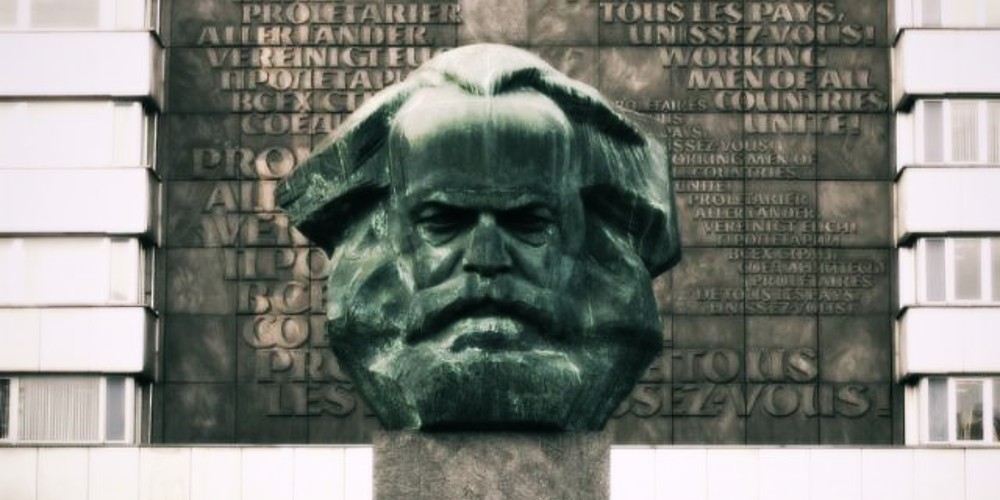
It is important to understand that censorship does not occur in a vacuum. It is a symptom of a worsening disease. It is an early indicator of the political repression to come. Like a canary in a coal mine, the criminalization of speech forewarns that State-sponsored terror and murder are not far away. First, certain words and thoughts are banned. Next, certain people are rounded up and imprisoned. Finally, certain “enemies of the State” are executed quite publicly. The imposition of fear supersedes the rule of law. Terrorism undergirds social order. Oppression replaces popular support.
What is happening in the West today is a concentrated push for global communism. We could bicker about precise definitions — whether we are under attack from Marxists, socialists, Leninists, Trotskyites, Maoists, or other “revolutionaries” — but the end goal is clear.
A small group of global “elites” seek to use ideological and economic leverage to centralize political power and direct all human activity. They seek the abolition of private property. They seek absolute control over individual lives and local communities. They are rebuilding twentieth-century totalitarianism with the privacy-destroying surveillance technologies of the twenty-first century.
Most Western nations are working together to promote a public vision that achieves their private totalitarian goals. Governments do not care about “hate speech”; they are dedicated to seizing control of the press, punishing dissent, censoring political opposition, and regulating public debate. Governments do not care about “climate change”; they are dedicated to seizing control over all economic activity by first establishing a monopoly on available energy. Governments do not care about “systemic racism,” “social justice,” or “income inequality”; they are dedicated to maximizing social divisions and distorting the meaning of fundamental rights, so that they may undermine long-cherished personal liberties.
Governments do not care about “gun violence”; they are dedicated to disarming their populations and making it impossible for them to fight back against tyranny. Governments do not care about minimizing vicious and costly wars; they are dedicated to distracting their citizens with false threats to their personal security. Governments do not care about maintaining the integrity and value of their monetary currencies; they are dedicated to printing and spending money that inflates household costs, taxes middle class savings, maximizes Wall Street profits, and increases welfare dependency.
Governments do not need to create central bank digital currencies to stave off economic disaster; they are dedicated to creating economic disasters, so that they can justify a future communist system that runs on privacy-destroying CBDCs.
We are right now in the middle of a war. It is as threatening to human civilization as the Cold War. However, it is rarely discussed except on the pages of alternative news media. By ignoring it, our compromised corporate press work to keep the war secret and the public confused. The most consequential war today is not flaring in Eastern Europe, the Middle East, or the Asia-Pacific. It is a quiet, chilling war raging between States that seek absolute control over society and citizens who insist on defending their constitutional rights and personal liberties. Everything Western governments do must be seen through the lens of this broader conflict.
For two centuries, Marxists have debated and fought each other over a salient point: should they patiently wait for the supposed contradictions of free market capitalism to naturally usher in their communist Utopia? Or should they actively promote societal conditions that speed the “revolution” and their beloved “fundamental transformation” along? So sure of Marx’s conception of historical materialism and its determinative impact on humanity’s future, plenty of nineteenth and twentieth-century intellectuals urged steady restraint. They used democratic elections to elevate Marxist socialists into political offices, but they cautioned against the use of violence to accelerate a process that they understood as foreordained.
Communist Utopia, however, is not foreordained, and the longer that Marx’s disciples had to wait for their “revolution,” the more anxious they became. Patience evaporated because Marx has always been a false prophet. In order to create a Marxist future that is wholly unnatural, his followers eventually realized that coercion and violence are instrumental to their vision. Just like the Jonestown Massacre in Guyana, Marxism requires everyone to “drink the Kool-Aid.” And just as with Jim Jones’s astonishing cult, Marxism always leads to “revolutionary suicide.”
Marxists cannot square their practical failures with Marx’s theoretical promises yet stubbornly refuse to learn from the contradiction. Failed ideologues who push false visions of the future inevitably become more coercive and violent as failures pile up. This is Marxism’s lasting mark upon history — bloody stains and mass graves wherever it has been imposed.
Some of Marxism’s most staunch defenders reluctantly acknowledged this truth last century. Karl Kautsky — a devout Marxist, colleague of Friedrich Engels, and influential theorist for Germany’s Social Democratic Party — excoriated Vladimir Lenin’s socialist revolution in Russia: “Among the phenomena for which Bolshevism has been responsible, Terrorism, which begins with the abolition of every form of freedom of the Press, and ends in a system of wholesale execution, is certainly the most striking and the most repellent of all.”
Unable to accept that violence is inextricably linked to Marxism, Kautsky echoed the naïve complaint that history cannot be “hurried.” History’s “speed,” however, has never been the source of Marxism’s violence. Marxism’s internal fallacies, disregard for personal freedom, and imposition of unnatural human relationships create the necessary conditions for terror, bloodshed, poverty, agony, and angst.
What is important to understand is that the various Western projects active today all reflect this long conflict among Marxists about the best way to achieve their “revolution.” Sure, there still remain a few residual peaceniks in the faculty lounge who believe — as Kautsky did — that human societies will naturally evolve into Marxist Utopias and “equitable” communes from the sheer deterministic forces of historical materialism. There are far more, however, who believe political repression, terror, and violence are essential for success.
Standing somewhere in the middle — for the time being, at least — are the great majority of governmental and non-governmental forces pushing demonstrable forms of Marxist socialism under the guise of public policies ostensibly meant to advance environmentalism, mass migration, pandemic preparedness, minority rights, or “sustainable” economic development in impoverished communities.

We are familiar with their many names: the World Economic Forum’s “Great Reset,” the United Nations’ “2030 Agenda,” the “Green New Deal,” the “Build Back Better” initiatives, George Soros’s “Open Society Foundations,” and the World Health Organization’s “Pandemic Treaty.” There are many others, of course. Every perceived global problem provides Marxist socialists with an opportunity to “solve” that problem by constructing financial and governmental institutions that advance their “revolution.” They believe that they can “speed up” the “progression” of human history by creating painful conditions that justify communism’s architecture. The vast majority of globalists who run central banks, newsrooms, intelligence agencies, administrative departments, legislative assemblies, religious nonprofits, and too many corporate boardrooms are all “true believers.”
Make no mistake, when these Marxist globalists conclude that an increasingly popular resistance force within Western society threatens their “long march” toward domination, they will not throw up their hands in defeat, shrug, and concede, “Well, that’s democracy.” In their twisted totalitarian minds, only ideological allies merit “democratic” respect or civil rights protections; ideological foes deserve dictatorial force and bloody despotism.
Just as Lenin justified “violent revolution” and defended “unrestricted power, based on force and not on law,” today’s globalists showed us who they are during the “Reign of COVID Tyranny.” Within a matter of weeks, they threw free speech, bodily integrity, religious freedom, due process, and economic liberty right out the window. In his short book, The Defense of Terrorism, Leon Trotsky argues that organized violence against opponents of the “revolution” is morally right. Today’s J6 political hostages serve as a tragic testament that D.C. ignominiously agrees.
Image: david__jones via Flickr, CC BY 2.0.

Starting the Day With a Scripture-Inspired Roast Helps Center Your Thoughts on Eternal Truths Amid Temporal Pressures
The world can seem chaotic, especially right after we wake up. Many believers start their mornings reaching for something familiar — a hot cup of coffee — yet end up settling for mediocre brews that do little more than deliver a caffeine jolt. The daily grind of life, with its endless distractions, news cycles, and responsibilities, can leave even the most faithful feeling spiritually parched alongside their physical fatigue. What if your morning ritual could do more than wake you up? What if it could ground you in truth, nourish your body with exceptional quality, and quietly advance a kingdom purpose at the same time?
That’s the promise — and the reality — behind Promised Grounds Coffee. This Christian-founded company doesn’t just roast beans; it approaches every step as an act of worship and discipleship. By selecting only the top 10% of specialty-grade beans, ethically sourced from dedicated farmers in Central and South America, and small-batch roasting them with reverence in Austin, Texas, Promised Grounds delivers what many describe as the best coffee available — never burnt, never bland, but rich with origin stories and layered flavors that honor God’s creation.
From the vibrant Psalm 27 Roast (a light, bright medium option) to the bold yet peaceful 2 Timothy 1:7 Decaf, each bag carries a Scripture verse that turns your daily pour into a gentle reminder of faith. And through their Ounce Per Ounce Promise, every ounce of coffee you enjoy provides an equal ounce of clean water to families in need via partnership with Filter of Hope — literally brewing hope for body and soul, one cup at a time.
The challenge for today’s Christians runs deeper than finding a decent cup. In an age of convenience-driven consumerism, it’s easy to support companies that dilute values or remain silent on matters of faith. Many believers want their everyday choices — from what they drink to how they spend — to reflect discipleship rather than just convenience. Promised Grounds solves this by weaving Christian excellence into the entire process: beans nurtured with prayerful stewardship by farming families, roasted as an offering rather than a commodity, and packaged with Bible verses to encourage a mindset of gratitude and purpose from the first sip. Reviewers consistently praise the smooth, rich profiles — whether enjoyed black in a drip maker, iced on a warm day, or shared in fellowship — noting how the quality stands toe-to-toe with premium secular brands while delivering something far more meaningful.
This integration of faith and flavor addresses a real need in Christian households and ministries. Busy parents, church leaders, and remote workers alike report that starting the day with a Scripture-inspired roast helps center their thoughts on eternal truths amid temporal pressures. The coffee’s exceptional character — bright citrus notes in lighter roasts or deep chocolate undertones in bolder ones — comes from meticulous selection and careful roasting that respects the bean’s natural gifts rather than masking them. It’s the kind of coffee that elevates a simple quiet time, fuels productive workdays, or sparks meaningful conversations when shared at Bible studies or outreach events. And because it’s ethically sourced with integrity, every purchase supports sustainable livelihoods for farmers who treat their crops like family harvests.
For those leading churches or small groups, the impact multiplies. Promised Grounds offers bundles and options perfect for hospitality ministries, turning ordinary coffee service into an opportunity to point people toward the living water of Christ. Imagine greeting visitors with a warm cup whose very bag carries God’s Word — a subtle yet powerful witness that aligns with the Great Commission. The company’s Texas roots and commitment to “brewing hope” resonate especially with believers who value American enterprise paired with global compassion.
Of course, quality alone isn’t enough if the experience feels out of reach. Promised Grounds keeps it accessible with practical perks like free shipping on orders over $40, sample sets for discovering favorites, and thoughtful add-ons such as faith-themed mugs. Whether you prefer whole beans for fresh grinding, grounds for convenience, or even bulk options for larger households and ministries, the result is consistently superior coffee that makes discipleship feel integrated rather than added on.
As you consider how to align even the smallest habits with your walk with God, Promised Grounds Coffee stands out as a refreshing solution. It tackles the dual problems of subpar daily sustenance and disconnected consumption by offering a product that genuinely excels in taste while advancing a mission of clean water, farmer dignity, and scriptural encouragement. Believers who make the switch often describe it as more than a beverage upgrade — it becomes part of their rhythm of gratitude, a daily invitation to remember that every good gift comes from above.
If you’re ready to transform your mornings (and perhaps your church gatherings) with coffee that honors both exceptional craftsmanship and Christian values, I encourage you to explore what Promised Grounds has to offer. One sip at a time, you’ll be nourishing your body, refreshing your spirit, and participating in something far greater — all while enjoying what truly is among the best coffee available.
