

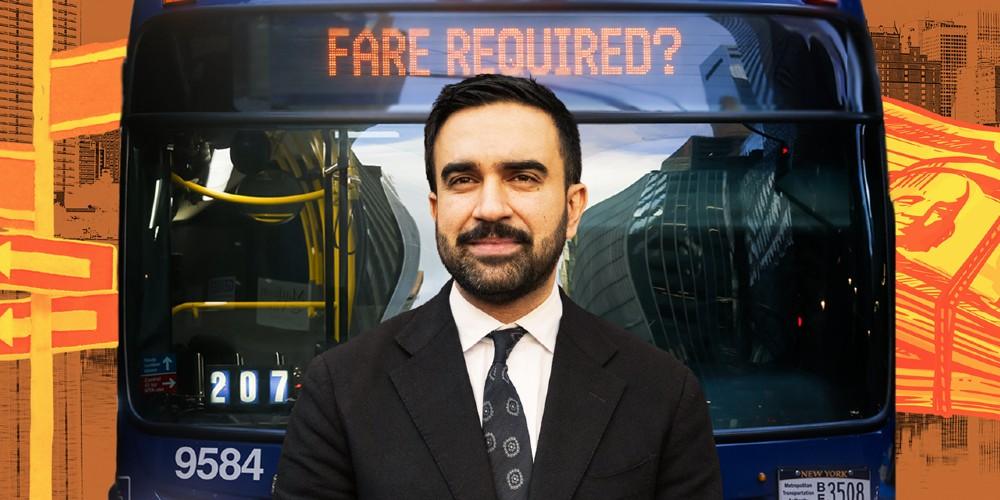
New York City Mayor Zohran Mamdani’s signature campaign promise has begun its collision course with the laws of municipal finance. His proposal to eliminate bus fares across the nation’s largest transit system represents either an overdue correction to decades of neglect or an ideologically driven fantasy, depending on whom you ask. What nobody disputes is the price tag: roughly $800 million annually, with no clear path to payment.
The debate over free buses cuts deeper than transportation policy. It reveals competing visions of government’s role in urban life, the sustainability of expanding public services without corresponding revenue, and whether democratic socialism can function at city scale. Mamdani, who openly identifies with that political tradition, has staked his early tenure on the proposition that essential services should be publicly financed and universally accessible, regardless of ability to pay. The buses are just the beginning.
New York’s bus system carries two million riders daily through the slowest urban transit network in America. Average speeds hover around seven miles per hour in Manhattan, slower than the horse-drawn carriages that once traversed the same streets. Danny Pearlstein, policy director at the Riders Alliance, frames the issue in stark terms during an interview conducted aboard a Bronx bus route. The city operates the nation’s largest bus network while delivering the worst performance, creating what he calls a fundamental unfairness that Mamdani’s proposal directly addresses.
The case for eliminating fares rests on three arguments. First, safety. Fare disputes between passengers and drivers have led to assaults, sometimes serious, and advocates contend that removing the transaction removes the conflict. Brian Fritsch, who advises the Metropolitan Transportation Authority through the Permanent Citizens Advisory Committee, acknowledges that friction disappears when payment obligations end. The question is whether that benefit justifies the cost.
Second, equity. Bus riders skew heavily toward lower-income New Yorkers, students, seniors, and caregivers who depend on the system for short, essential trips that driving or subway service cannot easily replace. Pearlstein notes that fare revenue constitutes only several hundred million dollars against operating costs already subsidized by several billion in public funds. The existing system, in his view, collects money from those least able to afford it while the broader public already shoulders most expenses.
Third, ridership and speed. Transit analyst Charles Komanoff, who modeled Mamdani’s proposal, estimates that eliminating fares could boost ridership by allowing people to take trips they currently forgo and could improve bus speeds by seven to twelve percent through faster boarding and all-door access. Not transformative, but meaningful for daily riders whose commutes currently involve painful delays.
Those arguments found empirical support in the Metropolitan Transportation Authority’s recent fare-free pilot program. Launched in late 2023 under a state budget mandate, the MTA suspended fares on one local route in each borough for nearly a year. Ridership jumped roughly 30 percent on weekdays and 40 percent on weekends before the agency restored fare collection in September 2024. The pilot cost approximately $12 million in lost revenue and related expenses.
Yet the pilot also exposed the central problem. Most of the ridership increase came from existing passengers taking more trips rather than new riders entering the system. The boost in usage created measurable costs without generating the transformational demand advocates predicted. That pattern raises uncomfortable questions about who benefits from universal free transit and whether targeted subsidies for low-income riders might deliver similar equity gains at lower cost.
Charlton D’Souza, founding president of Passengers United, represents the skeptical position. A southeast Queens native who lived through the 2008 service cuts, D’Souza worries that free buses would create expectations the system cannot meet. Driver shortages already leave trips unfilled. Equipment remains old and unreliable. Service varies wildly by neighborhood. Making buses free does nothing to solve those operational failures and risks making them worse by increasing demand without increasing capacity.
D’Souza also questions the equity logic. A universal free-fare system subsidizes riders earning six-figure salaries alongside those struggling to afford rent. He suggests expanding Fair Fares, the city’s existing discount program for low-income residents, rather than eliminating revenue from riders who can pay. That approach targets relief where needed while preserving a funding stream tied to usage.
The funding question looms largest. Bus fare revenue currently backs Metropolitan Transportation Authority bonds, meaning elimination requires restructuring existing debt, not merely replacing operating dollars. Fritsch’s advisory committee has identified more than 20 potential revenue sources, from congestion pricing to real estate transfer taxes to increased levies on high earners. The challenge is political will and coordination between city hall and Albany, where the MTA answers to the state.
Komanoff argues New York City taxpayers should fund the program through higher taxes on corporations and top earners, framing it as a modest sacrifice for improved mobility. Critics respond that $800 million is neither modest nor sustainable, particularly given the city’s volatile revenue base and history of service cuts during downturns. D’Souza remembers those cuts vividly. When budget pressures mounted in 2008, routes disappeared and service contracted. Free buses during boom times offer no protection against that pattern repeating.
The ideological dimension cannot be ignored. Fare elimination represents a core tenet of democratic socialist governance: converting services funded by user fees into universal public goods financed through progressive taxation. The policy severs the direct relationship between usage and payment, expanding government’s role in daily economic life while shifting costs entirely onto taxpayers. Supporters see that as moral progress toward equity. Skeptics see it as fiscal recklessness dressed in egalitarian language.
Mamdani’s political identity makes that ideological component explicit rather than implicit. His campaign materials prominently feature calls to tax corporations and the top one percent to fund expanded services. He frames affordability not as an economic problem requiring market solutions but as a justice issue requiring redistribution. The buses serve as both practical policy and symbolic statement about the kind of city he intends to build.

Even cautious observers credit Mamdani with shifting the conversation. Komanoff recalls encountering the then-assemblyman years ago at a congestion pricing rally and being struck by his positivity and willingness to challenge conventional political boundaries. That spirit now animates city government, for better or worse. Whether optimism translates into effective governance depends entirely on securing stable funding, addressing operational constraints, and convincing Albany to cooperate rather than obstruct.
Governor Kathy Hochul has already pushed back against the proposal, arguing the Metropolitan Transportation Authority cannot afford the lost revenue. That sets up a clash between city and state that could define both Mamdani’s mayoralty and Hochul’s political future. The governor faces her own pressures from suburban voters who use the system far less than city residents and resist tax increases to subsidize urban transit. Those competing constituencies may prove impossible to reconcile.
The pilot program offers a preview of the problems ahead. Ridership increased, but not dramatically. Costs were real and measurable. Operational challenges persisted. Most tellingly, the Metropolitan Transportation Authority restored fares after nine months, suggesting even a limited experiment proved unsustainable without dedicated revenue. Expanding that experiment citywide multiplies every problem by orders of magnitude while making retreat politically impossible.
Pearlstein maintains that the pilot demonstrated both safety improvements and popularity, even if it did not revolutionize demand. In his view, those gains justify the investment, particularly given that public subsidies already dwarf fare revenue. He dismisses concerns about funding as excuses for inaction, arguing the money exists if political leaders have courage to claim it through progressive taxation.
That confidence rests on assumptions about tax capacity and political will that recent history does not support. New York City has lost high earners to lower-tax jurisdictions throughout the pandemic era and after. The remote work revolution reduced the city’s captive workforce and made geographic arbitrage easier for mobile professionals. Aggressive tax increases risk accelerating that exodus, shrinking the revenue base and creating a fiscal death spiral that leaves fewer taxpayers funding ever-expanding services.
D’Souza frames the issue through his experience living under the current system and watching past promises evaporate during hard times. Elected officials talk about service improvements and affordability, he says, but rarely understand operational dynamics or budget constraints. Free buses sound appealing until the money runs out and routes get cut again. Then riders are left with neither affordable fares nor reliable service.

The comparison to other democratic socialist experiments in American cities offers limited guidance. Few municipalities operate transit systems at New York’s scale. None face the Metropolitan Transportation Authority’s particular governance structure, in which a state agency controls assets city residents depend on while answering to Albany rather than city hall. That arrangement guarantees conflict over Mamdani’s proposal regardless of its merits.
Transit advocates point to successful fare-free systems in smaller cities and abroad, but those examples rarely translate. Different population densities, governance structures, and revenue sources make direct comparisons misleading. What works in Tallinn or Luxembourg may fail catastrophically in New York without careful adaptation to local conditions. Mamdani’s team has yet to demonstrate that adaptation in sufficient detail to satisfy skeptics.
Fritsch, whose advisory role requires careful neutrality, acknowledges the proposal’s political appeal while noting his committee needs to see a concrete plan before taking a position. The ideas exist. The political momentum exists. What remains absent is the detailed blueprint showing exactly where $800 million in new annual revenue originates and how the Metropolitan Transportation Authority restructures its finances to accommodate lost fare revenue currently backing bonds.
Komanoff describes Mamdani’s bus plan as sitting at the intersection of ambition and arithmetic. That captures the tension perfectly. Ambition alone cannot fund transit operations. Arithmetic alone cannot inspire political movements. Success requires both, along with sustained negotiation between multiple government layers and interest groups with competing priorities.
The next several months will reveal whether Mamdani’s proposal represents transformative policy or expensive fantasy. His administration must produce a detailed funding plan, negotiate with Albany, address operational concerns, and build public support broad enough to withstand inevitable opposition. Failure means embarrassment for a mayor who made this promise central to his political identity. Success means fundamentally reshaping how New York funds and operates public services, with implications extending far beyond buses.
The broader question is whether democratic socialism can govern effectively at urban scale. Mamdani’s tenure will provide evidence either supporting or refuting that proposition. Free buses may seem like transportation policy, but they function as proof of concept for a governing philosophy that prioritizes universal access over market mechanisms and redistributive taxation over user fees. If the buses succeed, expect more ambitious proposals. If they fail, expect voters to reconsider whether socialist principles translate into workable governance.
For now, two million daily bus riders continue paying fares while waiting to see if their mayor can deliver on his promise. The arithmetic remains stubbornly unchanged: $800 million must come from somewhere, or the proposal dies. Ambition without funding is just talk, and New Yorkers have heard enough talk about transit to last several lifetimes.
Two Storms, One Harvest

Every food crisis in living memory has been a one-shock event. The 2008 price spike was a commodity bubble. The 2020 shortages were a logistics failure. The 2022 grain scare was a war on one exporter’s ports. Each time, the system bent, adjusted, and recovered, and each time the experts assured us afterward that global markets are simply too big and too diversified to fail.
What nobody in Washington seems eager to discuss is that 2026 is shaping up to be something the modern food system has never actually faced. Two independent shocks, one climatic and one geopolitical, are converging on the same harvest cycle at the same time. Not sequentially. Simultaneously.
Start with the weather. The Pacific Ocean is currently building toward what forecasters now openly call a record event. NOAA’s Climate Prediction Center puts the odds of at least a strong El Niño near 88 percent, with roughly two in three odds it reaches “very strong” status, the tier reserved for perhaps three or four events in the entire satellite era. Every major global model now projects a median peak in Super El Niño territory, and most of them project it exceeding the 2015-16 event, which until now held the modern record. Sea surface anomalies were already brushing the super threshold in mid-July, months before these events normally peak. The atmosphere has already shifted into El Niño mode, and the event is forecast to crest in late fall and early winter.
This is not about “climate change.” It’s about the standard cycles of weather, and the cycle we’re currently in is one that has likely devastated societies in the past. We’re better prepared as a society today, but not all Americans are equally prepared.
Serious households have started doing the quiet math on their own. Grocery bills tell part of the story, and the forecast maps tell the rest, which is why long-term food storage has moved from fringe hobby to mainstream line item in the family budget, with established suppliers like Heaven’s Harvest seeing demand from people who five years ago would have rolled their eyes at the idea. That instinct is not paranoia. It is pattern recognition, and the pattern is worth walking through carefully.
Editor’s Note: Heaven’s Harvest IS a sponsor, but the warnings of this article are real and would be written even if we didn’t have a survival food sponsor. With that said, those who take advantage of what they offer can use promo code “Patriot” for 15% off.
The Fertilizer Clock Is Already Running
While the Pacific warms, the second shock has been unfolding in the Strait of Hormuz. The conflict with Iran turned the world’s most important energy chokepoint into a contested waterway, and the consequences reach far beyond the gas pump. Roughly a third of global fertilizer trade moves through Hormuz, and the disruption sent urea prices up 86 percent year over year by March, with a 53 percent jump in a single month.
The World Bank projects energy prices rising about 24 percent in 2026 and fertilizer about 31 percent. By its own accounting, fertilizer prices ran 35 percent higher in the first five months of this year than the same period last year.
Here is the mechanism the nightly news will not explain. Fertilizer is not a grocery item. It is a time-delayed input. The nitrogen a farmer in Iowa or Punjab could not afford to apply this spring does not show up as a problem this spring. It shows up as a thinner harvest six to twelve months later.
The World Bank’s own food security brief concedes that the effects of reduced applications earlier this season “are likely to become visible only later in harvest outcomes.” Translate that from institutional language into plain English and it means this. The damage is already done, it is already in the ground, and we are simply waiting for it to arrive on the shelf.
Now check the calendar. Six to twelve months from the spring planting season lands us squarely in late 2026 and early 2027. Which is precisely when the strongest El Niño in the instrumental record is forecast to peak, bringing its signature droughts to Southeast Asia, Australia, southern Africa, northern Brazil, and South Asia, the very regions that grow the world’s rice, sugar, and oilseeds.
The World Bank warns openly that a strong El Niño “could disrupt multiple crop belts simultaneously” on top of the conflict-driven input costs. Their baseline projection assumes the Middle East disruptions ease by autumn. What in the last two years of Middle East history suggests that assumption is safe?
The System Has No Slack Left
The comfortable answer is that global markets always adjust. But adjustment requires slack, and the slack is gone. Global cereal production is expected to decline from last year’s records even before El Niño does its work. The UN World Food Programme, hardly a den of right-wing preppers, is calling this the most significant disruption to its supply chains since Covid and the invasion of Ukraine, and its supply chain director put the stakes bluntly.
Today’s supply chain challenges are tomorrow’s hunger crisis.
There is also a political dimension that markets cannot price. When food gets scarce, governments do not behave like economists. They behave like politicians. Export bans, hoarding mandates, and panic buying at the national level turned the modest rice shortfall of 2008 into a global crisis, and analysts are already warning that import-dependent nations are the first dominoes.
The 2015-16 Super El Niño, a far weaker event than what is now forecast, threw tens of millions into food stress across Africa and Asia. This one is projected to be stronger, and it arrives with fertilizer already rationed by price and shipping lanes already contested by missiles.
What Joseph Knew
Scripture does not treat preparation for lean years as faithlessness. It treats it as wisdom delivered in advance to those willing to act on it.
Behold, there come seven years of great plenty throughout all the land of Egypt: And there shall arise after them seven years of famine; and all the plenty shall be forgotten in the land of Egypt.
Joseph did not respond to that warning with a hashtag or a committee. He stored grain during the years of abundance, and when the famine came, Egypt stood while its neighbors begged. The lesson is not that famine is certain. It is that the time to prepare is precisely when preparation still looks optional.
Nobody who filled a pantry in a year of plenty has ever regretted it, and nobody standing in an empty aisle has ever been glad he waited for certainty.
None of this calls for panic, and panic is the enemy of sound judgment anyway. It calls for the same unglamorous prudence our grandparents considered ordinary. Keep some cash margin, know your local growers, and put real food in deep storage while it is cheap and available, because the entire arc of this story is that cheap and available is a closing window.
Families looking for a straightforward place to start can visit Heaven’s Harvest and use promo code Patriot for 15 percent off long-term storable food. The forecasts may yet soften, the strait may yet reopen, and we should pray they do. But hope is a fine thing to hold and a foolish thing to eat.
