

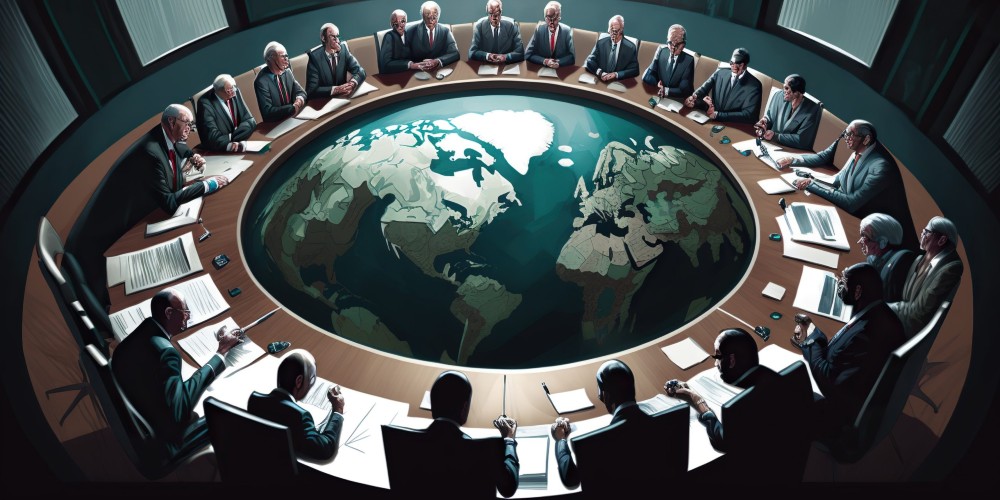
(Off-Guardian)—The global disruptions we have seen in recent years are frequently presented as a chaotic sequence of events: a ‘pandemic’, inflation, energy shortages and war. Little wonder that most people are confused. However, a structural analysis reveals a more deliberate controlled demolition of the 20th-century social contract.
We are witnessing a transition from a productive capitalist model, which required a healthy mass labour force, to what Yanis Varoufakis calls a techno-feudalist order.
The engine of this transition was a desperate financial stabilisation strategy carried out by means of a public health event. As identified by Professor Fabio Vighi, the global financial system reached a point of terminal instability in late 2019, evidenced by the collapse of the US repo market (where banks lend to each other).
By freezing the real economy through lockdowns, central banks performed massive liquidity injections to save the banking-finance tier. If that money had entered a functioning economy, it would have triggered hyper-inflation. By keeping the population at home, the elite performed a stealth bailout that preserved the dominance of the financial class by sacrificing the productive middle class.
However, a geopolitical reset also had to take place. For decades, Germany’s economy relied on three pillars: cheap Russian gas, high-tech exports to China and a US security umbrella. By late 2025, all three have been fractured. As Prof Michael Hudson notes, the ‘sabotage’ of the Nord Stream pipelines was a structural necessity for the Western financial elite.
If Germany continued to integrate with Russia and China, it would have created a power pole independent of the US dollar. The conflict in Ukraine served a purpose: it resulted in Germany replacing Russian pipeline gas and being forced into a massive build-out of liquefied natural gas (LNG) infrastructure and reliance on LNG from the US. Unlike pipeline gas, LNG must be super-cooled, shipped and re-gasified, a process that is inherently 3–4 times more expensive.
The result is that, in 2025, German industrial output is at its lowest since the 1990s. Heavy industries like BASF (chemicals) and ThyssenKrupp (steel) are relocating to the US or China. Meanwhile, Germany is pivoting from an industrial giant by betting on creating jobs in the likes of the green energy sector (including becoming a ‘hydrogen hub’), semiconductors and microelectronics, robotics and biotech and diverting its capital into a €150 billion annual defence spend.
At the same time, while Germany collapses, the City of London thrives on global volatility. Among other things, the City is the global hub for war risk insurance and energy brokerage. When a pipeline is destroyed or a strategically important shipping lane is threatened, the price of war risk insurance triples. The London insurance market (Lloyd’s) extracts these ‘risk premiums’ from the global economy.
The City’s brokers treat geopolitical instability as a volatile asset class. Even as British households are crushed by energy bills, the financial centre remains profitable by extracting wealth from the very chaos that foreign policy helps to manufacture.
Moreover, the City of London has secured its position as the indispensable middleman of the transatlantic energy pivot. While the physical gas originates in the US and is consumed in Europe, the financial and legal architecture of this trade is almost entirely managed in London.
Commodity brokers and exchanges like ICE (Intercontinental Exchange) in London have seen record volumes in LNG futures and derivatives. These are financial bets on the future price of gas. As volatility increases, the fees and commissions extracted by London-based traders and clearinghouses skyrocket.
More than 90% of the world’s marine insurance, including the specialised, high-premium coverage required for LNG tankers, is underwritten through Lloyd’s. By enforcing strict war risk premiums on any ship entering European waters, London effectively imposes a private tax on every molecule of gas that replaces the lost Russian pipeline supply.
This ensures that while European industry is struggling with high energy costs, the City’s financial firms extract a massive toll from the logistics of the replacement supply.
Of course, the structural readjustment of economies leads to huge social tensions. This is where the ‘Russian threat’ comes in. It has been elevated to an all-encompassing internal narrative used to manage domestic dissent and to galvanise the public to rally behind the flag. The bogeyman serves a vital psychological function by converting the growing anger of the impoverished into a patriotic duty to endure hardship.

Under this regime of ‘permanent emergency’, any industrial action, protest or systemic critique can be branded as malign foreign influence or subversion, allowing the state to use new, expansive policing powers to suppress internal friction.
To justify the redirection of billions in tax revenue away from failing public services and into the military-industrial complex to create ‘growth’ in a failing economy (a desperate attempt to revive a collapsing neoliberalism—see chapter two here), the state must maintain a high-decibel level of existential fear. In the UK, the Defence Industrial Strategy 2025 explicitly frames militarisation as an engine for growth, using the spectre of a Russian invasion to legitimise a state-subsidised transfer of wealth to high-tech defence contractors.
By manufacturing a permanent state of war-footing, the elite ensure that a main pillar of the economy is the one that directly serves the security of the state, while the population is told that their dwindling healthcare and pensions are a necessary sacrifice for national survival.
In this respect, we also see the changing status of the human being. In the industrial era, the state ‘subscribed’ to the working class, investing in the NHS and education because it required a fit population to drive production. Artificial intelligence, robotics and economic decline increasingly make much of this labour force redundant.
As capital may no longer find the reproduction of labour desirable or profitable, the state withdraws its subscription. The visible rot in the NHS is the result of deliberate divestment. (The UK private health insurance market has surged to a record £8.64 billion, a nearly 14% year-on-year increase.)
If the worker is no longer required for production, the state views healthcare as a ‘non-performing cost’ to be liquidated.

When a population is no longer an asset but a fiscal liability, the state moves from care to managing exit. It’s no accident that we have seen calls for the rapid legalisation of assisted suicide across the West. It might also help to explain the prescribing of midazolam and do not resuscitate orders in care homes during the COVID event. Data shows that the UK government purchased vast quantities of midazolam (two years’ worth of stock in just two months) in early 2020.
In 2025, official impact assessments noted that legalising assisted dying would result in “considerable cost savings” for the NHS and state pension system—estimated at up to £18.3 million within a decade for pensions alone. The Terminally Ill Adults (End of Life) Bill Impact Assessment (May 2025) officially quantified the ‘benefits and pensions’ impact. It estimated that by year 10, the state would save roughly £27.7 million per year in unpaid pension and benefit payments due to assisted deaths.
By accelerating the ‘offboarding’ of the non-productive elderly (whatever happened to the COVID era marketing slogan of ‘saving granny’?), the system wipes billions in future pension liabilities off the state balance sheet.
Moving forward, what can we expect? We will see the elite continue to rollout the narrative of permanent emergency under the guise of climate crisis and Russian threat to provide the ideological discipline required to justify a boosted austerity. Meanwhile, digital ID and central bank digital currencies will create a system of total surveillance. In this emerging system, the citizen is replaced by the ‘managed subject’, whose access to the economy is contingent upon a social credit score.
Sources and References
- Deutsche Bundesbank (Dec 2025): “Current Economic Policy Challenges in Germany.” (Primary data on the contraction of German industrial output and the fiscal burden of energy transition).
- Hudson, Michael (2025): American Imperialism in Plain Sight. (On the “Super-Imperialism” of the US dollar and the structural dismantling of European industrial autonomy).
- ICE (Intercontinental Exchange) (2025): Global Energy Derivatives Annual Report. (Statistics regarding the surge in LNG futures trading and the financialization of European energy markets).
- Law Society of Ireland Gazette (May 2025): “Assisted Dying Will Result in Huge Savings in Britain.” (On the fiscal implications of legalizing MAiD in relation to state pension and NHS cost reductions).
- Lloyd’s of London (Nov 2025): “The Geopolitics of Marine Risk.” (On the expansion of war risk premiums and London’s role in underwriting the transatlantic energy corridor).
- London Market Group (Nov 2025): “Helping to Secure the Future.” (On the City of London’s strategic positioning within the post-pipeline energy architecture).
- Robinson, S. (2020) ‘Supplies of sedative used for COVID-19 patients diverted from France to avoid potential shortages’, The Pharmaceutical Journal, 19 May.
- UK Ministry of Defence (2025): Defence Industrial Strategy 2025. (Official policy framing military expansion as a central pillar of the new national economic model).
- Varoufakis, Yanis (2024): Technofeudalism: What Killed Capitalism. (The foundational theoretical framework for the shift from profit-based production to rent-based digital extraction).
- Vighi, Fabio (2025): Emergency Capitalism. (On the use of systemic “crises” to manage the terminal instability of the global financial system).
- World Economic Forum (2025): Global Risks Report. (Data regarding “social fragility” and the management of populations in the age of automation).

Two Storms, One Harvest

Every food crisis in living memory has been a one-shock event. The 2008 price spike was a commodity bubble. The 2020 shortages were a logistics failure. The 2022 grain scare was a war on one exporter’s ports. Each time, the system bent, adjusted, and recovered, and each time the experts assured us afterward that global markets are simply too big and too diversified to fail.
What nobody in Washington seems eager to discuss is that 2026 is shaping up to be something the modern food system has never actually faced. Two independent shocks, one climatic and one geopolitical, are converging on the same harvest cycle at the same time. Not sequentially. Simultaneously.
Start with the weather. The Pacific Ocean is currently building toward what forecasters now openly call a record event. NOAA’s Climate Prediction Center puts the odds of at least a strong El Niño near 88 percent, with roughly two in three odds it reaches “very strong” status, the tier reserved for perhaps three or four events in the entire satellite era. Every major global model now projects a median peak in Super El Niño territory, and most of them project it exceeding the 2015-16 event, which until now held the modern record. Sea surface anomalies were already brushing the super threshold in mid-July, months before these events normally peak. The atmosphere has already shifted into El Niño mode, and the event is forecast to crest in late fall and early winter.
This is not about “climate change.” It’s about the standard cycles of weather, and the cycle we’re currently in is one that has likely devastated societies in the past. We’re better prepared as a society today, but not all Americans are equally prepared.
Serious households have started doing the quiet math on their own. Grocery bills tell part of the story, and the forecast maps tell the rest, which is why long-term food storage has moved from fringe hobby to mainstream line item in the family budget, with established suppliers like Heaven’s Harvest seeing demand from people who five years ago would have rolled their eyes at the idea. That instinct is not paranoia. It is pattern recognition, and the pattern is worth walking through carefully.
Editor’s Note: Heaven’s Harvest IS a sponsor, but the warnings of this article are real and would be written even if we didn’t have a survival food sponsor. With that said, those who take advantage of what they offer can use promo code “Patriot” for 15% off.
The Fertilizer Clock Is Already Running
While the Pacific warms, the second shock has been unfolding in the Strait of Hormuz. The conflict with Iran turned the world’s most important energy chokepoint into a contested waterway, and the consequences reach far beyond the gas pump. Roughly a third of global fertilizer trade moves through Hormuz, and the disruption sent urea prices up 86 percent year over year by March, with a 53 percent jump in a single month.
The World Bank projects energy prices rising about 24 percent in 2026 and fertilizer about 31 percent. By its own accounting, fertilizer prices ran 35 percent higher in the first five months of this year than the same period last year.
Here is the mechanism the nightly news will not explain. Fertilizer is not a grocery item. It is a time-delayed input. The nitrogen a farmer in Iowa or Punjab could not afford to apply this spring does not show up as a problem this spring. It shows up as a thinner harvest six to twelve months later.
The World Bank’s own food security brief concedes that the effects of reduced applications earlier this season “are likely to become visible only later in harvest outcomes.” Translate that from institutional language into plain English and it means this. The damage is already done, it is already in the ground, and we are simply waiting for it to arrive on the shelf.
Now check the calendar. Six to twelve months from the spring planting season lands us squarely in late 2026 and early 2027. Which is precisely when the strongest El Niño in the instrumental record is forecast to peak, bringing its signature droughts to Southeast Asia, Australia, southern Africa, northern Brazil, and South Asia, the very regions that grow the world’s rice, sugar, and oilseeds.
The World Bank warns openly that a strong El Niño “could disrupt multiple crop belts simultaneously” on top of the conflict-driven input costs. Their baseline projection assumes the Middle East disruptions ease by autumn. What in the last two years of Middle East history suggests that assumption is safe?
The System Has No Slack Left
The comfortable answer is that global markets always adjust. But adjustment requires slack, and the slack is gone. Global cereal production is expected to decline from last year’s records even before El Niño does its work. The UN World Food Programme, hardly a den of right-wing preppers, is calling this the most significant disruption to its supply chains since Covid and the invasion of Ukraine, and its supply chain director put the stakes bluntly.
Today’s supply chain challenges are tomorrow’s hunger crisis.
There is also a political dimension that markets cannot price. When food gets scarce, governments do not behave like economists. They behave like politicians. Export bans, hoarding mandates, and panic buying at the national level turned the modest rice shortfall of 2008 into a global crisis, and analysts are already warning that import-dependent nations are the first dominoes.
The 2015-16 Super El Niño, a far weaker event than what is now forecast, threw tens of millions into food stress across Africa and Asia. This one is projected to be stronger, and it arrives with fertilizer already rationed by price and shipping lanes already contested by missiles.
What Joseph Knew
Scripture does not treat preparation for lean years as faithlessness. It treats it as wisdom delivered in advance to those willing to act on it.
Behold, there come seven years of great plenty throughout all the land of Egypt: And there shall arise after them seven years of famine; and all the plenty shall be forgotten in the land of Egypt.
Joseph did not respond to that warning with a hashtag or a committee. He stored grain during the years of abundance, and when the famine came, Egypt stood while its neighbors begged. The lesson is not that famine is certain. It is that the time to prepare is precisely when preparation still looks optional.
Nobody who filled a pantry in a year of plenty has ever regretted it, and nobody standing in an empty aisle has ever been glad he waited for certainty.
None of this calls for panic, and panic is the enemy of sound judgment anyway. It calls for the same unglamorous prudence our grandparents considered ordinary. Keep some cash margin, know your local growers, and put real food in deep storage while it is cheap and available, because the entire arc of this story is that cheap and available is a closing window.
Families looking for a straightforward place to start can visit Heaven’s Harvest and use promo code Patriot for 15 percent off long-term storable food. The forecasts may yet soften, the strait may yet reopen, and we should pray they do. But hope is a fine thing to hold and a foolish thing to eat.

Thank you for your explanation……The global disruptions we have seen in recent years are frequently presented as a chaotic sequence of events: a ‘pandemic’, inflation, energy shortages and war. Little wonder that most people are confused. However, a structural analysis reveals a more deliberate controlled demolition of the 20th-century social contract…..
I will be forwarding it to my family members and include in my website which I am planting to updating.
https://knowingforyourself.com
Note: Are you able to recommend a Christian platform to move my website ?
Daniel
It would appear that in order for the world to ‘right itself’ the removal of said globalists is required.
Author has an opinion. Well stated but nevertheless..
so what? One more voice in the wilderness; merely nearly interesting in the gr8 scheme of things.
Assuming there IS such a “scheme”? Opinions vary on that as well.
REALITY bites—HARD! Deal with it as best u can, eh?