

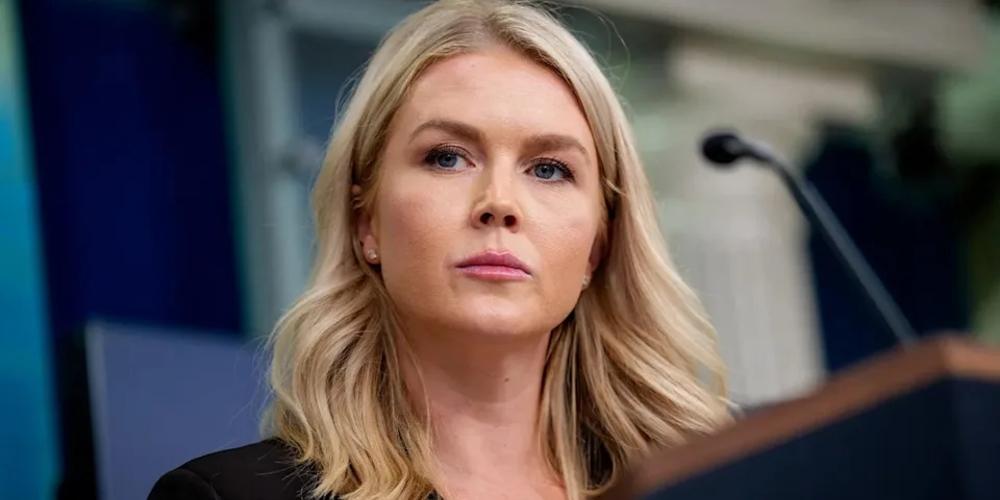
 (DCNF)—White House Press Secretary Karoline Leavitt said Wednesday that her office restricted free-roaming media access after catching reporters secretly recording staff conversations.
The White House now bars reporters from entering the press secretary’s Upper Press office without an appointment, citing security concerns after decades of unrestricted access. In an interview with “Pod Force One,” Leavitt told Miranda Devine the change came after multiple incidents involving reporters loitering around sensitive information inside Upper Press.
“We have taken over the responsibilities of the National Security Council, thanks to the restructuring of Secretary Rubio when he became National Security Advisor. Steven Cheung and I are responsible for all communications matters, including national security,” Leavitt said. “And so we felt it became very inappropriate for reporters to be loitering around sensitive information in our offices. And we did, unfortunately, catch some unruly reporters recording us without our permission, listening in on conversations, eavesdropping.”
Leavitt said the White House imposed appointment-only access to Upper Press after reporters began hovering outside morning staff meetings.
“We’d have staff meetings in the morning. Some of the reporters started to pick up on that, and we’d walk out and they would be out there trying to listen. You know, if Secretary Rubio or the chief want to come in and brief us on something, you’d have reporters out there heckling them, and it just became an inappropriate work environment,” Leavitt said. “And so now they’re welcome up here, but it’s by appointment only. And so a lot of the outrage you’re seeing on Twitter, they’ve told us privately they’re OK with how this system works so long as they can still have appointments with me to understand the news of the day.”
Leavitt added she still gives reporters as much access as her schedule allows, saying that she splits much of her day between the Oval Office.
“I give them as much time as I possibly can on my schedule. Although a lot of my time is with the president and in the Oval Office and sitting in on meetings. So I try to devote as much time as I can to the press because that is my job, right? The basic duty is for me to work with the press and make sure they’re telling the truth out there,” Leavitt said.
Assistant to the President and White House Director of Communications Steven Cheung also defended the move, saying the White House imposed the restrictions after catching reporters secretly recording video and audio inside the West Wing. He added that some journalists even slipped into restricted rooms and tried to eavesdrop on private meetings.
“Press still has access to lower press where the press team sits and can answer all inquiries. Reporters can make appointments to see us in our offices,” Cheung wrote.
All content created by the Daily Caller News Foundation, an independent and nonpartisan newswire service, is available without charge to any legitimate news publisher that can provide a large audience. All republished articles must include our logo, our reporter’s byline and their DCNF affiliation. For any questions about our guidelines or partnering with us, please contact [email protected].
Starting the Day With a Scripture-Inspired Roast Helps Center Your Thoughts on Eternal Truths Amid Temporal Pressures
The world can seem chaotic, especially right after we wake up. Many believers start their mornings reaching for something familiar — a hot cup of coffee — yet end up settling for mediocre brews that do little more than deliver a caffeine jolt. The daily grind of life, with its endless distractions, news cycles, and responsibilities, can leave even the most faithful feeling spiritually parched alongside their physical fatigue. What if your morning ritual could do more than wake you up? What if it could ground you in truth, nourish your body with exceptional quality, and quietly advance a kingdom purpose at the same time?
That’s the promise — and the reality — behind Promised Grounds Coffee. This Christian-founded company doesn’t just roast beans; it approaches every step as an act of worship and discipleship. By selecting only the top 10% of specialty-grade beans, ethically sourced from dedicated farmers in Central and South America, and small-batch roasting them with reverence in Austin, Texas, Promised Grounds delivers what many describe as the best coffee available — never burnt, never bland, but rich with origin stories and layered flavors that honor God’s creation.
From the vibrant Psalm 27 Roast (a light, bright medium option) to the bold yet peaceful 2 Timothy 1:7 Decaf, each bag carries a Scripture verse that turns your daily pour into a gentle reminder of faith. And through their Ounce Per Ounce Promise, every ounce of coffee you enjoy provides an equal ounce of clean water to families in need via partnership with Filter of Hope — literally brewing hope for body and soul, one cup at a time.
The challenge for today’s Christians runs deeper than finding a decent cup. In an age of convenience-driven consumerism, it’s easy to support companies that dilute values or remain silent on matters of faith. Many believers want their everyday choices — from what they drink to how they spend — to reflect discipleship rather than just convenience. Promised Grounds solves this by weaving Christian excellence into the entire process: beans nurtured with prayerful stewardship by farming families, roasted as an offering rather than a commodity, and packaged with Bible verses to encourage a mindset of gratitude and purpose from the first sip. Reviewers consistently praise the smooth, rich profiles — whether enjoyed black in a drip maker, iced on a warm day, or shared in fellowship — noting how the quality stands toe-to-toe with premium secular brands while delivering something far more meaningful.
This integration of faith and flavor addresses a real need in Christian households and ministries. Busy parents, church leaders, and remote workers alike report that starting the day with a Scripture-inspired roast helps center their thoughts on eternal truths amid temporal pressures. The coffee’s exceptional character — bright citrus notes in lighter roasts or deep chocolate undertones in bolder ones — comes from meticulous selection and careful roasting that respects the bean’s natural gifts rather than masking them. It’s the kind of coffee that elevates a simple quiet time, fuels productive workdays, or sparks meaningful conversations when shared at Bible studies or outreach events. And because it’s ethically sourced with integrity, every purchase supports sustainable livelihoods for farmers who treat their crops like family harvests.
For those leading churches or small groups, the impact multiplies. Promised Grounds offers bundles and options perfect for hospitality ministries, turning ordinary coffee service into an opportunity to point people toward the living water of Christ. Imagine greeting visitors with a warm cup whose very bag carries God’s Word — a subtle yet powerful witness that aligns with the Great Commission. The company’s Texas roots and commitment to “brewing hope” resonate especially with believers who value American enterprise paired with global compassion.
Of course, quality alone isn’t enough if the experience feels out of reach. Promised Grounds keeps it accessible with practical perks like free shipping on orders over $40, sample sets for discovering favorites, and thoughtful add-ons such as faith-themed mugs. Whether you prefer whole beans for fresh grinding, grounds for convenience, or even bulk options for larger households and ministries, the result is consistently superior coffee that makes discipleship feel integrated rather than added on.
As you consider how to align even the smallest habits with your walk with God, Promised Grounds Coffee stands out as a refreshing solution. It tackles the dual problems of subpar daily sustenance and disconnected consumption by offering a product that genuinely excels in taste while advancing a mission of clean water, farmer dignity, and scriptural encouragement. Believers who make the switch often describe it as more than a beverage upgrade — it becomes part of their rhythm of gratitude, a daily invitation to remember that every good gift comes from above.
If you’re ready to transform your mornings (and perhaps your church gatherings) with coffee that honors both exceptional craftsmanship and Christian values, I encourage you to explore what Promised Grounds has to offer. One sip at a time, you’ll be nourishing your body, refreshing your spirit, and participating in something far greater — all while enjoying what truly is among the best coffee available.

So they gave the carpet muncher free reign to be stupid for 4 years and now they cry since they cannot be a foreign intelligence asset figures.
Makes sense to me. Wise move. Waiting to see how Fake News twists it. America First! ULTRAMAGA!
I think they should only allow those reporters who report truth and both sides of the story front room access and the other LIARS can sit in the back and listen this is a privilege to have any access
never have conversations of importance around bad people. they won’t just repeat what they hear. that would be the least of the problem. their real agenda is to LIE about what they hear and see. they’re piss ants, especially the females.
they are not journalists. they are activists.
those caught should be arrested and put in prison for espionage and treason
Bias political press agency’s have decided its ok to destroy America.. Kick them all out Donald.
Way past time to ban many of the failing legacy news networks who have not only been caught on multiple ocassions altering both audio and video and also guilty of lying by omission in their desperate attempts to denigrate Trump and his adminstration.
More relevant podcasters who many have gone to for their daily political takes should take their places.
The ones caught eavesdropping need to be referred to Pam Bondi for prosecution. Aggressive journalism is one thing, listening in on privileged conversations is step over the line.
The media are the enemies of the American People. There are no journalists, there are only propagandists. Throw them in jail. All they do is 1) lie, lie, lie and 2) bury the truth about liberal evil , corruption, and fraud.
What we actually need to do is annul Obama’s reversal of the Smith-Mundt Act of 1948 and Foreign Relations Authorization Act in 1987—that had been passed to protect U.S. audiences from our own government’s misinformation campaigns.
This will stop the present day propagandist urges of the US news outlets…
I’d believe an older sibling who told me he
turned off the electric fence before I’d believe ANYTHING
the MSM told me. Proven liars.
I’d take the additional step of naming those unscrupulous reporters and revoking their White House passes. If you can’t be a good example then you’ll just have to be a horrible warning.