

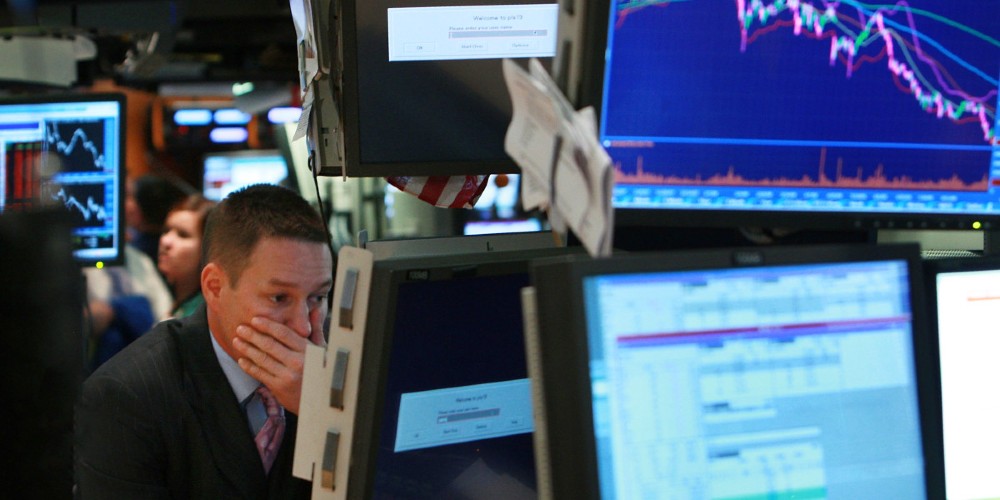
Do you remember the panic that swept through Wall Street in September 2008? Well, a lot of people believe that it is starting to happen again. And once selling starts to spiral out of control, it is going to be incredibly difficult to stop. On Monday, the Dow Jones Industrial Average fell 1,276 points. That was the seventh biggest single day decline in history, and on a point basis it was actually larger than anything that we witnessed back in 2008. Investors were bitterly disappointed by the monthly inflation report, because it showed that everything that the Fed has done so far has not worked. It appears to be inevitable that the Fed will continue to raise interest rates in a desperate attempt to get inflation under control, and that has put Wall Street in a very sour mood.
The widespread selling that we saw on Tuesday was more than just a little bit frightening. The Dow just kept plunging throughout the day, and the S&P 500 and the Nasdaq actually performed even worse than the Dow did…
The Dow Jones Industrial Average slid 1,276.37 points, or 3.94%, to close at 31,104.97. The S&P 500 dropped 4.32% to 3,932.69, and the Nasdaq Composite sank 5.16% to end the day at 11,633.57.
Just five stocks in the S&P 500 finished in positive territory. Tech stocks were hit particularly hard, with Facebook-parent Meta skidding 9.4% and chip giant Nvidia shedding 9.5%.
This was the worst day for stocks since the early days of the pandemic. But one bad day does not make a crisis.
Hopefully tomorrow will be better. But when you compare the current behavior of the stock market to how it behaved just prior to the crash of 2008, the similarities are astounding.
If you doubt this, just check out this chart.
It certainly isn’t going to take much to spark a massive rush for the exits. If a bad inflation number can cause the sort of stampede that we witnessed on Tuesday, what would happen if we received some really bad news?
Not that I am downplaying the severity of the inflation report. Consumer prices have now been going up for 27 months in a row, and what is happening to food is especially alarming…
The Consumer Price Index (CPI) report released today by the Bureau of Labor Statistics showed that prices on all items in the United States increased by 8.3 percent from August of 2021 to August of 2022, with the price of gasoline rising 25.6 percent, the price of electricity rising 15.8 percent and the price of food rising 11.4 percent.
The report indicated that the 11.4 percent year-to-year increase in the price of food was the highest in 43 years.
If you have been to the supermarket lately, you already know that food prices have risen to very painful levels.
And some of our most important staples such as milk, flour and eggs are leading the way…
Americans browsing the supermarket aisle will notice most food items are far more expensive than they were a year ago. Egg prices soared 39.8%, while flour got 23.3% more expensive. Milk rose 17% and the price of bread jumped 16.2%.
Meat and poultry also grew costlier. Chicken prices jumped 16.6%, while meats rose 6.7% and pork increased 6.8%. Fruits and vegetables together are up 9.4%.
The “experts” at the Fed don’t seem to understand that hiking interest rates won’t fix this.
We are in the early stages of a historic global food crisis that is going to be with us for a long time to come. The biggest reason why food prices are increasing so aggressively is because there simply isn’t enough supply.
So the Fed can try to hammer demand as much as it wants, but people are still going to have to buy food and hiking interest rates is not going to help us produce any additional food. If anything, higher rates may put a damper on food production.
This is a totally different environment from the early 1980s, and those that believe that higher rates will tame inflation like they did back then are just being delusional.
But just like we saw back in 2008, higher rates will crush the U.S. housing market and the economy as a whole.
During a recent interview, billionaire John Catsimatidis asked the Federal Reserve to stop raising rates because if we stay on the path that we are on it will “destroy the rest of the country”…
So I call upon the Federal Reserve…If we keep raising interest rates, we’re going to destroy the rest of the country.
Somebody has to stand up and say it doesn’t have to happen. And they’re going to destroy the rest of the country. And there is a recession, it could turn into a depression.
Are you willing to go through an economic depression just to get the inflation rate back down to acceptable levels?
If not, that is too bad, because the Federal Reserve is not accountable to you.
And we are already starting to see signs that higher rates are having a really negative impact on hiring plans…
Based on the latest data from U.S. small businesses (SMBs), the demand for labor has declined again, with nearly two out of every three (63%) putting their hiring on hold because they can’t afford to add staff, and 10% of that group is laying off workers.
This decline is quite significant, as it’s 18% higher than it was in July (at just 45%). Beyond that, the percentage reducing their staff jumped 6% to 10% this month from just 4% in July.
Just like in 2008, vast numbers of Americans will lose their jobs in the months ahead.
Are you sure that your job is secure?

Economic conditions are rapidly deteriorating all around us, and our short-term problems could get a whole lot worse if 100,000 railroad workers decide to initiate a work stoppage on Friday…
President Biden and senior administration officials are working with others in the transportation industry, including truckers, shippers, and air freight, for “contingency plans” if a rail shutdown materializes at the end of the week, a White House official told Bloomberg.
The administration is trying to understand what supply chains could be disrupted the most — and how to utilize other forms of transportation to ensure commodities and consumer goods continue to flow across the country.
More than 100,000 railroad workers could walk off the job on Friday if freight-rail companies and unions don’t reach labor agreements.
Let us hope that such a work stoppage can be avoided.
But even if it can, there is no short-term hope on the horizon.
Our current crop of leaders is the worst in all of U.S. history, and they have us on a path that leads to national economic suicide.
So many of us have been pleading with Fed officials to stop raising rates, because higher rates will absolutely cripple our economy.
Unfortunately, they don’t really care what any of us think, and they have made it quite clear that more extremely foolish rate hikes are dead ahead.
I would encourage you to brace yourself for a full-blown national economic meltdown, because that is precisely where the Fed’s policies will take us.
***It is finally here! Michael’s new book entitled “7 Year Apocalypse” is now available in paperback and for the Kindle on Amazon.***
About the Author: My name is Michael and my brand new book entitled “7 Year Apocalypse” is now available on Amazon.com. In addition to my new book I have written five other books that are available on Amazon.com including “Lost Prophecies Of The Future Of America”, “The Beginning Of The End”, “Get Prepared Now”, and “Living A Life That Really Matters”. (#CommissionsEarned) When you purchase any of these books you help to support the work that I am doing, and one way that you can really help is by sending digital copies as gifts through Amazon to family and friends. Time is short, and I need help getting these warnings into the hands of as many people as possible.
I have published thousands of articles on The Economic Collapse Blog, End Of The American Dream and The Most Important News, and the articles that I publish on those sites are republished on dozens of other prominent websites all over the globe. I always freely and happily allow others to republish my articles on their own websites, but I also ask that they include this “About the Author” section with each article. The material contained in this article is for general information purposes only, and readers should consult licensed professionals before making any legal, business, financial or health decisions.
I encourage you to follow me on social media on Facebook and Twitter, and any way that you can share these articles with others is a great help. These are such troubled times, and people need hope. John 3:16 tells us about the hope that God has given us through Jesus Christ: “For God so loved the world, that he gave his only begotten Son, that whosoever believeth in him should not perish, but have everlasting life.” If you have not already done so, I strongly urge you to ask Jesus to be your Lord and Savior today.
Article cross-posted from The Economic Collapse Blog.
Starting the Day With a Scripture-Inspired Roast Helps Center Your Thoughts on Eternal Truths Amid Temporal Pressures
The world can seem chaotic, especially right after we wake up. Many believers start their mornings reaching for something familiar — a hot cup of coffee — yet end up settling for mediocre brews that do little more than deliver a caffeine jolt. The daily grind of life, with its endless distractions, news cycles, and responsibilities, can leave even the most faithful feeling spiritually parched alongside their physical fatigue. What if your morning ritual could do more than wake you up? What if it could ground you in truth, nourish your body with exceptional quality, and quietly advance a kingdom purpose at the same time?
That’s the promise — and the reality — behind Promised Grounds Coffee. This Christian-founded company doesn’t just roast beans; it approaches every step as an act of worship and discipleship. By selecting only the top 10% of specialty-grade beans, ethically sourced from dedicated farmers in Central and South America, and small-batch roasting them with reverence in Austin, Texas, Promised Grounds delivers what many describe as the best coffee available — never burnt, never bland, but rich with origin stories and layered flavors that honor God’s creation.
From the vibrant Psalm 27 Roast (a light, bright medium option) to the bold yet peaceful 2 Timothy 1:7 Decaf, each bag carries a Scripture verse that turns your daily pour into a gentle reminder of faith. And through their Ounce Per Ounce Promise, every ounce of coffee you enjoy provides an equal ounce of clean water to families in need via partnership with Filter of Hope — literally brewing hope for body and soul, one cup at a time.
The challenge for today’s Christians runs deeper than finding a decent cup. In an age of convenience-driven consumerism, it’s easy to support companies that dilute values or remain silent on matters of faith. Many believers want their everyday choices — from what they drink to how they spend — to reflect discipleship rather than just convenience. Promised Grounds solves this by weaving Christian excellence into the entire process: beans nurtured with prayerful stewardship by farming families, roasted as an offering rather than a commodity, and packaged with Bible verses to encourage a mindset of gratitude and purpose from the first sip. Reviewers consistently praise the smooth, rich profiles — whether enjoyed black in a drip maker, iced on a warm day, or shared in fellowship — noting how the quality stands toe-to-toe with premium secular brands while delivering something far more meaningful.
This integration of faith and flavor addresses a real need in Christian households and ministries. Busy parents, church leaders, and remote workers alike report that starting the day with a Scripture-inspired roast helps center their thoughts on eternal truths amid temporal pressures. The coffee’s exceptional character — bright citrus notes in lighter roasts or deep chocolate undertones in bolder ones — comes from meticulous selection and careful roasting that respects the bean’s natural gifts rather than masking them. It’s the kind of coffee that elevates a simple quiet time, fuels productive workdays, or sparks meaningful conversations when shared at Bible studies or outreach events. And because it’s ethically sourced with integrity, every purchase supports sustainable livelihoods for farmers who treat their crops like family harvests.
For those leading churches or small groups, the impact multiplies. Promised Grounds offers bundles and options perfect for hospitality ministries, turning ordinary coffee service into an opportunity to point people toward the living water of Christ. Imagine greeting visitors with a warm cup whose very bag carries God’s Word — a subtle yet powerful witness that aligns with the Great Commission. The company’s Texas roots and commitment to “brewing hope” resonate especially with believers who value American enterprise paired with global compassion.
Of course, quality alone isn’t enough if the experience feels out of reach. Promised Grounds keeps it accessible with practical perks like free shipping on orders over $40, sample sets for discovering favorites, and thoughtful add-ons such as faith-themed mugs. Whether you prefer whole beans for fresh grinding, grounds for convenience, or even bulk options for larger households and ministries, the result is consistently superior coffee that makes discipleship feel integrated rather than added on.
As you consider how to align even the smallest habits with your walk with God, Promised Grounds Coffee stands out as a refreshing solution. It tackles the dual problems of subpar daily sustenance and disconnected consumption by offering a product that genuinely excels in taste while advancing a mission of clean water, farmer dignity, and scriptural encouragement. Believers who make the switch often describe it as more than a beverage upgrade — it becomes part of their rhythm of gratitude, a daily invitation to remember that every good gift comes from above.
If you’re ready to transform your mornings (and perhaps your church gatherings) with coffee that honors both exceptional craftsmanship and Christian values, I encourage you to explore what Promised Grounds has to offer. One sip at a time, you’ll be nourishing your body, refreshing your spirit, and participating in something far greater — all while enjoying what truly is among the best coffee available.
