
In one of the little ironies of history, Edward Gibbons began publishing a six-volume writing project, “The History of the Decline and Fall of the Roman Empire,” in 1776, just as what would become the American Empire was being launched with a revolution against a powerful British Empire still in its ascendency. His final book in the series was published in 1788 as America was in the middle of its two-year transition from a confederacy to a constitutional republic. The British Empire peaked around 1914 and was surpassed by the United States as the world’s foremost superpower in World War II, becoming the sole superpower upon the success of the Anglo-American partnership in collapsing its chief rival, the Soviet Union, during the Reagan and Thatcher administrations.
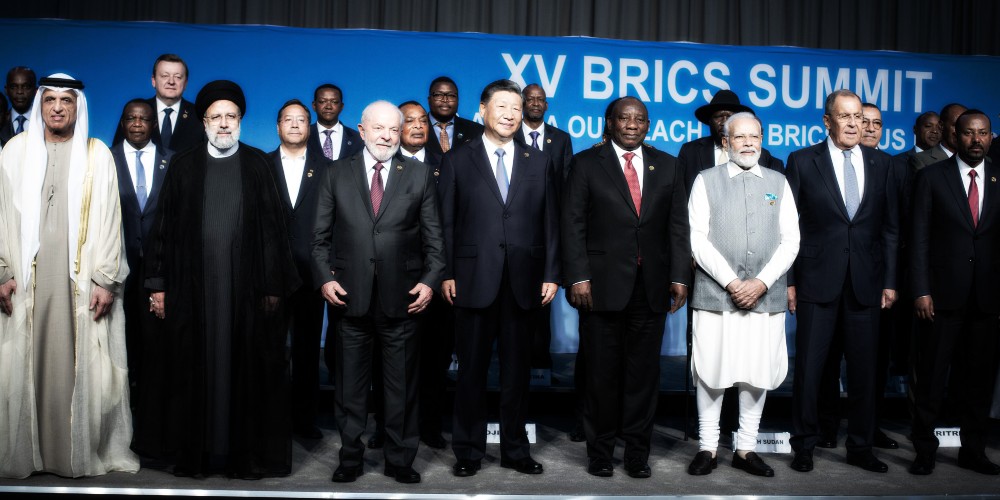
Studying the history of geopolitical upheavals is fascinating, but living through one makes the topic personal and often painful. Today the world is in the midst of a new upheaval involving many of the ancient powers seeking a new global order, led by a coalition called BRICS, which is an acronym for Brazil, Russia, India, China and South Africa. On Aug. 22-24, 2023, the BRICS coalition doubled in size, adding Iran, United Arab Emirates, Saudi Arabia, Argentina, Egypt and Ethiopia, effective Jan. 1, 2024.
The dominant powers of this group are primarily Russia and China, with Russia providing the executive and military leadership and China providing both the financial stability of an economic giant and the political leverage of holding most of deeply indebted America’s loans. But all 12 of these countries are developed nations with a common interest in ending Anglo-American hegemony – which largely translates into ending U.S./British control of global trade and banking, and defanging NATO as its global enforcer.
For decades, rival elites on both sides of this divide have been engaged in a global chess-match set mostly along the imaginary boundary line of Europe and Asia – because apparently most of them accept Mackinder’s maxim that whoever controls Eurasia controls the world. But adding to the complexity of this equation, and bringing in other regions, especially the Middle East, is the importance of trade routes, including oil pipelines.
If you start with this premise and look back over geopolitics since WWII, all the subsequent lesser wars and “police actions” initiated mostly by the U.S. fit easily into the chess-match paradigm. Syria is about rival oil pipeline routes. Iraq and Libya were about global banking dependency. Iran is about control of the Suez Canal. The Ukraine war is both about oil pipelines and creating an “Israel” on Russia’s border – meaning a heavily militarized forward base to represent Western interests on a mostly hostile frontier.
It is also about gaining a tighter political and economic grip on Europe through energy dependency, of which the U.S. destruction of the Nord Stream II pipeline was an essential component: to prevent a Russian/German economic alliance that would have also supplied all of Europe with cheap, abundant energy.
U.S. domestic policy is being heavily affected by these geopolitical moves. For example, I contend that the sudden move to ban natural gas stoves is to free more supply for Europe, which is building gigantic transfer terminals to receive liquified natural gas from U.S. tankers to offset the loss from Russia (none of which is getting U.S. media coverage).
Indeed, the entire frantic “climate crisis” over carbon emissions – while also a means of increasing globalists power – seems to be an acknowledgment by “our” elites that the BRICS alliance might very well wrest control of the oil-based global economy away from us, and we need to be positioned to survive a global ban on carbon-based fuels that we would attempt to impose as a counter-measure. While that goal may prove unattainable given the growing clout of the BRICS alliance, it does at least provide an emerging narrative theme to justify future wars and police actions to “save the planet” from “criminally carbon-spewing nations.”
This chess-game framework also explains why we’re being conditioned to prepare for a Great Reset. We already have no ability to pay back China and other holders of our massive debt, but that problem will become exponentially worse if/when the dollar loses its globally exclusive reserve currency status. The best chance for retaining our hegemony would be the announcement of a global debt jubilee in conjunction with the launch of a completely new economic system which we control. Think of the Great Reset like geopolitical chemotherapy: a dose of poison designed to kill off the “cancer” in the world (i.e., non-submissive regimes), which theoretically would not kill the host body in the process but leave it stronger in the end.
As much as the extreme moral degeneracy of our elites makes the thought of a new global order more appealing, I don’t think BRICS can beat the West in this worsening conflict, and I believe the example of Brazil shows why. Brazil’s recently coup-reinstalled President Luiz Inácio Lula da Silva is as much a creation of the American left as any of our homegrown blue-state tyrants, but he’s also a highly ambitious political animal who presumably would rather not be under the American thumb. He was one of the original founders of BRICS and is the only one of the original heads of state who were in the coalition at its founding.
The BRICS threat to U.S. hegemony during Lula’s first administration was nominal, but by last month’s meeting in South Africa it was massive and growing. Lula’s participation in that meeting suggests to me he now is either serving as a U.S. mole in the BRICS leadership, or he believes BRICS represents a realistic opportunity to break his country free from U.S. control. Perhaps it was only for managing public perceptions but concurrent with the BRICS summit, the Brazilian Supreme Court (which staged the coup that reinstalled him) passed one of the world’s first anti-homophobia laws with actual criminal penalties.
That fascist law was a major bone for Lula to throw to the American leftists who helped rig the Brazilian election for him, in essence saying, “I’m still your boy.” But it also exposes the weakness of the glue holding BRICS together – the LGBT agenda is anathema to Russia and the other members. There is really nothing but a mutual desire to escape U.S. control that keeps them aligned – and THAT makes it extremely vulnerable to the British side of the Anglo-American pact, who are history’s greatest masters of “divide and conquer.” Watch and see.
To the painful personal side of this crisis, it was Lula who, during his first term in 2007 first attempted to criminalize pro-family activism, and my great friend and ally Julio Severo had to flee Brazil for the jungles of Guatemala after leading the defeat of the law. He, his wife and their seven children lived in exile there until he died in 2021. My ministry has ever since provided financial support to keep them together in one home, fed and clothed. My point is that global changes always hit the “little people” hardest – but being aware of what’s really going on helps us to better prepare and adapt.
Note: To help Julio Severo’s widow and children survive and get their legal status resolved, donate here using the Emergency Help for the Severo Family option. To help carry on Julio’s work defending the biblical standard for marriage and family against LGBT bullying, choose the “Carry on his work” option.

Content created by the WND News Center is available for re-publication without charge to any eligible news publisher that can provide a large audience. For licensing opportunities of our original content, please contact [email protected].
Starting the Day With a Scripture-Inspired Roast Helps Center Your Thoughts on Eternal Truths Amid Temporal Pressures
The world can seem chaotic, especially right after we wake up. Many believers start their mornings reaching for something familiar — a hot cup of coffee — yet end up settling for mediocre brews that do little more than deliver a caffeine jolt. The daily grind of life, with its endless distractions, news cycles, and responsibilities, can leave even the most faithful feeling spiritually parched alongside their physical fatigue. What if your morning ritual could do more than wake you up? What if it could ground you in truth, nourish your body with exceptional quality, and quietly advance a kingdom purpose at the same time?
That’s the promise — and the reality — behind Promised Grounds Coffee. This Christian-founded company doesn’t just roast beans; it approaches every step as an act of worship and discipleship. By selecting only the top 10% of specialty-grade beans, ethically sourced from dedicated farmers in Central and South America, and small-batch roasting them with reverence in Austin, Texas, Promised Grounds delivers what many describe as the best coffee available — never burnt, never bland, but rich with origin stories and layered flavors that honor God’s creation.
From the vibrant Psalm 27 Roast (a light, bright medium option) to the bold yet peaceful 2 Timothy 1:7 Decaf, each bag carries a Scripture verse that turns your daily pour into a gentle reminder of faith. And through their Ounce Per Ounce Promise, every ounce of coffee you enjoy provides an equal ounce of clean water to families in need via partnership with Filter of Hope — literally brewing hope for body and soul, one cup at a time.
The challenge for today’s Christians runs deeper than finding a decent cup. In an age of convenience-driven consumerism, it’s easy to support companies that dilute values or remain silent on matters of faith. Many believers want their everyday choices — from what they drink to how they spend — to reflect discipleship rather than just convenience. Promised Grounds solves this by weaving Christian excellence into the entire process: beans nurtured with prayerful stewardship by farming families, roasted as an offering rather than a commodity, and packaged with Bible verses to encourage a mindset of gratitude and purpose from the first sip. Reviewers consistently praise the smooth, rich profiles — whether enjoyed black in a drip maker, iced on a warm day, or shared in fellowship — noting how the quality stands toe-to-toe with premium secular brands while delivering something far more meaningful.
This integration of faith and flavor addresses a real need in Christian households and ministries. Busy parents, church leaders, and remote workers alike report that starting the day with a Scripture-inspired roast helps center their thoughts on eternal truths amid temporal pressures. The coffee’s exceptional character — bright citrus notes in lighter roasts or deep chocolate undertones in bolder ones — comes from meticulous selection and careful roasting that respects the bean’s natural gifts rather than masking them. It’s the kind of coffee that elevates a simple quiet time, fuels productive workdays, or sparks meaningful conversations when shared at Bible studies or outreach events. And because it’s ethically sourced with integrity, every purchase supports sustainable livelihoods for farmers who treat their crops like family harvests.
For those leading churches or small groups, the impact multiplies. Promised Grounds offers bundles and options perfect for hospitality ministries, turning ordinary coffee service into an opportunity to point people toward the living water of Christ. Imagine greeting visitors with a warm cup whose very bag carries God’s Word — a subtle yet powerful witness that aligns with the Great Commission. The company’s Texas roots and commitment to “brewing hope” resonate especially with believers who value American enterprise paired with global compassion.
Of course, quality alone isn’t enough if the experience feels out of reach. Promised Grounds keeps it accessible with practical perks like free shipping on orders over $40, sample sets for discovering favorites, and thoughtful add-ons such as faith-themed mugs. Whether you prefer whole beans for fresh grinding, grounds for convenience, or even bulk options for larger households and ministries, the result is consistently superior coffee that makes discipleship feel integrated rather than added on.
As you consider how to align even the smallest habits with your walk with God, Promised Grounds Coffee stands out as a refreshing solution. It tackles the dual problems of subpar daily sustenance and disconnected consumption by offering a product that genuinely excels in taste while advancing a mission of clean water, farmer dignity, and scriptural encouragement. Believers who make the switch often describe it as more than a beverage upgrade — it becomes part of their rhythm of gratitude, a daily invitation to remember that every good gift comes from above.
If you’re ready to transform your mornings (and perhaps your church gatherings) with coffee that honors both exceptional craftsmanship and Christian values, I encourage you to explore what Promised Grounds has to offer. One sip at a time, you’ll be nourishing your body, refreshing your spirit, and participating in something far greater — all while enjoying what truly is among the best coffee available.
