

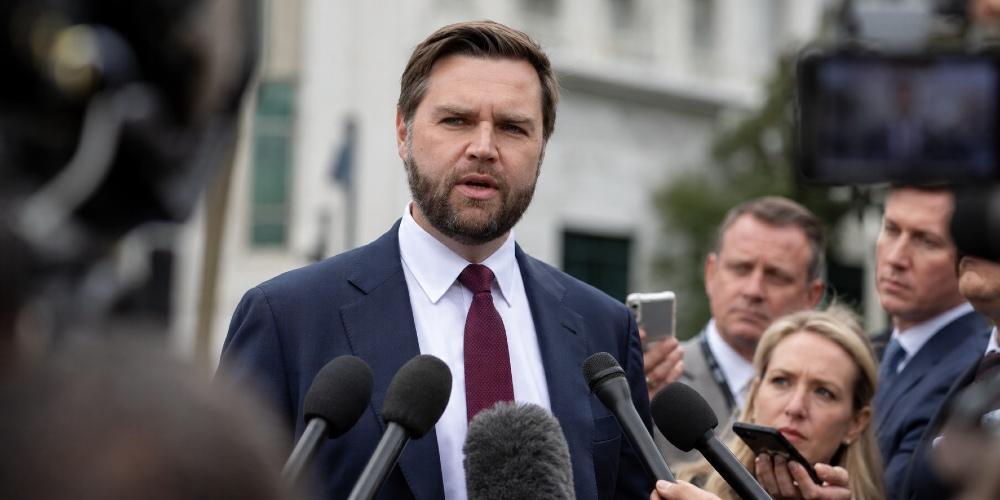
Donald Trump is a force of personality, and the movement bearing his name runs on his instincts, his grievances, and his gift for improvisation. He never handed anyone a reading list. He felt the country’s mood and said out loud what millions had been muttering for years. JD Vance is something that movement has never possessed before, a man who showed up with the argument already finished.
That is the deepest difference between the two men, and it is not a difference of policy. It is a difference of category. Trump is a phenomenon attached to one person. Vance is the carrier of a doctrine. Where Trump improvises, Vance reasons from a settled body of thought; where Trump’s appeal is inseparable from his persona, Vance’s appeal is portable, teachable, and therefore far more dangerous to his enemies. A Vance presidency would not merely extend Trumpism. It would convert it from an impulse into a program.
The left has spent a decade convinced that defeating the man would end the threat. They have rarely asked the harder question. What happens when the disruption acquires a curriculum? Personalities expire. Doctrines get taught, and the contest in 2028 is whether the realignment Trump began dies with him or hardens into something built to outlast its founder.
A Man Against a Movement
Trump’s politics has always been a kind of autobiography. His feuds, his deals, and his sense of betrayal at the hands of a class that looked down on him all flow from the life of one extraordinary man. Vance’s politics is an argument. He came up through the world of the New Right, the constellation of writers and institutions that traded free-market orthodoxy for industrial policy, foreign-policy restraint, and an unapologetic willingness to use power on behalf of working families. He does not feel his way to those conclusions. He reasons his way there, and he says so plainly.
At an American Compass gala last year, standing before a room of young activists, Vance described the project in terms no improviser would ever use.
I’ve given up hope that we can persuade most of the think-tank intellectuals in Washington, D.C., to change. We can’t change them. What we can do is replace them with all of you.
He called it a 20-year effort to return the country to commonsense economics. Twenty years. That is not the vocabulary of a man chasing a news cycle, it is the vocabulary of a man building an institution meant to function long after he leaves the stage. This is precisely how a movement escapes the mortality of its founder, and the pattern is older than American politics.
“And the things that thou hast heard of me among many witnesses, the same commit thou to faithful men, who shall be able to teach others also.”
A cause survives when its first champion hands it to people equipped to carry it forward. Trump built a following. Vance is trying to build successors.
The Restraint That Met Reality
Nowhere is the gap between conviction and circumstance clearer than on war. Vance is a former Marine who served in Iraq and came home convinced that Washington spends American blood on missions it cannot define. As a senator he scorned the forever wars, doubted the Ukraine commitment, and in a leaked group chat argued against striking the Houthis. In 2024 he said the American interest lay very much in not going to war with Iran.
Then the missiles flew. When Trump launched the air war against Iran, the most prominent skeptic of foreign entanglement on the national ticket became its house apologist. Trump, never one to spare an ally an awkward moment, told reporters that Vance had been “philosophically a little bit different than me” and “maybe less enthusiastic about going.”
Vance’s own friend Sohrab Ahmari, surveying the damage, judged that the vice president had lost the foreign-policy war inside his own administration.
Here the honest analyst has to pause. If Vance’s restraint folded the first time it collided with presidential power, why expect a Vance presidency to be any less willing to strike? The answer is not that he would prove reliably dovish, because Iran suggests he would not. The answer is that even his retreat was reasoned. He defended the operation by insisting its objective was narrow and clearly defined, a frame rather than a feeling. Trump’s contradictions arrive from the moment. Vance’s arrive from a framework that bends under pressure yet never quite vanishes. That is a real distinction, and it doubles as a warning to anyone expecting his stated convictions to govern automatically once he sits behind the desk.
A Faith That Governs
The difference that matters most runs deeper than tariffs or troop deployments. Trump’s relationship with Christianity has always been transactional, a politically useful alliance with believers whose votes he courts and whose grievances he channels.
Vance’s faith is something else. A convert to Catholicism, he has planted his worldview inside a tradition that treats the family, the common good, and the moral purpose of the state as the central business of government. Patrick Deneen, the postliberal theorist whose work helped shape that worldview, called Vance the ideal choice to carry the movement forward.
JD combines a dedication to domestic productivity, foreign policy realism, and a deep commitment to strengthening American families and the communities that sustain them.
This is where those who spent decades fighting for limited government should listen carefully rather than cheer reflexively. The postliberal project does not want a smaller state. It wants a stronger one, wielded by people who share its vision of the good. That is a coherent and serious position, and it is also a sword that cuts in whatever direction the hand holding it chooses.

A government muscular enough to reward the families and communities you favor is a government muscular enough to punish the ones you do not. Whose common good, defined by whom, and restrained by what? Those are not gotcha questions. They are the questions a faithful people ought to put to any leader who promises to bend power toward their souls’ benefit, however sincere he is, and Vance is plainly sincere.
Capturing the Citadel
Trump attacks institutions. Vance intends to take them. In 2021 he delivered a speech bluntly titled “The Universities Are the Enemy,” and the title was the thesis. The New Right does not dream of shrinking the administrative state into irrelevance so much as seizing its levers and staffing them with its own people.
Apply that to economics and the shape of a Vance term sharpens. Tariffs become a durable industrial policy rather than a negotiating bluff. Antitrust, labor, trade, and higher education all get bent toward the national interest as he defines it. Trump rattles the citadel from outside. Vance means to move in, change the locks, and run the place.
The Coronation Is Not Yet Written
None of this assumes the office is his for the asking. Trump has pointedly declined to bless an heir, praising both Vance and Marco Rubio while musing that one is “slightly more diplomatic than the other” and that the two would be hard to beat as a ticket.
Reporting suggests the president has privately wondered whether his vice president can truly go the distance. Even allies on the right have winced at Vance’s “heritage American” rhetoric, with Vivek Ramaswamy arguing that the notion of one citizen being more American than another is itself un-American. The doctrine is real. The throne is not promised, and the man’s own movement is still arguing about how far his ideas should travel.
Still, the central truth holds. The left has trained itself to fear a personality, and personalities can be beaten at the ballot box and outlasted by the calendar. An argument is harder to kill. Trump gave the realignment its energy and its audience. Vance is giving it a syllabus, a class of successors, and a timeline measured in decades.

You can vote a man out of office. It is considerably harder to vote out a doctrine that has already been committed to faithful men who are able to teach others also. That, more than any single policy, is what would make a Vance presidency different, and it is why his opponents would be wise to spend less time studying the man and far more time studying what he actually believes.

Starting the Day With a Scripture-Inspired Roast Helps Center Your Thoughts on Eternal Truths Amid Temporal Pressures
The world can seem chaotic, especially right after we wake up. Many believers start their mornings reaching for something familiar — a hot cup of coffee — yet end up settling for mediocre brews that do little more than deliver a caffeine jolt. The daily grind of life, with its endless distractions, news cycles, and responsibilities, can leave even the most faithful feeling spiritually parched alongside their physical fatigue. What if your morning ritual could do more than wake you up? What if it could ground you in truth, nourish your body with exceptional quality, and quietly advance a kingdom purpose at the same time?
That’s the promise — and the reality — behind Promised Grounds Coffee. This Christian-founded company doesn’t just roast beans; it approaches every step as an act of worship and discipleship. By selecting only the top 10% of specialty-grade beans, ethically sourced from dedicated farmers in Central and South America, and small-batch roasting them with reverence in Austin, Texas, Promised Grounds delivers what many describe as the best coffee available — never burnt, never bland, but rich with origin stories and layered flavors that honor God’s creation.
From the vibrant Psalm 27 Roast (a light, bright medium option) to the bold yet peaceful 2 Timothy 1:7 Decaf, each bag carries a Scripture verse that turns your daily pour into a gentle reminder of faith. And through their Ounce Per Ounce Promise, every ounce of coffee you enjoy provides an equal ounce of clean water to families in need via partnership with Filter of Hope — literally brewing hope for body and soul, one cup at a time.
The challenge for today’s Christians runs deeper than finding a decent cup. In an age of convenience-driven consumerism, it’s easy to support companies that dilute values or remain silent on matters of faith. Many believers want their everyday choices — from what they drink to how they spend — to reflect discipleship rather than just convenience. Promised Grounds solves this by weaving Christian excellence into the entire process: beans nurtured with prayerful stewardship by farming families, roasted as an offering rather than a commodity, and packaged with Bible verses to encourage a mindset of gratitude and purpose from the first sip. Reviewers consistently praise the smooth, rich profiles — whether enjoyed black in a drip maker, iced on a warm day, or shared in fellowship — noting how the quality stands toe-to-toe with premium secular brands while delivering something far more meaningful.
This integration of faith and flavor addresses a real need in Christian households and ministries. Busy parents, church leaders, and remote workers alike report that starting the day with a Scripture-inspired roast helps center their thoughts on eternal truths amid temporal pressures. The coffee’s exceptional character — bright citrus notes in lighter roasts or deep chocolate undertones in bolder ones — comes from meticulous selection and careful roasting that respects the bean’s natural gifts rather than masking them. It’s the kind of coffee that elevates a simple quiet time, fuels productive workdays, or sparks meaningful conversations when shared at Bible studies or outreach events. And because it’s ethically sourced with integrity, every purchase supports sustainable livelihoods for farmers who treat their crops like family harvests.
For those leading churches or small groups, the impact multiplies. Promised Grounds offers bundles and options perfect for hospitality ministries, turning ordinary coffee service into an opportunity to point people toward the living water of Christ. Imagine greeting visitors with a warm cup whose very bag carries God’s Word — a subtle yet powerful witness that aligns with the Great Commission. The company’s Texas roots and commitment to “brewing hope” resonate especially with believers who value American enterprise paired with global compassion.
Of course, quality alone isn’t enough if the experience feels out of reach. Promised Grounds keeps it accessible with practical perks like free shipping on orders over $40, sample sets for discovering favorites, and thoughtful add-ons such as faith-themed mugs. Whether you prefer whole beans for fresh grinding, grounds for convenience, or even bulk options for larger households and ministries, the result is consistently superior coffee that makes discipleship feel integrated rather than added on.
As you consider how to align even the smallest habits with your walk with God, Promised Grounds Coffee stands out as a refreshing solution. It tackles the dual problems of subpar daily sustenance and disconnected consumption by offering a product that genuinely excels in taste while advancing a mission of clean water, farmer dignity, and scriptural encouragement. Believers who make the switch often describe it as more than a beverage upgrade — it becomes part of their rhythm of gratitude, a daily invitation to remember that every good gift comes from above.
If you’re ready to transform your mornings (and perhaps your church gatherings) with coffee that honors both exceptional craftsmanship and Christian values, I encourage you to explore what Promised Grounds has to offer. One sip at a time, you’ll be nourishing your body, refreshing your spirit, and participating in something far greater — all while enjoying what truly is among the best coffee available.
