

(The Epoch Times)—Ukraine’s stunning drone attack against Russian nuclear bombers has underscored the United States’ own vulnerability to drone attacks.
On June 1, Ukraine carried out Spiderweb, an audacious attack on air bases deep inside Russian territory. The operation concealed drones in wooden sheds loaded onto trucks that were delivered by unsuspecting drivers to the perimeter of the bases. The roof panels of the sheds were then remotely lifted off, allowing the drones to fly out and begin their attack.
More than 100 drones armed with explosives were deployed, and they damaged or destroyed 41 percent of the country’s strategic cruise missile carriers, according to Ukraine officials.
Far away from that conflict, thousands of drones breach U.S. borders every month, while others fly over sensitive sites within the country.
Mexican cartels are known to carry out many of the border incursions, while foreign adversaries are behind a smaller, but far more worrisome number of the incursions over sensitive military sites and critical infrastructure.
Goods shipped into ports could pose a security risk, as well, said Michael Lucci, founder of the security agency State Armor.
“China is putting thousands of containers into our ports and then into our country every day. I mean, the vulnerability there is almost incomprehensible,” he said.
An executive order signed by President Donald Trump on June 6 addresses the growing threat of “criminal terrorists and foreign misuse of drones in U.S. airspace,” Michael Kratsios, director of the White House Office of Science and Technology Policy, said during a press briefing.
Sebastian Gorka, Trump’s senior director for counterterrorism, said at the briefing that the executive order was in response to a flurry of drone sightings over New Jersey beginning last year, but also because of the drone warfare playing out in real time.
“Anyone can go online right now and just look at footage from … Ukraine,” Gorka said. He added that the timing of the order couldn’t be better “given what we witnessed with the remarkable drone operation that occurred just a few days ago in Russia.”
The presidential directive was issued after a rise in incidents that caused the Federal Aviation Administration (FAA) in 2024 to temporarily ban drone flights over some critical infrastructure locations and prompted congressional leaders to hold hearings this spring into drone incursions.
Still, Ukraine’s successful Trojan-horse style attack against a larger enemy suggests that prohibitions alone are not enough to prevent what could be a devastating attack.
Homeland Drone Threat
In December 2024, the FAA announced a temporary ban on drone flights over 22 critical infrastructure locations in New Jersey in response to a flurry of unexplained sightings, prompting lawmakers to demand answers.
The ban followed drone sightings in or near the airspace of airports and military facilities in late 2024 in California, Maryland, Massachusetts, New Jersey, New York, Ohio, Pennsylvania, Utah, and Virginia.

At the time, the FBI said it received more than 5,000 reports of drone sightings, with 100 warranting further investigation.
House Foreign Affairs Chairman Michael McCaul (R-Texas) told reporters in December 2024 he received intelligence from NASA confirming drone activity over military sites.
“My judgment, based on my experience, is that those that are over our military sites are adversarial and most likely are coming from the People’s Republic of China,” McCaul said.

However, the White House announced during a press briefing in late January that the spate of sightings were the result of legitimate drone use by researchers, hobbyists, or commercial operations, and not linked to foreign actors.
Yet concerns over national security persisted, leading to hearings in both the House and Senate this spring.
Robert Newcomb, a Utah-based weapons engineer and defense contractor who works with drones, said drone incursions demonstrate glaring vulnerabilities in national security.

Newcomb said drones were spotted hovering over fuel tanks at Hill Air Force Base in his home state of Utah in 2024. The after-the-fact human response underscored the lack of technology capable of dealing with drones, he said.
“They chased them down with security on base with a car,” he told The Epoch Times. “It’s clear that our tactics from a domestic military perspective need to be upgraded.”
Hill Air Force Base is home to F-35 combat aircraft, which are some of the most advanced aircraft in the United States’ arsenal. The base also houses the Ogden Air Logistics Complex, which supervises a wide range of military aircraft, missiles, and software.
Yet a small drone worth a few hundred dollars could damage an F-35 costing between $80 million and $100 million.
An attack such as Ukraine’s Spiderweb operation against Russia was proven difficult to defend against.
Lucci said that the sheer number of incursions in the United States, and the technology used in some instances, indicate they are coming from adversaries such as China.
Lucci, whose organization helps states assess global security threats, said the number of drones crossing U.S. borders, and their capabilities, should put the United States on “high alert.”
“We should very much be changing our approach to domestic resilience and security issues,” Lucci said.
If asymmetrical warfare can surprise Russia, then it could surprise the United States, he said.
While drone breaches have focused attention on land, attacks could come from sea ports just as easily. Drone sightings in New Jersey included some along the coastline.
In 2024, Chinese student Fengyun Shi flew a drone over the Newport News Shipbuilding facility. The Virginia naval shipyard builds nuclear submarines and next-generation Gerald R. Ford-class aircraft carriers.
Shi pleaded guilty to two misdemeanors under the Espionage Act in July 2024 and was originally sentenced to six months in prison and one year of supervised release. He was deported in May.
Border Drone Incursions
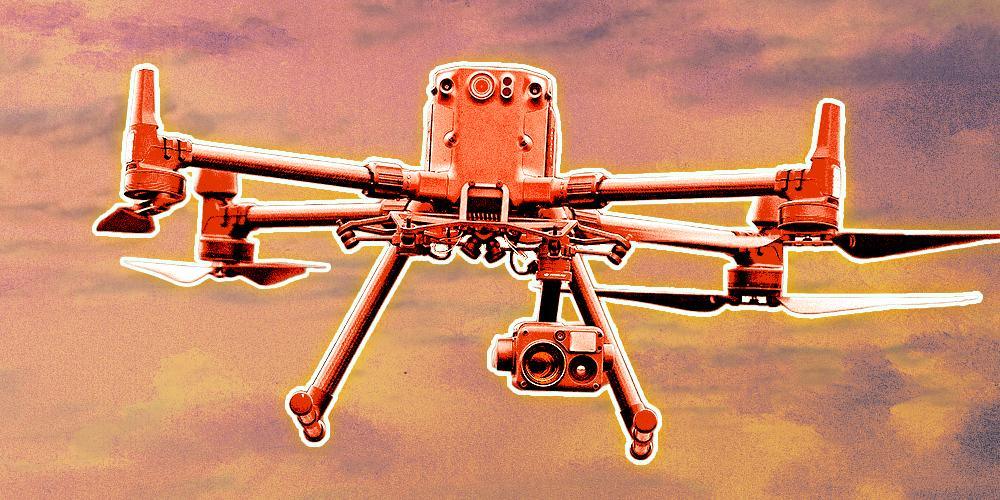
In the early morning hours of Sept. 21, 2022, Border Patrol agents identified a Chinese-made DJI M300 drone flying across the U.S.–Canada border from an upscale home in Youngstown, New York.
The drone landed for 10 minutes near an Ontario winery after crossing the Niagara River, then returned home on the U.S. side with a package attached, according to a federal criminal affidavit.
Homeland Security task force agents moved in, surprising the drone pilot and others present—all Chinese nationals claiming U.S. citizenship—who darted into the New York residence with the agents in hot pursuit.
They arrested the pilot, and the remainder of the suspects fled into the neighborhood. Agents later took two others into custody.
The drone package was found to contain about 6.5 pounds of the drug MDMA, commonly known as ecstasy, investigators said.
The investigation led to one guilty plea in 2024, with two others facing charges.
It was one example of what experts say are thousands of drone border incursions per month into the United States, many believed to be the work of cartels and transnational crime organizations.
The Department of Homeland Security Investigations affidavit detailed a task force operation “combatting transnational criminal organizations exploiting vulnerabilities of the shared international border between the United States and Canada.”
During a congressional hearing last year, Air Force Gen. Gregory M. Guillot, who became commander of the U.S. Northern Command and the North American Aerospace Defense Command in February 2024, estimated there were more than 1,000 drone incursions per month along the U.S.–Mexico border.
“I don’t know the actual number—I don’t think anybody does—but it’s in the thousands,” Guillot said.
During a May Senate hearing, Staff Captain Troy Wilson of the Texas Rangers, said drone incursions along the Texas–Mexico border were a growing problem.
Over a 12-month period ending in April, a dozen Texas-owned sensors identified 1,216 unmanned aircraft systems (UAS) border incursions from Mexico, he said. But those sensors only cover 180 miles of the state’s 1,254 miles of border with Mexico.
“We know this is a fraction of the actual number of incidents,” Wilson said.
He asked lawmakers to authorize states to counter transnational crime using UAS, or drones, and provide more funds to detect and stop them.
Wilson said drones are increasingly being used by criminals to deliver drugs and facilitate human trafficking, and called them a “significant, evolving threat” along the border.
“Alarmingly, nearly half of these UAS incursions occurred at altitudes ranging between 600 to 1,800 feet above ground level—the typical altitude range for helicopter operations,” he said.
Illegal drone usages in Texas range from delivering drugs and contraband into Texas prisons to the spraying of substances in remote areas, he said.
In May, Border Patrol agents in Texas’s Big Bend Sector, a vast desert area, reported two drones hovering above them.
“The agents stated that they observed the drones spray a mist or fog which gave the drones a strange fuzzy appearance,” Wilson said, adding the agents didn’t feel threatened by the spray itself because of the distance between them.
After a few minutes, the drones turned off their lights and flew north, away from the agents and the U.S.–Mexico border.
Trump has made securing the border a hallmark of his second term, along with using tariffs to pressure China, Mexico, and Canada into doing more to stop drug trafficking.
Some of the breaches appear to be from much more sophisticated drones flying into U.S. airspace, mainly along the Arizona–Mexico border, as detailed in The War Zone’s 2023 defense industry report.
The report included hazardous air traffic incidents of drones operating in military air combat training ranges in Arizona, reaching altitudes of up to 36,000 feet, with multiple drones spotted flying together.
One drone hit an F-16 Viper, damaging its canopy. Another drone was reported flying at a speed of Mach 0.75 (575 mph).
Lucci said one explanation for the sightings of sophisticated drones is that China is using its drone technology to help Mexican cartels in their criminal operations.
Lucci said technology to counter incursions could be a game-changer along the border.
Bill Edwards, a retired U.S. Army colonel and owner of Phoenix 6 Consulting, a drone security training company, said drone technology is progressing exponentially, especially when paired with artificial intelligence (AI).
He said the problem is that current laws governing drones, such as when they can be legally stopped or disabled, are outdated
“We have to be given the authority, legally, to mitigate those types of drones that we detect and determine as a threat,” he told The Epoch Times.
Drones can be stopped in several ways—lasers, microwaves, projectiles, disrupting their GPS guidance systems, or taking command of the signal, Edwards said.

The FAA considers drones to be aircraft, meaning it’s illegal to shoot them down in most cases.
The Preventing Emerging Threats Act, which was part of the Federal Aviation Administration Reauthorization Act of 2018, gives the departments of Justice and Homeland Security the ability to address threats posed by drones at “critical government facilities.”
But it doesn’t address state and local authorities who are trying to deal with drone breaches.
States are trying to pass laws to help law enforcement deal with drones operated by criminal enterprises, but how those laws will interact with the federal ones remains to be worked out.
Arizona recently passed House Bill 2733, which addresses concerns about drones being used by cartels to transport drugs across the border.
The new law grants law enforcement immunity from liability for damaging or shooting down drones suspected of supporting criminal activity within 15 miles of the Arizona–Mexico border.
Lucci said there are companies developing responses to asymmetrical warfare, such as California-based Epirus, capable of knocking hundreds of drones out of the sky using energy pulses and AI.
“So we are coming up with tools to counter drone warfare, which is essential,” he said. “China has hundreds if not thousands of technological vectors into the United States that will allow them to sabotage us, and we really just seem to be behind the eight ball on that.”
Rep. Jimmy Patronis (R-Fla.), who sits on the House Transportation and Infrastructure Committee, said the laws on shooting down or disabling drones need to be reexamined, especially when dealing with those flying over U.S. borders.
“The border is all about human trafficking, drugs, money, and guns,” he told The Epoch Times.
Patronis said he believes that drone incursions, whether crossing the U.S. border or those flying off the coast of New Jersey, need to be taken seriously.
“We’re going to have to take a more hands-on approach to drone warfare,” he said. “These are real. We have to deal with unmanned vehicles.”

Two Storms, One Harvest

Every food crisis in living memory has been a one-shock event. The 2008 price spike was a commodity bubble. The 2020 shortages were a logistics failure. The 2022 grain scare was a war on one exporter’s ports. Each time, the system bent, adjusted, and recovered, and each time the experts assured us afterward that global markets are simply too big and too diversified to fail.
What nobody in Washington seems eager to discuss is that 2026 is shaping up to be something the modern food system has never actually faced. Two independent shocks, one climatic and one geopolitical, are converging on the same harvest cycle at the same time. Not sequentially. Simultaneously.
Start with the weather. The Pacific Ocean is currently building toward what forecasters now openly call a record event. NOAA’s Climate Prediction Center puts the odds of at least a strong El Niño near 88 percent, with roughly two in three odds it reaches “very strong” status, the tier reserved for perhaps three or four events in the entire satellite era. Every major global model now projects a median peak in Super El Niño territory, and most of them project it exceeding the 2015-16 event, which until now held the modern record. Sea surface anomalies were already brushing the super threshold in mid-July, months before these events normally peak. The atmosphere has already shifted into El Niño mode, and the event is forecast to crest in late fall and early winter.
This is not about “climate change.” It’s about the standard cycles of weather, and the cycle we’re currently in is one that has likely devastated societies in the past. We’re better prepared as a society today, but not all Americans are equally prepared.
Serious households have started doing the quiet math on their own. Grocery bills tell part of the story, and the forecast maps tell the rest, which is why long-term food storage has moved from fringe hobby to mainstream line item in the family budget, with established suppliers like Heaven’s Harvest seeing demand from people who five years ago would have rolled their eyes at the idea. That instinct is not paranoia. It is pattern recognition, and the pattern is worth walking through carefully.
Editor’s Note: Heaven’s Harvest IS a sponsor, but the warnings of this article are real and would be written even if we didn’t have a survival food sponsor. With that said, those who take advantage of what they offer can use promo code “Patriot” for 15% off.
The Fertilizer Clock Is Already Running
While the Pacific warms, the second shock has been unfolding in the Strait of Hormuz. The conflict with Iran turned the world’s most important energy chokepoint into a contested waterway, and the consequences reach far beyond the gas pump. Roughly a third of global fertilizer trade moves through Hormuz, and the disruption sent urea prices up 86 percent year over year by March, with a 53 percent jump in a single month.
The World Bank projects energy prices rising about 24 percent in 2026 and fertilizer about 31 percent. By its own accounting, fertilizer prices ran 35 percent higher in the first five months of this year than the same period last year.
Here is the mechanism the nightly news will not explain. Fertilizer is not a grocery item. It is a time-delayed input. The nitrogen a farmer in Iowa or Punjab could not afford to apply this spring does not show up as a problem this spring. It shows up as a thinner harvest six to twelve months later.
The World Bank’s own food security brief concedes that the effects of reduced applications earlier this season “are likely to become visible only later in harvest outcomes.” Translate that from institutional language into plain English and it means this. The damage is already done, it is already in the ground, and we are simply waiting for it to arrive on the shelf.
Now check the calendar. Six to twelve months from the spring planting season lands us squarely in late 2026 and early 2027. Which is precisely when the strongest El Niño in the instrumental record is forecast to peak, bringing its signature droughts to Southeast Asia, Australia, southern Africa, northern Brazil, and South Asia, the very regions that grow the world’s rice, sugar, and oilseeds.
The World Bank warns openly that a strong El Niño “could disrupt multiple crop belts simultaneously” on top of the conflict-driven input costs. Their baseline projection assumes the Middle East disruptions ease by autumn. What in the last two years of Middle East history suggests that assumption is safe?
The System Has No Slack Left
The comfortable answer is that global markets always adjust. But adjustment requires slack, and the slack is gone. Global cereal production is expected to decline from last year’s records even before El Niño does its work. The UN World Food Programme, hardly a den of right-wing preppers, is calling this the most significant disruption to its supply chains since Covid and the invasion of Ukraine, and its supply chain director put the stakes bluntly.
Today’s supply chain challenges are tomorrow’s hunger crisis.
There is also a political dimension that markets cannot price. When food gets scarce, governments do not behave like economists. They behave like politicians. Export bans, hoarding mandates, and panic buying at the national level turned the modest rice shortfall of 2008 into a global crisis, and analysts are already warning that import-dependent nations are the first dominoes.
The 2015-16 Super El Niño, a far weaker event than what is now forecast, threw tens of millions into food stress across Africa and Asia. This one is projected to be stronger, and it arrives with fertilizer already rationed by price and shipping lanes already contested by missiles.
What Joseph Knew
Scripture does not treat preparation for lean years as faithlessness. It treats it as wisdom delivered in advance to those willing to act on it.
Behold, there come seven years of great plenty throughout all the land of Egypt: And there shall arise after them seven years of famine; and all the plenty shall be forgotten in the land of Egypt.
Joseph did not respond to that warning with a hashtag or a committee. He stored grain during the years of abundance, and when the famine came, Egypt stood while its neighbors begged. The lesson is not that famine is certain. It is that the time to prepare is precisely when preparation still looks optional.
Nobody who filled a pantry in a year of plenty has ever regretted it, and nobody standing in an empty aisle has ever been glad he waited for certainty.
None of this calls for panic, and panic is the enemy of sound judgment anyway. It calls for the same unglamorous prudence our grandparents considered ordinary. Keep some cash margin, know your local growers, and put real food in deep storage while it is cheap and available, because the entire arc of this story is that cheap and available is a closing window.
Families looking for a straightforward place to start can visit Heaven’s Harvest and use promo code Patriot for 15 percent off long-term storable food. The forecasts may yet soften, the strait may yet reopen, and we should pray they do. But hope is a fine thing to hold and a foolish thing to eat.
