

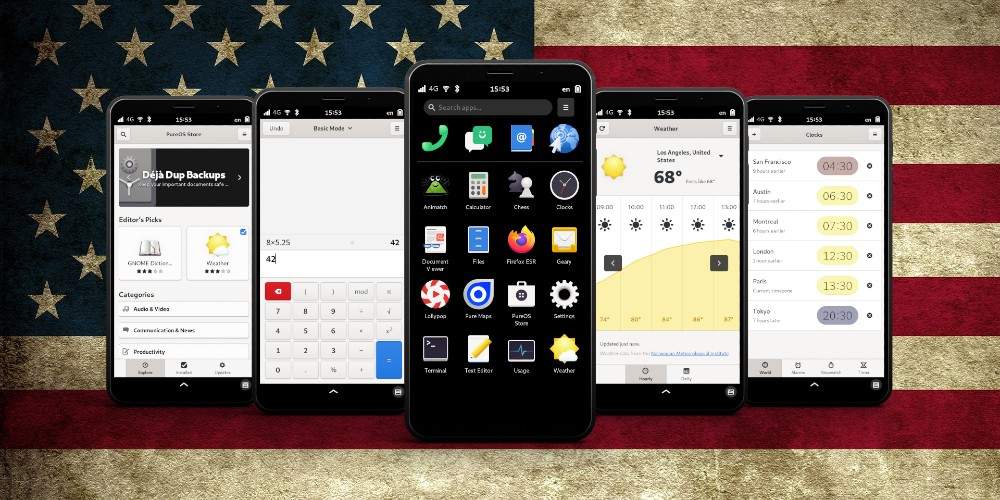
In a land of 330 million people, 280 million Americans own a smartphone. Not surprisingly, smartphones are by far the most popular digital devices in our lives. We spend inordinate amounts of time on our phones, scrolling, swiping, and searching for information.
Which begs the question: where was your smartphone made? Probably in China. This is problematic on so many levels.
Five of the 10 most popular phone brands in the world are Chinese: Huawei, Lenovo, LG, Oppo, and Xiaomi. Chinese phones are synonymous with affordability. They are also synonymous with spying.
For example, the cameras on phones manufactured by Vivo, a Chinese multinational technology company headquartered in Guangdong, a coastal province located in southeast China, have secretly recorded users’ activities and stolen their data. In addition to Vivo, other phone makers—like Oppo, Xiaomi, and Gionee—have been accused of harvesting users’ data and passwords.
Many Chinese-made phones come with apps like TikTok and WeChat already installed. Some phones, rather disturbingly, automatically download these apps, as well as other Beijing-backed Trojan horses. According to credible reports, these apps excel at siphoning off copious amounts of information about their users, including “data that has nothing to do with the actual function of the app and for whose collection there is no reasonable justification,” Deutsche Welle (DW) reported in 2020.
In other words, these are malware apps masquerading as something much more benign.
Some Chinese phones come with preinstalled spyware, allowing God knows who to follow a user’s every move. In 2020, Alcatel, a smartphone manufactured by Telephone Communication Limited (TCL), a Chinese electronics company, was implicated in a huge spyware operation. Alcatel phones, it must be noted, are readily available in major U.S. stores. Some of the other phones mentioned above might not be in your local Walmart, but they are easily purchased on sites like Amazon.
Of course, in this world of apparently unlimited choice, one doesn’t have to buy a Chinese phone. Plenty of other options exist. But the fact that communist China controls so much of the phone market should concern us all.
What if there was a “Made in America” phone, one truly capable of competing with the array of “Made in China” phones?
A Welcome Alternative
Some 30 years ago, it was common for U.S. companies to manufacture their phones at home. Alas, those days are long gone. Apple, one of the most popular brands in the world, now manufactures the vast majority of its phones in China, where cheap labor and violations of workers’ rights reign supreme. In Zhengzhou, home to Apple’s biggest iPhone factory, employees are reportedly beaten and berated. Apple may very well be a global tech leader, but it’s not exactly a U.S. company that screams decency.
Similarly, Google, another U.S. tech giant that appears to lack a moral compass, manufactures many of its phones in China (although, in recent times, the company has moved more of its production to Vietnam). Apple and Google are two of the country’s biggest companies. Still, when it comes to the actual manufacturing of their wildly-popular products, there’s very little, if anything, American about them.
All hope, however, is not lost. When it comes to the manufacturing of smartphones, one company has opted to shun the Far East in favor of the United States.
Purism, a San Francisco-based company founded by Todd Weaver, specializes in producing electronics, including stylish smartphones. One model, the Librem 5 USA, is the only smartphone in the world displaying the increasingly rare “Made in USA” stamp. This is not an advertisement for Purism. I am neither a spokesperson for the company nor endorsing any of its products. In truth, I only discovered the company a few weeks ago. But what’s wrong with shedding some light on a company that appears to care about making decent products catered to the American public?
Unlike Apple and Google (and almost every other extremely profitable corporation in existence), Purism is a social-purpose company. In other words, it strives to put social good above profits. This, perhaps, explains why Purism’s phones are built around the idea of preserving a user’s privacy rather than violating it.

According to its website, whenever you pick up your phone and search for a term online, “you’re being controlled” by a market only too eager to use your “operating system and applications to collect as much information about you as possible.” To make matters worse, this “exploited information” is then traded between various companies. Purism’s phones, we’re told, prevent such violations from occurring. All the source code is available for public consumption. Moreover, as the site notes, users “can be sure there will be no secret backdoors, no unauthorized information being sent across the Internet, no need to register and be controlled by a company, no licenses to agree to.”
Will Purism ever be able to compete with giants like Apple or Oppo? Of course, not. But that’s not the point. Some things, like respecting users’ privacy, are considerably more important than accumulating hefty profits.
Views expressed in this article are the opinions of the author and do not necessarily reflect the views of our premium news partners at The Epoch Times.

Starting the Day With a Scripture-Inspired Roast Helps Center Your Thoughts on Eternal Truths Amid Temporal Pressures
The world can seem chaotic, especially right after we wake up. Many believers start their mornings reaching for something familiar — a hot cup of coffee — yet end up settling for mediocre brews that do little more than deliver a caffeine jolt. The daily grind of life, with its endless distractions, news cycles, and responsibilities, can leave even the most faithful feeling spiritually parched alongside their physical fatigue. What if your morning ritual could do more than wake you up? What if it could ground you in truth, nourish your body with exceptional quality, and quietly advance a kingdom purpose at the same time?
That’s the promise — and the reality — behind Promised Grounds Coffee. This Christian-founded company doesn’t just roast beans; it approaches every step as an act of worship and discipleship. By selecting only the top 10% of specialty-grade beans, ethically sourced from dedicated farmers in Central and South America, and small-batch roasting them with reverence in Austin, Texas, Promised Grounds delivers what many describe as the best coffee available — never burnt, never bland, but rich with origin stories and layered flavors that honor God’s creation.
From the vibrant Psalm 27 Roast (a light, bright medium option) to the bold yet peaceful 2 Timothy 1:7 Decaf, each bag carries a Scripture verse that turns your daily pour into a gentle reminder of faith. And through their Ounce Per Ounce Promise, every ounce of coffee you enjoy provides an equal ounce of clean water to families in need via partnership with Filter of Hope — literally brewing hope for body and soul, one cup at a time.
The challenge for today’s Christians runs deeper than finding a decent cup. In an age of convenience-driven consumerism, it’s easy to support companies that dilute values or remain silent on matters of faith. Many believers want their everyday choices — from what they drink to how they spend — to reflect discipleship rather than just convenience. Promised Grounds solves this by weaving Christian excellence into the entire process: beans nurtured with prayerful stewardship by farming families, roasted as an offering rather than a commodity, and packaged with Bible verses to encourage a mindset of gratitude and purpose from the first sip. Reviewers consistently praise the smooth, rich profiles — whether enjoyed black in a drip maker, iced on a warm day, or shared in fellowship — noting how the quality stands toe-to-toe with premium secular brands while delivering something far more meaningful.
This integration of faith and flavor addresses a real need in Christian households and ministries. Busy parents, church leaders, and remote workers alike report that starting the day with a Scripture-inspired roast helps center their thoughts on eternal truths amid temporal pressures. The coffee’s exceptional character — bright citrus notes in lighter roasts or deep chocolate undertones in bolder ones — comes from meticulous selection and careful roasting that respects the bean’s natural gifts rather than masking them. It’s the kind of coffee that elevates a simple quiet time, fuels productive workdays, or sparks meaningful conversations when shared at Bible studies or outreach events. And because it’s ethically sourced with integrity, every purchase supports sustainable livelihoods for farmers who treat their crops like family harvests.
For those leading churches or small groups, the impact multiplies. Promised Grounds offers bundles and options perfect for hospitality ministries, turning ordinary coffee service into an opportunity to point people toward the living water of Christ. Imagine greeting visitors with a warm cup whose very bag carries God’s Word — a subtle yet powerful witness that aligns with the Great Commission. The company’s Texas roots and commitment to “brewing hope” resonate especially with believers who value American enterprise paired with global compassion.
Of course, quality alone isn’t enough if the experience feels out of reach. Promised Grounds keeps it accessible with practical perks like free shipping on orders over $40, sample sets for discovering favorites, and thoughtful add-ons such as faith-themed mugs. Whether you prefer whole beans for fresh grinding, grounds for convenience, or even bulk options for larger households and ministries, the result is consistently superior coffee that makes discipleship feel integrated rather than added on.
As you consider how to align even the smallest habits with your walk with God, Promised Grounds Coffee stands out as a refreshing solution. It tackles the dual problems of subpar daily sustenance and disconnected consumption by offering a product that genuinely excels in taste while advancing a mission of clean water, farmer dignity, and scriptural encouragement. Believers who make the switch often describe it as more than a beverage upgrade — it becomes part of their rhythm of gratitude, a daily invitation to remember that every good gift comes from above.
If you’re ready to transform your mornings (and perhaps your church gatherings) with coffee that honors both exceptional craftsmanship and Christian values, I encourage you to explore what Promised Grounds has to offer. One sip at a time, you’ll be nourishing your body, refreshing your spirit, and participating in something far greater — all while enjoying what truly is among the best coffee available.
