

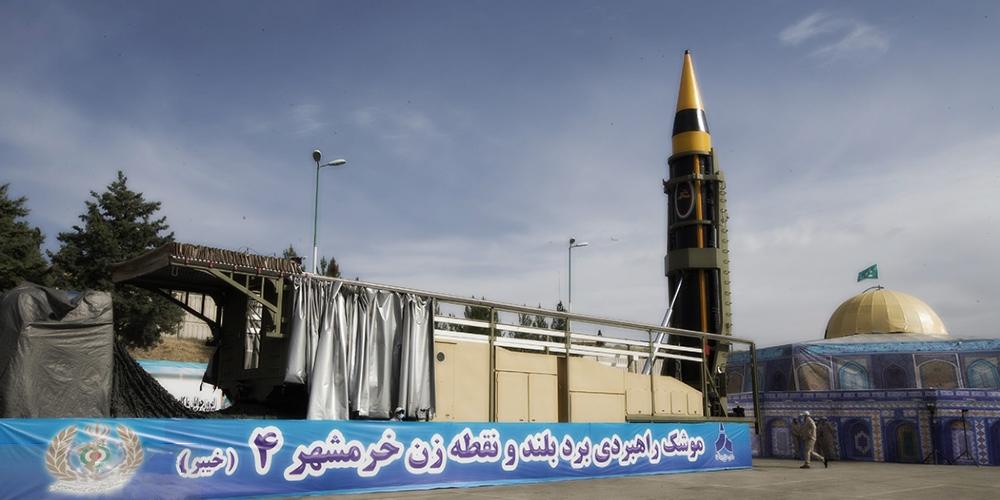
(End of the American Dream)—War is at the door. On Friday, last ditch talks will be held in Oman, but nobody is really expecting anything to come out of them. The U.S. wants Iran to end all nuclear enrichment, limit the range of their missiles, end the funding of proxies throughout the Middle East, and stop killing protesters. Needless to say, the Iranians are not going to agree to any of that. So it appears that a major conflict is about to erupt, and it is going to look much different from the 12 Day War. The Iranians have been feverishly rebuilding their missile arsenal, and now it is larger and more sophisticated than ever before. In fact, they just publicly unveiled the Khorramshahr-4 which is the “most advanced long-range ballistic missile” that they possess…
Iran’s state-run Press TV announced that Iran has deployed its “most advanced long-range ballistic missile,” the Khorramshahr 4, in one of the Islamic Revolutionary Guard Corps’s (IRGC) underground “missile cities” on Thursday.
The deployment of the missile comes as the IRGC shifts from a defensive position to an offensive position, Press TV said, adding that the pivot “carries a clear message to regional and extra-regional adversaries.”
The Khorramshahr-4 ballistic missile is a very serious weapon.
It has a range of approximately 2,000 kilometers, and it can travel at speeds that are absolutely blistering…
During the unveiling of a new missile city operated by the Aerospace Force of Iran’s Islamic Revolutionary Guard Corps (IRGC) on Tuesday night, the Khorramshahr-4 ballistic missile was seen among the operational systems deployed at the site—an event observers describe as signaling a new phase in Iran’s deterrence strategy.
According to the information released, the Khorramshahr-4 has a range of about 2,000 kilometers and carries a 1,500-kilogram warhead, making it one of Iran’s heaviest operational ballistic missiles. Its reported accuracy is around 30 meters, while its speed reaches up to Mach 16 outside the atmosphere and Mach 8 within it, significantly reducing the reaction time of enemy air-defense systems.
The missile is equipped with a maneuverable reentry vehicle (MaRV), mid-course guidance, a reduced radar cross-section, and high resistance to electronic warfare. Analysts say this combination of features substantially enhances its penetration capability against missile-defense networks.
Older Iranian missiles were relatively easy for our anti-missile systems to intercept.
But the Khorramshahr-4 is a completely different animal.
We are being told that it is so fast that it can travel from Iran to Israel in about 10 minutes…
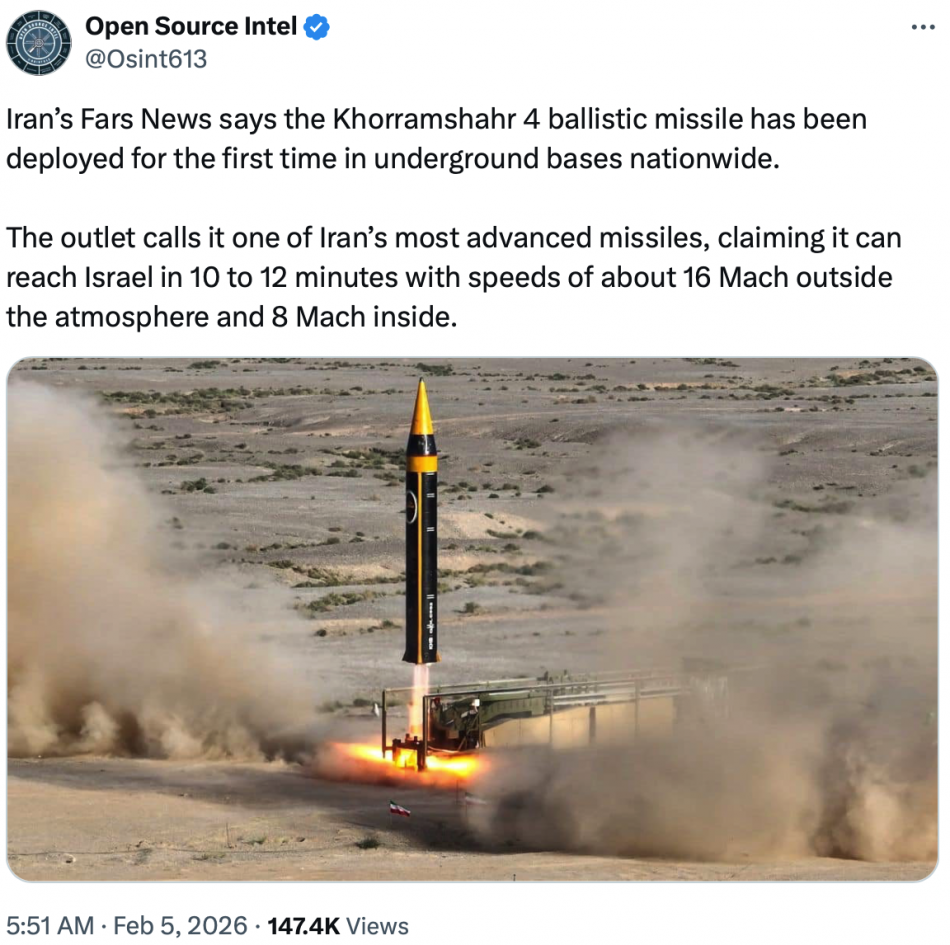
If Khorramshahr-4 missiles are launched at major Israeli cities, they will do a tremendous amount of damage even if they are just carrying conventional warheads.
But what if they are actually carrying something else instead?
Iran International reported late last year that the IRGC was “developing biological and chemical warheads for the country’s long-range ballistic missiles”…
Iran’s Islamic Revolutionary Guard Corps (IRGC) is developing biological and chemical warheads for the country’s long-range ballistic missiles, informed military sources told Iran International on Sunday.
The IRGC Aerospace Force is working on the unconventional warheads for ballistic missiles as it transfers missile launchers to eastern regions of Iran, the sources said.
The sources, who requested anonymity due to the sensitivity of the matter, said these activities have accelerated in recent months and are being pursued amid rising regional tensions and Tehran’s concerns about the possibility of another direct confrontation with Israel and the United States.
If biological or chemical weapons are used against major Israeli cities, what do you think the response will be?
It doesn’t take much imagination to figure that one out.
There is also the possibility that the Iranians could use their long-range ballistic missiles to deliver dirty bombs.
The regime in Tehran understands that their survival will be on the line if a major war breaks out, and so they will likely throw everything that they have got in their arsenal at us.
In addition to fearsome new missiles, it is also being reported that China has given Iran highly advanced radar systems that can actually track stealth aircraft…

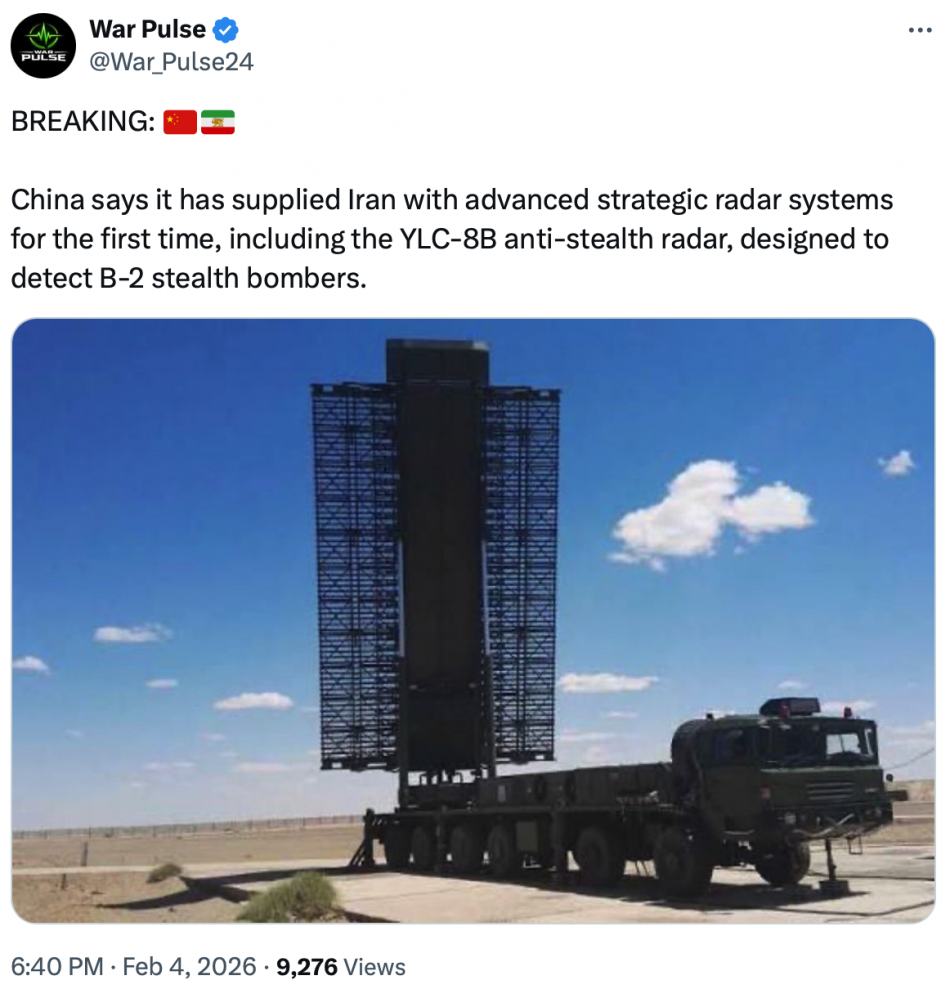
A war with Iran would not be easy.
I hope that those that are running our military understand this.
On Thursday, the White House once again warned that war is an option if negotiations fail…
The White House warned on Thursday that Washington has other options if diplomacy with Iran fails.
“While these negotiations are taking place, I would remind the Iranian regime that the President has many options at his disposal, aside from diplomacy, as the Commander in Chief of the most powerful military in the history of the world,” Press Secretary Karoline Leavitt said.
I think that the Trump administration realizes that the negotiations aren’t going anywhere.
I think that they are taking part in these talks to show that they tried to do things peacefully.
Ultimately, what the White House wants to do is to solve the Iran problem for good.

This is something that Vice-President JD Vance talked about during a recent interview…
‘But fundamentally, three years down the road, the president is likely, as he said, to leave the Oval Office. Who is the next president? Maybe you get a crazy person in there who doesn’t care about Iran having a nuclear weapon.’ The Vice President said that Trump wants ‘to create the long term situation that ensures and confirms Iran doesn’t get a nuclear weapon.’
The only way to guarantee that Iran will not get a nuclear weapon is to bring down the regime in Tehran.
If the Trump administration wants to make that happen, it will have to move fast.
Because if the Democrats take control of Congress in the mid-term elections, President Trump will have a lot less flexibility in 2027 and 2028.
But will rushing to attack Iran cause a major regional conflict to erupt?
This is something that Iranian leaders have warned about, and now Hezbollah has issued a similar warning…
The political wing of Hezbollah in Lebanon’s parliament warned that any US attack on Iran would trigger a wider regional war.
“Iran’s firm and resilient stance will enable it to withstand any potential aggression,” the Loyalty to the Resistance bloc said, adding that if the United States launched a war, it would be unable to control the consequences and the conflict would engulf the Middle East.
Speaking of Hezbollah, Israel just conducted another wave of airstrikes on a number of highly sensitive targets throughout Lebanon…
Several underground Hezbollah weapon storage sites were hit in a wave of Israeli airstrikes across Lebanon, the IDF says.
According to the IDF, the targeted tunnel shafts were located at Hezbollah sites in the Marjaayoun area of southern Lebanon, near Baalbek in the eastern Beqaa Valley, and in the Hermel area of northern Lebanon.
The military says that in recent months it has identified Hezbollah activity at the sites, which it says “constitutes a violation of the understandings between Israel and Lebanon.”
Everything that has happened in the Middle East for the last several decades has been building up to this.
Now a final showdown with Iran is looming, and once the missiles start flying there will be no turning back.
Interestingly, Shia Islam teaches that the Mahdi will reappear during a great war.
So the Iranians may actually be looking forward to the coming conflict because they may be convinced that it will cause the 12th Imam to show up.
The Iranians see the world far differently than we do, and we should not underestimate what they are capable of doing.
Michael’s new book entitled “10 Prophetic Events That Are Coming Next” is available in paperback and for the Kindle on Amazon.com, and you can subscribe to his Substack newsletter at michaeltsnyder.substack.com.

Starting the Day With a Scripture-Inspired Roast Helps Center Your Thoughts on Eternal Truths Amid Temporal Pressures
The world can seem chaotic, especially right after we wake up. Many believers start their mornings reaching for something familiar — a hot cup of coffee — yet end up settling for mediocre brews that do little more than deliver a caffeine jolt. The daily grind of life, with its endless distractions, news cycles, and responsibilities, can leave even the most faithful feeling spiritually parched alongside their physical fatigue. What if your morning ritual could do more than wake you up? What if it could ground you in truth, nourish your body with exceptional quality, and quietly advance a kingdom purpose at the same time?
That’s the promise — and the reality — behind Promised Grounds Coffee. This Christian-founded company doesn’t just roast beans; it approaches every step as an act of worship and discipleship. By selecting only the top 10% of specialty-grade beans, ethically sourced from dedicated farmers in Central and South America, and small-batch roasting them with reverence in Austin, Texas, Promised Grounds delivers what many describe as the best coffee available — never burnt, never bland, but rich with origin stories and layered flavors that honor God’s creation.
From the vibrant Psalm 27 Roast (a light, bright medium option) to the bold yet peaceful 2 Timothy 1:7 Decaf, each bag carries a Scripture verse that turns your daily pour into a gentle reminder of faith. And through their Ounce Per Ounce Promise, every ounce of coffee you enjoy provides an equal ounce of clean water to families in need via partnership with Filter of Hope — literally brewing hope for body and soul, one cup at a time.
The challenge for today’s Christians runs deeper than finding a decent cup. In an age of convenience-driven consumerism, it’s easy to support companies that dilute values or remain silent on matters of faith. Many believers want their everyday choices — from what they drink to how they spend — to reflect discipleship rather than just convenience. Promised Grounds solves this by weaving Christian excellence into the entire process: beans nurtured with prayerful stewardship by farming families, roasted as an offering rather than a commodity, and packaged with Bible verses to encourage a mindset of gratitude and purpose from the first sip. Reviewers consistently praise the smooth, rich profiles — whether enjoyed black in a drip maker, iced on a warm day, or shared in fellowship — noting how the quality stands toe-to-toe with premium secular brands while delivering something far more meaningful.
This integration of faith and flavor addresses a real need in Christian households and ministries. Busy parents, church leaders, and remote workers alike report that starting the day with a Scripture-inspired roast helps center their thoughts on eternal truths amid temporal pressures. The coffee’s exceptional character — bright citrus notes in lighter roasts or deep chocolate undertones in bolder ones — comes from meticulous selection and careful roasting that respects the bean’s natural gifts rather than masking them. It’s the kind of coffee that elevates a simple quiet time, fuels productive workdays, or sparks meaningful conversations when shared at Bible studies or outreach events. And because it’s ethically sourced with integrity, every purchase supports sustainable livelihoods for farmers who treat their crops like family harvests.
For those leading churches or small groups, the impact multiplies. Promised Grounds offers bundles and options perfect for hospitality ministries, turning ordinary coffee service into an opportunity to point people toward the living water of Christ. Imagine greeting visitors with a warm cup whose very bag carries God’s Word — a subtle yet powerful witness that aligns with the Great Commission. The company’s Texas roots and commitment to “brewing hope” resonate especially with believers who value American enterprise paired with global compassion.
Of course, quality alone isn’t enough if the experience feels out of reach. Promised Grounds keeps it accessible with practical perks like free shipping on orders over $40, sample sets for discovering favorites, and thoughtful add-ons such as faith-themed mugs. Whether you prefer whole beans for fresh grinding, grounds for convenience, or even bulk options for larger households and ministries, the result is consistently superior coffee that makes discipleship feel integrated rather than added on.
As you consider how to align even the smallest habits with your walk with God, Promised Grounds Coffee stands out as a refreshing solution. It tackles the dual problems of subpar daily sustenance and disconnected consumption by offering a product that genuinely excels in taste while advancing a mission of clean water, farmer dignity, and scriptural encouragement. Believers who make the switch often describe it as more than a beverage upgrade — it becomes part of their rhythm of gratitude, a daily invitation to remember that every good gift comes from above.
If you’re ready to transform your mornings (and perhaps your church gatherings) with coffee that honors both exceptional craftsmanship and Christian values, I encourage you to explore what Promised Grounds has to offer. One sip at a time, you’ll be nourishing your body, refreshing your spirit, and participating in something far greater — all while enjoying what truly is among the best coffee available.
