

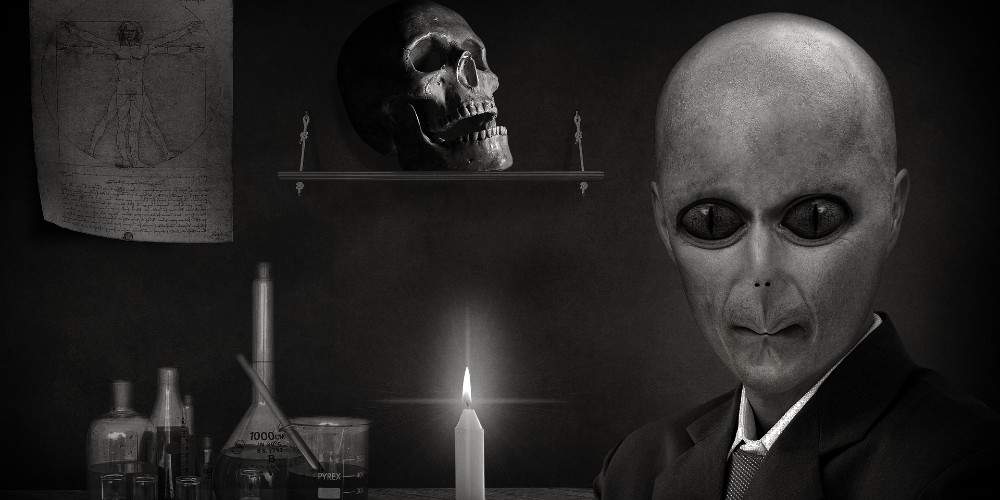
Conspiracy theories. What to some is a sign of critical thinking is, to others, a sign of dangerous insubordination.
I was taught by my father that a good argument can stand up to criticism and that finding someone who disagreed was a fine way to test your theory. I’ve never been too bothered when folks disagree with me. In fact, I’m eager to know why. I want to learn whether or not I’m missing something. But these days, it seems that I’m in the minority.
The “danger” of conspiracy theories
The term has long been used in a derogatory fashion to belittle the ideas of a person who doesn’t necessarily accept that everything can be taken at face value. These days, it’s used to denote a train of thought that is downright dangerous, even an existential threat to civil society.
What’s everyone so afraid of?
Normies – folks who aren’t big questions of the status quo – used to just shake their heads and smile at the “quirky” conspiracy theorist in their life. They considered it a harmless past-time, an eccentricity.
However, now we have the media breathlessly warning people of the innate deadly danger of conspiracy theories and the people who espouse them. Outright FEAR is being stoked. Let’s take a closer look.
The FBI warning
Back in 2019, the FBI said that conspiracy theories posed a domestic terrorism threat:
“The FBI assesses anti-government, identity based, and fringe political conspiracy theories very likely motivate some domestic extremists, wholly or in part, to commit criminal and sometimes violent activity,” the document said. “The FBI further assesses in some cases these conspiracy theories very likely encourage the targeting of specific people, places, and organizations, thereby increasing the likelihood of violence against these targets.”
The document continued to say that the bureau reached its conclusion “with high confidence” and based on information it obtained from other federal agencies, open source information, court documents, FBI investigations, and human sources.
Yep, this is the same FBI whose own documents concluded that they had investigated the Trump campaign without justification. The one whose director was caught violating DOJ policies and breaking protocol in a lackluster investigation of Hillary Clinton’s emails.
Pardon me if I’m not too worried about what the FBI thinks.
The academic warning
Then we have the people who consider themselves smarter than the rest of us: the academics. The website “The Conversation” boasts that their content “is written by university scholars and researchers with deep expertise in their subjects, sharing their knowledge in their own words.”
So it must be true, right?
Anyway, a postdoctoral research fellow in philosophy warns us of the “dangers” of conspiracy theories. He kindly dumbs it down for the peons by comparing it to “the floor is lava.”
When a child declares that “the floor is lava,” few if any believe the declaration. But that child, and others, begin to act as if the declaration were true. Those who do may clamber onto furniture, and repeat the declaration to others who enter the space. Some children play just for fun, some play to show off their climbing and jumping skills, and some play to appease the child who initiated the game.
Some kids quickly tire of the game and wish to stop playing, but like or respect the child who initiated the game, and don’t want to upset that person by stopping. As the game progresses, some take it too seriously. Furniture is damaged, and some get injured while attempting to leap from one raised surface to another. The lava is fake, but real things get broken.
More seriously, when Donald Trump claimed that the 2020 presidential election was “rigged,” some officials and ordinary citizens acted accordingly. Whether out of sincere belief, partisanship, loyalty to Trump or financial opportunism, many Americans behaved as if the 2020 election was unfairly decided.
Some people acting as if the election conspiracy theory were true assembled in Washington, D.C., some stormed the Capitol building and, behind the scenes, some developed a scheme to submit fake slates of electors supporting Trump’s reelection despite his loss at the ballot box. The people involved in these activities could count on the support of others who endorsed the rigged election claim, even if these endorsements were largely insincere.
The costs of acting as if the 2020 election were rigged are no doubt greater than those for acting as if the floor is lava. The costs of acting as if the 2020 election were rigged led to millions of dollars worth of damage to the Capitol building, led to hundreds of arrests for Capitol rioters, led to multiple deaths and imperiled American democracy.
My goodness, that’s a lot of rhetoric, isn’t it?
I guess he missed that documentary 2000 Mules, huh? Of course, a journalist on NPR said that 2000 Mules is a “wild tale” and a “conspiracy theory” with “absolutely no evidence.” Heck, it’s downright “extremism.”

But the film is the latest in a long line of movies that use the tropes and signifiers of documentaries to gain credibility. In recent years, documentary style films about the 2020 election, the COVID-19 pandemic and vaccines have spread conspiracy theories and recycled debunked lies.
“Documentaries have been used for decades to try to make bad actors and folks who are trying to push conspiracies or push disinformation or push a specific political agenda look more professional, look glamorous, look like something that you can believe,” said Jiore Craig, head of elections and digital integrity at the Institute for Strategic Dialogue, which tracks online extremism.
My question is: what makes their conspiracy theory more valid than the original conspiracy theory?
The “assault on democracy” warning
The Economist interviewed Nancy Rosenblum and Russell Muirhead about the “dangers” of conspiracy theories. They are the co-authors of the book, A Lot of People Are Saying: The New Conspiracism and the Assault on Democracy. Nancy and Russell call it “conspiracy without the theory,” claiming it’s all nothing more than baseless accusations and somebody ought to do something about it. (Emphasis mine.)
The new media—social media, of course, but even basic things like internet message boards—challenge the traditional gatekeeping function of editors and producers. Today anyone can say anything to everyone in the world instantly and for free. And because validation of conspiracy claims takes the form of repetition and assent, even the most casual “likes” and “retweets” give authority to senseless, destructive charges (“a lot of people are saying”). We are seeing the political effects of this change and one of the first things we’re seeing is the spread of a politically malignant form of conspiracy without the theory.
Can the same technology that disseminates charges like “fake news” or the “deep state” also disempower it? Can political representatives and citizens who grasp the effects of conspiracism, the way it delegitimises democratic institutions, exile it again to the fringes of political life? No one has figured out how to do this yet, short of some form of public- or corporate-censorship of egregious conspiracy-entrepreneurs like Alex Jones or, what is now unthinkable, censoring irresponsible political officials who endorse conspiracist claims.
Nancy and Russell believe we need to defer to the scholars.
The counter-force comes from the authority of knowledge-producing institutions (that is, courts, expert-staffed agencies, research universities) on one side, and democratic common sense on the other. Wherever conspiracism is reshaping public life, two preventatives are vital: to defend the integrity of knowledge-producing institutions and bolster confidence in the ballast of common sense.
After all, it’s only “rational.”
Interestingly, painting women as irrational and hysterical was a tool that was used to oppress them for centuries. But I guess it’s A-OK to do that to political opponents.
(How do you starve the beast? Check out our free QUICKSTART Guide to learn more.)

The thing is, conspiracy theories are often more valid than the “news.”
When you read those arguments in a bubble, they sound perfectly reasonable. It’s only when you look at them through the lens of the things going on in the United States, and heck, the world, that you see how stifling it is.
For a decade, I’ve written about “conspiracy theories.” I’ve shared information and suggested that while it might seem innocent at first, it’s a slippery slope. Then people call me crazy, and then the next thing you know, we’ve slid down that slippery slope, and when we’re in a pile at the bottom, nobody steps up and says, “Whoops, I guess you were right.
Instead, they memory-hole (thanks, Orwell) their initial (incorrect) arguments and gaslight us, acting as though they never disagreed with us in the first place.
That’s why I put together a PDF book this week with many of the “conspiracy theories” I’ve written about over the past ten years. The Conspiracy Files: “Crazy “Theories That Turned Out to Be TRUE is a limited run – the book will only be available this week. It discusses propaganda, censorship, Covid-19, the Ukraine war, the election, the Great Reset, dangerous technology, and much more. It’s 543 pages, and I think, if you are a conspiracy theorist like me, you’ll find it very interesting how many of these “crazy conspiracy theories” turned out to be true. You can get your copy here, and it’s name-your-price.
Repeatedly, we’ve seen our theories and opinions publicly mocked, the purveyors of those opinions defunded and shunned, and the people who believe them belittled and degraded. Sure, some conspiracy theories are truly nuts – but the beauty of free speech means that we can decide for ourselves through research and reason what we believe to be the most accurate portrayal of the facts.
If you think about the scientific method, it all starts with a theory. Then the person tests it and holds it up for examination to see whether or not it’s true. Why are conversations looked at differently? I should be able to provide my evidence and converse with someone who provides evidence to the contrary. Nobody should be cast as a villain for that, but it seems rather villainous to silence people for daring to believe something other than what the media tells us is true, without question.
Of course, I guess us thinking for ourselves instead of believing what we’re spoon fed is what makes conspiracy theories so darned dangerous.
(Want uninterrupted access to The Organic Prepper? Check out our paid-subscription newsletter.)
What about left-wing conspiracy theories?
The argument that conspiracy theories are dangerous often overlooks left-wing conspiracy theories. All of the things below have been proven objectively WRONG but nobody seems to think these are dangerous.
- That conservative kid from Covington was disrespectful to the Native American guy
- Donald Trump colluded with the Russians
- The Covid pandemic started in a wet market because someone ate a bad bat
- Hunter Biden’s laptop didn’t exist
- Covid vaccines will keep you from getting Covid
There are a whole bunch more and most of them are about President Trump. Whether you love him or hate him, he didn’t say that neo-Nazis were very fine people and he did not tell folks to drink bleach to cure Covid.
Nobody in the mainstream media is running around calling these attacks on the former President a threat to democracy. Nobody in academia is calling the nonsense about Covid that destroyed our very economy dangerous. In fact, you have to really dig to find out anything about those subjects online and a lot of folks still believe them.
I’d say that there was a coverup of left-wing conspiracy theories but then I’d sound like a crazy conspiracy theorist.
What are your thoughts on conspiracy theories?
I’ll proudly wear the tin foil. I refuse to just “absorb” the opinions of the mainstream media. Conspiracy theories give me another perspective, another way of looking at the world. And it’s a way I’m free to take or leave. Just like I should also be free to take or leave what passes for “news” these days.
I’m not saying you need to be delusional, but there’s absolutely nothing wrong with questioning things, coming up with a theory, and having a conversation about it. Obviously, you shouldn’t use those questions to harm others. Folks who act in violence based on a conspiracy actually are crazy, regardless of whether that is a left-wing or right-wing conspiracy theory. There will always be crazy people out there. But most people don’t do that. They just discuss it and ask questions.
Long live the conspiracy theory and the freedom to discuss things.
Do you believe in conspiracy theories? Are you “dangerous?” Do you think those conspiracy theories are something that should be silenced? Let’s talk about it in the comments.
About the Author
Daisy Luther is a coffee-swigging, adventure-seeking, globe-trotting blogger. She is the founder and publisher of three websites. 1) The Organic Prepper, which is about current events, preparedness, self-reliance, and the pursuit of liberty; 2) The Frugalite, a website with thrifty tips and solutions to help people get a handle on their personal finances without feeling deprived; and 3) PreppersDailyNews.com, an aggregate site where you can find links to all the most important news for those who wish to be prepared. Her work is widely republished across alternative media and she has appeared in many interviews.
Daisy is the best-selling author of 5 traditionally published books, 12 self-published books, and runs a small digital publishing company with PDF guides, printables, and courses at SelfRelianceand Survival.com You can find her on Facebook, Pinterest, Gab, MeWe, Parler, Instagram, and Twitter.
Article cross-posted from The Organic Prepper.
Two Storms, One Harvest

Every food crisis in living memory has been a one-shock event. The 2008 price spike was a commodity bubble. The 2020 shortages were a logistics failure. The 2022 grain scare was a war on one exporter’s ports. Each time, the system bent, adjusted, and recovered, and each time the experts assured us afterward that global markets are simply too big and too diversified to fail.
What nobody in Washington seems eager to discuss is that 2026 is shaping up to be something the modern food system has never actually faced. Two independent shocks, one climatic and one geopolitical, are converging on the same harvest cycle at the same time. Not sequentially. Simultaneously.
Start with the weather. The Pacific Ocean is currently building toward what forecasters now openly call a record event. NOAA’s Climate Prediction Center puts the odds of at least a strong El Niño near 88 percent, with roughly two in three odds it reaches “very strong” status, the tier reserved for perhaps three or four events in the entire satellite era. Every major global model now projects a median peak in Super El Niño territory, and most of them project it exceeding the 2015-16 event, which until now held the modern record. Sea surface anomalies were already brushing the super threshold in mid-July, months before these events normally peak. The atmosphere has already shifted into El Niño mode, and the event is forecast to crest in late fall and early winter.
This is not about “climate change.” It’s about the standard cycles of weather, and the cycle we’re currently in is one that has likely devastated societies in the past. We’re better prepared as a society today, but not all Americans are equally prepared.
Serious households have started doing the quiet math on their own. Grocery bills tell part of the story, and the forecast maps tell the rest, which is why long-term food storage has moved from fringe hobby to mainstream line item in the family budget, with established suppliers like Heaven’s Harvest seeing demand from people who five years ago would have rolled their eyes at the idea. That instinct is not paranoia. It is pattern recognition, and the pattern is worth walking through carefully.
Editor’s Note: Heaven’s Harvest IS a sponsor, but the warnings of this article are real and would be written even if we didn’t have a survival food sponsor. With that said, those who take advantage of what they offer can use promo code “Patriot” for 15% off.
The Fertilizer Clock Is Already Running
While the Pacific warms, the second shock has been unfolding in the Strait of Hormuz. The conflict with Iran turned the world’s most important energy chokepoint into a contested waterway, and the consequences reach far beyond the gas pump. Roughly a third of global fertilizer trade moves through Hormuz, and the disruption sent urea prices up 86 percent year over year by March, with a 53 percent jump in a single month.
The World Bank projects energy prices rising about 24 percent in 2026 and fertilizer about 31 percent. By its own accounting, fertilizer prices ran 35 percent higher in the first five months of this year than the same period last year.
Here is the mechanism the nightly news will not explain. Fertilizer is not a grocery item. It is a time-delayed input. The nitrogen a farmer in Iowa or Punjab could not afford to apply this spring does not show up as a problem this spring. It shows up as a thinner harvest six to twelve months later.
The World Bank’s own food security brief concedes that the effects of reduced applications earlier this season “are likely to become visible only later in harvest outcomes.” Translate that from institutional language into plain English and it means this. The damage is already done, it is already in the ground, and we are simply waiting for it to arrive on the shelf.
Now check the calendar. Six to twelve months from the spring planting season lands us squarely in late 2026 and early 2027. Which is precisely when the strongest El Niño in the instrumental record is forecast to peak, bringing its signature droughts to Southeast Asia, Australia, southern Africa, northern Brazil, and South Asia, the very regions that grow the world’s rice, sugar, and oilseeds.
The World Bank warns openly that a strong El Niño “could disrupt multiple crop belts simultaneously” on top of the conflict-driven input costs. Their baseline projection assumes the Middle East disruptions ease by autumn. What in the last two years of Middle East history suggests that assumption is safe?
The System Has No Slack Left
The comfortable answer is that global markets always adjust. But adjustment requires slack, and the slack is gone. Global cereal production is expected to decline from last year’s records even before El Niño does its work. The UN World Food Programme, hardly a den of right-wing preppers, is calling this the most significant disruption to its supply chains since Covid and the invasion of Ukraine, and its supply chain director put the stakes bluntly.
Today’s supply chain challenges are tomorrow’s hunger crisis.
There is also a political dimension that markets cannot price. When food gets scarce, governments do not behave like economists. They behave like politicians. Export bans, hoarding mandates, and panic buying at the national level turned the modest rice shortfall of 2008 into a global crisis, and analysts are already warning that import-dependent nations are the first dominoes.
The 2015-16 Super El Niño, a far weaker event than what is now forecast, threw tens of millions into food stress across Africa and Asia. This one is projected to be stronger, and it arrives with fertilizer already rationed by price and shipping lanes already contested by missiles.
What Joseph Knew
Scripture does not treat preparation for lean years as faithlessness. It treats it as wisdom delivered in advance to those willing to act on it.
Behold, there come seven years of great plenty throughout all the land of Egypt: And there shall arise after them seven years of famine; and all the plenty shall be forgotten in the land of Egypt.
Joseph did not respond to that warning with a hashtag or a committee. He stored grain during the years of abundance, and when the famine came, Egypt stood while its neighbors begged. The lesson is not that famine is certain. It is that the time to prepare is precisely when preparation still looks optional.
Nobody who filled a pantry in a year of plenty has ever regretted it, and nobody standing in an empty aisle has ever been glad he waited for certainty.
None of this calls for panic, and panic is the enemy of sound judgment anyway. It calls for the same unglamorous prudence our grandparents considered ordinary. Keep some cash margin, know your local growers, and put real food in deep storage while it is cheap and available, because the entire arc of this story is that cheap and available is a closing window.
Families looking for a straightforward place to start can visit Heaven’s Harvest and use promo code Patriot for 15 percent off long-term storable food. The forecasts may yet soften, the strait may yet reopen, and we should pray they do. But hope is a fine thing to hold and a foolish thing to eat.

Oh Daisy, what a great article. Why4LimitedBookRunTho? Print that bad boy onto a hard cover and let it live on in posterity. I don’t buy ebooks, because we refuse ewaste devices for all but essentials like long lasting PC’s, but we still support paper. Forests are where trees, birds, and bees live. The printing press changed the world once, and is standing by to do so again, if only we’d remember to use it. Ebooks will be lost in the data dustbin of history so our position there is we demand paper for meaningful digital pursuits.
More of these news sites like this one could really do well by returning to a paper based subscription model like a zine or mag. We still to this day subscribe to at least a few paper publications we cherish to read and often read at dinner, leave in waiting rooms, etc. All these meaningful well written unique articles. Push them into quarterlies or monthlies, curate best commentary for limited comment prints, and that’s all you need, print it at home, staple it at home, mail it bulk and get more subscribers. That’s the rub with ‘conspiracy theories’, is that they don’t seem tangible to people because they often exist only in the digital realm. It’s exceedingly difficult to get biased people to click new links but you may be suprised to find they’ll willingly digest the exact same information with a more open mind, if the medium of presentation is different.
There is a saying (and there is a really interesting wikipedia page on this actual concept too); “The medium is the message.” The form of communication is as vital to delivering content and messages as the message itself. As digital is saturated with propaganda, it is important to remember the concepts of publish or perish in a literal sense which does not disregard the use of paper. The age of censorship is here and that is due to paperless. Paperless reduction may be responsible for government agencies and massive bureaucracies, but is not a good standard for us individuals seeking meaningful data and lasting data. We’re dealing with proverbial book burning on a massive scale never before seen in human history, it’s just not recognized as such, because it’s a digital sweep.
Yep, I had to do some mental gymnastics to even read some of the trife being pushed these days. People have lost their ability to be critical thinkers. My saying for the past few years has been; ‘Who knew it would be so easy to mind control an entire population, by simply forcing them to watch more television?’ But damnit, this really happened. I’m inclined to agree with the ‘mass formation theory’, (as seen on banned dot video!), and the general concept of Stockholm syndrome. People need snapped out of it. But this is the result of ‘poisonous protectionism’. We are from the government and are here to help. We are really glad to have subscribed to Ron Paul’s Liberty Report on youbozob and finally they’re getting a rumble channel together. We never miss a friday with Chris Rosinni, bash the fed friday. And we watch routinely with Daniel McAdams too. It warms the heart to hear the kids talking about liberty and matters relating to freedom and individual choice. As they say; Good ideas do not require force. Ron’s steadfast logic and simple analysis methods are truly masterful and sophisticated ways to interpret complex data alongside complex often biased intention. Ron is always shaking his head making a sarcastic comment, now I wonder why they would take that position, or do you think they might be getting paid, etc, etc. Clearly, we can know the answer through inference without any further investigation. It’s so obvious, the corruption, the conflicts of interest, the disparity of positions and illogical claims. People really do fall for just about anything these days, if the medium of messaging delivery fits their preconceived world views and narratives.
And that’s how you recognize truth from fiction, discernment. Discernment is a complex advanced logistical skill which many presume they are in possession of, when in fact they are not mentally equipped to actually discern anything. Repeat after me; safe and effective, safe and effective, squaaaak! I seek to bring people into the entry level understanding of discernment with jabs and quips such as; What’s it like to be a parrot in a cage, constantly squacking RED BLUE RED BLUE!? Or; Do you really believe there is no such thing as collusion and racketeering?
People can’t get their minds around the level of systemic ingrained corruption which has captured many societies on earth on such a massive scale, which is why they turn to weak mental gymnastic arguments vainly trying to believe in the inherent good of humanity. To hope beyond hope that all these complex systems being systematically corrupted and mismanaged is just some random calamity of errors based on the human condition.
Because accepting the notion that we are really dealing with criminal enterprises and international influence which has corrupted our entire process, political, judicial, local enforcement, media, education systems, even down to the printed word, and otherwise, is just too much for some people to take. Some people you can help, others are so hopelessly dependent on the system, we can not free them from their mental prison otherwise known as the Matrix. Either the internet is the greatest science fiction story ever told or we should actually be very afraid. But as Author Dent was advised; That impending feeling of doom is actually quite common. The number one rule of the universe is ‘Don’t Panic’.
So long and thanks for all the fish. Too bad that it has come to this. We tried to warn you all but oh dear.
Aluminum Foil! Wear a hat that’s foil lined. In case an alien is inclined, to probe your butt or read your mind. Some day I’ll prove, I’ll prove, I’ll prove, there’s a big conspiracy. Thanks. Cheers.