

(The Epoch Times)—Former President Donald Trump’s reelection to the presidency was welcomed by many business leaders and investors, driving the S&P 500 index up more than 2.5 percent on the day after Election Day, when his victory became apparent.
Many expect the Trump administration to enact lower taxes, lighter regulations, and reverse many signature programs of the Biden administration, including the government-mandated transition from fossil fuel energy to wind and solar, and from gasoline-powered cars and trucks to electric vehicles (EVs).
“I think a lot of CEOs in the country said enough is enough,” Andy Puzder, former chief executive of CKE Restaurants, told The Epoch Times.
“Just look at the stock market on the day after the election and you can see exactly how American CEOs and American businesses felt about Trump winning the presidency.”
Cutting Regulations
Regulatory policy is likely the area where the incoming administration could have the most immediate impact on businesses.
According to an analysis by the American Action Forum (AAF), as of August this year, the Biden administration has handed down 994 new regulatory rules, adding an estimated $1.69 trillion in costs to American businesses. By comparison, during Trump’s first four years in office, his administration wrote 1,084 new rules that mostly eased regulations and reduced costs by $99.9 billion.
“Agencies like the EPA and Department of Energy regularly acknowledge in their cost-benefit analyses how energy efficiency regulations will raise up-front product costs,” AAF director of regulatory policy Dan Goldbeck told The Epoch Times.
A July study by University of Chicago economist Casey Mulligan calculated that the present value of the cost of regulations imposed by the Biden–Harris administration amounted to $47,000 for each American household, while deregulation during the Trump administration reduced costs by nearly $11,000 per household.
The new fuel economy standards set by the Biden administration, for example, are predicted to add $3,400 to the cost of new cars, trucks, and SUVs. The Biden administration similarly imposed tough new emissions restrictions on electric utilities, as well as new efficiency regulations on furnaces, water heaters, central air conditioners, dishwashers, and other household appliances.
Trump, by contrast, pledged during a campaign rally in October to “sign an executive order directing every federal agency to immediately remove every single burdensome regulation driving up the cost of goods.”
Trump has also toyed with appointing Tesla and SpaceX founder Elon Musk to run a newly-proposed Department of Government Efficiency, with the goal of cutting $2 trillion or more from the federal budget.
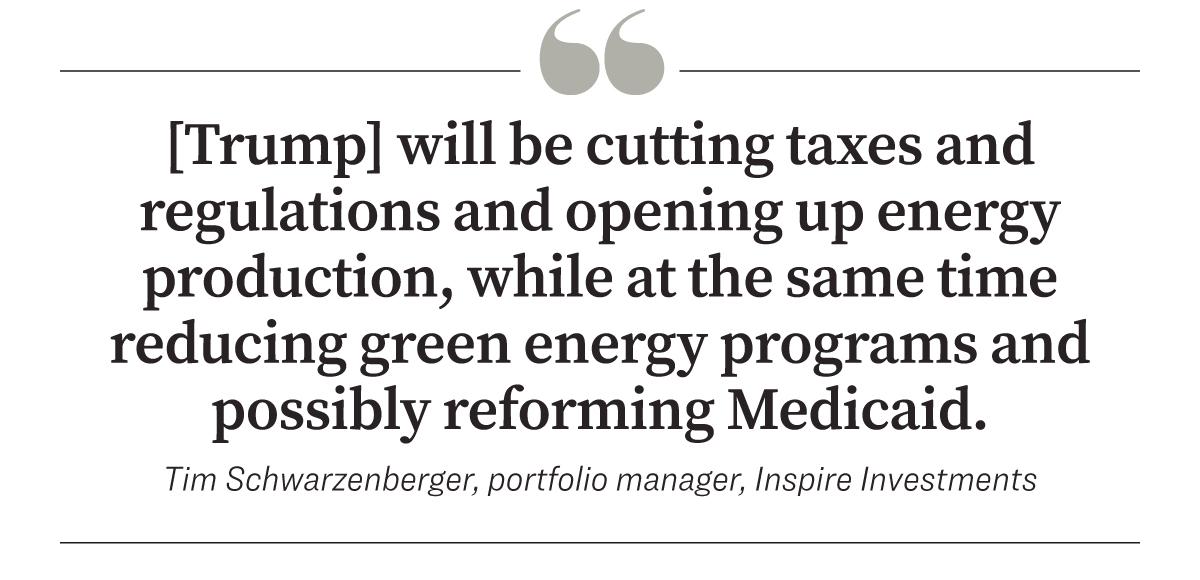
“If what President Trump says about establishing a government efficiency agency with Elon Musk is in fact going to happen, and they have the fortitude to start taking a chainsaw to government bureaucracy, that would be positive for the economy long-term, but there will likely be some added pain over the short-term,” Tim Schwarzenberger, portfolio manager with Inspire Investments, told The Epoch Times.
While Schwarzenberger predicts a recession in early 2025, he says that Trump’s policies “could make that downturn less severe as he will be cutting taxes and regulations and opening up energy production, while at the same time reducing green energy programs and possibly reforming Medicaid.”
Boosting Oil and Gas Production
America’s energy industry will be the sector most heavily impacted by the change in administrations, analysts say.

“Trump is likely to remove regulations and other limits on fracking and other forms of energy production, which would be good for oil drillers, refiners, and sectors that use a lot of energy products: transportation, manufacturing, aviation and others,” Peter Earle, senior economist at the American Institute for Economic Research, told The Epoch Times.
Despite efforts by the Biden administration to restrict drilling on federal lands, U.S. oil and gas production continues to break records. The U.S. Energy Information Administration reported in March that “the United States produced more crude oil than any nation at any time, according to our International Energy Statistics, for the past six years in a row.”
However, given America’s abundance of energy resources, analysts say there is a lot of room to expand domestic production further.
“We’ve got record production of energy, but it’s all happened despite the administration, and on lands that the administration cannot control,” Dan Kish, senior vice president of policy at the Institute for Energy Research, told The Epoch Times. “We just don’t think there’s any reason to have a scarcity of affordable and reliable electricity or energy of any kind in the United States.”
Expanding energy production, particularly in oil and gas, has been a cornerstone of Trump’s economic platform.
“One of the major proposals in energy has been to ease the permitting process of drilling on federal land and encouraging new natural gas pipelines, which will ultimately create greater supply and should reduce consumer costs and have positive economic impacts,” Ryan Yonk, an economist at the American Institute for Economic Research, told The Epoch Times.

Coal plants, which are facing closures due to new emissions regulations, could also benefit under a Trump administration. According to the Department of Energy (DOE), nearly one-third of existing U.S. coal plants are scheduled to be shut down by 2035. But that may change.
Brian Savoy, CFO of Duke Energy, an electricity utility that serves the Carolinas, Florida, Indiana, Ohio, and Kentucky, said his company might keep its coal plants running if the Trump administration cuts back EPA emissions regulations that were enacted under the Biden administration.
However, while it is one thing to get oil and gas companies to produce more from existing wells, it is quite another to get them to invest significant capital into exploration and building new wells and refineries. It is not only regulatory uncertainty that is holding them back, it is also the over-investment that led to a glut, which drove prices down a decade ago. By reducing the cost of regulation and providing some assurance that the industry will not be targeted by climate mandates, analysts say the incoming Trump administration might reduce the cost structure enough to entice the industry to begin investing again.
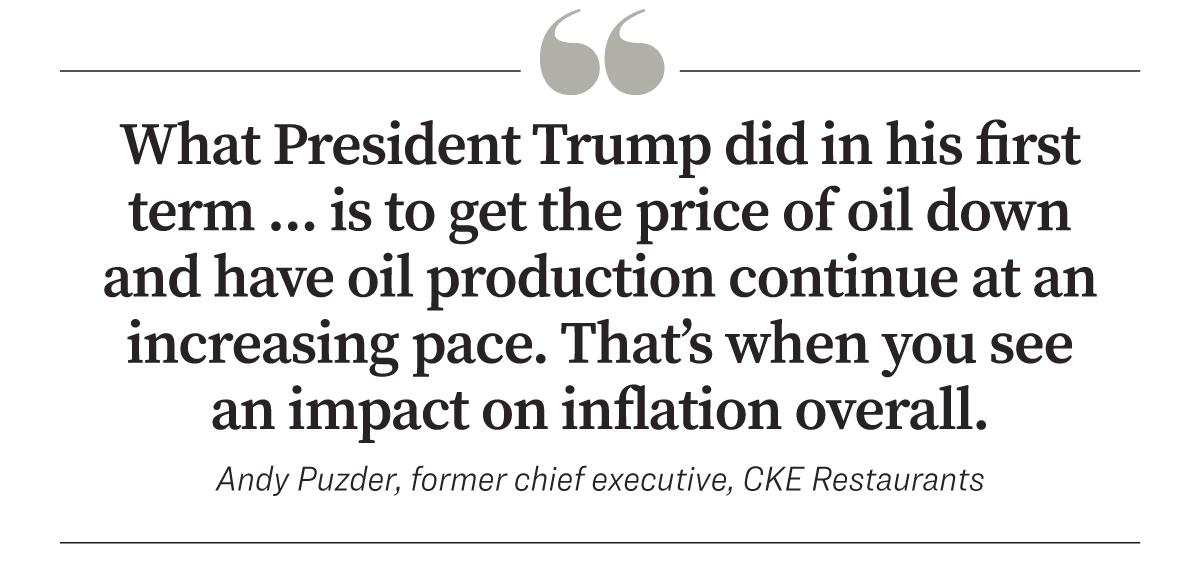
“What President Trump did in his first term, and what President Biden has been unable to do, is to get the price of oil down and have oil production continue at an increasing pace,” Puzder said. “That’s when you see an impact on inflation overall; it’s when oil companies can make a profit at a lower price per barrel.”
Many analysts predict that if a second Trump term can bring lower energy prices, this will have a ripple effect throughout the U.S. economy.
Retail gasoline prices, which were already coming down during the final years of the Obama administration, hit a low of less than $2 per gallon during the first Trump administration and remained under $3 per gallon throughout his term. Gas prices shot up to more than $5 per gallon during the Biden administration before falling back to the current range of between $3 and $4 per gallon.
“All of these things that have gone up in price significantly are affected by the input costs of energy,” Kish said. “Everything that goes into the price of eggs is affected by the price of energy—it’s heating the hen house, it’s the energy consumed in making food to feed the chickens, it’s the transportation of the eggs, it’s the refrigeration.”
Renewable Energy May Retreat
One segment of the stock market that has not responded well to Trump’s victory, however, is renewable energy.
The stock price of Sunnova Energy, a solar energy developer, tumbled from $6.90 per share on election day to $3.96 per share the following day, and continued to fall to just over $3 per share at the end of the week. More broadly, the Solar Energy Index CFD, which tracks the performance of publicly traded companies in the solar energy sector, fell from $42 before the election to $36 by week’s end.
Anticipated headwinds regarding federal regulations and subsidies that support this industry are the likely cause.
“Trump has pledged to kill the offshore wind industry on his first day in office,” Robert Bryce, energy analyst and author, told The Epoch Times. “There’s no reason to doubt that he will do just that, which will be good news for whales and ratepayers.”
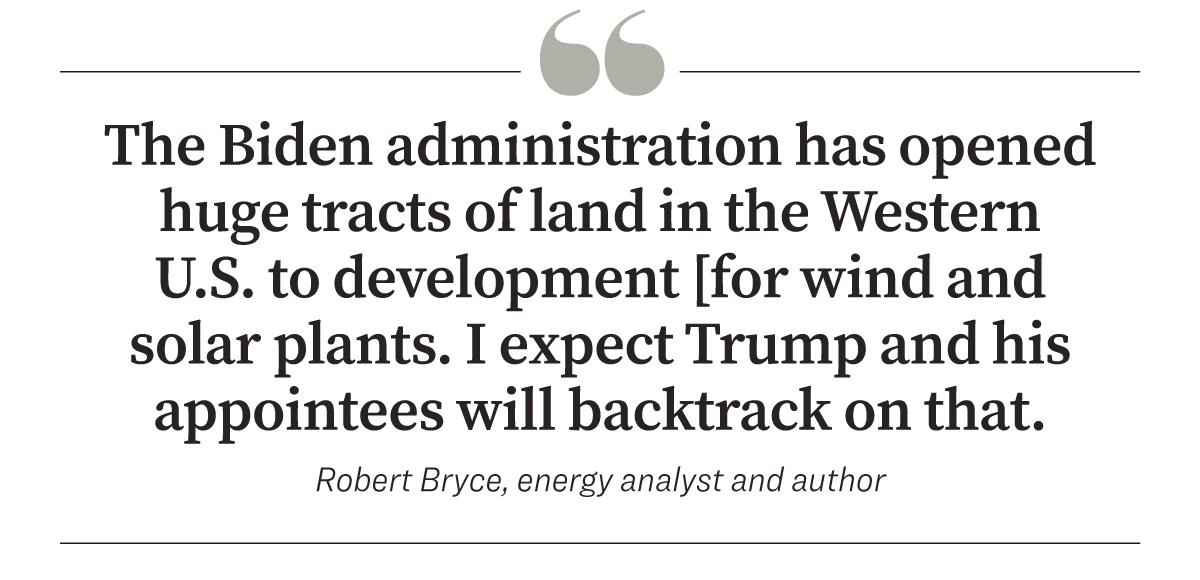
In addition, “the Biden administration has opened huge tracts of land in the Western U.S. to development [for wind and solar plants],” Bryce said. “I expect Trump and his appointees will backtrack on that and may even withdraw some of the permits that have already been granted.”
Reaching net zero has been a central goal of the Biden–Harris administration, which committed in April 2023 to “achieving a carbon pollution-free power sector by 2035 and net zero emissions economy by no later than 2050.”
The Inflation Reduction Act of 2022 allocated approximately $400 billion in tax credits, federal loans and subsidies toward the production of “green” energy in the United States, primarily for wind and solar power, but also for nuclear energy.
However, a 2021 University of Chicago report, authored by economists Michael Greenstone and Ishan Nath, analyzed regulations, called renewable portfolio standards (RPS), which forced utilities to have at least 2 to 5 percent of their power come from wind and solar, and concluded that “electricity prices are 11 percent higher seven years after RPS passage.”
In addition, a 2021 report by Columbia University’s Climate School, found that as the share of renewables exceeds a minimal share of the energy mix, electricity bills go up.
“Continuing to push the false narrative of abundant and affordable clean energy is a huge political risk that will backfire when the public has to pony up for a bill they weren’t expecting,” the report’s author Lucas Toh writes.
Cutting Personal Taxes, Hiking Tariffs
Tax policy is another area where many expect to see significant changes under a Trump administration.
Much of the tax cutting that Trump pledged during his reelection campaign will require cooperation from Congress, and while Republicans were able to gain a majority in the Senate, they are still waiting on vote counts to see whether they will also control the House.
Particularly significant is whether Republicans will succeed in extending the Tax Cuts and Jobs Act (TCJA) of 2017, which is due to expire in 2025.
The TCJA cut the corporate tax rate to 21 percent from 35 percent, and while this rate cut has no expiry date, both President Joe Biden and Vice President Kamala Harris had proposed increasing the corporate tax rate to 28 percent.
If the TCJA is not renewed, however, personal income tax rates will rise, standard deductions will be reduced, and the child tax credit will be reduced as well. The maximum tax bracket will go up from 37 percent to 39.6 percent; however, the $10,000 cap on deductions for state and local taxes, which largely benefitted wealthy people in high-tax states such as California and New York, will no longer apply.
To the extent keeping these tax cuts in place spurs consumption and investment, many economists favor it. Critics, however, fear it will reduce government revenue and increase the federal deficit, which is projected by the Congressional Budget Office to hit $1.9 trillion at the end of this year.
Government revenues do not always correlate to tax rates, however, and if the tax cuts lead to significant economic growth, they could end up bringing in more tax revenues. Government tax receipts have increased consistently since the passage of the TCJA, from $3.3 trillion in 2017 to $4.4 trillion in 2023, according to Statista.
Other elements of Trump’s tax plan have received less positive reviews.
This includes his pledge to impose 20 percent tariffs on most imports, and tariffs as high as 60 percent on Chinese imports, which could include EVs, wind and solar components, furniture, toys, clothes, and sporting equipment.
Import taxes at this level “would spike the average tariff rate on all imports to highs not seen since the Great Depression,” Tax Foundation economist Erica York wrote. It could hurt the retail industry and fuel inflation.
However, it is unclear how much a Trump administration will ultimately differ from his predecessor in regard to trade with China.
During his term in office, Trump imposed about $80 billion in new import taxes on thousands of products such as steel, aluminum, appliances, semiconductors, and solar panels, many of which were coming from China, according to the Tax Foundation.
The Biden administration kept most of those tariffs in place, and in May added an additional $3.6 billion in tariffs on Chinese imports, including semiconductors and electric vehicles. And while the Trump administration collected $89 billion from so-called “trade war” tariffs, the Biden administration collected more than $144 billion.
In addition, Trump’s pledge to cut taxes on tips, which Vice President Kamala Harris also promised to implement, has been met with some skepticism.
“Among the most popular proposals are those to lower or stop taxation on tips and overtime wages for service workers, or eliminate taxes on social security benefits,” Yonk said.
But these piecemeal efforts would have little overall economic benefit, while further complicating the tax code and raising questions about fairness for workers outside the service industry, York said.
“Instead, extending the tax cuts from the first term and expanding them, without narrowly targeting specific groups, would yield better economic effects and create broad-based tax relief rather than special programs for narrower groups,” he said.

Two Storms, One Harvest

Every food crisis in living memory has been a one-shock event. The 2008 price spike was a commodity bubble. The 2020 shortages were a logistics failure. The 2022 grain scare was a war on one exporter’s ports. Each time, the system bent, adjusted, and recovered, and each time the experts assured us afterward that global markets are simply too big and too diversified to fail.
What nobody in Washington seems eager to discuss is that 2026 is shaping up to be something the modern food system has never actually faced. Two independent shocks, one climatic and one geopolitical, are converging on the same harvest cycle at the same time. Not sequentially. Simultaneously.
Start with the weather. The Pacific Ocean is currently building toward what forecasters now openly call a record event. NOAA’s Climate Prediction Center puts the odds of at least a strong El Niño near 88 percent, with roughly two in three odds it reaches “very strong” status, the tier reserved for perhaps three or four events in the entire satellite era. Every major global model now projects a median peak in Super El Niño territory, and most of them project it exceeding the 2015-16 event, which until now held the modern record. Sea surface anomalies were already brushing the super threshold in mid-July, months before these events normally peak. The atmosphere has already shifted into El Niño mode, and the event is forecast to crest in late fall and early winter.
This is not about “climate change.” It’s about the standard cycles of weather, and the cycle we’re currently in is one that has likely devastated societies in the past. We’re better prepared as a society today, but not all Americans are equally prepared.
Serious households have started doing the quiet math on their own. Grocery bills tell part of the story, and the forecast maps tell the rest, which is why long-term food storage has moved from fringe hobby to mainstream line item in the family budget, with established suppliers like Heaven’s Harvest seeing demand from people who five years ago would have rolled their eyes at the idea. That instinct is not paranoia. It is pattern recognition, and the pattern is worth walking through carefully.
Editor’s Note: Heaven’s Harvest IS a sponsor, but the warnings of this article are real and would be written even if we didn’t have a survival food sponsor. With that said, those who take advantage of what they offer can use promo code “Patriot” for 15% off.
The Fertilizer Clock Is Already Running
While the Pacific warms, the second shock has been unfolding in the Strait of Hormuz. The conflict with Iran turned the world’s most important energy chokepoint into a contested waterway, and the consequences reach far beyond the gas pump. Roughly a third of global fertilizer trade moves through Hormuz, and the disruption sent urea prices up 86 percent year over year by March, with a 53 percent jump in a single month.
The World Bank projects energy prices rising about 24 percent in 2026 and fertilizer about 31 percent. By its own accounting, fertilizer prices ran 35 percent higher in the first five months of this year than the same period last year.
Here is the mechanism the nightly news will not explain. Fertilizer is not a grocery item. It is a time-delayed input. The nitrogen a farmer in Iowa or Punjab could not afford to apply this spring does not show up as a problem this spring. It shows up as a thinner harvest six to twelve months later.
The World Bank’s own food security brief concedes that the effects of reduced applications earlier this season “are likely to become visible only later in harvest outcomes.” Translate that from institutional language into plain English and it means this. The damage is already done, it is already in the ground, and we are simply waiting for it to arrive on the shelf.
Now check the calendar. Six to twelve months from the spring planting season lands us squarely in late 2026 and early 2027. Which is precisely when the strongest El Niño in the instrumental record is forecast to peak, bringing its signature droughts to Southeast Asia, Australia, southern Africa, northern Brazil, and South Asia, the very regions that grow the world’s rice, sugar, and oilseeds.
The World Bank warns openly that a strong El Niño “could disrupt multiple crop belts simultaneously” on top of the conflict-driven input costs. Their baseline projection assumes the Middle East disruptions ease by autumn. What in the last two years of Middle East history suggests that assumption is safe?
The System Has No Slack Left
The comfortable answer is that global markets always adjust. But adjustment requires slack, and the slack is gone. Global cereal production is expected to decline from last year’s records even before El Niño does its work. The UN World Food Programme, hardly a den of right-wing preppers, is calling this the most significant disruption to its supply chains since Covid and the invasion of Ukraine, and its supply chain director put the stakes bluntly.
Today’s supply chain challenges are tomorrow’s hunger crisis.
There is also a political dimension that markets cannot price. When food gets scarce, governments do not behave like economists. They behave like politicians. Export bans, hoarding mandates, and panic buying at the national level turned the modest rice shortfall of 2008 into a global crisis, and analysts are already warning that import-dependent nations are the first dominoes.
The 2015-16 Super El Niño, a far weaker event than what is now forecast, threw tens of millions into food stress across Africa and Asia. This one is projected to be stronger, and it arrives with fertilizer already rationed by price and shipping lanes already contested by missiles.
What Joseph Knew
Scripture does not treat preparation for lean years as faithlessness. It treats it as wisdom delivered in advance to those willing to act on it.
Behold, there come seven years of great plenty throughout all the land of Egypt: And there shall arise after them seven years of famine; and all the plenty shall be forgotten in the land of Egypt.
Joseph did not respond to that warning with a hashtag or a committee. He stored grain during the years of abundance, and when the famine came, Egypt stood while its neighbors begged. The lesson is not that famine is certain. It is that the time to prepare is precisely when preparation still looks optional.
Nobody who filled a pantry in a year of plenty has ever regretted it, and nobody standing in an empty aisle has ever been glad he waited for certainty.
None of this calls for panic, and panic is the enemy of sound judgment anyway. It calls for the same unglamorous prudence our grandparents considered ordinary. Keep some cash margin, know your local growers, and put real food in deep storage while it is cheap and available, because the entire arc of this story is that cheap and available is a closing window.
Families looking for a straightforward place to start can visit Heaven’s Harvest and use promo code Patriot for 15 percent off long-term storable food. The forecasts may yet soften, the strait may yet reopen, and we should pray they do. But hope is a fine thing to hold and a foolish thing to eat.
