

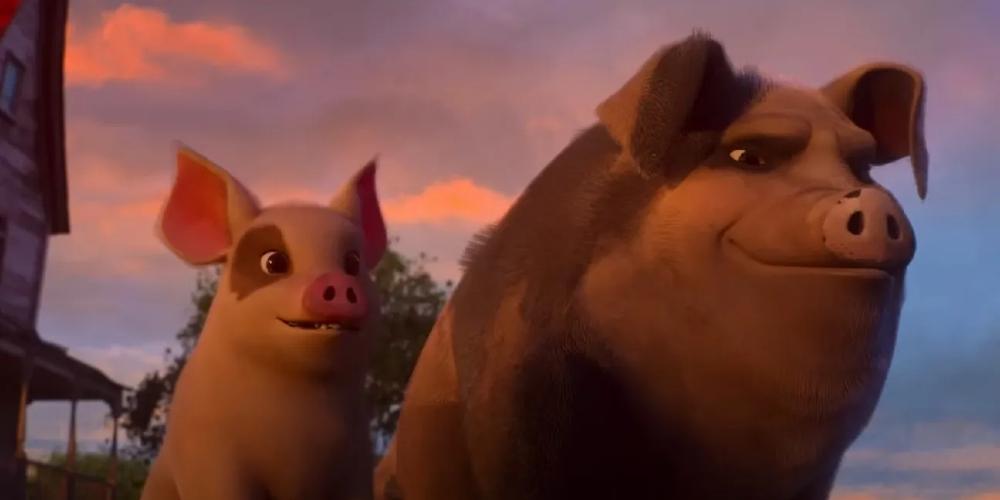
George Orwell did not write a children’s book. He wrote a warning — lean, merciless, and deliberately without comfort. When the final page of Animal Farm closes and the animals look through the farmhouse window to find they can no longer distinguish the pigs from the men, there is no rescue, no uprising, no redemption. The horror is the point. Orwell meant for the reader to sit in that discomfort, because the lesson history teaches is not that good men triumph over tyrants — it is that power, left unchecked, consumes even the men who claimed to despise it.
That lesson is precisely what Andy Serkis has decided modern audiences cannot be trusted to receive. His new animated adaptation of Animal Farm, set for theatrical release on May 1, 2026 and distributed by Angel Studios, takes Orwell’s bleak masterwork and gifts it something the original never had and never wanted — a happy ending. The animals overthrow Napoleon. They plan a brighter future. Hope blooms over the barnyard. As Serkis explained at the Annecy International Animation Film Festival, the rationale was straightforward:
“We wanted some hope.”
One can almost hear Orwell — who nearly died in Spain fighting against the very ideological forces his book exposed — rotating in his grave at Sutton Courtenay.
Quick Summary
- Andy Serkis’s new animated Animal Farm, releasing May 1, 2026, rewrites Orwell’s bleak anti-totalitarian allegory into a family-friendly animated adventure with a hopeful conclusion.
- Orwell’s original novella was a deliberate allegory for the Soviet Union under Stalin, depicting how revolutionary idealism collapses into tyranny — a warning with no redemptive ending by design.
- The new film shifts the primary villain from internal communist corruption to external capitalist greed, embodied by a new character, businesswoman Freida Pilkington, voiced by Glenn Close.
- Napoleon, Orwell’s stand-in for Stalin, is voiced by Seth Rogen and reimagined as a goofy, buffoonish figure — his rise to power played partly for laughs and flatulence jokes.
- Serkis wrote in a Washington Examiner op-ed that his film “has no ideology, but it does have idealism,” and that the animals “enthusiastically embrace capitalism” while rebelling only against “corruption.”
- Critics, including Variety’s Peter Debruge, argued the film trades Orwell’s political allegory for a dumbed-down, celebrity-voiced animated spectacle designed for the widest possible commercial audience.
- Online backlash was swift and sharp, with one podcaster’s post — “Hollywood takes Orwell’s anti-communist masterpiece — makes it anti-capitalist and woke instead” — drawing over 600,000 views on X.
- The deeper problem, as the American Spectator noted, is that Serkis’s film mistakes greed for the totality of Orwell’s concern, when the original was about the inescapable corruption embedded in human nature itself.
- The film fits a broader and now familiar Hollywood pattern of refashioning morally complex Western literature into ideologically safe, capitalism-critical entertainment.
What Orwell Actually Wrote — and Why It Still Matters
Before dissecting what Serkis has done, it is worth remembering what Orwell actually accomplished. Written in 1945 after Orwell witnessed, firsthand, the Soviet-aligned communist factions in Spain murder and disappear his comrades, Animal Farm was a surgical strike against a specific lie — the lie that a collectivist revolution, led by the right people with the right slogans, could produce lasting equality and justice. The animals overthrow the drunken farmer Mr. Jones. The pigs assume leadership. Commandments are written. Equality is proclaimed. And then, methodically, each commandment is revised, each promise is broken, each dissident is purged, until the final devastating tableau: the pigs walking upright, indistinguishable from the humans they replaced.
Orwell was not writing a story about bad men corrupting a good system. He was writing about the nature of power itself — that the system, any system built on the seizure of authority from one group by another, carries the seeds of its own corruption within it. The pigs were always going to become the farmers. That was the thesis, and its bleakness was not a flaw. It was the entire argument.
Serkis acknowledges he understands the book. Yet understanding a text and honoring it are two different acts, and this production enthusiastically commits to the former while quietly abandoning the latter.
Greed Is Not the Point — Human Nature Is
In a Washington Examiner op-ed defending his creative choices, Serkis wrote that his film
“has no ideology, but it does have idealism. Our characters enthusiastically embrace capitalism. What they rebel against is corruption.”
That sentence, meant as a defense, is actually the confession. When you relocate the origin of evil from within the revolutionary movement — from within the hearts of the pigs themselves — and plant it instead in an outside capitalist antagonist named Freida Pilkington (Glenn Close, naturally), you have not adapted Orwell. You have inverted him. The new film suggests that collectivism works well enough until capitalism gets its hands on it. Viewers reacting to the trailer on social media noticed this immediately, with one post summarizing the film’s apparent message with withering accuracy:
“It’s 2025. And Animal Farm is a movie about communism working, and being ruined by capitalism.”
The American Spectator‘s review captures the philosophical failure with precision, noting that Orwell’s novel was fundamentally about human nature — not merely greed, which is only one expression of it. The Spectator invokes Fyodor Dostoyevsky, whose own understanding of sin and power ran far deeper than Marx or any revolutionary theorist: the line between good and evil does not run between people, but through every human heart. That is Orwell’s true inheritance, and it is the insight Serkis has filed off to make room for a cheerful redemption arc.
It is a deeply telling creative choice. Hollywood cannot imagine a villain who is not a corporation. It cannot conceive of corruption that does not have a capitalist address. The notion that the revolution itself — the seizure of power, the collectivist impulse — might be the problem, not merely the people who corrupted it, is apparently too subversive an idea for a 2026 studio release to entertain.
Napoleon as a Goofball — The Aesthetics of Disarmament
There is also the small matter of Seth Rogen voicing Joseph Stalin.
In Orwell’s telling, Napoleon is cold, calculating, and genuinely frightening. His transformation from revolutionary leader to tyrant is gradual, insidious, and chilling precisely because it is so logical. In Serkis’s version, Napoleon is — per the trailers — a goofy, lovable buffoon prone to slapstick and, apparently, flatulence. Where Orwell’s Napoleon walking upright on two legs is a symbol of horrifying transformation, the film’s equivalent moment is accompanied by a fart joke.
Variety’s Peter Debruge, not exactly a right-wing publication, described the adaptation as one that
“dilutes Orwell’s political allegory in favor of what passes for something more ‘audience friendly.'”
The Daily Telegraph’s Tim Robey awarded it one star out of five, calling it “totally misjudged.” These are not conservative culture warriors complaining about ideology — these are mainstream film critics registering that something artistically essential has been discarded.

The slaughterhouse scene is perhaps the most emblematic example. One of Animal Farm‘s most harrowing moments is the fate of Boxer, the loyal and exhausted workhorse, sent to the knacker’s yard while his comrades are deceived about his destination. In the new film, the arrival of the slaughterhouse van is played as comedy — the “S” on the sign is momentarily obscured so the animals read “laughterhouse” instead. A moment Orwell designed to depict the cold betrayal of the loyal working class by the ruling revolutionary elite has been converted into a pun.
The Pattern Hollywood Cannot Quit
What is happening with Animal Farm is not an isolated creative decision. It is a symptom of a broader and now thoroughly predictable cultural reflex. Over the past decade, Hollywood has demonstrated a remarkable consistency in its approach to classic literature and moral complexity — sand off the hard edges, soften the verdicts, insert a capitalist villain, and guarantee a hopeful ending that sends audiences home feeling vaguely affirmed. Snow White was remade. The Little Mermaid was remade. Now Orwell is being remade, and the renovation follows the same blueprint every time.
Content creator and church pastor Jamie Bambrick summarized the reaction of many with blunt clarity:
“Only Hollywood leftists could turn the greatest critique of communism into a movie about the evils of capitalism.”
He is not wrong. But the deeper question is why. Why is it that an entertainment industry that prides itself on speaking truth to power cannot bring itself to hold the left’s own revolutionary tradition to account? Why can Hollywood produce a thousand films about corporate malfeasance but cannot faithfully adapt a book that demolished collectivist ideology with eighty pages of talking animals?
The answer may be simpler than it first appears. To tell Orwell’s story faithfully is to tell a story about the failure of the left’s foundational political project. Hollywood is not prepared to make that film. So instead, it makes a different film, borrows Orwell’s name, his animals, and his barnyard — and quietly replaces his thesis with its own.
What the Children Will Learn
Serkis argues, not without some legitimacy, that he wanted to bring the story to a younger generation in an accessible form. He worked with the Orwell estate. He has genuine affection for the source material. That sincerity does not make the creative choices wise.

The new protagonist, Lucky — a piglet voiced by Gaten Matarazzo of Stranger Things — follows Napoleon until conscience drives him to lead a rebellion against him. His arc is, as the American Spectator’s reviewer notes, inspiring and even heroic. It is also, precisely for that reason, not Orwellian. Lucky’s virtue saves the day. The right man in the right moment redirects history toward justice. That is not the lesson of Animal Farm. The lesson is that Lucky, given enough time and enough power, would have become Napoleon.
The children who see this film will walk away believing that revolutions fail because of greed, and that the right kind of idealism — paired with the right kind of leader — can actually deliver the promised equality. They will not walk away having encountered the far more sobering and far more biblical truth that the corruption of power is not an accident of character but a feature of fallen human nature. As the prophet Jeremiah wrote, “The heart is deceitful above all things, and desperately wicked: who can know it?” That understanding is precisely what even atheist Orwell was trying to communicate, and it is precisely what this adaptation cannot afford to say.
The Revolution Will Be Animated — But Not Honest
In the end, what Andy Serkis has produced may be a competent animated film. Early reviews from festival screenings suggest it is visually accomplished, that Lucky’s character arc is genuinely affecting, and that some of the emotional beats land. None of that redeems the central act of intellectual dishonesty at its core.
A faithful adaptation of Animal Farm for children is genuinely difficult. The book ends in despair. There are no heroes, only survivors and their oppressors. Adapting that for a modern audience without gutting the thesis would require real courage — the courage to tell young people that power is dangerous not just in the hands of obvious villains, but in the hands of idealists, reformers, and anyone who is absolutely certain he is on the right side of history. That is the story Hollywood will not tell, because it is, in the end, a story about Hollywood itself.
The pigs are always already walking on two legs. The tragedy is that they never notice when it happens.
Starting the Day With a Scripture-Inspired Roast Helps Center Your Thoughts on Eternal Truths Amid Temporal Pressures
The world can seem chaotic, especially right after we wake up. Many believers start their mornings reaching for something familiar — a hot cup of coffee — yet end up settling for mediocre brews that do little more than deliver a caffeine jolt. The daily grind of life, with its endless distractions, news cycles, and responsibilities, can leave even the most faithful feeling spiritually parched alongside their physical fatigue. What if your morning ritual could do more than wake you up? What if it could ground you in truth, nourish your body with exceptional quality, and quietly advance a kingdom purpose at the same time?
That’s the promise — and the reality — behind Promised Grounds Coffee. This Christian-founded company doesn’t just roast beans; it approaches every step as an act of worship and discipleship. By selecting only the top 10% of specialty-grade beans, ethically sourced from dedicated farmers in Central and South America, and small-batch roasting them with reverence in Austin, Texas, Promised Grounds delivers what many describe as the best coffee available — never burnt, never bland, but rich with origin stories and layered flavors that honor God’s creation.
From the vibrant Psalm 27 Roast (a light, bright medium option) to the bold yet peaceful 2 Timothy 1:7 Decaf, each bag carries a Scripture verse that turns your daily pour into a gentle reminder of faith. And through their Ounce Per Ounce Promise, every ounce of coffee you enjoy provides an equal ounce of clean water to families in need via partnership with Filter of Hope — literally brewing hope for body and soul, one cup at a time.
The challenge for today’s Christians runs deeper than finding a decent cup. In an age of convenience-driven consumerism, it’s easy to support companies that dilute values or remain silent on matters of faith. Many believers want their everyday choices — from what they drink to how they spend — to reflect discipleship rather than just convenience. Promised Grounds solves this by weaving Christian excellence into the entire process: beans nurtured with prayerful stewardship by farming families, roasted as an offering rather than a commodity, and packaged with Bible verses to encourage a mindset of gratitude and purpose from the first sip. Reviewers consistently praise the smooth, rich profiles — whether enjoyed black in a drip maker, iced on a warm day, or shared in fellowship — noting how the quality stands toe-to-toe with premium secular brands while delivering something far more meaningful.
This integration of faith and flavor addresses a real need in Christian households and ministries. Busy parents, church leaders, and remote workers alike report that starting the day with a Scripture-inspired roast helps center their thoughts on eternal truths amid temporal pressures. The coffee’s exceptional character — bright citrus notes in lighter roasts or deep chocolate undertones in bolder ones — comes from meticulous selection and careful roasting that respects the bean’s natural gifts rather than masking them. It’s the kind of coffee that elevates a simple quiet time, fuels productive workdays, or sparks meaningful conversations when shared at Bible studies or outreach events. And because it’s ethically sourced with integrity, every purchase supports sustainable livelihoods for farmers who treat their crops like family harvests.
For those leading churches or small groups, the impact multiplies. Promised Grounds offers bundles and options perfect for hospitality ministries, turning ordinary coffee service into an opportunity to point people toward the living water of Christ. Imagine greeting visitors with a warm cup whose very bag carries God’s Word — a subtle yet powerful witness that aligns with the Great Commission. The company’s Texas roots and commitment to “brewing hope” resonate especially with believers who value American enterprise paired with global compassion.
Of course, quality alone isn’t enough if the experience feels out of reach. Promised Grounds keeps it accessible with practical perks like free shipping on orders over $40, sample sets for discovering favorites, and thoughtful add-ons such as faith-themed mugs. Whether you prefer whole beans for fresh grinding, grounds for convenience, or even bulk options for larger households and ministries, the result is consistently superior coffee that makes discipleship feel integrated rather than added on.
As you consider how to align even the smallest habits with your walk with God, Promised Grounds Coffee stands out as a refreshing solution. It tackles the dual problems of subpar daily sustenance and disconnected consumption by offering a product that genuinely excels in taste while advancing a mission of clean water, farmer dignity, and scriptural encouragement. Believers who make the switch often describe it as more than a beverage upgrade — it becomes part of their rhythm of gratitude, a daily invitation to remember that every good gift comes from above.
If you’re ready to transform your mornings (and perhaps your church gatherings) with coffee that honors both exceptional craftsmanship and Christian values, I encourage you to explore what Promised Grounds has to offer. One sip at a time, you’ll be nourishing your body, refreshing your spirit, and participating in something far greater — all while enjoying what truly is among the best coffee available.
