

Food doesn’t just magically show up at the grocery store. If farmers and ranchers do not produce it, we do not eat. I know that I have been writing about the rapidly growing global food crisis a lot lately, but that is because this really is a big deal. All over the globe, agricultural production is going to be below expectations in 2022. As a result, those of us that live in wealthy countries will pay much more for food in 2023, while many of those that live in poor countries will either deeply suffer or die. In fact, children are already dropping dead from starvation in large numbers in some parts of Africa, but most Americans haven’t heard about this because they aren’t showing it on the news.
Of course this isn’t just a crisis for poor countries on the other side of the planet.
Here in the United States, the food that is not being grown in 2022 will cause immense economic pain in 2023.
There are 17 western states that collectively produce almost half of our food, and right now those 17 states are being absolutely devastated by the worst multi-year megadrought in 1,200 years…
The 17 states including and north of Texas, up along the Central Plains to North Dakota and west to California are vital to the U.S. agricultural sector, supporting nearly half of the nation’s $364 billion production by value. This includes 74% of beef cattle, responsible (in total) for 18% of U.S. agricultural production by value; 50% of dairy production, responsible (in total) for 11% of U.S. agricultural production by value, over 80% of wheat production by value and over 70% of vegetable, fruit and tree nut production by value. Drought conditions, which have persisted well into 2022, put production of these commodities at risk, along with the stability of farms, ranches and local economies reliant on crops, livestock and downstream products and services for income.
The American Farm Bureau Federation wanted to know how farmers in that half of the nation are faring during this drought, and so they conducted a survey.
And what they discovered is extremely alarming. Here is one example…
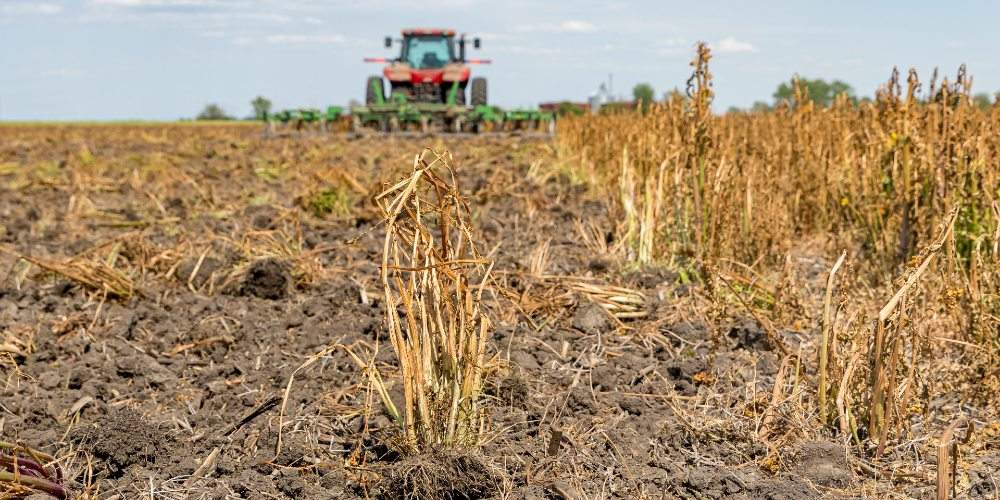
This year’s drought conditions are taking a harder toll than last year’s, as 37% of farmers said they are plowing through and killing existing crops that won’t reach maturity because of dry conditions.
Do you understand what that is saying?
37 percent of all farmers in the western half of the country are killing their own crops because those crops won’t even reach maturity because of the endless drought.
I was absolutely floored when I first saw that figure.
And that same survey also found that staggering numbers of ranchers in some western states have been selling off their cattle…
Farmers in Texas are being forced to sell off their cattle herds earlier than normal due to extreme drought — as water sources dry out and grass burns up. Farmers in the Lone Star state reported the largest reduction in herd size, down 50%, followed by New Mexico and Oregon at 43% and 41% respectively.
The cattle that are being slaughtered now are helping to stabilize short-term beef prices.
But in the long run we will see a much smaller cattle population and far higher beef prices.
In fact, some beef producers in Oklahoma are warning that “cheap ground beef could eventually top $50 per pound”…
Thanks to the unending economic symptoms of the pandemic and 2022’s inflation double-punch, average beef prices are currently about twice what they were in 2019. Add in the deepening widespread drought, a shortage of hay and feed, skyrocketing prices, transport costs, and various other metrics, some Southwest Oklahoma beef producers suggest cheap ground beef could eventually top $50 per pound.
Could you imagine paying 50 dollars for a pound of ground beef?

Even now, we are being told that U.S. consumers are increasingly switching to chicken…
Inflation-weary shoppers are pulling back on buying pricey steaks and switching to cheaper chicken at the grocery store.
Tyson (TSN), the meat processing giant, said Monday that “demand for chicken is extremely strong,” while demand for its higher-priced cuts of beef has softened.
Of course it isn’t just the United States that is moving into unprecedented territory.
We just learned that there will be crop losses in France of up to 35 percent…
France’s fruit and vegetable crops have fallen by nearly 35% due to the extreme drought this summer, Jacques Rouchausse, president of the French national association of vegetable producers, Legumes de France, said on Tuesday.
“We have losses on the yields. For the moment, we estimate that these losses are between 25% and 35 percent. We have to stress that if we want food sovereignty, if we want food security, we really have to find ways to continue producing on our territory,” Rouchausse said on air of Radio Franceinfo.
Yesterday, I discussed the fact that there will be crop losses in the UK of up to 50 percent in some cases.
And in Italy, it is being reported that there will be crop losses of up to 80 percent in certain areas.
As global food supplies get tighter and tighter, the wealthy countries will have enough money to import the food that they need.

But what will the poorer countries do?
At this point, tens of millions of Africans are already dealing with severe food shortages…
Drought is gripping the Horn of Africa, leaving some 26 million people facing food shortages in Kenya, Ethiopia and Somalia over the next six months. More than 7 million livestock animals have already been wiped out. Across East Africa as a whole, some 50 million people are facing acute food insecurity.
This is a crisis that isn’t going away.
Not too long ago, UN Secretary General António Guterres openly admitted that it is likely that there will be “multiple famines” in 2023…
In a video message to the meeting, UN chief António Guterres commended the partners for joining forces at what he called “this critical moment”, noting that the number of people who are severely food insecure has doubled in the last two years.
“We face a real risk of multiple famines this year. And next year could be even worse. But we can avoid this catastrophe if we act now,” said Mr. Guterres.
Of course this is exactly what I have been saying for years.
Global famine is coming. There is no way to avoid it, and it is going to turn the entire global economy upside down.
When you know that a global famine is coming, the prudent thing to do is to get prepared. So I hope that all of you are taking action while there is still time to do so.
***It is finally here! Michael’s new book entitled “7 Year Apocalypse” is now available in paperback and for the Kindle on Amazon.***
About the Author: My name is Michael and my brand new book entitled “7 Year Apocalypse” is now available on Amazon.com. In addition to my new book I have written five other books that are available on Amazon.com including “Lost Prophecies Of The Future Of America”, “The Beginning Of The End”, “Get Prepared Now”, and “Living A Life That Really Matters”. (#CommissionsEarned) When you purchase any of these books you help to support the work that I am doing, and one way that you can really help is by sending digital copies as gifts through Amazon to family and friends. Time is short, and I need help getting these warnings into the hands of as many people as possible.
I have published thousands of articles on The Economic Collapse Blog, End Of The American Dream and The Most Important News, and the articles that I publish on those sites are republished on dozens of other prominent websites all over the globe. I always freely and happily allow others to republish my articles on their own websites, but I also ask that they include this “About the Author” section with each article. The material contained in this article is for general information purposes only, and readers should consult licensed professionals before making any legal, business, financial or health decisions.
I encourage you to follow me on social media on Facebook and Twitter, and any way that you can share these articles with others is a great help. These are such troubled times, and people need hope. John 3:16 tells us about the hope that God has given us through Jesus Christ: “For God so loved the world, that he gave his only begotten Son, that whosoever believeth in him should not perish, but have everlasting life.” If you have not already done so, I strongly urge you to ask Jesus to be your Lord and Savior today.
Article cross-posted from The Economic Collapse Blog.

Two Storms, One Harvest

Every food crisis in living memory has been a one-shock event. The 2008 price spike was a commodity bubble. The 2020 shortages were a logistics failure. The 2022 grain scare was a war on one exporter’s ports. Each time, the system bent, adjusted, and recovered, and each time the experts assured us afterward that global markets are simply too big and too diversified to fail.
What nobody in Washington seems eager to discuss is that 2026 is shaping up to be something the modern food system has never actually faced. Two independent shocks, one climatic and one geopolitical, are converging on the same harvest cycle at the same time. Not sequentially. Simultaneously.
Start with the weather. The Pacific Ocean is currently building toward what forecasters now openly call a record event. NOAA’s Climate Prediction Center puts the odds of at least a strong El Niño near 88 percent, with roughly two in three odds it reaches “very strong” status, the tier reserved for perhaps three or four events in the entire satellite era. Every major global model now projects a median peak in Super El Niño territory, and most of them project it exceeding the 2015-16 event, which until now held the modern record. Sea surface anomalies were already brushing the super threshold in mid-July, months before these events normally peak. The atmosphere has already shifted into El Niño mode, and the event is forecast to crest in late fall and early winter.
This is not about “climate change.” It’s about the standard cycles of weather, and the cycle we’re currently in is one that has likely devastated societies in the past. We’re better prepared as a society today, but not all Americans are equally prepared.
Serious households have started doing the quiet math on their own. Grocery bills tell part of the story, and the forecast maps tell the rest, which is why long-term food storage has moved from fringe hobby to mainstream line item in the family budget, with established suppliers like Heaven’s Harvest seeing demand from people who five years ago would have rolled their eyes at the idea. That instinct is not paranoia. It is pattern recognition, and the pattern is worth walking through carefully.
Editor’s Note: Heaven’s Harvest IS a sponsor, but the warnings of this article are real and would be written even if we didn’t have a survival food sponsor. With that said, those who take advantage of what they offer can use promo code “Patriot” for 15% off.
The Fertilizer Clock Is Already Running
While the Pacific warms, the second shock has been unfolding in the Strait of Hormuz. The conflict with Iran turned the world’s most important energy chokepoint into a contested waterway, and the consequences reach far beyond the gas pump. Roughly a third of global fertilizer trade moves through Hormuz, and the disruption sent urea prices up 86 percent year over year by March, with a 53 percent jump in a single month.
The World Bank projects energy prices rising about 24 percent in 2026 and fertilizer about 31 percent. By its own accounting, fertilizer prices ran 35 percent higher in the first five months of this year than the same period last year.
Here is the mechanism the nightly news will not explain. Fertilizer is not a grocery item. It is a time-delayed input. The nitrogen a farmer in Iowa or Punjab could not afford to apply this spring does not show up as a problem this spring. It shows up as a thinner harvest six to twelve months later.
The World Bank’s own food security brief concedes that the effects of reduced applications earlier this season “are likely to become visible only later in harvest outcomes.” Translate that from institutional language into plain English and it means this. The damage is already done, it is already in the ground, and we are simply waiting for it to arrive on the shelf.
Now check the calendar. Six to twelve months from the spring planting season lands us squarely in late 2026 and early 2027. Which is precisely when the strongest El Niño in the instrumental record is forecast to peak, bringing its signature droughts to Southeast Asia, Australia, southern Africa, northern Brazil, and South Asia, the very regions that grow the world’s rice, sugar, and oilseeds.
The World Bank warns openly that a strong El Niño “could disrupt multiple crop belts simultaneously” on top of the conflict-driven input costs. Their baseline projection assumes the Middle East disruptions ease by autumn. What in the last two years of Middle East history suggests that assumption is safe?
The System Has No Slack Left
The comfortable answer is that global markets always adjust. But adjustment requires slack, and the slack is gone. Global cereal production is expected to decline from last year’s records even before El Niño does its work. The UN World Food Programme, hardly a den of right-wing preppers, is calling this the most significant disruption to its supply chains since Covid and the invasion of Ukraine, and its supply chain director put the stakes bluntly.
Today’s supply chain challenges are tomorrow’s hunger crisis.
There is also a political dimension that markets cannot price. When food gets scarce, governments do not behave like economists. They behave like politicians. Export bans, hoarding mandates, and panic buying at the national level turned the modest rice shortfall of 2008 into a global crisis, and analysts are already warning that import-dependent nations are the first dominoes.
The 2015-16 Super El Niño, a far weaker event than what is now forecast, threw tens of millions into food stress across Africa and Asia. This one is projected to be stronger, and it arrives with fertilizer already rationed by price and shipping lanes already contested by missiles.
What Joseph Knew
Scripture does not treat preparation for lean years as faithlessness. It treats it as wisdom delivered in advance to those willing to act on it.
Behold, there come seven years of great plenty throughout all the land of Egypt: And there shall arise after them seven years of famine; and all the plenty shall be forgotten in the land of Egypt.
Joseph did not respond to that warning with a hashtag or a committee. He stored grain during the years of abundance, and when the famine came, Egypt stood while its neighbors begged. The lesson is not that famine is certain. It is that the time to prepare is precisely when preparation still looks optional.
Nobody who filled a pantry in a year of plenty has ever regretted it, and nobody standing in an empty aisle has ever been glad he waited for certainty.
None of this calls for panic, and panic is the enemy of sound judgment anyway. It calls for the same unglamorous prudence our grandparents considered ordinary. Keep some cash margin, know your local growers, and put real food in deep storage while it is cheap and available, because the entire arc of this story is that cheap and available is a closing window.
Families looking for a straightforward place to start can visit Heaven’s Harvest and use promo code Patriot for 15 percent off long-term storable food. The forecasts may yet soften, the strait may yet reopen, and we should pray they do. But hope is a fine thing to hold and a foolish thing to eat.

No doubt drought has had some effect (it alsays does), but let’s not ignore the PRIMARY causes – Vaccine mandates on dockworkers, truckers, & rail workers, lockdowns, dozens of food processing & distribution plants destroyed, farmers being paid not to grow, supply chain disruption, pipeline shutowns, drilling leases halted, drilling bans, Gates & the Chinese buying up hundreds of thousands of acres of farmland, and skyrocketing fuel prices.
Sell drought and Ukraine to the libtards.
I didn’t get the impression Michael (the author) was saying it is only drought to blame. He simply focused on it for this article. All of the things you said are true, and I’ve seen other articles by Michael saying so as well.
Jees! You two ard effing weird-try to avokd conspiracy misinformation – but factor in climate-change effects…..
One third (killing their crops) of one half (half the food is grown in this region) is 17% of the grand total for the country. It could cause higher prices, but I don’t see how it causes famine.
Hi, My name is Russ and I live in NE SD. We are not in a drought but were last yr. We are still in flood stage from a very wet spring and summer. Our rainfall has diminished the last 4 weeks where grass is starting to turn brown in areas. However, wheat and barley harvest are under way. Next is the soybean harvest, in early Oct, then corn after that. My in laws are farmers. I do believe the supply chain is being cut short purposely. The turkey and chicken flocks here were killed off by the 10s of thousands, supposedly, bc of the bird flu. We are in perilous times. Please dont reveal my name as I live in a small community. Thank you for your time.
Russ
Aberdeen, SD
40 years of chem trails and experiments in climate modification have CAUSED this drought, in order to de-populate the world. All of this is based on the banksters/globalists/ who want to totally control the underclass (that means you, mr man-in-the-street) and farm you for taxes and fees to make them richer. They control the Media, most universities (all the important ones) Hollywood, the Justice System, the public school system and they don’t care if there is a nuclear war because they believe it will help with depopulation and they can stay healthy in their bunkers or their space station or wherever they think their billions can keep them safe. The WORLD has just been “punked” by the COVID scam the the m-RNA clot shot that is killing millions. Have you noticed all the athletes and famous people who are dropping dead for “no reason at all?” Not mysterious at all. Better start your survival garden. It’s about to get very ugly.
Ha ha ha….. All that bs-hit and no mention of man-made climate-change.
The biggest drought in 1200 years right in the middle of conmen using global warming to destroy capitalism and enslave us is downright suspicious. It is possible out governments are seeding clouds out over the Pacific and Atlantic in order to wring all the water out before it reaches land.