

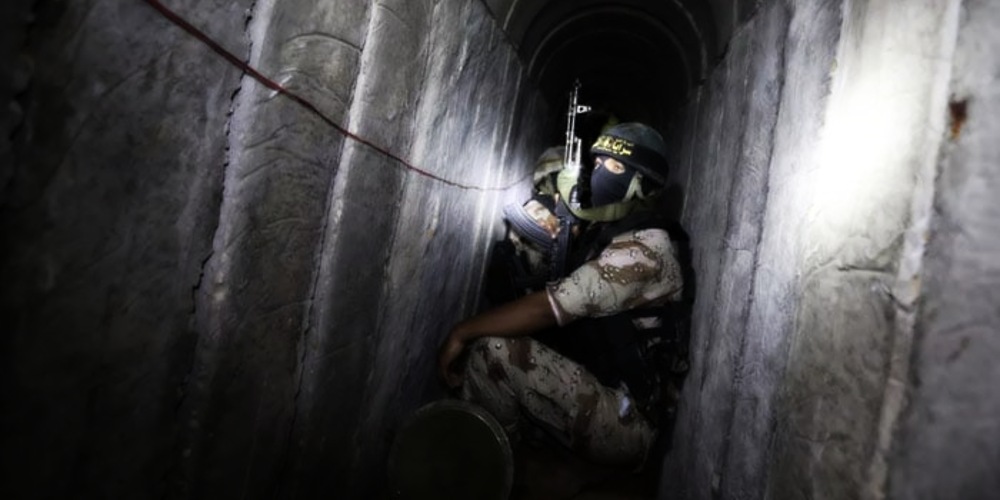
(Natural News)—The vast and mysterious networks of tunnels in Gaza dug through the years by the militant group Hamas pose a significant challenge for Israel.
The risk of getting bogged down in urban warfare and in Hamas’s tunnel systems has forced Israel to repeatedly postpone its ground offensive on Gaza, with fears rising that such a scenario could damage the prestige of the the Israel Defense Forces (IDF).
Over the past week, prominent retired American officials have warned Israel against initiating a big ground offensive in Gaza, including retired Army Gen. David Petraeus, who warned that IDF forces could be going into “a very, very tough fight.” He added that the tunnels might have rooms with improvised explosive devices (IEDs).
Bradley Bowman, a security analyst based in Washington, said the tunnels could hide enemy forces from soldiers traveling “across the field or into the outskirts of the city.”
IDF spokesman Jonathan Conricus conceded that eliminating Hamas would not be easy because Hamas has efficiently “embedded itself inside and underneath the Gaza Strip,” and that the group has previously utilized its maze of tunnels to stop enemy weapons and hide rockets.
John Spencer, a West Point Modern War Institute expert, said the Hamas tunnel systems are a “nightmare” and that there is currently no solution to the obstacle Israeli forces may face if and when Tel Aviv decides to launch a land operation.
Meanwhile, the tunnels can allow Hamas to carry out surprise attacks against advancing enemy forces, with militants infiltrating behind enemy lines and causing havoc on rearward-facing units with snipers, anti-tank guns and RPG-armed troops. The tunnels can also be used by special small hunter-killer teams to target military forces and evade counterattacks when facing against Israeli troops.
Israeli soldiers pursuing Hamas into the tunnels could also face several time-consuming and hazardous challenges since navigation and communications equipment, along with night vision goggles that depend on ambient light, would not function. Spencer added that in the Gaza tunnels, a lone Hamas defender can take his place in a narrow tunnel and face off against a superior force.
Outside of the tunnels, Petraeus warned that soldiers may still have to clear every building, home and basement in Gaza before being able to push deeper into the Strip.
IDF commanders wary of Hamas fighters
IDF commanders are also wary of the challenges they would face in ensuring battlefield superiority against the estimated 30,000 Hamas fighters in Gaza’s dense urban environment, much of which has already been reduced to rubble, which could be used for ambushes and snipers’ nests from Israeli airstrikes. This could also explain Israeli reluctance about a ground-based operation inside Gaza. (Related: 9 UN workers killed as Gaza Strip suffers from unrelenting Israeli airstrikes.)
In an analysis, the Modern War Institute at West Point said that defenders often hold the advantage in urban conflict.
The paper highlighted that “the advantages provided to a weaker force to occupy urban terrain are great.” A weaker enemy can use the physical terrain for concealment and cover both to fight from and to maneuver.
Tunneling has been a common tactic used by Hamas to smuggle supplies and equipment across the heavily guarded border encircling Gaza for decades. Experts believe that their methods have now advanced to the point where they can now build entire underground networks to quickly move and evacuate fighters and equipment, control underground command posts and operate workshops for the manufacture of weapons.
In 2018, Ismail Haniyeh, the head of the Hamas Political Bureau, claimed that the Hamas tunnel network in Gaza was twice as large as the Cu Chi tunnels the Viet Cong excavated beneath Saigon during the U.S. War in Vietnam.

Hamas’ tunneling initiatives through the Gaza Strip have been significantly revealed in detailed maps based on IDF data. Israeli forces reported that there were at least 100 kilometers (62 miles) of underground tunnels during the 2014 Gaza War.
Additionally, Hamas boasted that it had constructed tunnels with a combined length of at least 500 kilometers (310 miles) in 2021.
Go to WWIII.news for more updates about the Israel-Hamas conflict. Watch the video below for a review of Gaza’s place in Jewish history and the present.
This video is from the Gabe Mondragon channel on Brighteon.com.
More related stories:
- Hezbollah threat in the north delays Israel invasion of Gaza.
- GENOCIDAL: Israeli lawmaker demands deployment of “Doomsday” weapons to annihilate Gaza.
- Israeli military gets “green light” to enter Gaza and begin ground offensive.
Sources include:

Starting the Day With a Scripture-Inspired Roast Helps Center Your Thoughts on Eternal Truths Amid Temporal Pressures
The world can seem chaotic, especially right after we wake up. Many believers start their mornings reaching for something familiar — a hot cup of coffee — yet end up settling for mediocre brews that do little more than deliver a caffeine jolt. The daily grind of life, with its endless distractions, news cycles, and responsibilities, can leave even the most faithful feeling spiritually parched alongside their physical fatigue. What if your morning ritual could do more than wake you up? What if it could ground you in truth, nourish your body with exceptional quality, and quietly advance a kingdom purpose at the same time?
That’s the promise — and the reality — behind Promised Grounds Coffee. This Christian-founded company doesn’t just roast beans; it approaches every step as an act of worship and discipleship. By selecting only the top 10% of specialty-grade beans, ethically sourced from dedicated farmers in Central and South America, and small-batch roasting them with reverence in Austin, Texas, Promised Grounds delivers what many describe as the best coffee available — never burnt, never bland, but rich with origin stories and layered flavors that honor God’s creation.
From the vibrant Psalm 27 Roast (a light, bright medium option) to the bold yet peaceful 2 Timothy 1:7 Decaf, each bag carries a Scripture verse that turns your daily pour into a gentle reminder of faith. And through their Ounce Per Ounce Promise, every ounce of coffee you enjoy provides an equal ounce of clean water to families in need via partnership with Filter of Hope — literally brewing hope for body and soul, one cup at a time.
The challenge for today’s Christians runs deeper than finding a decent cup. In an age of convenience-driven consumerism, it’s easy to support companies that dilute values or remain silent on matters of faith. Many believers want their everyday choices — from what they drink to how they spend — to reflect discipleship rather than just convenience. Promised Grounds solves this by weaving Christian excellence into the entire process: beans nurtured with prayerful stewardship by farming families, roasted as an offering rather than a commodity, and packaged with Bible verses to encourage a mindset of gratitude and purpose from the first sip. Reviewers consistently praise the smooth, rich profiles — whether enjoyed black in a drip maker, iced on a warm day, or shared in fellowship — noting how the quality stands toe-to-toe with premium secular brands while delivering something far more meaningful.
This integration of faith and flavor addresses a real need in Christian households and ministries. Busy parents, church leaders, and remote workers alike report that starting the day with a Scripture-inspired roast helps center their thoughts on eternal truths amid temporal pressures. The coffee’s exceptional character — bright citrus notes in lighter roasts or deep chocolate undertones in bolder ones — comes from meticulous selection and careful roasting that respects the bean’s natural gifts rather than masking them. It’s the kind of coffee that elevates a simple quiet time, fuels productive workdays, or sparks meaningful conversations when shared at Bible studies or outreach events. And because it’s ethically sourced with integrity, every purchase supports sustainable livelihoods for farmers who treat their crops like family harvests.
For those leading churches or small groups, the impact multiplies. Promised Grounds offers bundles and options perfect for hospitality ministries, turning ordinary coffee service into an opportunity to point people toward the living water of Christ. Imagine greeting visitors with a warm cup whose very bag carries God’s Word — a subtle yet powerful witness that aligns with the Great Commission. The company’s Texas roots and commitment to “brewing hope” resonate especially with believers who value American enterprise paired with global compassion.
Of course, quality alone isn’t enough if the experience feels out of reach. Promised Grounds keeps it accessible with practical perks like free shipping on orders over $40, sample sets for discovering favorites, and thoughtful add-ons such as faith-themed mugs. Whether you prefer whole beans for fresh grinding, grounds for convenience, or even bulk options for larger households and ministries, the result is consistently superior coffee that makes discipleship feel integrated rather than added on.
As you consider how to align even the smallest habits with your walk with God, Promised Grounds Coffee stands out as a refreshing solution. It tackles the dual problems of subpar daily sustenance and disconnected consumption by offering a product that genuinely excels in taste while advancing a mission of clean water, farmer dignity, and scriptural encouragement. Believers who make the switch often describe it as more than a beverage upgrade — it becomes part of their rhythm of gratitude, a daily invitation to remember that every good gift comes from above.
If you’re ready to transform your mornings (and perhaps your church gatherings) with coffee that honors both exceptional craftsmanship and Christian values, I encourage you to explore what Promised Grounds has to offer. One sip at a time, you’ll be nourishing your body, refreshing your spirit, and participating in something far greater — all while enjoying what truly is among the best coffee available.

You drop a couple of thermobaric bombs in separate entrances it will end hamas. If they did not build concrete supports only small areas would have collapsed. This will affect miles of tunnels. It is gruesome anyway you do it.
How about a couple of industrial-power fans blowing tear gas or something a bit more potent into an opening and marked with a color dye at multiple entrances, so that the IDF can easily see smoke rising out of multiple locations. Wash, rinse and repeat.