

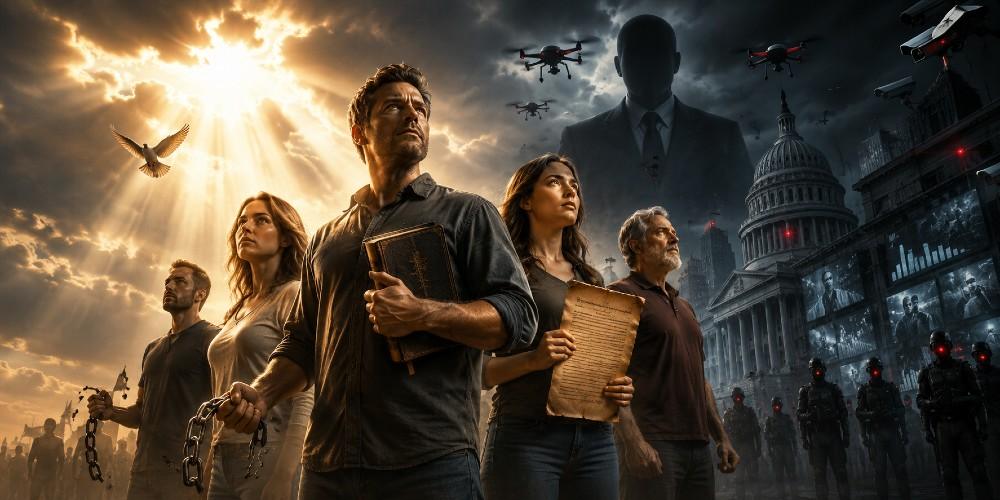
We Westerners have an important job to do. In the years and decades ahead, we must reassert our God-given rights.
Note that I do not assign this task to Western governments. Governments, in the best of times, are an annoyance; in anything but the best of times, governments are oppressive and dangerous. It is in governments’ nature to use their respective monopolies on violence to take more and more from the citizens who live within their jurisdictions. It is unnatural for governments to fight for our rights and liberties because our rights and liberties are fundamental checks on every government’s powers.
Governments will not fight for your free speech; they fight to be the only voices that can be heard. Governments will not fight for your religious freedom because governments cannot countenance a higher moral authority than their own. Governments will not fight for your property rights because their taxes and regulations rely on the immoral premise that your property is never really yours. Governments do not defend citizens’ natural, inalienable, God-given rights from attacks because governments are the offensive entities doing the attacking.
Only the people can defend their God-given rights. And only the people can decide when they’ve endured a sufficient number of attacks on their rights to stand up and tell their governments, “No more.” Until citizens do so, governments will pretend that the people have given them permission to infringe upon those natural rights and accrue more power for themselves.
Across the West, governments continue to probe just how far they can go before the people push back. They regulate what citizens are permitted to say on social media platforms. They censor points of view that contradict official government narratives.
They criminalize public expressions of Christian faith. They read our emails, bank records, medical charts, chat messages, credit card statements, phone logs, and online shopping histories without first obtaining warrants or establishing probable cause that any crimes have been committed. They spy on us with their cameras, computers, AI systems, and drones.
Governments violate our God-given rights every single day, while telling us that these violations are justified. They tell us that their attacks on our speech, faith, privacy, and domestic sovereignty are done for our own good. That’s a bit like spousal abuse, is it not? Just as a bad husband might beat his wife until she “learns to behave,” governments censor, demean, spy on, and threaten us into submission. Whether through taxation, regulation, police intimidation, constant monitoring, or criminal enforcement, every government creates the conditions for an abusive relationship. The only question is how abusive each government will become.
A major reason why our rights and liberties are under attack today is that so many of us in the West have been asleep. We told ourselves that we belonged to the nations that defeated fascism, Nazism, and, more generally, totalitarianism. We spent decades standing up to the Soviet Union and championing freedom over communist tyranny. We took pride in knowing that we lived in countries where you could speak your mind without going to jail. We understood that in despotic nations, such as communist China, Christians practice their faith in secret.
We saw images of tanks massacring Chinese demonstrators in Tiananmen Square. We heard stories of famine and mass execution coming from North Korea. We knew that communists and drug cartels slaughtered people in South and Central America. Knowing that extreme barbarity and oppression exist elsewhere in the world made us feel relatively comfortable and safe. In other words, we took our freedoms for granted.
We forgot that totalitarianism is not some exotic creation of the Italians, Germans, or Japanese. We allowed ourselves to believe that the forms of government oppression against which our family members fought in prior wars could never find a foothold here. But just because our nations fought oppression in the past does not mean our governments became naturally immune to the totalitarian disease.
In some ways, Western governments have found it easier to imprison us precisely because we celebrated our past successes while ignoring the signs of failure in our own countries. We told ourselves, “We have free speech.” Our governments said, “Sure you do, except for words and ideas that we designate as ‘dis-,’ ‘mal-,’ or ‘mis-information,’” and we deluded ourselves into thinking that that contradiction somehow made sense. We told ourselves, “We are free to practice our religious faiths without fear of government interference.”
Our governments said, “Sure you are, except if you choose to pray before a football game or outside of an abortion clinic, and, of course, you definitely can’t call homosexuality a sin or ‘transgenderism’ a mental disorder”; and we convinced ourselves that governments’ will took precedence over God’s will. We told ourselves, “Our homes, papers, private communications, and personal effects are secure against government searches and seizures.”
Our governments said, “Of course they are, but we’re still going to have to look through all of your personal messages and belongings to make sure that you’re not doing anything illegal or spreading ‘disinformation’ or engaging in nondescript forms of ‘hate’”; and we assured ourselves that our governments were only spying on us in order to “protect the children” from all manner of threats.
All the while, these governments that we defended as part of the “free world” have adopted elements of the closed, authoritarian, centrally-controlled systems that leaders of the “free world” claim to oppose. Western officials never miss an opportunity to rail against “fascism,” while working hand-in-glove with unelected central banks, NGOs, multinational corporations, and vast armies of bureaucrats to impose the will of a small cabal of elites upon entire nations of citizens. Western officials rarely say anything negative about communism because they are constructing socialist systems that share much in common with the Chinese Communist Party.

Western officials have spent ten years telling us that the election of President Donald Trump in the United States represents a resurgence in “authoritarianism,” yet those same officials demand that Westerners obey the authority of so-called “experts” and the edicts that come from international organizations, “climate change” treaties, and health bureaucracies.
Western governments engage in all these contradictions by playing a devilish magic trick against Western peoples: They never speak about rights or freedoms. They speak only of “democracy.”
“Democracy,” however, means nothing without a Bill of Rights or similar charter that effectively prevents governments from infringing the natural rights of the people. In the United Kingdom, the unelected king just made Andy Burnham prime minister, even though the former mayor of Greater Manchester was handed a seat in Parliament.
In Ukraine, dictator Volodymyr Zelenskyy remains “president” two years after the expiration of his term. In France, the Netherlands, and Germany, prosecutors, courts, intelligence agencies, and news media conspire to prevent politicians who believe in national sovereignty from coming to power.
In Romania, a presidential election was canceled when the wrong candidate won (who was then prosecuted for made-up “crimes” as so many other pro-nation politicians have been throughout the West). Unelected European Commission President Ursula von der Leyen controls the legislation and foreign policy of the continent.
In the United States, President Obama’s administration framed President Trump as a Russian spy; Democrats rigged the 2020 “election” with unlawful mail-in-ballots; and unethical prosecutors and judges fabricated charges against Trump that could have imprisoned him for life. Then, in the 2024 presidential contest, Democrats summarily replaced Joe Biden with Kamala Harris, even though she never won a single primary. This is what Western governments call “democracy.”

As Western governments more frequently resort to installing leaders at whim, it becomes more difficult to distinguish Western “democracy” from oligarchy or dictatorship. This is why we must reassert our God-given rights. Fake “democracies” cannot take what only God can give us.

Starting the Day With a Scripture-Inspired Roast Helps Center Your Thoughts on Eternal Truths Amid Temporal Pressures
The world can seem chaotic, especially right after we wake up. Many believers start their mornings reaching for something familiar — a hot cup of coffee — yet end up settling for mediocre brews that do little more than deliver a caffeine jolt. The daily grind of life, with its endless distractions, news cycles, and responsibilities, can leave even the most faithful feeling spiritually parched alongside their physical fatigue. What if your morning ritual could do more than wake you up? What if it could ground you in truth, nourish your body with exceptional quality, and quietly advance a kingdom purpose at the same time?
That’s the promise — and the reality — behind Promised Grounds Coffee. This Christian-founded company doesn’t just roast beans; it approaches every step as an act of worship and discipleship. By selecting only the top 10% of specialty-grade beans, ethically sourced from dedicated farmers in Central and South America, and small-batch roasting them with reverence in Austin, Texas, Promised Grounds delivers what many describe as the best coffee available — never burnt, never bland, but rich with origin stories and layered flavors that honor God’s creation.
From the vibrant Psalm 27 Roast (a light, bright medium option) to the bold yet peaceful 2 Timothy 1:7 Decaf, each bag carries a Scripture verse that turns your daily pour into a gentle reminder of faith. And through their Ounce Per Ounce Promise, every ounce of coffee you enjoy provides an equal ounce of clean water to families in need via partnership with Filter of Hope — literally brewing hope for body and soul, one cup at a time.
The challenge for today’s Christians runs deeper than finding a decent cup. In an age of convenience-driven consumerism, it’s easy to support companies that dilute values or remain silent on matters of faith. Many believers want their everyday choices — from what they drink to how they spend — to reflect discipleship rather than just convenience. Promised Grounds solves this by weaving Christian excellence into the entire process: beans nurtured with prayerful stewardship by farming families, roasted as an offering rather than a commodity, and packaged with Bible verses to encourage a mindset of gratitude and purpose from the first sip. Reviewers consistently praise the smooth, rich profiles — whether enjoyed black in a drip maker, iced on a warm day, or shared in fellowship — noting how the quality stands toe-to-toe with premium secular brands while delivering something far more meaningful.
This integration of faith and flavor addresses a real need in Christian households and ministries. Busy parents, church leaders, and remote workers alike report that starting the day with a Scripture-inspired roast helps center their thoughts on eternal truths amid temporal pressures. The coffee’s exceptional character — bright citrus notes in lighter roasts or deep chocolate undertones in bolder ones — comes from meticulous selection and careful roasting that respects the bean’s natural gifts rather than masking them. It’s the kind of coffee that elevates a simple quiet time, fuels productive workdays, or sparks meaningful conversations when shared at Bible studies or outreach events. And because it’s ethically sourced with integrity, every purchase supports sustainable livelihoods for farmers who treat their crops like family harvests.
For those leading churches or small groups, the impact multiplies. Promised Grounds offers bundles and options perfect for hospitality ministries, turning ordinary coffee service into an opportunity to point people toward the living water of Christ. Imagine greeting visitors with a warm cup whose very bag carries God’s Word — a subtle yet powerful witness that aligns with the Great Commission. The company’s Texas roots and commitment to “brewing hope” resonate especially with believers who value American enterprise paired with global compassion.
Of course, quality alone isn’t enough if the experience feels out of reach. Promised Grounds keeps it accessible with practical perks like free shipping on orders over $40, sample sets for discovering favorites, and thoughtful add-ons such as faith-themed mugs. Whether you prefer whole beans for fresh grinding, grounds for convenience, or even bulk options for larger households and ministries, the result is consistently superior coffee that makes discipleship feel integrated rather than added on.
As you consider how to align even the smallest habits with your walk with God, Promised Grounds Coffee stands out as a refreshing solution. It tackles the dual problems of subpar daily sustenance and disconnected consumption by offering a product that genuinely excels in taste while advancing a mission of clean water, farmer dignity, and scriptural encouragement. Believers who make the switch often describe it as more than a beverage upgrade — it becomes part of their rhythm of gratitude, a daily invitation to remember that every good gift comes from above.
If you’re ready to transform your mornings (and perhaps your church gatherings) with coffee that honors both exceptional craftsmanship and Christian values, I encourage you to explore what Promised Grounds has to offer. One sip at a time, you’ll be nourishing your body, refreshing your spirit, and participating in something far greater — all while enjoying what truly is among the best coffee available.
