


(Zero Hedge)—Earlier today we reported that the latest BofA Fund Manager Survey confirmed what most already knew: that the shoeshine boy, the kitchen sink, and the basement-dwelling daytrader, not to mention everyone on Wall Street, were short the dollar. In fact, according to the FMS respondents, professional traders were effectively shorting the dollar in record amounts.
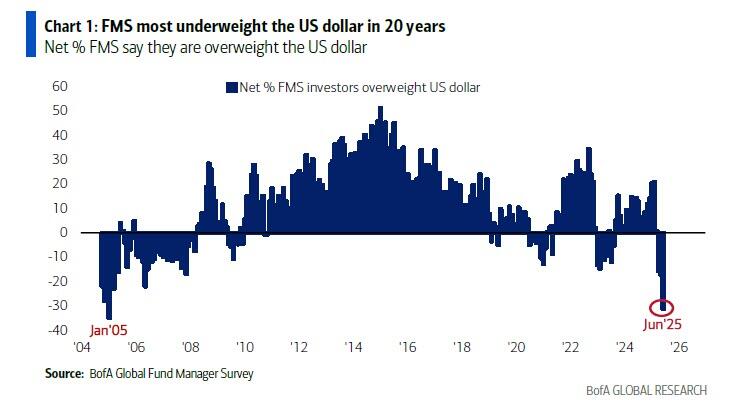
But while we will leave aside the debate whether this record dollar short will transform into a record squeeze, another question is just as appropriate: is the decline and fall of the US dollar just a one-time flash in the pan, or is there something much more ominous here than meets the eye.
The answer, it turns out, is the latter: the decline of the dollar has been truly a secular development, one which started over a decade ago but was kicked into higher gear in the aftermath of the 2022 Ukraine war when the weaponization of the US Dollar sparked a flight away from the greenback – i.e., dedollarization – by any regime that was worried it may be on the receiving end of SWIFT sanctions.
But what is perhaps far more notable is that as Socgen shows, since 2024, dedollarization has not benefited any of the major reserve currencies as one would expect in a fiat world where one currency’s loss is another currency’s gain. Instead, the share of gold in the IMF’s classification has increased.
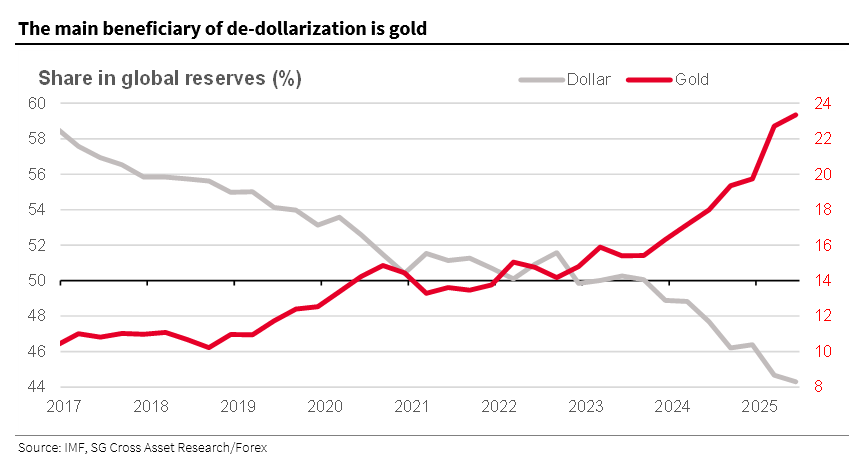
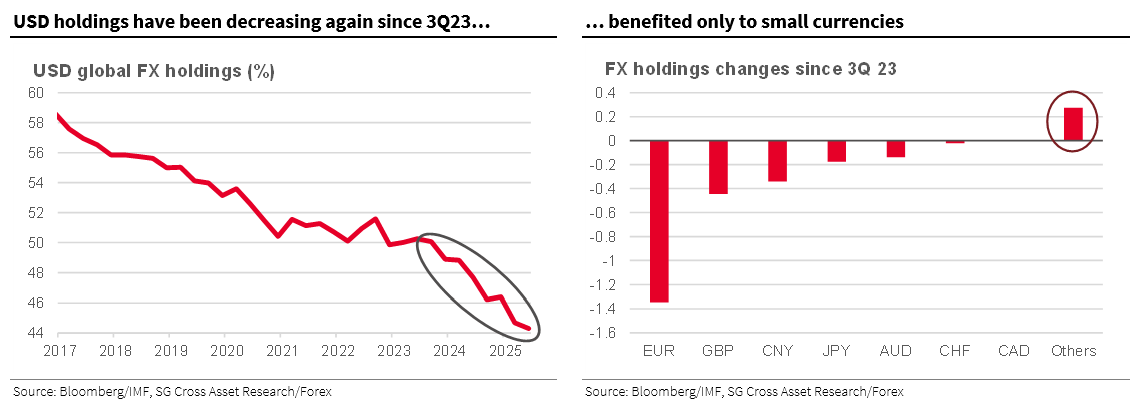
As the French bank goes on to note, the erosion of the dollar’s share in global FX reserves, or de-dollarization, paused during the COVID crisis in 2020 but resumed in the second half of 2023. Since 3Q23, the share of USD FX reserves has fallen below 50%, representing a decline of -5.8%. The main beneficiary has been gold, which increased by +7.9% to 23.3%, reflecting how central banks are diversifying their dollar holdings…
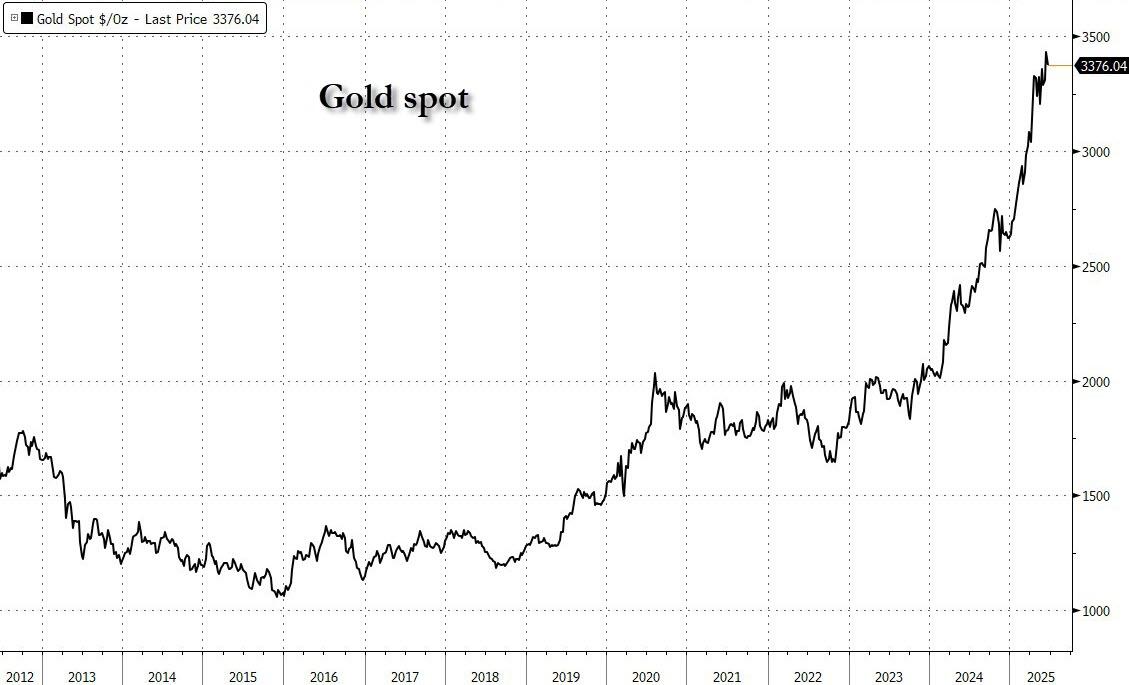
… although one look at the price of gold would have been sufficient.
Perhaps the most surprising outcome of the dedollarization process is that process it has not benefited any of the major reserve currencies; indeed, the share of EUR, GBP, CNY and JPY has been declining too.
Meanwhile, despite the laughable attempts of ECB head Christine Lagarde to paint the Eurozone and the euro as somehow more stable than the world’s reserve currency – when just over a decade ago the euro was hours away from disintegration and only Mario Draghi’s a last ditch gambit to do “whatever it takes” prevented the complete disintegration of the Eurozone – Gold has now overtaken the euro as the world’s second-most important reserve asset for central banks, driven by record purchases and soaring prices, according to the European Central Bank.
As shown in the chart below, gold accounted for 20% of global official reserves last year, surpassing for the first time the euro’s 16%, and second only to the US dollar at 46%, data from an ECB report published on Wednesday showed.
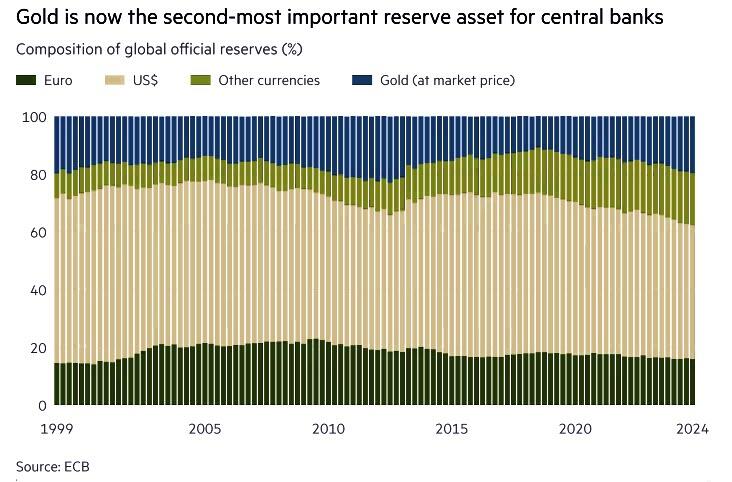
“Central banks continued to accumulate gold at a record pace,” the ECB wrote, adding that central banks for the third year in a row acquired more than 1,000 tonnes of gold in 2024, a fifth of the total global annual production and twice the annual amount in the decade of the 2010s.
As the FT notes, the stock of gold held by central banks worldwide is approaching the historic highs of the postwar Bretton Woods era. Until 1971, global exchange rates were fixed to the dollar, which in turn could be converted into gold at a fixed exchange rate. That all ended with the Nixon gold shock in 1971.
Central bank gold reserves, which peaked at 38,000 tonnes in the mid-1960s, rose again to reach 36,000 tonnes in 2024, according to the latest ECB numbers. “Central banks worldwide now hold almost as much gold as they did in 1965,” the ECB report said.
Large buyers last year included India, China, Turkey and Poland, according to the World Gold Council.
While there are no indications that the relentless demand for gold among official buyers is slowing, the ECB noted that the supply of gold in recent decades increased during times of high prices: “If history is any guide, further increases in the official demand for gold reserves may also support further growth in global gold supply.”

Which is a wonderful theoretical thought experiment, the only problem is that now that gold has become a Giffen good (where demand only goes up with price), any incremental supply will be quickly absorbed by even more demand.
And if that is indeed the case, and the current trajectory of gold accumulation and dedollarization persist, expect gold to surpass the dollar as the world’s preferred reserve currency sometime in 2030… right around the time US debt will be $50 trillion and bitcoin will be well over $1 million.
Which is ironic: a handful of powerful brought the end of the Bretton Woods world in the early 1970s, sparking an anti-gold regime which was adopted by a world kicking and screaming in disgust. 50 years later, without any outside influence, the world in which gold is once again the reserve “currency” has effectively returned.
Nature is healing.
More in the full Socgen note available to pro subs.

Two Storms, One Harvest

Every food crisis in living memory has been a one-shock event. The 2008 price spike was a commodity bubble. The 2020 shortages were a logistics failure. The 2022 grain scare was a war on one exporter’s ports. Each time, the system bent, adjusted, and recovered, and each time the experts assured us afterward that global markets are simply too big and too diversified to fail.
What nobody in Washington seems eager to discuss is that 2026 is shaping up to be something the modern food system has never actually faced. Two independent shocks, one climatic and one geopolitical, are converging on the same harvest cycle at the same time. Not sequentially. Simultaneously.
Start with the weather. The Pacific Ocean is currently building toward what forecasters now openly call a record event. NOAA’s Climate Prediction Center puts the odds of at least a strong El Niño near 88 percent, with roughly two in three odds it reaches “very strong” status, the tier reserved for perhaps three or four events in the entire satellite era. Every major global model now projects a median peak in Super El Niño territory, and most of them project it exceeding the 2015-16 event, which until now held the modern record. Sea surface anomalies were already brushing the super threshold in mid-July, months before these events normally peak. The atmosphere has already shifted into El Niño mode, and the event is forecast to crest in late fall and early winter.
This is not about “climate change.” It’s about the standard cycles of weather, and the cycle we’re currently in is one that has likely devastated societies in the past. We’re better prepared as a society today, but not all Americans are equally prepared.
Serious households have started doing the quiet math on their own. Grocery bills tell part of the story, and the forecast maps tell the rest, which is why long-term food storage has moved from fringe hobby to mainstream line item in the family budget, with established suppliers like Heaven’s Harvest seeing demand from people who five years ago would have rolled their eyes at the idea. That instinct is not paranoia. It is pattern recognition, and the pattern is worth walking through carefully.
Editor’s Note: Heaven’s Harvest IS a sponsor, but the warnings of this article are real and would be written even if we didn’t have a survival food sponsor. With that said, those who take advantage of what they offer can use promo code “Patriot” for 15% off.
The Fertilizer Clock Is Already Running
While the Pacific warms, the second shock has been unfolding in the Strait of Hormuz. The conflict with Iran turned the world’s most important energy chokepoint into a contested waterway, and the consequences reach far beyond the gas pump. Roughly a third of global fertilizer trade moves through Hormuz, and the disruption sent urea prices up 86 percent year over year by March, with a 53 percent jump in a single month.
The World Bank projects energy prices rising about 24 percent in 2026 and fertilizer about 31 percent. By its own accounting, fertilizer prices ran 35 percent higher in the first five months of this year than the same period last year.
Here is the mechanism the nightly news will not explain. Fertilizer is not a grocery item. It is a time-delayed input. The nitrogen a farmer in Iowa or Punjab could not afford to apply this spring does not show up as a problem this spring. It shows up as a thinner harvest six to twelve months later.
The World Bank’s own food security brief concedes that the effects of reduced applications earlier this season “are likely to become visible only later in harvest outcomes.” Translate that from institutional language into plain English and it means this. The damage is already done, it is already in the ground, and we are simply waiting for it to arrive on the shelf.
Now check the calendar. Six to twelve months from the spring planting season lands us squarely in late 2026 and early 2027. Which is precisely when the strongest El Niño in the instrumental record is forecast to peak, bringing its signature droughts to Southeast Asia, Australia, southern Africa, northern Brazil, and South Asia, the very regions that grow the world’s rice, sugar, and oilseeds.
The World Bank warns openly that a strong El Niño “could disrupt multiple crop belts simultaneously” on top of the conflict-driven input costs. Their baseline projection assumes the Middle East disruptions ease by autumn. What in the last two years of Middle East history suggests that assumption is safe?
The System Has No Slack Left
The comfortable answer is that global markets always adjust. But adjustment requires slack, and the slack is gone. Global cereal production is expected to decline from last year’s records even before El Niño does its work. The UN World Food Programme, hardly a den of right-wing preppers, is calling this the most significant disruption to its supply chains since Covid and the invasion of Ukraine, and its supply chain director put the stakes bluntly.
Today’s supply chain challenges are tomorrow’s hunger crisis.
There is also a political dimension that markets cannot price. When food gets scarce, governments do not behave like economists. They behave like politicians. Export bans, hoarding mandates, and panic buying at the national level turned the modest rice shortfall of 2008 into a global crisis, and analysts are already warning that import-dependent nations are the first dominoes.
The 2015-16 Super El Niño, a far weaker event than what is now forecast, threw tens of millions into food stress across Africa and Asia. This one is projected to be stronger, and it arrives with fertilizer already rationed by price and shipping lanes already contested by missiles.
What Joseph Knew
Scripture does not treat preparation for lean years as faithlessness. It treats it as wisdom delivered in advance to those willing to act on it.
Behold, there come seven years of great plenty throughout all the land of Egypt: And there shall arise after them seven years of famine; and all the plenty shall be forgotten in the land of Egypt.
Joseph did not respond to that warning with a hashtag or a committee. He stored grain during the years of abundance, and when the famine came, Egypt stood while its neighbors begged. The lesson is not that famine is certain. It is that the time to prepare is precisely when preparation still looks optional.
Nobody who filled a pantry in a year of plenty has ever regretted it, and nobody standing in an empty aisle has ever been glad he waited for certainty.
None of this calls for panic, and panic is the enemy of sound judgment anyway. It calls for the same unglamorous prudence our grandparents considered ordinary. Keep some cash margin, know your local growers, and put real food in deep storage while it is cheap and available, because the entire arc of this story is that cheap and available is a closing window.
Families looking for a straightforward place to start can visit Heaven’s Harvest and use promo code Patriot for 15 percent off long-term storable food. The forecasts may yet soften, the strait may yet reopen, and we should pray they do. But hope is a fine thing to hold and a foolish thing to eat.
