

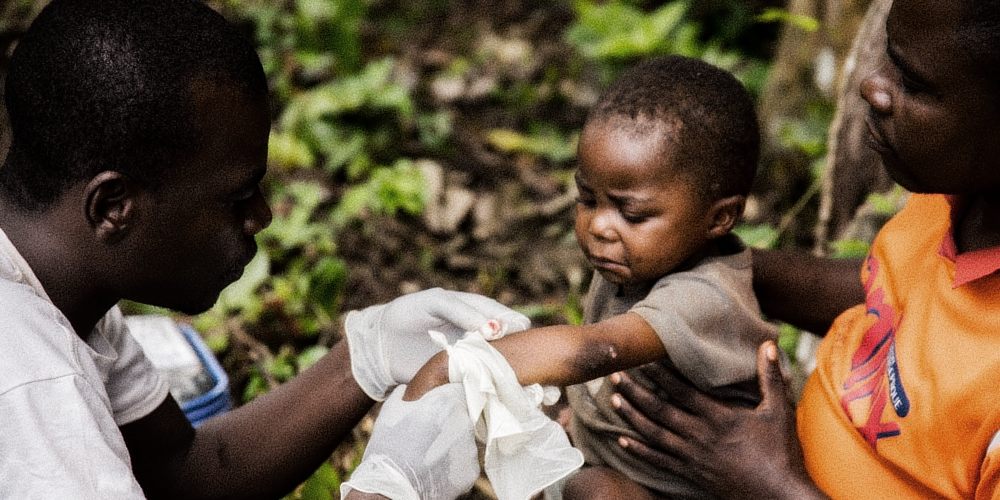
Editor’s Commentary: This was originally titled, “Global Health Authorities Press the Panic Button as a Strain of Monkeypox That Is “10 Times Deadlier” Starts Spreading Rapidly.” I changed the title because I believe the real lede was missed. I’m always skeptical when “global health authorities” press panic buttons because they’re political, not scientific. But the fact that this strain seems to be targeting children and not just homosexual men like the old version is very concerning.
We often talk about how Bird Flu is the new Plandemic, Scamdemic, whatever you want to call it. But what if it’s Monkeypox instead of or in addition to Bird Flu? The last time a disease centered around homosexual relationships in Africa before spreading across the world, the result was AIDS. This new strain of Monkeypox could be a repeat, only more contagious. I am NOT fearmongering or ringing any alarm bells yet, but it’s worth keeping an eye on. With that said, here’s the article by Michael Snyder from The Economic Collapse Blog…
A deadly new strain of monkeypox that is “killing children and causing miscarriages” is causing a tremendous amount of fear among global health authorities. We are being told that this strain is “10 times deadlier” than the one that infected people in more than 100 different countries in 2022, and apparently it spreads much more easily. The World Health Organization is sounding the alarm about what might happen if there is a full-blown global outbreak of this new strain, and some experts are concerned that it may already be too late to prevent that from happening.
Right now, the news is filled with lots of ominous stories about this new strain of monkeypox. The dramatic surge of cases that we are currently witnessing in the Democratic Republic of Congo has officials at the WHO extremely concerned…
The spread of mpox in Africa needs to be addressed urgently, the World Health Organization said on Tuesday, as scientists warned separately of a dangerous strain in the Democratic Republic of Congo.
“There is a critical need to address the recent surge in mpox cases in Africa,” Rosamund Lewis, the WHO’s technical lead for mpox, said in a briefing note to journalists.
The strain of monkeypox that spread around the world in 2022 caused excruciating pain, but there were very few deaths.
Unfortunately, this new strain of monkeypox still causes excruciating pain, but it also has a high death rate.
Of the 384 people that monkeypox has killed in the Democratic Republic of Congo so far this year, over 60 percent of them have been children…
There remain many “important unknowns” about the new strain, Lang cautioned, comparing this stage of investigation to the early days of Covid-19.
Out of 384 people who died from all mpox strains in DR Congo this year, more than 60 percent were children, according to the World Health Organization.
It is being reported that this new strain of monkeypox is “10 times deadlier”, and those that get infected often develop “horrendous whole body rashes”…
It gives sufferers “horrendous whole body rashes,” unlike clade II, which caused lesions normally more limited to the genital area, said Trudie Lang, a global health researcher at Oxford University.
Even if you don’t die, if you get infected you are going to experience absolutely horrifying pain and you are likely to develop disgusting sores all over your body.
The good news is that this strain of monkeypox has not appeared in the western world yet.
But authorities are warning that it could be just a matter of time before that happens…
There are fears the new virus – now officially called mpox – could quickly spread to Europe and beyond.
The mutant variant, clade 1b, is “undoubtedly the most dangerous strain of mpox yet,” stressed Prof Trudie Lang, the director of Global Health Network at Oxford University.
The strain that caused so much chaos in 2022 was spread primarily by sexual contact between men.
But this new strain can spread much more easily without any sexual contact at all. That is why so many children are getting infected…
The new strain of the virus does not require sexual contact to spread.
On a Zoom call with journalists on Tuesday, the researchers confirmed that clade 1b is spreading through touch, something which is “incredibly worrying,” according to Prof Lang.
It was spreading mother to child, as well as in schools and workplaces, they said.
Can you imagine the panic that is going to erupt if this thing gets loose in the western world?

Anyone that has any sort of visible sores will instantly cause people around them to freak out when they go out in public.
We will want to keep a very close eye on this one.
Meanwhile, an unprecedented outbreak of dengue fever has already infected close to 10 million people on our side of the globe…
The Centers for Disease Control and Prevention (CDC) issued a health advisory on Tuesday warning the public of a heightened risk of dengue virus (DENV) infections in the U.S. this year as cases continue to rise around the globe.
Countries in the Americas reported the highest number of cases ever, exceeding the record for a full year in less than six months. Since the start of 2024, there have been a total of 9.7 million dengue cases, more than twice the number recorded in all of 2023 (4.6 million).
We have never seen a dengue fever outbreak of this magnitude before.
Hopefully it will not continue to get worse.
On top of everything else, former CDC Director Dr. Robert Redfield is warning that “we will have a bird flu pandemic”…

“I really do think it’s very likely that we will, at some time, it’s not a question of if, it’s more of a question of when we will have a bird flu pandemic,” Redfield told NewsNation on Friday.
He added that the mortality rate is likely to be much higher from bird flu compared to Covid-19.
While the mortality rate was 0.6 per cent for Covid-19, Redfield said the mortality for the bird flu would probably be “somewhere between 25 and 50 percent.”
We have already been through a pandemic that had a death rate of well under 1 percent, and we all saw the immense panic that it caused.
So what would a pandemic with a 25 to 50 percent death rate look like?
You might want to think about that, because they are telling us that it is coming.
This week, the FDA announced that it will be testing 155 different grocery store products for traces of the bird flu…
Ice cream, butter and cheese are among the latest products set to be tested for bird flu by the FDA — amid a rampant outbreak in dairy cows.
In a release, the agency revealed it would swab 155 products bought from grocery stores nationwide for traces of the H5N1 virus.
If any are positive for the virus, further tests will be carried out to determine whether the virus inside them is ‘alive’ — or able to cause an infection in humans.
For the moment, life in America feels at least somewhat normal.
But as we have seen before, that can change in the blink of an eye.
We live at a time when horrifying outbreaks of disease will be very common, and once a deadly bug gets loose it can spread around the globe very rapidly.
The last pandemic was extremely unpleasant, but the truth is that it was just a warm up for what is ahead of us.
So enjoy this summer while you still can, because a number of extremely dangerous diseases are already on the verge of becoming major problems, and it is just a matter of time before all of our lives are once again turned upside down by another worldwide health crisis.
Michael’s new book entitled “Chaos” is available in paperback and for the Kindle on Amazon.com, and you can subscribe to his Substack newsletter at michaeltsnyder.substack.com.

Starting the Day With a Scripture-Inspired Roast Helps Center Your Thoughts on Eternal Truths Amid Temporal Pressures
The world can seem chaotic, especially right after we wake up. Many believers start their mornings reaching for something familiar — a hot cup of coffee — yet end up settling for mediocre brews that do little more than deliver a caffeine jolt. The daily grind of life, with its endless distractions, news cycles, and responsibilities, can leave even the most faithful feeling spiritually parched alongside their physical fatigue. What if your morning ritual could do more than wake you up? What if it could ground you in truth, nourish your body with exceptional quality, and quietly advance a kingdom purpose at the same time?
That’s the promise — and the reality — behind Promised Grounds Coffee. This Christian-founded company doesn’t just roast beans; it approaches every step as an act of worship and discipleship. By selecting only the top 10% of specialty-grade beans, ethically sourced from dedicated farmers in Central and South America, and small-batch roasting them with reverence in Austin, Texas, Promised Grounds delivers what many describe as the best coffee available — never burnt, never bland, but rich with origin stories and layered flavors that honor God’s creation.
From the vibrant Psalm 27 Roast (a light, bright medium option) to the bold yet peaceful 2 Timothy 1:7 Decaf, each bag carries a Scripture verse that turns your daily pour into a gentle reminder of faith. And through their Ounce Per Ounce Promise, every ounce of coffee you enjoy provides an equal ounce of clean water to families in need via partnership with Filter of Hope — literally brewing hope for body and soul, one cup at a time.
The challenge for today’s Christians runs deeper than finding a decent cup. In an age of convenience-driven consumerism, it’s easy to support companies that dilute values or remain silent on matters of faith. Many believers want their everyday choices — from what they drink to how they spend — to reflect discipleship rather than just convenience. Promised Grounds solves this by weaving Christian excellence into the entire process: beans nurtured with prayerful stewardship by farming families, roasted as an offering rather than a commodity, and packaged with Bible verses to encourage a mindset of gratitude and purpose from the first sip. Reviewers consistently praise the smooth, rich profiles — whether enjoyed black in a drip maker, iced on a warm day, or shared in fellowship — noting how the quality stands toe-to-toe with premium secular brands while delivering something far more meaningful.
This integration of faith and flavor addresses a real need in Christian households and ministries. Busy parents, church leaders, and remote workers alike report that starting the day with a Scripture-inspired roast helps center their thoughts on eternal truths amid temporal pressures. The coffee’s exceptional character — bright citrus notes in lighter roasts or deep chocolate undertones in bolder ones — comes from meticulous selection and careful roasting that respects the bean’s natural gifts rather than masking them. It’s the kind of coffee that elevates a simple quiet time, fuels productive workdays, or sparks meaningful conversations when shared at Bible studies or outreach events. And because it’s ethically sourced with integrity, every purchase supports sustainable livelihoods for farmers who treat their crops like family harvests.
For those leading churches or small groups, the impact multiplies. Promised Grounds offers bundles and options perfect for hospitality ministries, turning ordinary coffee service into an opportunity to point people toward the living water of Christ. Imagine greeting visitors with a warm cup whose very bag carries God’s Word — a subtle yet powerful witness that aligns with the Great Commission. The company’s Texas roots and commitment to “brewing hope” resonate especially with believers who value American enterprise paired with global compassion.
Of course, quality alone isn’t enough if the experience feels out of reach. Promised Grounds keeps it accessible with practical perks like free shipping on orders over $40, sample sets for discovering favorites, and thoughtful add-ons such as faith-themed mugs. Whether you prefer whole beans for fresh grinding, grounds for convenience, or even bulk options for larger households and ministries, the result is consistently superior coffee that makes discipleship feel integrated rather than added on.
As you consider how to align even the smallest habits with your walk with God, Promised Grounds Coffee stands out as a refreshing solution. It tackles the dual problems of subpar daily sustenance and disconnected consumption by offering a product that genuinely excels in taste while advancing a mission of clean water, farmer dignity, and scriptural encouragement. Believers who make the switch often describe it as more than a beverage upgrade — it becomes part of their rhythm of gratitude, a daily invitation to remember that every good gift comes from above.
If you’re ready to transform your mornings (and perhaps your church gatherings) with coffee that honors both exceptional craftsmanship and Christian values, I encourage you to explore what Promised Grounds has to offer. One sip at a time, you’ll be nourishing your body, refreshing your spirit, and participating in something far greater — all while enjoying what truly is among the best coffee available.

When will citizens take out these bioweapons labs that keep creating these weapons against humanity and the government agencies and people that enable them?
Meaning either it’s been weaponized and released uncontrolled, just like the last bioweapon “pandemic”… or the vectors are just being deliberately falsified to cover for an STD spreading among child molesters.
it’s the new PEDO POX.
They’re tweaking the formula
more initial fear mongering by the lackeys who pretend to be on the right but carry the water for the left. Getting a head start on the next dramatized nonsense.
Let me guess… a naturally developed disease that was first noticed in close proximity to a Fauci funded lab but definitely was not the product of gain of function research and was definitely not intentionally released.