

(Zero Hedge via Substack)—The American people have just taken their first full breath after surviving an attempt to smother the Republic through a Marxist-inspired cultural campaign carried out largely through the administrative state, media, academia, and politicized elements of the national security bureaucracy. Most citizens did not fully perceive it while it was happening. Many in the intelligence community either passively accepted it or actively furthered it. The architects of this project are not finished, but their effort has been damaged and delayed. It is only by the grace of God that the country has endured to this point.
The American version of the cultural revolution is distinct from the Maoist model that ravaged China in the twentieth century. It did not coalesce around a single charismatic revolutionary figure. Instead, it spread along the arteries of bureaucracy, higher education, corporate structures, and activist networks. The long march through the institutions, as described by Antonio Gramsci, became the operational template. Rather than Red Guards filling the streets under the orders of an identifiable supreme leader, the United States experienced a coordinated convergence of agencies, NGOs, foundations, media outlets, and activist fronts, all advancing the same ideological project under different labels.
Because federal agencies differ widely in size, mission, culture, and internal resistance, this revolution unfolded unevenly. It never achieved total dominance in a single decisive stroke. Instead, it advanced by fragmentary gains and suffered fragmentary defeats. Wherever the ideological project captured an HR department, a training pipeline, a public school system, or a central media platform, it encountered resistance in state governments, independent media, individual courts, and networks of citizens who refused to comply. This piecemeal quality of implementation slowed the collapse and gave the American people time to see what was happening and respond.
Even as these battles played out in public, darker currents moved beneath the surface. We now assess that thousands of religious and conservative federal employees were quietly identified and referred to a little-known federal entity, the Pre-Trial Services Agency. Accounts and initial documentation indicate that this agency may have been used to catalog individuals solely on the basis of ideology and religious conviction, under the pretext of January 6, and vaccine-related non-compliance. The intention appears to have been not only administrative removal but also potential criminalization. This matter demands immediate, transparent investigation by any future administration that claims to be serious about the rule of law.
To understand the broader context, it is necessary to define what we mean by the concept of the welfare state. We are not merely describing traditional social programs. We refer instead to a constellation of fully funded professional activist groups that present themselves as separate causes but in reality form a single revolutionary bloc. Over the last decade, organizations under the banners of antifascism, racial justice, radical feminism, abortion on demand, certain LGBTQ plus factions, environmental extremism, and gun control advocacy have shown remarkable cohesion. They share donors, staff, narrative frameworks, and street-level tactics. Their membership overlaps. Their messaging is synchronized. They rapidly support one another’s campaigns and protests.
These groups present themselves as grassroots movements. In reality, they function much more like a professionalized revolutionary caste. Their core is composed not of ordinary citizens but of trained activists who treat agitation as a full-time occupation. They are funded through a mix of private foundations, wealthy donors, and, in some cases, federal and state resources. They serve as the street and digital arm of a broader ideological project whose goal is not reform but transformation. They are bound together by a worldview that is explicitly revolutionary and implicitly Marxist, even if many of their foot soldiers do not use that language.
Within this structure, Diversity, Equity, and Inclusion plays a central role. DEI is not a harmless corporate fad. It is a cultural and psychological weapon system. In practice, DEI training and enforcement operate as a mechanism for behavioral conditioning, using guilt, struggle sessions, and the constant threat of social or professional punishment to bring individuals into line. The language of microaggressions, privilege, and systemic bias functions as a soft form of ideological policing. It compels people to monitor their speech, second-guess their instincts, and submit to an ever-expanding set of forbidden words and mandatory rituals.
This is not inclusion. It is coerced conformity disguised as virtue. The outcomes within institutions are fear, silence, and self-censorship. People learn quickly that specific questions cannot be asked, certain facts cannot be stated, and certain perspectives cannot be acknowledged without risking their careers. This is not an accidental side effect. It is the point. If you can compel people to lie about obvious realities in public, you own them. DEI is therefore best understood as a domestic application of political reeducation, aligned with Marxist and neo-Marxist approaches to cultural change.
Red washing is the term we use for the systematic erasure of material that exposes Marxism’s history, tactics, and consequences. When civics and traditional American history are removed from curricula and replaced with grievance narratives, the ground is prepared for a new ideology. When the record of socialist atrocities is buried or dismissed, whole generations lose the ability to recognize patterns that their grandparents would have seen immediately. This did not happen accidentally. Higher education, media, and entertainment became primary targets for this rewriting of memory.
By 2020, the United States had been subjected to decades of this cultural reshaping. The country entered that year already weakened and divided. The combined impact of a global pandemic, a Chinese Communist Party information campaign, and unprecedented civil unrest brought the country to a state of exhaustion. Law enforcement was undermanned and demoralized. The medical system was stretched to the limit. Schools at every level were shuttered or reduced to screens. The basic functions that distinguish a first-world nation were placed under siege.
These conditions were ideal for revolutionary actors who understood the Bolshevik concept of the spark. In Mao’s China, youth brigades became instruments of chaos once police authority had been stripped and traditional structures weakened. In the United States, policies calling for the defunding and delegitimizing of police, combined with political protection for rioters, produced something similar in spirit. The rolling riots of 2020 were not a spontaneous eruption. They were a conditioning phase, designed to hollow out public confidence, normalize political violence from the left, and set the emotional stage for a more targeted crisis.
That crisis came on January 6. Here, the doctrine of moderated violence is essential to understand. This tactic seeks to provoke an adversary into a desperate or unwise act that can then be weaponized to justify a crackdown. For a year, Americans watched their cities burn and were told it was mostly peaceful. Then, in a single day, a protest on Capitol grounds was framed as an insurrection, an existential threat to “democracy,” and the moral foundation for a years-long campaign of arrests, surveillance, and persecution. The left’s riots stopped instantly. The narrative flipped overnight. That abrupt shift reveals design, not coincidence.
January 6 was the planned inflection point that allowed the bureaucratic and activist alliance to declare open season on conservative and religious Americans. It became the lens through which all dissent could be labeled dangerous and disloyal. The people who entered the Capitol that day, many of them peaceful and bewildered, became the pretext for a broader project aimed at remaking the national security apparatus from within.
What came next moved beyond street-level activism or cultural capture. It entered the bloodstream of the national security state. The aftermath of January 6, the collapse of Afghanistan, and the federal vaccine mandates combined into an unprecedented attempt to remake the federal workforce through coercion, intimidation, and ideological purification. Inside the CIA and across the national security apparatus, the internal revolution reached its apex and then began to fracture under its own contradictions.

Societal collapse is never a singular event. It is a process.
* * *
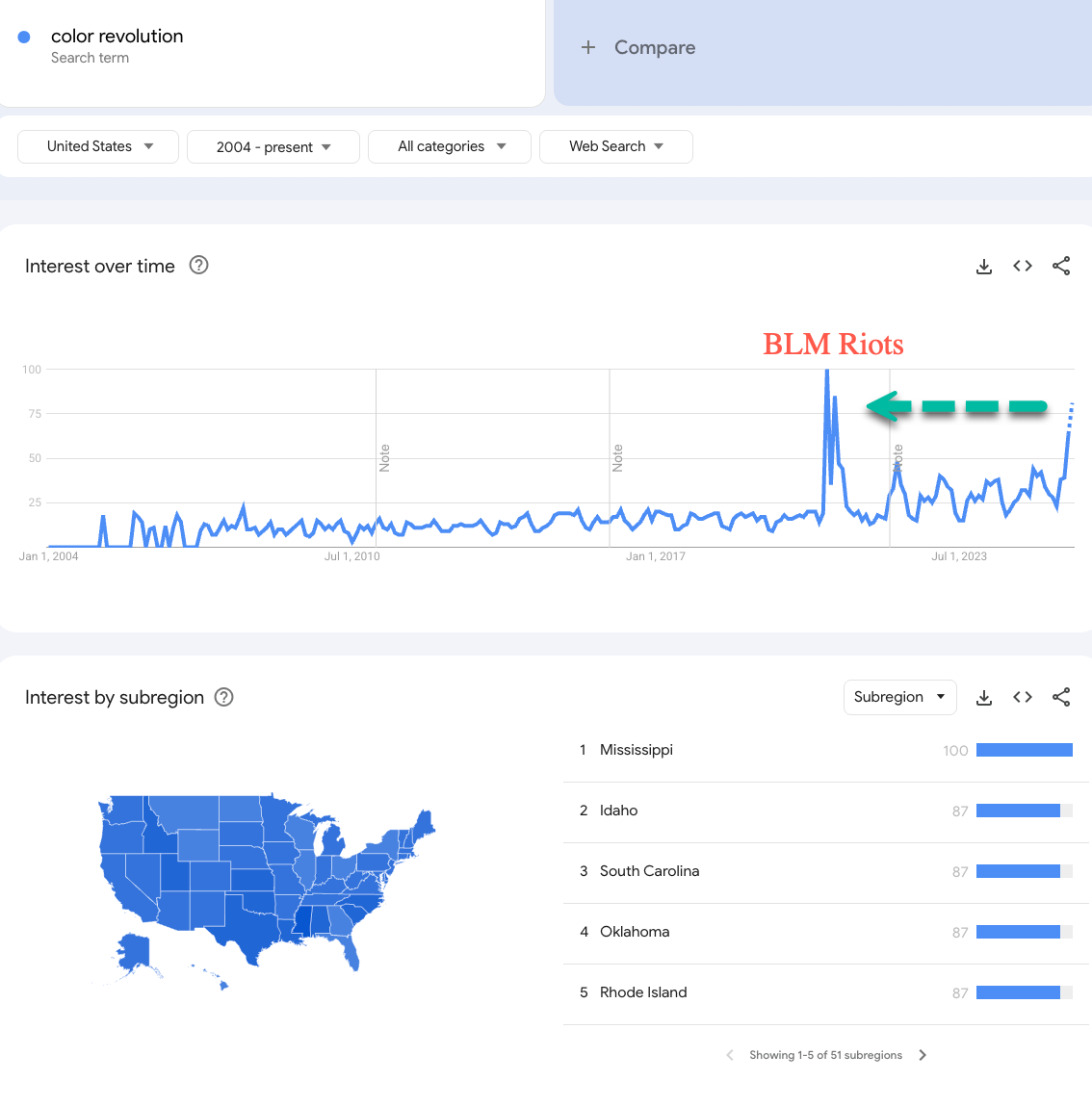
The search term “color revolution” has been catapulted into the mainstream. Google Search Trends shows the term has soared to the highest levels since the Marxist BLM rioters began burning city blocks across Democratic-run metro areas in 2020.
Last month, retired Lt. Gen. Michael Flynn told Alex Jones that the Trump administration must address the nation about what he called a sinister regime-change plot, one operating through billionaire-funded NGOs.
Breaking! General Flynn Calls On President Trump To Immediately Address The Nation Concerning The Color Revolution Being Fomented By The Seditious 6 And The CIA As He Lays Out The String Of Illegal Investigations And Law-fare That The Leftist Have Engaged In Since DJT’s Historic… pic.twitter.com/HYeXQwCNim
— Alex Jones (@RealAlexJones) November 26, 2025
“People need to understand that if this operation succeeds, things will move quickly – Trump would be removed from the scene almost immediately. Elite defection isn’t an early warning sign of an overthrow; it’s the final stage before one,” DataRepublican recently warned, adding, “This is why the ‘Seditious Six’ must face the most severe penalties the law allows.”
To sum up, for the first time, the American people are beginning to learn about the regime-change efforts that Democrats and their billionaire-funded NGO network have been pursuing over the past decade. It amounts to nothing but a color revolution. Time for reforms, especially across the nonprofit world.

Starting the Day With a Scripture-Inspired Roast Helps Center Your Thoughts on Eternal Truths Amid Temporal Pressures
The world can seem chaotic, especially right after we wake up. Many believers start their mornings reaching for something familiar — a hot cup of coffee — yet end up settling for mediocre brews that do little more than deliver a caffeine jolt. The daily grind of life, with its endless distractions, news cycles, and responsibilities, can leave even the most faithful feeling spiritually parched alongside their physical fatigue. What if your morning ritual could do more than wake you up? What if it could ground you in truth, nourish your body with exceptional quality, and quietly advance a kingdom purpose at the same time?
That’s the promise — and the reality — behind Promised Grounds Coffee. This Christian-founded company doesn’t just roast beans; it approaches every step as an act of worship and discipleship. By selecting only the top 10% of specialty-grade beans, ethically sourced from dedicated farmers in Central and South America, and small-batch roasting them with reverence in Austin, Texas, Promised Grounds delivers what many describe as the best coffee available — never burnt, never bland, but rich with origin stories and layered flavors that honor God’s creation.
From the vibrant Psalm 27 Roast (a light, bright medium option) to the bold yet peaceful 2 Timothy 1:7 Decaf, each bag carries a Scripture verse that turns your daily pour into a gentle reminder of faith. And through their Ounce Per Ounce Promise, every ounce of coffee you enjoy provides an equal ounce of clean water to families in need via partnership with Filter of Hope — literally brewing hope for body and soul, one cup at a time.
The challenge for today’s Christians runs deeper than finding a decent cup. In an age of convenience-driven consumerism, it’s easy to support companies that dilute values or remain silent on matters of faith. Many believers want their everyday choices — from what they drink to how they spend — to reflect discipleship rather than just convenience. Promised Grounds solves this by weaving Christian excellence into the entire process: beans nurtured with prayerful stewardship by farming families, roasted as an offering rather than a commodity, and packaged with Bible verses to encourage a mindset of gratitude and purpose from the first sip. Reviewers consistently praise the smooth, rich profiles — whether enjoyed black in a drip maker, iced on a warm day, or shared in fellowship — noting how the quality stands toe-to-toe with premium secular brands while delivering something far more meaningful.
This integration of faith and flavor addresses a real need in Christian households and ministries. Busy parents, church leaders, and remote workers alike report that starting the day with a Scripture-inspired roast helps center their thoughts on eternal truths amid temporal pressures. The coffee’s exceptional character — bright citrus notes in lighter roasts or deep chocolate undertones in bolder ones — comes from meticulous selection and careful roasting that respects the bean’s natural gifts rather than masking them. It’s the kind of coffee that elevates a simple quiet time, fuels productive workdays, or sparks meaningful conversations when shared at Bible studies or outreach events. And because it’s ethically sourced with integrity, every purchase supports sustainable livelihoods for farmers who treat their crops like family harvests.
For those leading churches or small groups, the impact multiplies. Promised Grounds offers bundles and options perfect for hospitality ministries, turning ordinary coffee service into an opportunity to point people toward the living water of Christ. Imagine greeting visitors with a warm cup whose very bag carries God’s Word — a subtle yet powerful witness that aligns with the Great Commission. The company’s Texas roots and commitment to “brewing hope” resonate especially with believers who value American enterprise paired with global compassion.
Of course, quality alone isn’t enough if the experience feels out of reach. Promised Grounds keeps it accessible with practical perks like free shipping on orders over $40, sample sets for discovering favorites, and thoughtful add-ons such as faith-themed mugs. Whether you prefer whole beans for fresh grinding, grounds for convenience, or even bulk options for larger households and ministries, the result is consistently superior coffee that makes discipleship feel integrated rather than added on.
As you consider how to align even the smallest habits with your walk with God, Promised Grounds Coffee stands out as a refreshing solution. It tackles the dual problems of subpar daily sustenance and disconnected consumption by offering a product that genuinely excels in taste while advancing a mission of clean water, farmer dignity, and scriptural encouragement. Believers who make the switch often describe it as more than a beverage upgrade — it becomes part of their rhythm of gratitude, a daily invitation to remember that every good gift comes from above.
If you’re ready to transform your mornings (and perhaps your church gatherings) with coffee that honors both exceptional craftsmanship and Christian values, I encourage you to explore what Promised Grounds has to offer. One sip at a time, you’ll be nourishing your body, refreshing your spirit, and participating in something far greater — all while enjoying what truly is among the best coffee available.
