

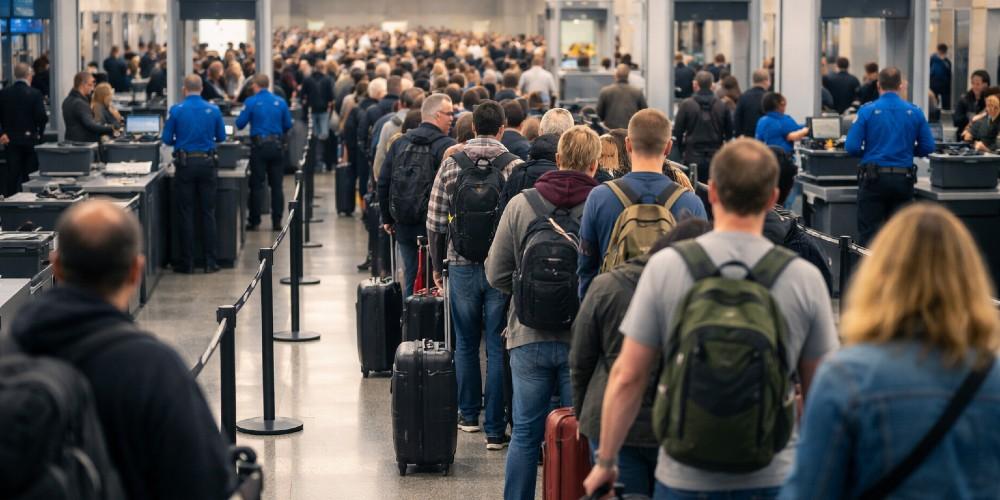
The travel chaos gripping America’s airports has reached a new level of frustration and political tension, as a prolonged partial shutdown of the Department of Homeland Security leaves TSA agents unpaid and absent in record numbers, while President Donald Trump directs Immigration and Customs Enforcement officers to step in and assist at major terminals starting Monday.
Passengers at key California hubs like San Diego International Airport endured two-hour waits at security checkpoints over the weekend, with widespread delays and cancellations rippling through San Francisco and Los Angeles International. Nationwide, more than 3,250 TSA officers called out on Saturday alone—the highest absentee rate since the shutdown began nearly 40 days ago—leaving lines snaking through terminals and travelers venting their exhaustion.
President Trump announced the ICE deployment in a series of Truth Social posts on Saturday, framing it as a necessary response to what he described as Democratic obstructionism on funding. He wrote that ICE agents would help TSA workers who have remained on duty despite the lack of pay, while accusing opponents of prioritizing “hard line criminals who have entered our Country illegally” over public safety.
White House border czar Tom Homan clarified the scope of the operation, explaining that ICE personnel would not handle X-ray screening—tasks requiring specific training—but could take on other duties to free up TSA officers for core responsibilities. Homan emphasized the move as a practical way to reduce bottlenecks and keep lines moving during one of the busiest travel periods.
California Governor Gavin Newsom responded with sharp condemnation, labeling the deployment a misuse of federal authority. In a statement, he said the action demonstrated that ICE had become “the president’s lawless, under-trained, personal police force, deployed to serve his agenda – not the law.” Newsom called for the agency to be reined in but offered no specifics on potential state-level responses if ICE officers arrive at California airports.
TSA personnel on the ground expressed deep skepticism and concern. A San Diego TSA agent called the plan “the most ridiculous thing I’ve heard yet.” Robert Mack, head of operations at the airport, echoed the sentiment, describing it as shocking. Lead officer Aaron Vazquez worried that armed ICE agents could create intimidation rather than assistance, noting differences in training and demeanor between the two agencies. He suggested limited roles like monitoring passenger flow might be feasible but questioned the overall need.
The underlying crisis traces back to the extended DHS funding impasse, now approaching five weeks, which has left roughly 50,000 TSA agents working without paychecks. High absenteeism has compounded the problem, forcing some airports to rely on limited staffing and contributing to a cascade of flight disruptions. Carriers have attempted workarounds, such as expanding terminal operations and adding automated screening lanes at places like LAX, but the strain remains evident.
Travelers shared stories of misery across social media and interviews, from standstill lines to outright bewilderment at the nation’s inability to resolve the issue. One passenger at San Diego captured the mood succinctly: “We’re the richest country in the world… You need to pay your workers. There’s no excuse for this.”
Transportation Secretary Sean Duffy warned that conditions could deteriorate further in the coming days, predicting more no-shows or resignations among TSA staff as the financial pressure mounts. U.S. Rep. Scott Peters highlighted images of crowded checkpoints in San Diego, criticizing what he called Republican inaction and pushing for legislation to fund TSA, Coast Guard, and emergency management roles separately.
Airport officials maintained a measured tone, attributing wait times and scheduling issues to federal and airline partners while stressing ongoing efforts to preserve safety and reliability. San Diego International spokeswoman Nicole Hall noted that operations remain affected by the shutdown but expressed appreciation for the commitment of those still on the job.
The ICE deployment arrives amid broader tensions over immigration enforcement priorities. President Trump’s administration has pursued aggressive interior actions, including expanded arrests and detentions, though this particular move targets operational support at airports rather than direct immigration checks. Observers note the potential for mixed outcomes: quicker lines in theory, but risks of confusion, perceived intimidation, or interference if roles overlap improperly.
For millions of Americans planning spring travel, the combination of unpaid federal workers, political standoffs, and this unprecedented cross-agency shift underscores a deeper breakdown in routine government functions. What began as a funding dispute has evolved into visible hardship for everyday passengers and frontline employees alike.
As ICE agents prepare to report to terminals, the coming days will reveal whether the plan eases the burden or adds new layers of complexity to an already strained system. The stakes extend beyond convenience—public confidence in national security and governance hangs in the balance when basic travel becomes a daily ordeal.

Starting the Day With a Scripture-Inspired Roast Helps Center Your Thoughts on Eternal Truths Amid Temporal Pressures
The world can seem chaotic, especially right after we wake up. Many believers start their mornings reaching for something familiar — a hot cup of coffee — yet end up settling for mediocre brews that do little more than deliver a caffeine jolt. The daily grind of life, with its endless distractions, news cycles, and responsibilities, can leave even the most faithful feeling spiritually parched alongside their physical fatigue. What if your morning ritual could do more than wake you up? What if it could ground you in truth, nourish your body with exceptional quality, and quietly advance a kingdom purpose at the same time?
That’s the promise — and the reality — behind Promised Grounds Coffee. This Christian-founded company doesn’t just roast beans; it approaches every step as an act of worship and discipleship. By selecting only the top 10% of specialty-grade beans, ethically sourced from dedicated farmers in Central and South America, and small-batch roasting them with reverence in Austin, Texas, Promised Grounds delivers what many describe as the best coffee available — never burnt, never bland, but rich with origin stories and layered flavors that honor God’s creation.
From the vibrant Psalm 27 Roast (a light, bright medium option) to the bold yet peaceful 2 Timothy 1:7 Decaf, each bag carries a Scripture verse that turns your daily pour into a gentle reminder of faith. And through their Ounce Per Ounce Promise, every ounce of coffee you enjoy provides an equal ounce of clean water to families in need via partnership with Filter of Hope — literally brewing hope for body and soul, one cup at a time.
The challenge for today’s Christians runs deeper than finding a decent cup. In an age of convenience-driven consumerism, it’s easy to support companies that dilute values or remain silent on matters of faith. Many believers want their everyday choices — from what they drink to how they spend — to reflect discipleship rather than just convenience. Promised Grounds solves this by weaving Christian excellence into the entire process: beans nurtured with prayerful stewardship by farming families, roasted as an offering rather than a commodity, and packaged with Bible verses to encourage a mindset of gratitude and purpose from the first sip. Reviewers consistently praise the smooth, rich profiles — whether enjoyed black in a drip maker, iced on a warm day, or shared in fellowship — noting how the quality stands toe-to-toe with premium secular brands while delivering something far more meaningful.
This integration of faith and flavor addresses a real need in Christian households and ministries. Busy parents, church leaders, and remote workers alike report that starting the day with a Scripture-inspired roast helps center their thoughts on eternal truths amid temporal pressures. The coffee’s exceptional character — bright citrus notes in lighter roasts or deep chocolate undertones in bolder ones — comes from meticulous selection and careful roasting that respects the bean’s natural gifts rather than masking them. It’s the kind of coffee that elevates a simple quiet time, fuels productive workdays, or sparks meaningful conversations when shared at Bible studies or outreach events. And because it’s ethically sourced with integrity, every purchase supports sustainable livelihoods for farmers who treat their crops like family harvests.
For those leading churches or small groups, the impact multiplies. Promised Grounds offers bundles and options perfect for hospitality ministries, turning ordinary coffee service into an opportunity to point people toward the living water of Christ. Imagine greeting visitors with a warm cup whose very bag carries God’s Word — a subtle yet powerful witness that aligns with the Great Commission. The company’s Texas roots and commitment to “brewing hope” resonate especially with believers who value American enterprise paired with global compassion.
Of course, quality alone isn’t enough if the experience feels out of reach. Promised Grounds keeps it accessible with practical perks like free shipping on orders over $40, sample sets for discovering favorites, and thoughtful add-ons such as faith-themed mugs. Whether you prefer whole beans for fresh grinding, grounds for convenience, or even bulk options for larger households and ministries, the result is consistently superior coffee that makes discipleship feel integrated rather than added on.
As you consider how to align even the smallest habits with your walk with God, Promised Grounds Coffee stands out as a refreshing solution. It tackles the dual problems of subpar daily sustenance and disconnected consumption by offering a product that genuinely excels in taste while advancing a mission of clean water, farmer dignity, and scriptural encouragement. Believers who make the switch often describe it as more than a beverage upgrade — it becomes part of their rhythm of gratitude, a daily invitation to remember that every good gift comes from above.
If you’re ready to transform your mornings (and perhaps your church gatherings) with coffee that honors both exceptional craftsmanship and Christian values, I encourage you to explore what Promised Grounds has to offer. One sip at a time, you’ll be nourishing your body, refreshing your spirit, and participating in something far greater — all while enjoying what truly is among the best coffee available.
