

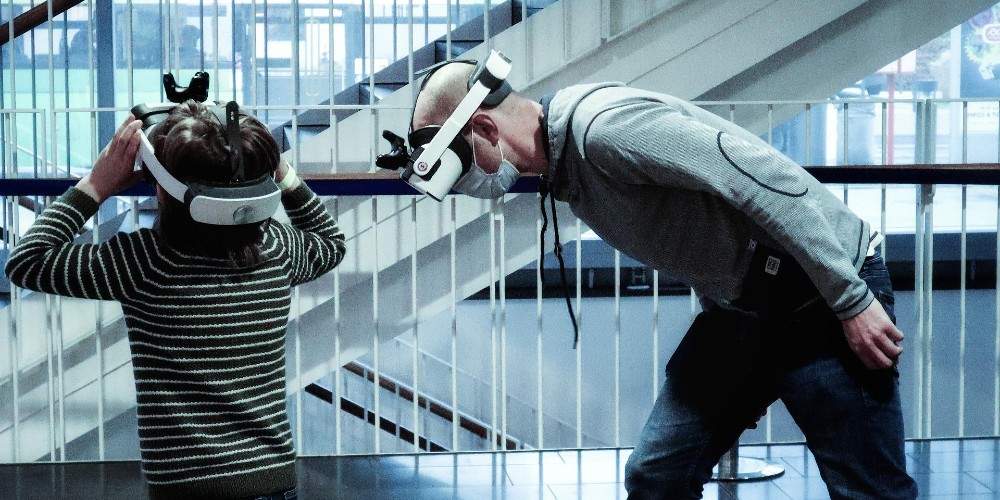
Leveraging the metaverse wasn’t the only topic on the agenda at this year’s World Economic Forum (WEF) annual meeting — the future of education, as envisioned by the meeting’s participants, also prominently figured in the meetings last month in Davos, Switzerland.
The WEF held several sessions on education, including “Growing Up in the Pandemic” and “Restating the Economic Case for Education.”
The theme coming out of this year’s meeting, in relation to education, is the sense of urgency in “reimagining” education, whose future — as imagined by WEF stakeholders — includes a heavy dose of virtual reality (VR) and artificial intelligence (AI) technologies.
While participants touted the purported economic benefits that would accompany the adoption of these technologies in the classroom, they had little to say about the need to protect children’s data or digital identities — or, for that matter, providing the types of early-life experiences children require as part of their socialization.
WEF touts new education-related initiatives
According to the WEF, “investing broadly” in the “skills of the future” may “add an additional $8.3 trillion in increased productivity to the global economy by 2030.”
This economic incentive appears to underlie the WEF’s “Reskilling Revolution” initiative, first introduced in 2020, and which brings together “50 CEOs, 25 ministers and 350 organizations committed to realizing these gains for their economies, societies and organizations.”
The aim of “Reskilling Revolution” initiative is to:
“…inspire large-scale global systems change across the skills and education agendas by demonstrating, in a tangible way, how progress can be achieved on highly complex and intractable issues by reframing and piloting new models and templates for action; accelerating vehicles for coordinating and funding collective action at scale; and strategically raising the bar on what credible business leadership commitment on reskilling, upskilling and education transformation looks like.”
The WEF claims its “work will benefit over 100 million workers on their journey towards reaching 1 billion people by 2030 with better education, skills and economic opportunity.”
What is the impetus for this initiative?
According to the WEF, it’s the “Fourth Industrial Revolution,” which is “creating demand for millions of new jobs, with vast opportunities for fulfilling people’s aspirations and potential,” but which is being held back by “unequal opportunity, job displacement and widening inequality,” including in schools.
The WEF argued:
“With societal unrest on the rise across much of the industrialized and emerging world, labour markets in flux from the fallout of the pandemic, technological disruption and the green transition, collaboration between the public and private sectors can advance an entirely different agenda, where people’s futures and global economic prospects are enhanced by mobilizing worldwide mass action on reskilling, upskilling and education transformation.”
The “Reskilling Revolution” initiative encompasses three components: 1) “connecting action and thought leaders;” 2) “inspiring the next generation of bold business leadership commitment on the human capital investment agenda;” and 3) developing “innovative pilots for action at national, industry, organizational and school levels.”
The initiative has already led to the launch of “accelerators” in 12 countries, and the mobilization of “a multistakeholder community of over 350 organizations.”
At this year’s WEF meeting, the Education 4.0 Alliance was added to this initiative, as part of the WEF’s broader New Economy and Social Platform, in an effort to “expand beyond adult reskilling and upskilling and integrate a focus on education for children and youth.”

Specifically, the three main objectives of this new alliance include:
- “Align on key skills for childhood education and co-create a public narrative around the importance of incorporating these skills in childhood learning.
- Surface and promote innovative, public-private-led approaches to developing Education 4.0 skills.
- Incentivize and reward the adoption of Education 4.0 skills within childhood learning.”
Saadia Zahidi, managing director of the WEF, described the new alliance:
“In an era of multiple disruptions to the labour market — the pandemic, supply chain changes, the green transition, technological transformation — the one ‘no regret’ investment all governments and business can make is in education, reskilling and upskilling.
“It is the best pathway to expanding opportunity, enhancing social mobility and accelerating future growth.”
Further emphasizing the projected economic benefits of such an educational transition, the launch of the Education 4.0 Alliance was accompanied by the release of a report: “Catalysing Education 4.0: Investing in the Future of Learning for a Human-Centric Recovery.”
The report “focuses on a broad range of skills to prepare learners for the Fourth Industrial Revolution, and leverages technological and pedagogical innovation to put learners at the centre of learning.”
Arguing there is today “a unique window of opportunity to invest in Education 4.0,” the report claims that “preparing today’s generation of school-age children with better collaborative problem-solving … could add $2.54 trillion — more than $3,000 per school-age child — from this one skill alone.”
The report presents “three key investment areas” related to the Education 4.0 Alliance: 1) new assessment mechanisms; 2) adoption of new learning technologies; and 3) empowerment of the teaching workforce.

Ushering in virtual reality learning?
Describing a hypothetical scenario in which COVID-related closures of educational institutions interrupted one student’s nursing education, the WEF presents VR technology as coming to the rescue, via a “virtual emergency room.”
The WEF defines VR training as “the process of learning in a simulated or artificial environment,” adding that it “has existed in the realm of education for over half a century but has dramatically expanded over the past fifteen years.”
An article released as part of this year’s WEF meeting states, “VR is making education less conventional and [is] advancing K-12, higher education and vocational training.”
According to the WEF, “training using Virtual Reality has recently been applied in many education fields, but primarily in health and safety, engineering, and technical education.”
Why is VR learning such an apparent priority for the WEF?
According to the WEF, “Education is the foundation of a strong economy. It increases human capital [emphasis added], drives productivity and boosts economic output,” and for individuals, “education paves the way to acquire new skills, develop critical thinking and analytical know-how, contribute to economic welfare, develop a sense of purpose and shape one’s career.”
However, “Methods to educate people have not always kept pace with technological developments,” the WEF said, with “imminent” change expected in the next 10 years, making “the imperative of change … more apparent.”
Highlighting this, a WEF report claims that by 2065, 65% of children currently in primary school will work in job positions that do not exist today.
As a result, the WEF argued, “AI should be incorporated into school curricula to equip future generations with coding skills and provide them with adequate AI training.”
Indeed, technologies such as AI and VR are described as “the forces of change” that have made the present moment “the time to act.”
Justifying the sought-for expansion of such technologies in the classroom, the WEF argues that even before COVID-19 entered our lives, it was “particularly challenging for educational systems” to provide hands-on laboratories for students.
However, instead of investing in said laboratories, “Educators are starting to rely on VR simulations to develop learning experiences that would otherwise not be easily accessible to students.”
While praising the remote education technologies that became commonplace over the past two-plus years of COVID-19-related restrictions, and the UN’s role in providing these technologies to developing economies, the WEF said these technologies alone are insufficient, as “they mostly focused on transferring knowledge, not the practical and in-person experience students needed to grasp concepts.”
For the WEF, this does not result in an argument in favor of a return to the status quo, but instead, a “transformation” that will “disrupt education” and “revolutionize teaching and learning,” via “innovative pedagogies, augmented reality, virtual reality (VR) and mixed reality,” which “create a competitive advantage for all stakeholders involved.”
Reflecting the metaverse concept it is concurrently promoting, the WEF said this would be a “re-envisioned” learning environment, “using multiple physical and virtual spaces both in and outside of schools,” and where “there would be full individual personalization of content and pedagogy enabled by cutting-edge technology, using body information, facial expressions or neural signals.”
Indeed, the WEF said the use of “textbooks, notebooks and pencils as critical learning tools” is on the way out, due to “environmental pressures and COP26 goals (from the 2021 United Nations Climate Change Conference),” which “will drive the digitalizing of education streams.”
Instead, this new technology can be “coupled with the metaverse” so that students may “immerse themselves in an interactive experience where they can visualize their actions’ outcomes first-hand” while benefiting from an accelerated learning curve “in a simulated environment, reproducing real-life conditions and situations without time or space limitations and much fewer risks than real environments.”
The WEF touted several “advantages” to learning using VR and similar technologies, including:
- “The advantage of providing students and teachers with a standardized, reproducible environment for repeated and optimized training.”
- Allowing “gamification, performance metrics, and collaborative features (using avatars)” to be “embedded in the software, enabling continuous peer interaction, active learning, enjoyment, and performance feedback.”
The WEF cited research showing “VR positively influences students’ learning outcomes,” and improves “student-teacher interactions through practical hybrid implementation, whether in or out of the classroom.”
Another study cited by the WEF, supported by the Korea World Bank Partnership Facility, claims VR learning “is more effective than traditional teaching at developing technical, practical and socio-emotional skills,” improving students’ confidence by 20% and their “efficiency” by 30%.
Other benefits of VR learning, the WEF said, include “global teleportation,” “the time machine effect,” “multi-sensory experiences,” “active autonomy,” “focused immersion,” an “empathy agent,” and “extraordinary abilities” that “break the laws of physics.”
Using more economic terminology, the WEF emphasized the need for “unlocking … maximum output” from these technologies.
Already, according to the WEF, these technologies are bringing about changes in educational systems across the world, as “schooling systems in many countries have already opened up to new stakeholders,” where “consultation is giving way to co-creation.”
In March 2019, the WEF presented a set of global standards “for digital literacy, skills and readiness across the education and technology sectors,” encompassing “the eight digital citizenship skills” every child will need, including “digital citizen identity,” “digital empathy,” and “cyber security management.”
What is particularly noteworthy is that the WEF emphasized the importance of preparing “our education systems for the future” in relation to the need to “achieve our vision” — a vision, however, that is not clearly specified or defined.
Indeed, “current spaces, people, time and technology in schooling” are called into question regarding the extent to which they are “helping or hindering” this unspecified vision.
Instead, the WEF tells us, “the COVID-19 pandemic shows us we cannot take the future of education for granted,” and that “by imagining alternative futures for education we can better think through the outcomes, develop agile and responsive systems and plan for future shocks.”
These “alternative futures” were outlined by the Organization for Economic Co-operation and Development as part of its “four scenarios for the future of schooling,” which were cited by the WEF and which include:
- The expansion of formal education.
- The outsourcing of education, as “traditional schooling systems break down, a process where digital technology will be “a key driver.”
- The transformation of schools into “learning hubs” where “diversity and experimentation have become the norm.”
- A “learn-as-you-go” model where “education takes place everywhere, anytime” and where “distinctions between formal and informal learning are no longer valid as society turns itself entirely to the power of the machine.”
According to the WEF, “schools could disappear altogether” on the back of “rapid advancements in artificial intelligence, virtual and augmented reality and the Internet of Things.”
Privacy and data protection an oversight?
While the perceived or projected economic benefits of a move toward VR and AI in education figure prominently in the WEF’s articles and reports, there’s much less emphasis on privacy and data protection, particularly for children.
However, a number of organizations, advocacy groups, educators and parents have raised concerns on that front.
In the report issued as part of this year’s WEF meeting, these concerns appear almost as an afterthought, and are quickly glossed over:
“It should be noted that VR does somewhat limit human interaction if not appropriately monitored and introduced with a guided programme and can cause isolation in younger generations.
“Still, with the proper research, developments and safeguards, the benefits of VR outweigh the risks.”
A separate January 2022 WEF report explores and analyzes these concerns in more detail. The report states, for instance:
“Scepticism on the widespread use of AI is also present in discussions on children’s privacy and safety.
“Children’s information including sensitive and biometric data is captured and processed by intelligent devices including virtual assistants and smart toys. In the wrong hands, such data could put children’s safety at risk.”
The report cites a 2017 incident in which CloudPets teddy bears were withdrawn from the market as a result of “a data breach that exposed private information including photos and recordings of more than two million children’s voice messages.”
In addition, the report states:
“Serious concerns have also been raised over the use of children’s data, such as juvenile records in AI systems, to predict future criminal behaviour and recidivism.
“Other than posing a threat to privacy, civil society representatives and activists have warned against possible discrimination, bias and unfair treatment.”
According to the WEF, though, it has already foreseen solutions to these issues, stating:
“To ensure that AI is child-centred, decision-makers and tech innovators must prioritize children’s rights and wellbeing when designing and developing AI systems.
“UNICEF and OHCHR have been particularly vocal in this regard. As part of its AI for Children project, UNICEF has worked closely with the World Economic Forum to develop policy guidance on artificial intelligence for children featuring a set of recommendations for building AI policies and systems that, among other things, uphold children’s rights to privacy and data protection.”
However, such concerns were not emphasized in any way as part of the WEF’s promotion of its new Education 4.0 Alliance or in the reports and articles arising from its recent annual meeting.
© 2022 Children’s Health Defense, Inc. This work is reproduced and distributed with the permission of Children’s Health Defense, Inc. Want to learn more from Children’s Health Defense? Sign up for free news and updates from Robert F. Kennedy, Jr. and the Children’s Health Defense. Your donation will help to support us in our efforts.

Two Storms, One Harvest

Every food crisis in living memory has been a one-shock event. The 2008 price spike was a commodity bubble. The 2020 shortages were a logistics failure. The 2022 grain scare was a war on one exporter’s ports. Each time, the system bent, adjusted, and recovered, and each time the experts assured us afterward that global markets are simply too big and too diversified to fail.
What nobody in Washington seems eager to discuss is that 2026 is shaping up to be something the modern food system has never actually faced. Two independent shocks, one climatic and one geopolitical, are converging on the same harvest cycle at the same time. Not sequentially. Simultaneously.
Start with the weather. The Pacific Ocean is currently building toward what forecasters now openly call a record event. NOAA’s Climate Prediction Center puts the odds of at least a strong El Niño near 88 percent, with roughly two in three odds it reaches “very strong” status, the tier reserved for perhaps three or four events in the entire satellite era. Every major global model now projects a median peak in Super El Niño territory, and most of them project it exceeding the 2015-16 event, which until now held the modern record. Sea surface anomalies were already brushing the super threshold in mid-July, months before these events normally peak. The atmosphere has already shifted into El Niño mode, and the event is forecast to crest in late fall and early winter.
This is not about “climate change.” It’s about the standard cycles of weather, and the cycle we’re currently in is one that has likely devastated societies in the past. We’re better prepared as a society today, but not all Americans are equally prepared.
Serious households have started doing the quiet math on their own. Grocery bills tell part of the story, and the forecast maps tell the rest, which is why long-term food storage has moved from fringe hobby to mainstream line item in the family budget, with established suppliers like Heaven’s Harvest seeing demand from people who five years ago would have rolled their eyes at the idea. That instinct is not paranoia. It is pattern recognition, and the pattern is worth walking through carefully.
Editor’s Note: Heaven’s Harvest IS a sponsor, but the warnings of this article are real and would be written even if we didn’t have a survival food sponsor. With that said, those who take advantage of what they offer can use promo code “Patriot” for 15% off.
The Fertilizer Clock Is Already Running
While the Pacific warms, the second shock has been unfolding in the Strait of Hormuz. The conflict with Iran turned the world’s most important energy chokepoint into a contested waterway, and the consequences reach far beyond the gas pump. Roughly a third of global fertilizer trade moves through Hormuz, and the disruption sent urea prices up 86 percent year over year by March, with a 53 percent jump in a single month.
The World Bank projects energy prices rising about 24 percent in 2026 and fertilizer about 31 percent. By its own accounting, fertilizer prices ran 35 percent higher in the first five months of this year than the same period last year.
Here is the mechanism the nightly news will not explain. Fertilizer is not a grocery item. It is a time-delayed input. The nitrogen a farmer in Iowa or Punjab could not afford to apply this spring does not show up as a problem this spring. It shows up as a thinner harvest six to twelve months later.
The World Bank’s own food security brief concedes that the effects of reduced applications earlier this season “are likely to become visible only later in harvest outcomes.” Translate that from institutional language into plain English and it means this. The damage is already done, it is already in the ground, and we are simply waiting for it to arrive on the shelf.
Now check the calendar. Six to twelve months from the spring planting season lands us squarely in late 2026 and early 2027. Which is precisely when the strongest El Niño in the instrumental record is forecast to peak, bringing its signature droughts to Southeast Asia, Australia, southern Africa, northern Brazil, and South Asia, the very regions that grow the world’s rice, sugar, and oilseeds.
The World Bank warns openly that a strong El Niño “could disrupt multiple crop belts simultaneously” on top of the conflict-driven input costs. Their baseline projection assumes the Middle East disruptions ease by autumn. What in the last two years of Middle East history suggests that assumption is safe?
The System Has No Slack Left
The comfortable answer is that global markets always adjust. But adjustment requires slack, and the slack is gone. Global cereal production is expected to decline from last year’s records even before El Niño does its work. The UN World Food Programme, hardly a den of right-wing preppers, is calling this the most significant disruption to its supply chains since Covid and the invasion of Ukraine, and its supply chain director put the stakes bluntly.
Today’s supply chain challenges are tomorrow’s hunger crisis.
There is also a political dimension that markets cannot price. When food gets scarce, governments do not behave like economists. They behave like politicians. Export bans, hoarding mandates, and panic buying at the national level turned the modest rice shortfall of 2008 into a global crisis, and analysts are already warning that import-dependent nations are the first dominoes.
The 2015-16 Super El Niño, a far weaker event than what is now forecast, threw tens of millions into food stress across Africa and Asia. This one is projected to be stronger, and it arrives with fertilizer already rationed by price and shipping lanes already contested by missiles.
What Joseph Knew
Scripture does not treat preparation for lean years as faithlessness. It treats it as wisdom delivered in advance to those willing to act on it.
Behold, there come seven years of great plenty throughout all the land of Egypt: And there shall arise after them seven years of famine; and all the plenty shall be forgotten in the land of Egypt.
Joseph did not respond to that warning with a hashtag or a committee. He stored grain during the years of abundance, and when the famine came, Egypt stood while its neighbors begged. The lesson is not that famine is certain. It is that the time to prepare is precisely when preparation still looks optional.
Nobody who filled a pantry in a year of plenty has ever regretted it, and nobody standing in an empty aisle has ever been glad he waited for certainty.
None of this calls for panic, and panic is the enemy of sound judgment anyway. It calls for the same unglamorous prudence our grandparents considered ordinary. Keep some cash margin, know your local growers, and put real food in deep storage while it is cheap and available, because the entire arc of this story is that cheap and available is a closing window.
Families looking for a straightforward place to start can visit Heaven’s Harvest and use promo code Patriot for 15 percent off long-term storable food. The forecasts may yet soften, the strait may yet reopen, and we should pray they do. But hope is a fine thing to hold and a foolish thing to eat.

WEF and their vision 2030, they dont hide what their goals are, anyone can go read, the WEF talks were public everyone can listen, and still no outcry… its all fine.
Children will sure spend alot time in the coming metaverse, education and entertainment it all gets combined.
It’s been shown that in children and youth social skills, knowledge retention, and the ability to communicate effectively are all inversely proportional to the amount of education that is done via “screen time”. The more screen time, the less effective is the learning experience. VR and AR are not effective nor healthy substitutes for the traditional and very effective modes of learning that involve direct human interaction and tactile methods.