

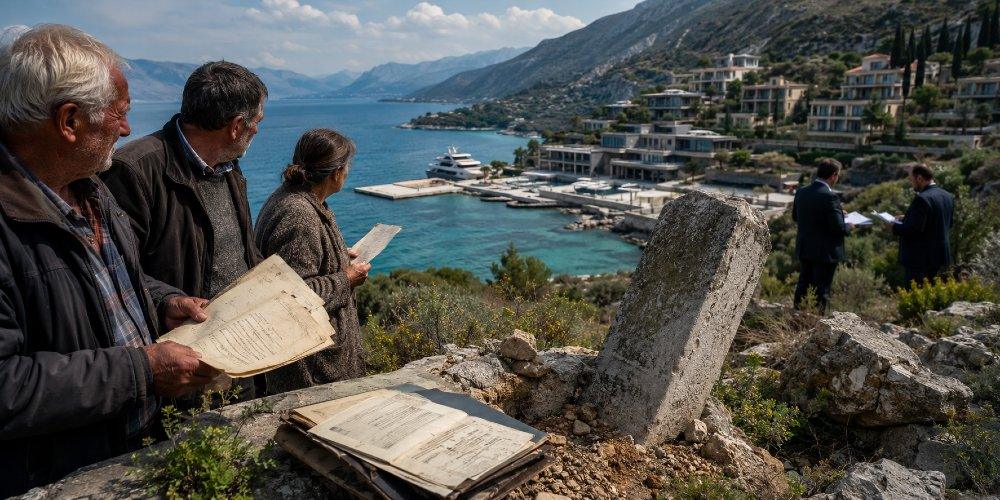
“Cursed be he that removeth his neighbour’s landmark. And all the people shall say, Amen.”
That ancient command was read aloud to an entire nation because civilization itself depends on one unglamorous thing, secure title to land. Strip that away and everything built on top of it, commerce, family inheritance, the rule of law, collapses into a contest of force and forgery.
Which brings us to the Adriatic coast of Albania, where Jared Kushner’s multi-billion-dollar resort project just collided with a problem older than any government in Europe.
According to case files reviewed by Reuters, Albania’s anti-corruption and organized crime agency, known as SPAK, suspects that Artur Shehu, the Miami-based businessman who sold a strip of coastline to the resort’s land entity in April, built his real estate holdings on forged ownership documents.
Prosecutors have issued a warrant for Shehu’s arrest, accusing him and associates of trafficking South American cocaine into European ports and laundering the proceeds through property. Prosecutors wrote in the files that there are reasonable suspicions, based on evidence, that the assets were acquired through forged documents.
Shehu denies everything. His lawyer, Kujtim Cakrani, told Reuters his client is neither a drug trafficker nor a forger, that the family has held the land since Ottoman times, and that it is widely assumed in Albania that prosecutors answer to political and business interests.
That last claim deserves attention rather than dismissal. Albania is a country where the deputy prime minister was charged with corruption last year and a socialist parliamentary majority blocked her arrest. Skepticism about prosecutorial independence there is not paranoia, it is pattern recognition. Shehu remains an accused man, not a convicted one.
What the Coverage Wants You to Miss
Here is the part the headline writers hope you will skim past. The 200 pages of case files make no allegation of wrongdoing against Kushner, against Sazan Real Estate Development, against Albania Land Development, or against any investor in the project. Reuters found no indication that anyone involved knew of any suspicions about Shehu when the land changed hands. A SPAK spokesperson separately told CBS News that its investigation does not concern any company associated with Kushner.
The legacy press will nonetheless run this as a Kushner scandal, because a Trump family name in a headline about cocaine and forgery is irresistible, and because the standard applied to this family has never been the standard applied to anyone else.
When the Biden family’s business entanglements ran through actual foreign officials, we were told there was nothing to see. When a Kushner-backed entity buys land from a seller who later comes under investigation, with no allegation the buyers knew anything, it becomes an international story within hours. Note the machinery and adjust your reading accordingly.
The Real Story Is Property Rights
None of that means Americans should wave this away, because underneath the tabloid framing sits an issue we claim to care about more than anyone. Residents of the village of Zvernec have been contesting Shehu’s claim to this land in Albanian courts for more than a decade. Last month a dozen of them showed Reuters their own title deeds and tax records, and their lawyer says they intend to seek a court order halting the project. One landowner, Nikolin Markpalaj, told Al Jazeera that what is happening in his country is madness.
If those villagers hold legitimate title, then no resort, however gorgeous the renderings Kushner posted in 2024, has a right to rise on their land. That is not an anti-development position. It is the development position, because no serious investor builds billions of dollars of hotels, villas, and yacht jetties on a foundation of disputed deeds.
Albania’s land records have been a shambles since communism collapsed, competing claims date back generations, and the government of Prime Minister Edi Rama has bulldozed ahead anyway, declaring the project beautiful and promising it will proceed regardless.
“Regardless” is doing a lot of work in that sentence. A government that backs a foreign-linked megaproject regardless of unresolved title disputes and an active forgery investigation is not defending investment, it is advertising that property rights in Albania are negotiable, which is precisely why the country stayed poor for so long.

Ivanka Trump has said she and her husband conceived the resort after spotting the coastline from a yacht. It is a fine origin story. But the lesson of this week is that in countries where the landmark can be moved with a forged paper and a friendly ministry, the view from the yacht is the easy part.
The Kushner team’s smartest move now is the boring one, let the Albanian courts sort the title completely, publicly, and to the satisfaction of the villagers holding those old deeds, before another shovel touches the sand. Build on clean title or do not build at all.
And all the people shall say, Amen.

Starting the Day With a Scripture-Inspired Roast Helps Center Your Thoughts on Eternal Truths Amid Temporal Pressures
The world can seem chaotic, especially right after we wake up. Many believers start their mornings reaching for something familiar — a hot cup of coffee — yet end up settling for mediocre brews that do little more than deliver a caffeine jolt. The daily grind of life, with its endless distractions, news cycles, and responsibilities, can leave even the most faithful feeling spiritually parched alongside their physical fatigue. What if your morning ritual could do more than wake you up? What if it could ground you in truth, nourish your body with exceptional quality, and quietly advance a kingdom purpose at the same time?
That’s the promise — and the reality — behind Promised Grounds Coffee. This Christian-founded company doesn’t just roast beans; it approaches every step as an act of worship and discipleship. By selecting only the top 10% of specialty-grade beans, ethically sourced from dedicated farmers in Central and South America, and small-batch roasting them with reverence in Austin, Texas, Promised Grounds delivers what many describe as the best coffee available — never burnt, never bland, but rich with origin stories and layered flavors that honor God’s creation.
From the vibrant Psalm 27 Roast (a light, bright medium option) to the bold yet peaceful 2 Timothy 1:7 Decaf, each bag carries a Scripture verse that turns your daily pour into a gentle reminder of faith. And through their Ounce Per Ounce Promise, every ounce of coffee you enjoy provides an equal ounce of clean water to families in need via partnership with Filter of Hope — literally brewing hope for body and soul, one cup at a time.
The challenge for today’s Christians runs deeper than finding a decent cup. In an age of convenience-driven consumerism, it’s easy to support companies that dilute values or remain silent on matters of faith. Many believers want their everyday choices — from what they drink to how they spend — to reflect discipleship rather than just convenience. Promised Grounds solves this by weaving Christian excellence into the entire process: beans nurtured with prayerful stewardship by farming families, roasted as an offering rather than a commodity, and packaged with Bible verses to encourage a mindset of gratitude and purpose from the first sip. Reviewers consistently praise the smooth, rich profiles — whether enjoyed black in a drip maker, iced on a warm day, or shared in fellowship — noting how the quality stands toe-to-toe with premium secular brands while delivering something far more meaningful.
This integration of faith and flavor addresses a real need in Christian households and ministries. Busy parents, church leaders, and remote workers alike report that starting the day with a Scripture-inspired roast helps center their thoughts on eternal truths amid temporal pressures. The coffee’s exceptional character — bright citrus notes in lighter roasts or deep chocolate undertones in bolder ones — comes from meticulous selection and careful roasting that respects the bean’s natural gifts rather than masking them. It’s the kind of coffee that elevates a simple quiet time, fuels productive workdays, or sparks meaningful conversations when shared at Bible studies or outreach events. And because it’s ethically sourced with integrity, every purchase supports sustainable livelihoods for farmers who treat their crops like family harvests.
For those leading churches or small groups, the impact multiplies. Promised Grounds offers bundles and options perfect for hospitality ministries, turning ordinary coffee service into an opportunity to point people toward the living water of Christ. Imagine greeting visitors with a warm cup whose very bag carries God’s Word — a subtle yet powerful witness that aligns with the Great Commission. The company’s Texas roots and commitment to “brewing hope” resonate especially with believers who value American enterprise paired with global compassion.
Of course, quality alone isn’t enough if the experience feels out of reach. Promised Grounds keeps it accessible with practical perks like free shipping on orders over $40, sample sets for discovering favorites, and thoughtful add-ons such as faith-themed mugs. Whether you prefer whole beans for fresh grinding, grounds for convenience, or even bulk options for larger households and ministries, the result is consistently superior coffee that makes discipleship feel integrated rather than added on.
As you consider how to align even the smallest habits with your walk with God, Promised Grounds Coffee stands out as a refreshing solution. It tackles the dual problems of subpar daily sustenance and disconnected consumption by offering a product that genuinely excels in taste while advancing a mission of clean water, farmer dignity, and scriptural encouragement. Believers who make the switch often describe it as more than a beverage upgrade — it becomes part of their rhythm of gratitude, a daily invitation to remember that every good gift comes from above.
If you’re ready to transform your mornings (and perhaps your church gatherings) with coffee that honors both exceptional craftsmanship and Christian values, I encourage you to explore what Promised Grounds has to offer. One sip at a time, you’ll be nourishing your body, refreshing your spirit, and participating in something far greater — all while enjoying what truly is among the best coffee available.
