

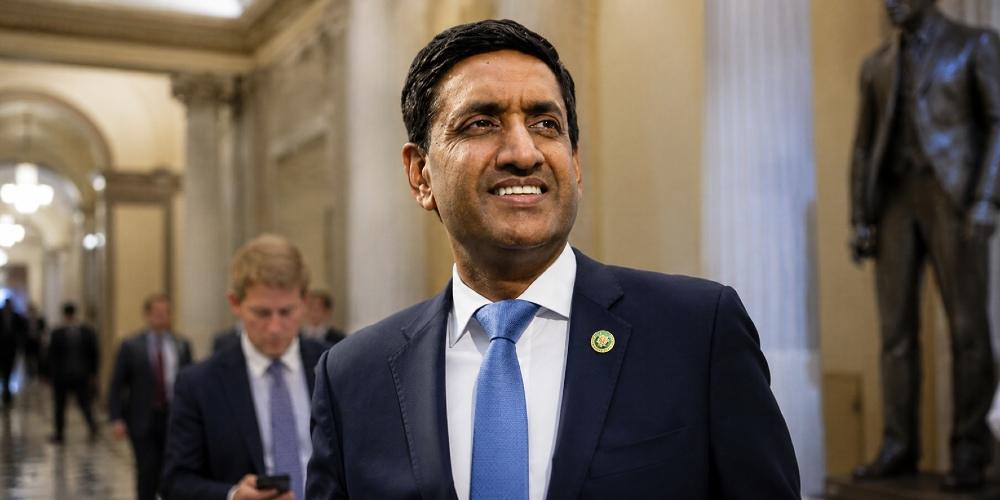
(Zero Hedge)—Rep. Ro Khanna (D-CA) – fresh off endorsing California’s November ballot measure to seize 5% of billionaire wealth – published a Substack essay Wednesday titled, no really, “Why I Support a Billionaire Wealth Tax.”
He makes it roughly a dozen paragraphs before explaining that it isn’t one.
“The tax should not stop at billionaires, it must reach centimillionaires,” Khanna writes, before spelling out exactly what that means: every fortune of $50 million and up, hit with a 2% federal levy on wealth above that line – every year, forever, on top of everything else you already pay. The vehicle is Elizabeth Warren’s Ultra-Millionaire Tax Act, which Khanna notes he has cosponsored every single year it’s been introduced.
And before anyone reaches for the estate planner: Khanna wants the levy to pierce irrevocable trusts, with the tax billed to the grantor who set them up – because parking a fortune in a trust, in his telling, shouldn’t take it off the government’s books.
Former Microsoft executive Steven Sinofsky summed up the reveal in eight words: “Just like that, no longer a billionaires tax.”
Pirate Wires’ Mike Solana was less diplomatic, characterizing the scheme as an annual asset seizure in which the government tallies everything you own and demands a cut on top of your existing tax bill – now openly targeting anyone worth $50 million. His prediction for where the ratchet stops: “this ends with your 401k.”
For those keeping score at home, the threshold discourse has traveled a long way in a short time:
The measure headed to California voters in November is a one-time 5% tax on the state’s roughly 250 billionaires. Newsom, opposing it, countered on June 26 with a national “billionaires’ tax” – which, in its original form, applied to anyone worth $100 million or more, language that was quietly scrubbed after multiple outlets quoted it as we reported. Six days later, Khanna planted the flag at $50 million.
None of this is exactly new, of course. The Warren bill has carried the $50 million line since she rolled it out in 2019, and Biden’s 2022 “Billionaire Minimum Income Tax” kicked in at $100 million households. The branding always says billionaire, but the fine print ios a slippery slope.
Then there’s inflation… The bill’s $50 million threshold is a flat statutory number that hasn’t moved since 2019 – meaning inflation has already quietly cut the real threshold by more than a fifth. The creep shows up in the sponsors’ own math: when the bill debuted, backers said it touched the top 0.05% of American households; the 2026 reintroduction, per the same Saez-Zucman analysis the sponsors tout, now reaches 260,000 households – the top 0.15%. Same words, triple the coverage, five years. Asset inflation does the broadening automatically. Congress just has to sit still.
The escalator, meanwhile, is pre-drafted: buried in the bill is a provision doubling the top rate to 6% automatically in any year that qualifying trigger legislation is on the books.
And anyone curious where a “normalized” wealth tax eventually settles can consult the countries that already normalized one. Norway’s kicks in around $160,000 of net worth. The Netherlands taxes deemed returns on assets above roughly €57,000. Swiss cantons start in the low six figures. The European wealth taxes that stayed rich-only – France, Sweden, Germany, Austria, Denmark – were repealed as revenue duds. The ones that survived did so by reaching the middle class. The slippery slope is quite literally the only way these things ‘work.’
Khanna spends a portion of the essay taking intramural shots at Newsom, dismissing the governor’s version as an income tax billionaires will never feel – since they take no salary, borrow against their stock, and pass fortunes to their kids without selling a share – while boasting that he and Bernie Sanders tax the wealth itself, to the tune of a claimed $4.4 trillion.
The replies were not kind. Christopher Rufo suggested Washington recover the estimated half-trillion dollars a year lost to fraud before inventing new revenue streams. The most-liked response, from James Hafner, noted that the essay’s “philosophical case” never actually argues its one load-bearing premise – that one man’s need constitutes a claim on another man’s property. “There is arithmetic, and there is need,” Hafner wrote of the piece’s actual contents.
Khanna’s comeback – asking Hafner what he thinks of property taxes – was promptly ratioed, sitting at 135 replies to 11 likes at press time.


Except – property taxes are local, visible, and appealable; they pay for the pothole crew, the 2 a.m. patrol car, and the school down the street – and when assessments outran paychecks, voters famously revolted and capped them. Khanna’s essay actually frames the California fight as Proposition 13 in reverse, which is a remarkable self-own: he’s marketing the sequel to a movie that ended in a taxpayer revolt, triggered by precisely the dynamic critics warn about – paper valuations rising faster than the cash available to pay the levy.
The federal version offers none of the offsetting virtues. The Ultra-Millionaire Tax deposits into the general fund; the child-care-and-community-college wish list lives in the press release, not the bill text. What the bill text does contain is enforcement – just not of the spending. It orders the IRS to audit at least 30% of everyone subject to the tax, every single year. It hands the agency expanded authority to assign values to private businesses, farmland, art, and anything else that’s hard to price. It wires in FATCA-style third-party reporting. And should you decide you’ve had enough of the annual appraisal and leave, it imposes a 40% exit tax on net worth above $50 million on your way out the door. In other words: relentless annual oversight of the taxpayers, and none whatsoever of where the money goes. Even Khanna seems to grasp the trust problem – he launched a state-fraud probe in December, conceding taxpayers “need to have a receipt” for what their money funds – which rather makes Rufo’s point: by his own estimate Washington loses half a trillion a year to fraud, and the remedy on offer is an audit of your art collection.
All of which lands a little awkwardly next to this week’s Free Beacon report detailing how Khanna’s own family fortune – courtesy of centimillionaire father-in-law and auto-parts magnate Monte Ahuja – is sheltered through the very sort of irrevocable trusts the congressman now wants taxed to the grantor. Per the Beacon, Khanna’s minor children hold trust stakes in three private golf clubs and multiple hedge funds, the family occupies a $6 million, marble-clad Washington home with a private elevator, and the congressman’s financial disclosures run to 333 pages of conveniently non-searchable tables.
What it does say, in writing, is what the fine print has said all along: the number was never $1 billion. This week it’s $50 million. Ask again next cycle.

Starting the Day With a Scripture-Inspired Roast Helps Center Your Thoughts on Eternal Truths Amid Temporal Pressures
The world can seem chaotic, especially right after we wake up. Many believers start their mornings reaching for something familiar — a hot cup of coffee — yet end up settling for mediocre brews that do little more than deliver a caffeine jolt. The daily grind of life, with its endless distractions, news cycles, and responsibilities, can leave even the most faithful feeling spiritually parched alongside their physical fatigue. What if your morning ritual could do more than wake you up? What if it could ground you in truth, nourish your body with exceptional quality, and quietly advance a kingdom purpose at the same time?
That’s the promise — and the reality — behind Promised Grounds Coffee. This Christian-founded company doesn’t just roast beans; it approaches every step as an act of worship and discipleship. By selecting only the top 10% of specialty-grade beans, ethically sourced from dedicated farmers in Central and South America, and small-batch roasting them with reverence in Austin, Texas, Promised Grounds delivers what many describe as the best coffee available — never burnt, never bland, but rich with origin stories and layered flavors that honor God’s creation.
From the vibrant Psalm 27 Roast (a light, bright medium option) to the bold yet peaceful 2 Timothy 1:7 Decaf, each bag carries a Scripture verse that turns your daily pour into a gentle reminder of faith. And through their Ounce Per Ounce Promise, every ounce of coffee you enjoy provides an equal ounce of clean water to families in need via partnership with Filter of Hope — literally brewing hope for body and soul, one cup at a time.
The challenge for today’s Christians runs deeper than finding a decent cup. In an age of convenience-driven consumerism, it’s easy to support companies that dilute values or remain silent on matters of faith. Many believers want their everyday choices — from what they drink to how they spend — to reflect discipleship rather than just convenience. Promised Grounds solves this by weaving Christian excellence into the entire process: beans nurtured with prayerful stewardship by farming families, roasted as an offering rather than a commodity, and packaged with Bible verses to encourage a mindset of gratitude and purpose from the first sip. Reviewers consistently praise the smooth, rich profiles — whether enjoyed black in a drip maker, iced on a warm day, or shared in fellowship — noting how the quality stands toe-to-toe with premium secular brands while delivering something far more meaningful.
This integration of faith and flavor addresses a real need in Christian households and ministries. Busy parents, church leaders, and remote workers alike report that starting the day with a Scripture-inspired roast helps center their thoughts on eternal truths amid temporal pressures. The coffee’s exceptional character — bright citrus notes in lighter roasts or deep chocolate undertones in bolder ones — comes from meticulous selection and careful roasting that respects the bean’s natural gifts rather than masking them. It’s the kind of coffee that elevates a simple quiet time, fuels productive workdays, or sparks meaningful conversations when shared at Bible studies or outreach events. And because it’s ethically sourced with integrity, every purchase supports sustainable livelihoods for farmers who treat their crops like family harvests.
For those leading churches or small groups, the impact multiplies. Promised Grounds offers bundles and options perfect for hospitality ministries, turning ordinary coffee service into an opportunity to point people toward the living water of Christ. Imagine greeting visitors with a warm cup whose very bag carries God’s Word — a subtle yet powerful witness that aligns with the Great Commission. The company’s Texas roots and commitment to “brewing hope” resonate especially with believers who value American enterprise paired with global compassion.
Of course, quality alone isn’t enough if the experience feels out of reach. Promised Grounds keeps it accessible with practical perks like free shipping on orders over $40, sample sets for discovering favorites, and thoughtful add-ons such as faith-themed mugs. Whether you prefer whole beans for fresh grinding, grounds for convenience, or even bulk options for larger households and ministries, the result is consistently superior coffee that makes discipleship feel integrated rather than added on.
As you consider how to align even the smallest habits with your walk with God, Promised Grounds Coffee stands out as a refreshing solution. It tackles the dual problems of subpar daily sustenance and disconnected consumption by offering a product that genuinely excels in taste while advancing a mission of clean water, farmer dignity, and scriptural encouragement. Believers who make the switch often describe it as more than a beverage upgrade — it becomes part of their rhythm of gratitude, a daily invitation to remember that every good gift comes from above.
If you’re ready to transform your mornings (and perhaps your church gatherings) with coffee that honors both exceptional craftsmanship and Christian values, I encourage you to explore what Promised Grounds has to offer. One sip at a time, you’ll be nourishing your body, refreshing your spirit, and participating in something far greater — all while enjoying what truly is among the best coffee available.
