

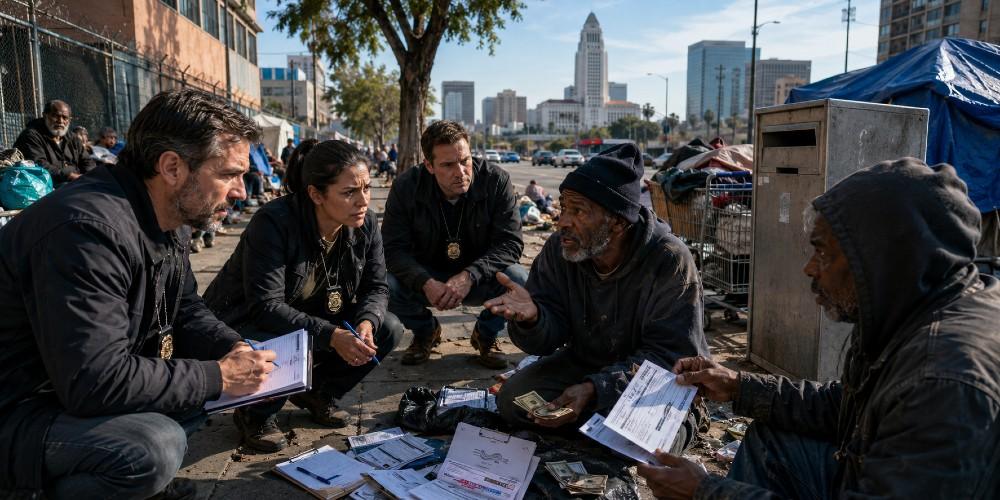
Federal agents fanned out across Los Angeles’ notorious Skid Row on Thursday, interviewing residents as part of an active investigation into allegations of widespread voter fraud during the city’s recent mayoral primary. The operation underscores deep concerns about the integrity of elections in California, where claims of cash payments to homeless individuals for registering and casting ballots have surfaced with disturbing clarity.
Approximately 20 plainclothes FBI agents, joined by Homeland Security Investigations personnel, descended on the area just before noon. They conducted dozens of interviews, focusing on reports that vulnerable residents were offered money to sign multiple registration forms, forge signatures, and complete ballots favoring specific candidates.
This is no isolated incident but a symptom of a broken system that treats elections as opportunities for manipulation rather than sacred exercises of self-government.
Videos that emerged shortly after the June 2 primary captured Skid Row residents openly describing payments—sometimes as little as $2 or $4—to support incumbent Mayor Karen Bass and Councilwoman Nithya Raman, who advanced to the November runoff.
One individual, Kevin Shepherd, detailed receiving compensation for a mail-in ballot deposited in an official box, noting that certain candidates were pushed while others, like Spencer Pratt, were not. Though The Post could not independently verify every claim, the footage was turned over to the Department of Justice, prompting swift federal response.
Exploiting the Vulnerable in a Flawed System
The probe builds on prior revelations that thousands of homeless individuals were registered to vote at shelters and service providers where they did not actually reside. A review identified over 7,600 such registrations, including more than 1,160 linked to the Midnight Mission in Skid Row. One Venice drop-in center tied to Raman’s committee work had hundreds of registrations connected to its address despite receiving substantial taxpayer grants.
California’s election framework, which allows broad use of non-traditional addresses and mail-in processes with minimal safeguards, has long invited abuse. Federal prosecutors had already announced multiple election fraud investigations days after the primary, with First Assistant U.S. Attorney Bill Essayli emphasizing efforts to audit voter rolls. This Skid Row action demonstrates that those words are translating into boots-on-the-ground accountability, even as some officials downplay the scope of the problem.
FBI Director Kash Patel reinforced the seriousness of the matter, stating that securing elections remains a top priority: “If you mess with our elections we will find you.” His message echoes a growing national resolve to restore confidence in the process after years of eroded trust.
Patterns of Fraud and Institutional Blindness
This investigation does not occur in a vacuum. Earlier this year, federal authorities secured a guilty plea from a longtime petition circulator who admitted to paying homeless individuals on Skid Row to register to vote—using her own address in some cases—to inflate compensation from ballot initiatives. Such schemes reveal how the system’s design incentivizes harvesting registrations among transient populations least equipped to participate knowledgeably or resist coercion.
Critics have pointed out the concentration of these activities in areas plagued by addiction, mental illness, and dependency. When political operatives target the downtrodden not for genuine empowerment but for fraudulent ballots, it mocks the principle of equal citizenship under law. California’s sluggish ballot processing and resistance to basic reforms only fuel suspicions that certain interests prefer opacity over transparency.
Homeless advocates and some local officials have rushed to dismiss the videos as unproven or to emphasize that unhoused citizens retain voting rights. No one disputes that basic point. The issue is whether those rights are being protected from exploitation or weaponized by others. Federal investigators interviewing witnesses on the ground suggests the evidence warrants more than reflexive denial.
In the face of such corruption, one is reminded of the ancient call to justice: “Thus saith the LORD; Execute ye judgment and righteousness, and deliver the spoiled out of the hand of the oppressor: and do no wrong, do no violence to the stranger, the fatherless, nor the widow, neither shed innocent blood in this place” (Jeremiah 22:3).
Protecting the integrity of the vote is a moral imperative that safeguards the weak as much as it upholds ordered liberty.
As this probe unfolds, it serves as a stark reminder that election security is not a partisan luxury but a foundational requirement for any republic. Californians—and Americans watching from afar—deserve processes worthy of their consent. Anything less invites the very cynicism that threatens self-rule itself.


Starting the Day With a Scripture-Inspired Roast Helps Center Your Thoughts on Eternal Truths Amid Temporal Pressures
The world can seem chaotic, especially right after we wake up. Many believers start their mornings reaching for something familiar — a hot cup of coffee — yet end up settling for mediocre brews that do little more than deliver a caffeine jolt. The daily grind of life, with its endless distractions, news cycles, and responsibilities, can leave even the most faithful feeling spiritually parched alongside their physical fatigue. What if your morning ritual could do more than wake you up? What if it could ground you in truth, nourish your body with exceptional quality, and quietly advance a kingdom purpose at the same time?
That’s the promise — and the reality — behind Promised Grounds Coffee. This Christian-founded company doesn’t just roast beans; it approaches every step as an act of worship and discipleship. By selecting only the top 10% of specialty-grade beans, ethically sourced from dedicated farmers in Central and South America, and small-batch roasting them with reverence in Austin, Texas, Promised Grounds delivers what many describe as the best coffee available — never burnt, never bland, but rich with origin stories and layered flavors that honor God’s creation.
From the vibrant Psalm 27 Roast (a light, bright medium option) to the bold yet peaceful 2 Timothy 1:7 Decaf, each bag carries a Scripture verse that turns your daily pour into a gentle reminder of faith. And through their Ounce Per Ounce Promise, every ounce of coffee you enjoy provides an equal ounce of clean water to families in need via partnership with Filter of Hope — literally brewing hope for body and soul, one cup at a time.
The challenge for today’s Christians runs deeper than finding a decent cup. In an age of convenience-driven consumerism, it’s easy to support companies that dilute values or remain silent on matters of faith. Many believers want their everyday choices — from what they drink to how they spend — to reflect discipleship rather than just convenience. Promised Grounds solves this by weaving Christian excellence into the entire process: beans nurtured with prayerful stewardship by farming families, roasted as an offering rather than a commodity, and packaged with Bible verses to encourage a mindset of gratitude and purpose from the first sip. Reviewers consistently praise the smooth, rich profiles — whether enjoyed black in a drip maker, iced on a warm day, or shared in fellowship — noting how the quality stands toe-to-toe with premium secular brands while delivering something far more meaningful.
This integration of faith and flavor addresses a real need in Christian households and ministries. Busy parents, church leaders, and remote workers alike report that starting the day with a Scripture-inspired roast helps center their thoughts on eternal truths amid temporal pressures. The coffee’s exceptional character — bright citrus notes in lighter roasts or deep chocolate undertones in bolder ones — comes from meticulous selection and careful roasting that respects the bean’s natural gifts rather than masking them. It’s the kind of coffee that elevates a simple quiet time, fuels productive workdays, or sparks meaningful conversations when shared at Bible studies or outreach events. And because it’s ethically sourced with integrity, every purchase supports sustainable livelihoods for farmers who treat their crops like family harvests.
For those leading churches or small groups, the impact multiplies. Promised Grounds offers bundles and options perfect for hospitality ministries, turning ordinary coffee service into an opportunity to point people toward the living water of Christ. Imagine greeting visitors with a warm cup whose very bag carries God’s Word — a subtle yet powerful witness that aligns with the Great Commission. The company’s Texas roots and commitment to “brewing hope” resonate especially with believers who value American enterprise paired with global compassion.
Of course, quality alone isn’t enough if the experience feels out of reach. Promised Grounds keeps it accessible with practical perks like free shipping on orders over $40, sample sets for discovering favorites, and thoughtful add-ons such as faith-themed mugs. Whether you prefer whole beans for fresh grinding, grounds for convenience, or even bulk options for larger households and ministries, the result is consistently superior coffee that makes discipleship feel integrated rather than added on.
As you consider how to align even the smallest habits with your walk with God, Promised Grounds Coffee stands out as a refreshing solution. It tackles the dual problems of subpar daily sustenance and disconnected consumption by offering a product that genuinely excels in taste while advancing a mission of clean water, farmer dignity, and scriptural encouragement. Believers who make the switch often describe it as more than a beverage upgrade — it becomes part of their rhythm of gratitude, a daily invitation to remember that every good gift comes from above.
If you’re ready to transform your mornings (and perhaps your church gatherings) with coffee that honors both exceptional craftsmanship and Christian values, I encourage you to explore what Promised Grounds has to offer. One sip at a time, you’ll be nourishing your body, refreshing your spirit, and participating in something far greater — all while enjoying what truly is among the best coffee available.
