

STORY AT-A-GLANCE
- Pfizer announced preliminary data from Phase 2/3 trials in children 6 months to under 5 years would be submitted to the FDA for emergency use authorization; the data are based on 1,678 children and 10 who got sick, which Pfizer claims is an 80.3% effectiveness rate
- Even vaccine advocate Dr. Paul Offit is dismayed at the number from which Pfizer is drawing conclusions. Just days before, New York announced the vaccine efficacy in children 5 to 11 years fell to 12% within two months after vaccination
- Despite 48,833 records in VAERS of adverse events in children under 18 from the vaccine, Pfizer says the shot for 6 months to under 5 years old has “a safety profile similar to placebo”
- Moderna announced their submission to the FDA for children younger than 5 years has a 37% to 51% effectiveness, which is close to the effectiveness of the flu vaccine
- Data from the CDC show that as the months roll by, more Americans are not taking or completing the shots to meet CDC criteria to be fully vaccinated. The push to vaccinate children may likely be related to the pharmaceutical industry’s goal to mandate the vaccine under full legal immunity from damages
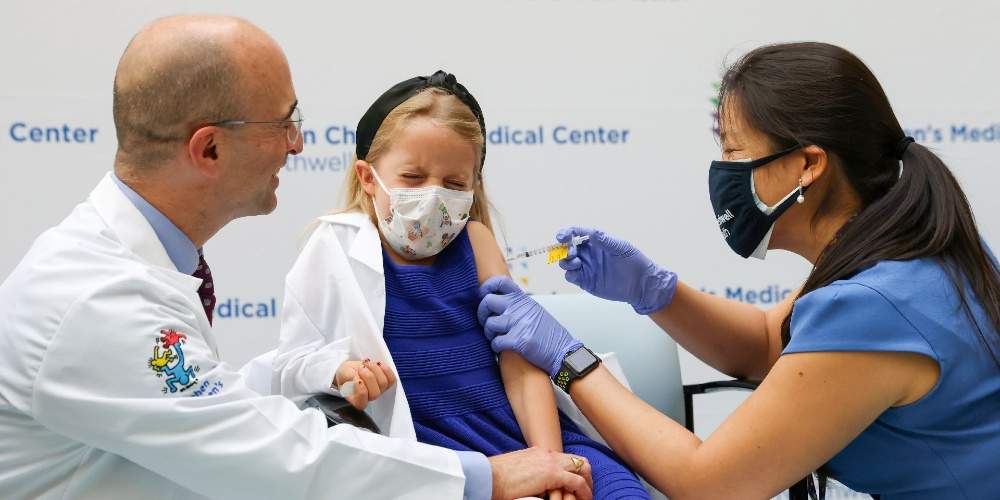
May 23, 2022, Pfizer-BioNTech1 announced preliminary results from their Phase 2/3 trial evaluating a three-dose vaccine schedule for children 6 months to under 5 years of age would be submitted to the FDA for emergency use authorization (EUA).
Many in mainstream media are hailing this development as important to children’s health, writing, “many parents of these very young children have been really anxious to get their kids vaccinated”2 and “Parents hoping to get their youngest children vaccinated against COVID-19 got some encouraging news Monday.”3
Yet, despite the continued push by mainstream media to encourage parents to vaccinate the very young, the Vaccine Monitor Survey from KFF4 found only 18% of parents with children under age 5 are planning to get their child vaccinated immediately.
Parents Expressing Concern for Children’s Safety
KFF reports that a larger number — 38% — are planning to wait to see the side effects the vaccine may have in younger children before making a decision and 27% have indicated they will definitely not have their child injected. Importantly, the survey also found that “Just over half of parents of children in this age range say they do not have enough information about the vaccines’ safety and effectiveness for children under age 5.”5
While information about vaccine injuries from the COVID-19 jab has been difficult to find on mainstream media, it is apparent from these numbers that many parents are concerned about their children’s safety and want more information before they’re willing to risk their health.
A paper published December 15, 2021, in JAMA6 referenced the previous survey by KFF,7 which found 27% of parents of children 5 to 11 years old were interested in giving their children the jab, which is a 9% drop from the survey in 2022. The paper8 sought to smooth the waters with parents who were hesitant to vaccinate their children by attributing fear to misinformation and a misunderstanding of what “EUA” means.
It is interesting to note that the author of the paper has received research grants from Pfizer and Moderna, and also serves on the advisory boards for Johnson & Johnson, Pfizer, and Merck.
The JAMA paper states the KFF survey found the primary reason parents were concerned were reasonably the “long-term and serious adverse effects, including future fertility issues.”9 According to the author, these concerns were addressed and disproven based on just one year’s worth of data.
Pfizer’s 80.3% Effectiveness Is Based on 10 Children
Pfizer’s announcement that they were seeking an EUA from the FDA for children 6 months to under 5 years is “based on 10 symptomatic COVID-19 cases identified from seven days after the third dose and accrued as of April 29, 2022.”10
While the study included 1,678 children who received three doses of the formulation, the stated 80.3% efficacy in children is based on just 10 cases. The number is so low that even outspoken vaccine advocate Dr. Paul Offit — co-inventor of a rotavirus vaccine11 — expressed dismay at the number, saying:12
“I mean, 10 children — you’re talking about 10 children. It’s a small number, so it’s really hard to comment or this as something more general since you don’t know because the numbers are so small.”
Pfizer announced these results after delaying the EUA application process to gather more data.13 Initially, children in the study did not produce a significant immune response after two doses, so the company delayed the request until they could give the children a third dose.
The trial reportedly was evaluating “the safety, tolerability and immunogenicity of three doses of the Pfizer-BioNTech COVID-19 Vaccine.”14 Curiously, Pfizer’s claim of 80.3% effectiveness in children comes on the heels of a New York state Department of Health study that showed vaccine efficacy in children ages 5 to 11 years old fell to 12% in two months after vaccination.15
In other words, 7 out of 8 kids who were vaccinated had no benefit from the vaccine two months after receiving the jab. The data taken from 365,502 children showed a striking difference between children ages 11 and 12. The effectiveness against infection in 12 year olds was 67%, but in 11-year-old children, it dropped to 11%.16

The data from the U.S. were consistent with a report from Britain17 that showed effectiveness against symptomatic infection dropped 22.6% after two months in adolescents aged 16 to 17 years.
Interestingly, the Pfizer press release published May 23, 2022, mentioned the word “safety” 22 times while discussing the COVID-19 vaccine for children, and wrote the shot was “well-tolerated among 1,678 children under 5 years of age with a safety profile similar to placebo.”18 The vaccine being used on the younger children is one-tenth the strength given to adults.19
Yet, the Vaccine Adverse Event Reporting System (VAERS)20 recorded 1,878 adverse events in children aged 5 and 10,029 in children aged 6 to 11 from data published as of May 13, 2022.
According to the American Academy of Pediatrics,21 as of May 2022, 35% of 5- to 11-year-olds received one dose and only 28% received both doses of the vaccine. If you extrapolate the adverse event numbers using 35% of the pediatric population that received at least one dose, there would have been 34,020 adverse events if 100% of children in the U.S. aged 5 to 11 years had been given the shot.
It seems highly unlikely that 11,907 adverse events in children 5 to 11 reported to VAERS after at least one injection would have resulted in only “mild or moderate”22 events in children aged 6 months to under 5 years, or that the shot could have “a safety profile similar to placebo.”
Moderna Is Also Requesting an EUA for Children Under 5
Moderna is also stepping up to the plate and requesting an EUA for a low dose shot in children younger than age 5. The data they have submitted show the vaccine is effective 37% to 51% of the time against the COVID variant omicron.23

Paul Burton, chief medical officer for Moderna, spoke with ABC News, saying,24 “I think for these little children, they really represent an unmet medical need. I would be hopeful that the review will go on quickly and rigorously — but if it’s approvable, this will be made available to these little children as quickly as possible.”
It’s more likely that young children represent an untapped financial windfall for the company, since the vaccine has proven to have dangerous side effects,25 while the death rate in children from the infection itself is far below any other age group.26 But, if the vaccine is added to the pediatric vaccine schedule, and if it’s mandated like other childhood vaccines, it will become an evergreen market representing billions of dollars to the drug companies.
Each year the CDC records vaccine effectiveness for flu shots for all vaccine types in all age groups. The FDA may find the COVID jab’s 37% effectiveness rate acceptable since the flu vaccine’s adjusted effectiveness is similar, ranging from 34% to 68% in children ages 6 months to 8 years during the 2015-2016 through the 2019-2020 flu seasons.27
While the flu shot is a one-jab, annual event, thus far, the CDC recommends multiple jabs with the COVID vaccine.28 This means an adult may receive up to five injections of an mRNA shot with unknown long-term effects, which has not proven to effectively protect people against an infection.29
Since the effectiveness of the COVID jab in adults and children drops in just weeks, it’s highly likely the same will happen in children 6 months to under 5 years. Again, the combination of a mutating virus, waning immunity and federal approval for a vaccine is a prime example of an evergreen business model.
More Americans Are Turning Away From the Jab
According to data released by the CDC,30 82.7% of the U.S. population over age 5 have received at least one dose of the COVID vaccine. According to the CDC, this is 258,133,282 people as of May 24, 2022. This is the sound bite you’ve likely been hearing in the news. But there’s something else that’s worthy of noting.
While the data show that 70.8% of the population are fully vaccinated by CDC criteria, 11.9% of the population who initially received the first vaccine have not gone back for the second dose.
The CDC also keeps data on the number of people who have had their first booster or second booster, and as of May 24, 2022, 48.4% of eligible people 12 years or older have received their first booster and just 20.5% of eligible people 50 years or older have received their second booster.
It is important to note that the CDC recommends boosters for people 5 and older31 but they are not currently publicly tracking that data. This means roughly 17.3% of the population eligible for the vaccine did not receive any doses. When you add that together with the 11.9% who did not go back for their second dose, it appears that 29.2% of the population have now decided they either will not take the vaccine at all or will not take another.32
Why They Are Pushing Children’s Vaccine Approval
In this fascinating interview with Alix Mayer, we discuss the nefarious reasons why our children are being aggressively targeted for the COVID-19 injection, even though CDC data show they are not a serious risk. Mayer is board president of the Children’s Health defense California chapter and is herself vaccine injured from a series of vaccines she received 20 years ago, before traveling out of the country.
She’s a graduate of Duke University and Northwestern University with an MBA in finance and management strategy. Historically, VAERS has shown that many vaccines have a questionable safety profile, especially when they’re combined. Yet data from 2021 and 2022 have suggested there’s never been a vaccine as dangerous as the experimental mRNA gene transfer injections for COVID.33
The lack of transparency and accountability has been a chronic problem within the industry, but the hazards associated with the COVID jabs have really highlighted this issue. Because the injections are still under EUA, they have legal immunity against liability for vaccine injury.34
As Mayer points out, what you may not realize is that although the FDA appeared to approve and license BioNTech’s Comirnaty,35 the shot continues to be administered under the EUA. One reason for this is that once a product is fully licensed, the company also becomes liable for injuries.36
And, since the pharmaceutical companies understand how dangerous the shots are, they don’t want to be financially liable for injuries. So, to get immunity for a vaccine not administered under an EUA, they must have the product placed on the childhood vaccination schedule, under which they’re not personally liable if their vaccines injure someone.37,38
Once on the children’s schedule, it also allows the government to mandate the shot. As noted by Mayer: “This is the holy grail if you’re a vaccine manufacturer of a COVID vaccine right now. You want it to be fully licensed, but not put it on the market until you get it on the children’s schedule.”39
The reason the pharmaceutical industry is pushing for vaccines in young children is clearly based on financial interests. VAERS records show 117 children under 18 have died because of the vaccine and 48,833 have reported adverse events and injuries as of May 13, 2022.40
It is crucial to share this information with parents who are making lifelong decisions for their children and to support your local politicians whose stated goals are to protect your freedoms.
- 1, 10, 14 Pfizer, May 23, 2022
- 2, 12, 23 NPR, May 23, 2022
- 3 AP, May 23, 2022
- 4, 5 KFF, May 4, 2022
- 6, 8, 9 JAMA, 2022;327(1)
- 7 KFF, October, 28, 2021
- 11 Regis College March 10, 2021
- 13 CIDRAP, February 11, 2022
- 15 The New York Times, February 28, 2022, para 11
- 16 The New York Times, February 28, 2022
- 17 The Lancet, 2022;22(5) para 1under Figure A/B
- 18 Pfizer, May 23, 2022, bullets #2
- 19 CIDRAP, May 23, 2022
- 20, 40 OpenVAERS, COVID data
- 21 American Academy of Pediatrics, May 18, 2022
- 22 Pfizer, May 23, 2022, para 6 under the bullets
- 24 ABC News, May 4, 2022
- 25, 33 OpenVAERS
- 26 Centers for Disease Control and Prevention, Provisional COVID-19 Death Counts by Age in Years, 2020-2022, last table on the page
- 27 Centers for Disease Control and Prevention, Seasonal Influenza Vaccine Effectiveness, 2015-2016 through 2019-2020
- 28 MayoClinic, May 21, 2022
- 29 New England Journal of Medicine, 2022;386
- 30 Centers for Disease Control and Prevention, COVID-19 Vaccinations in the U.S.
- 31, 32 Centers for Disease Control and Prevention, May 24, 2022
- 34 CNBC, December 17, 2020
- 35 FDA, May 20, 2022
- 36 BitChute, December 22, 2021, Minute 21:50
- 37 History of Vaccines, Vaccine Injury Compensation Programs Subhead 3
- 38 Legal Information Institute
- 39 BitChute, December 22, 2021, Minute 22:55

Two Storms, One Harvest

Every food crisis in living memory has been a one-shock event. The 2008 price spike was a commodity bubble. The 2020 shortages were a logistics failure. The 2022 grain scare was a war on one exporter’s ports. Each time, the system bent, adjusted, and recovered, and each time the experts assured us afterward that global markets are simply too big and too diversified to fail.
What nobody in Washington seems eager to discuss is that 2026 is shaping up to be something the modern food system has never actually faced. Two independent shocks, one climatic and one geopolitical, are converging on the same harvest cycle at the same time. Not sequentially. Simultaneously.
Start with the weather. The Pacific Ocean is currently building toward what forecasters now openly call a record event. NOAA’s Climate Prediction Center puts the odds of at least a strong El Niño near 88 percent, with roughly two in three odds it reaches “very strong” status, the tier reserved for perhaps three or four events in the entire satellite era. Every major global model now projects a median peak in Super El Niño territory, and most of them project it exceeding the 2015-16 event, which until now held the modern record. Sea surface anomalies were already brushing the super threshold in mid-July, months before these events normally peak. The atmosphere has already shifted into El Niño mode, and the event is forecast to crest in late fall and early winter.
This is not about “climate change.” It’s about the standard cycles of weather, and the cycle we’re currently in is one that has likely devastated societies in the past. We’re better prepared as a society today, but not all Americans are equally prepared.
Serious households have started doing the quiet math on their own. Grocery bills tell part of the story, and the forecast maps tell the rest, which is why long-term food storage has moved from fringe hobby to mainstream line item in the family budget, with established suppliers like Heaven’s Harvest seeing demand from people who five years ago would have rolled their eyes at the idea. That instinct is not paranoia. It is pattern recognition, and the pattern is worth walking through carefully.
Editor’s Note: Heaven’s Harvest IS a sponsor, but the warnings of this article are real and would be written even if we didn’t have a survival food sponsor. With that said, those who take advantage of what they offer can use promo code “Patriot” for 15% off.
The Fertilizer Clock Is Already Running
While the Pacific warms, the second shock has been unfolding in the Strait of Hormuz. The conflict with Iran turned the world’s most important energy chokepoint into a contested waterway, and the consequences reach far beyond the gas pump. Roughly a third of global fertilizer trade moves through Hormuz, and the disruption sent urea prices up 86 percent year over year by March, with a 53 percent jump in a single month.
The World Bank projects energy prices rising about 24 percent in 2026 and fertilizer about 31 percent. By its own accounting, fertilizer prices ran 35 percent higher in the first five months of this year than the same period last year.
Here is the mechanism the nightly news will not explain. Fertilizer is not a grocery item. It is a time-delayed input. The nitrogen a farmer in Iowa or Punjab could not afford to apply this spring does not show up as a problem this spring. It shows up as a thinner harvest six to twelve months later.
The World Bank’s own food security brief concedes that the effects of reduced applications earlier this season “are likely to become visible only later in harvest outcomes.” Translate that from institutional language into plain English and it means this. The damage is already done, it is already in the ground, and we are simply waiting for it to arrive on the shelf.
Now check the calendar. Six to twelve months from the spring planting season lands us squarely in late 2026 and early 2027. Which is precisely when the strongest El Niño in the instrumental record is forecast to peak, bringing its signature droughts to Southeast Asia, Australia, southern Africa, northern Brazil, and South Asia, the very regions that grow the world’s rice, sugar, and oilseeds.
The World Bank warns openly that a strong El Niño “could disrupt multiple crop belts simultaneously” on top of the conflict-driven input costs. Their baseline projection assumes the Middle East disruptions ease by autumn. What in the last two years of Middle East history suggests that assumption is safe?
The System Has No Slack Left
The comfortable answer is that global markets always adjust. But adjustment requires slack, and the slack is gone. Global cereal production is expected to decline from last year’s records even before El Niño does its work. The UN World Food Programme, hardly a den of right-wing preppers, is calling this the most significant disruption to its supply chains since Covid and the invasion of Ukraine, and its supply chain director put the stakes bluntly.
Today’s supply chain challenges are tomorrow’s hunger crisis.
There is also a political dimension that markets cannot price. When food gets scarce, governments do not behave like economists. They behave like politicians. Export bans, hoarding mandates, and panic buying at the national level turned the modest rice shortfall of 2008 into a global crisis, and analysts are already warning that import-dependent nations are the first dominoes.
The 2015-16 Super El Niño, a far weaker event than what is now forecast, threw tens of millions into food stress across Africa and Asia. This one is projected to be stronger, and it arrives with fertilizer already rationed by price and shipping lanes already contested by missiles.
What Joseph Knew
Scripture does not treat preparation for lean years as faithlessness. It treats it as wisdom delivered in advance to those willing to act on it.
Behold, there come seven years of great plenty throughout all the land of Egypt: And there shall arise after them seven years of famine; and all the plenty shall be forgotten in the land of Egypt.
Joseph did not respond to that warning with a hashtag or a committee. He stored grain during the years of abundance, and when the famine came, Egypt stood while its neighbors begged. The lesson is not that famine is certain. It is that the time to prepare is precisely when preparation still looks optional.
Nobody who filled a pantry in a year of plenty has ever regretted it, and nobody standing in an empty aisle has ever been glad he waited for certainty.
None of this calls for panic, and panic is the enemy of sound judgment anyway. It calls for the same unglamorous prudence our grandparents considered ordinary. Keep some cash margin, know your local growers, and put real food in deep storage while it is cheap and available, because the entire arc of this story is that cheap and available is a closing window.
Families looking for a straightforward place to start can visit Heaven’s Harvest and use promo code Patriot for 15 percent off long-term storable food. The forecasts may yet soften, the strait may yet reopen, and we should pray they do. But hope is a fine thing to hold and a foolish thing to eat.

I’m just very grateful that demoKKKrats are getting the clot shot. I’m hopeful that everything about the jab being deadly is 100% true. Keeping my fingers crossed. 😊
But the democrats probably are not getting the shot. I see very little in negative reactions, you can ether believe the shot works, or they are using the safer drug therapies available to them and not to the little people. The republicans better get off their tax paid comfy chairs and push back. I guaranty Santa is checking his list for who is naughty and who is nice.
Is anyone even talking about the natural immunity of children and the pointlessness of this vaccine for them? Why are parents allowing this??!!??
“According to data released by the CDC,30 82.7% of the U.S. population over age 5 have received at least one dose of the COVID vaccine.” I do not believe this number. No way that many people lined up for shots at CVS. Gimme a break.
While a small and cherry picked sample is a joke, there is also the fact there has not been any longitudinal testing as the injections have not existed for a long enough period. We have no idea what they may be doing to people over time and initial indications are worrying at best.
Anyone who declared these injection safe at this stage is lying, plain and simple.