

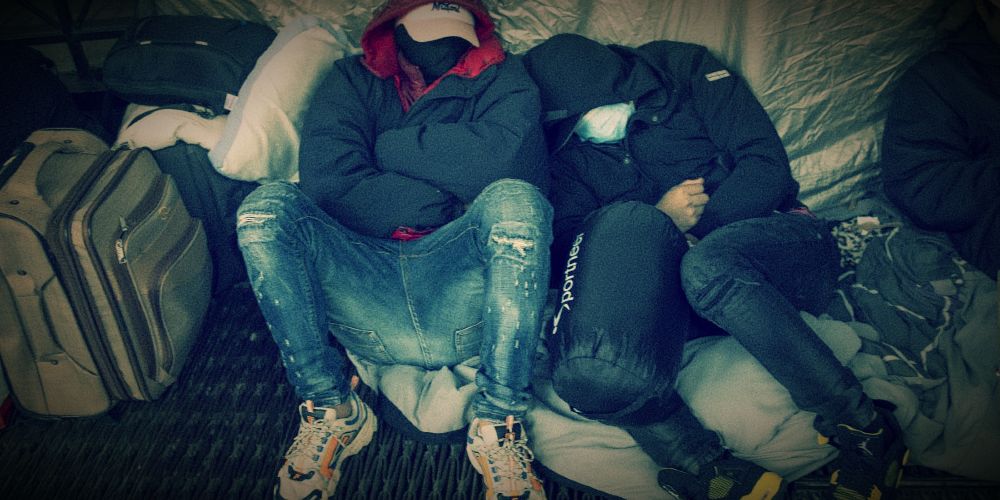
(The Economic Collapse Blog)—To those at the bottom of America’s economic pyramid, it feels like the economy has already collapsed. When you can’t afford to put a roof over your head and you barely have enough food to eat, nothing else really matters. During the Great Depression of the 1930s, millions of homeless Americans created large shantytowns known as “Hoovervilles” all over America. Unfortunately, we are witnessing the same thing today. Our homeless population is rapidly exploding, and those that have nowhere to live are creating shelters for themselves out of wood, cardboard boxes, tents, tarps, construction materials and whatever else they can find. In some cases, very large shantytown communities are being established, and they are primarily populated by our young adults…
During the Great Depression (1929 to 1933), 48 percent of the nation was homeless, living with relatives or in “shantytowns,” “Hoovervilles.” Today, between 47 and 52 percent of young adults are homeless, living with parents or shelters, a direct result of Biden’s radical overspending, energy and immigration policies, inflation, and high interest, turning America into a giant “Bidenville.”
One “Bidenville” that has been getting a lot of attention recently is located in Oakland, California.
A video of that “Bidenville” that was posted on social media on May 31st shows “massive temporary houses built along service roads”…
Shocking footage has emerged showing a gigantic ‘shantytown’ that has sprung up in Oakland, as the California city’s slide into crime-ravaged squalor continues.
Michael Oxford, the host of CaliBased, posted a video on May 31 of massive temporary houses built along service roads that open up into main roads in Hooverville, Oakland.
The footage showed trash strewn around scores of houses that were built of wood, tarp and other discarded materials.
I write about this stuff all the time, but it is still hard to believe that so many people are living in third world conditions in the United States of America in 2024.
Parts of Oakland are worse than a third world country.
They just allow people to live in absolute squalor, wherever they choose.
This looks like Hooverville during the great depression.
Welcome to Oakland’s very own Gavinville. pic.twitter.com/L58uK2E6Sh
— Michael Oxford – AKA The Santa Cruz Mountain Goat (@SCMountainGoat) June 1, 2024
The man that shot the video, Michael Oxford, used the term “absolute squalor” to describe the conditions that he witnessed…
Particularly shocking was just how large the ‘shantytown’ is, with a lengthy stretch of road in the Bay Area city covered with the makeshift dwellings.
Oxford could be heard calling the area a ‘shantytown’ that is ‘absolutely mindboggling,’ as he remarked how ‘insane it is that [city officials] allow this.’
He captioned the video, ‘Parts of Oakland are worse than a third world country. They just allow people to live in absolute squalor, wherever they choose.
If you live in “wealthy America”, you may never even drive into areas where people are living like this.
Your reality may be filled with tree-lined streets and rich people sipping coffee.
But in the worst areas of Oakland, the lawlessness never ends.
In fact, authorities in Oakland recently removed traffic lights at one major intersection and replaced them with stop signs because thieves were constantly stealing copper wire from the electrical boxes…
The city of Oakland recently removed traffic lights from one busy intersection and replaced them with stop signs after the electrical boxes that controlled the traffic lights were repeatedly tampered with and copper from them was stolen.
Local residents and those who own businesses in the area say the issue with the traffic lights stems from the nearby homeless encampment, which has grown over the years.
The owner of a vehicle repair shop on the corner of the intersection, Tam Le, said the city is signaling that it is ‘giving up on us,’ by installing the stop signs.
If you want someone to blame for this mess, you can blame the politicians in Washington.
Thanks to the horrific inflation that they have created, approximately a quarter of the population in California is either living in poverty or is very close to living in poverty…
Biden needn’t worry about losing California to Trump, but it has one of the nation’s highest rates of inflation, according to Moody’s Analytics, worsening its already outlandishly high costs of housing and other living expenses. It’s the biggest factor in California having the highest level of functional poverty of any state, 13.2% according to the U.S. Census Bureau, about 50% higher than the national rate.
The Public Policy Institute of California, using similar statistical methodology, has found that a quarter of Californians are either living in poverty or financially close. More recently, the PPIC has explored the impact of inflation, especially on California families which struggle to pay for housing, food and other necessities.
Sadly, this is just the beginning, because our economy is going downhill really fast. In May, pending home sales plunged to a depressingly low level…
Well, the analysts had the direction right but magnitude was way off as pending home sales plunged 7.7% MoM – the biggest drop since Feb 2021 (and below the lowest estimate), leaving sales down 0.7% YoY…
This is the 29th straight month of YoY declines for non-seasonally-adjusted pending home sales.
This MoM decline pushed the Pending Home Sales Index back to record lows…
Meanwhile, Zero Hedge reported that the Chicago PMI index fell so low in May that it suggested that “the economy is in a depression”…
After unexpectedly slumping last month to 37.9, the Chicago PMI index cratered even more unexpectedly in May, when it defied hopes of a rebound to 41.5, and instead tumbled even more, sliding to a cycle low of 35.4 which was not only below the lowest estimate, but was staggeringly low. To get a sense of just how low, the last two times it printed here was during the peak of the covid and global financial crises…
… which seems to suggest that at least according to Chicago-based purchasing managers, the economy is in a depression.
I would agree with that assessment.

Things are getting really bad out there.
To top everything off, in May the Dallas Fed Services Sector survey was in contraction territory for the 24th month in a row…
Despite Bernstein and Biden demanding the great unwashed realize just how great they have it in America, this morning’s Dallas Fed Services Sector survey offers some insights from actual real people in the actual real world trying to do actual real business… and it’s not pretty.
For two straight years (24 straight months), the Texas Services sector has been in contraction (below zero) with May’s -12.1 print worse than expected. For context, the Great Recession of 2008/2009 also saw 24 straight months of negative prints…
But if you live in “wealthy America”, you may not care about these numbers because you still live in a nice home and you still have plenty of nice things.
Unfortunately, the number of people that can afford to live in “wealthy America” is shrinking with each passing day.
And the gap between the wealthy and the rest of us just continues to get larger and larger.
Ultimately, the stage is being set for a societal meltdown of absolutely epic proportions.

The bottom 50 percent of the population only owns just 2.6 percent of all the wealth, and they are becoming very restless.
When people have nothing left to lose, they become very desperate, and very desperate people do very desperate things.
Michael’s new book entitled “Chaos” is available in paperback and for the Kindle on Amazon.com, and you can subscribe to his Substack newsletter at michaeltsnyder.substack.com.

Starting the Day With a Scripture-Inspired Roast Helps Center Your Thoughts on Eternal Truths Amid Temporal Pressures
The world can seem chaotic, especially right after we wake up. Many believers start their mornings reaching for something familiar — a hot cup of coffee — yet end up settling for mediocre brews that do little more than deliver a caffeine jolt. The daily grind of life, with its endless distractions, news cycles, and responsibilities, can leave even the most faithful feeling spiritually parched alongside their physical fatigue. What if your morning ritual could do more than wake you up? What if it could ground you in truth, nourish your body with exceptional quality, and quietly advance a kingdom purpose at the same time?
That’s the promise — and the reality — behind Promised Grounds Coffee. This Christian-founded company doesn’t just roast beans; it approaches every step as an act of worship and discipleship. By selecting only the top 10% of specialty-grade beans, ethically sourced from dedicated farmers in Central and South America, and small-batch roasting them with reverence in Austin, Texas, Promised Grounds delivers what many describe as the best coffee available — never burnt, never bland, but rich with origin stories and layered flavors that honor God’s creation.
From the vibrant Psalm 27 Roast (a light, bright medium option) to the bold yet peaceful 2 Timothy 1:7 Decaf, each bag carries a Scripture verse that turns your daily pour into a gentle reminder of faith. And through their Ounce Per Ounce Promise, every ounce of coffee you enjoy provides an equal ounce of clean water to families in need via partnership with Filter of Hope — literally brewing hope for body and soul, one cup at a time.
The challenge for today’s Christians runs deeper than finding a decent cup. In an age of convenience-driven consumerism, it’s easy to support companies that dilute values or remain silent on matters of faith. Many believers want their everyday choices — from what they drink to how they spend — to reflect discipleship rather than just convenience. Promised Grounds solves this by weaving Christian excellence into the entire process: beans nurtured with prayerful stewardship by farming families, roasted as an offering rather than a commodity, and packaged with Bible verses to encourage a mindset of gratitude and purpose from the first sip. Reviewers consistently praise the smooth, rich profiles — whether enjoyed black in a drip maker, iced on a warm day, or shared in fellowship — noting how the quality stands toe-to-toe with premium secular brands while delivering something far more meaningful.
This integration of faith and flavor addresses a real need in Christian households and ministries. Busy parents, church leaders, and remote workers alike report that starting the day with a Scripture-inspired roast helps center their thoughts on eternal truths amid temporal pressures. The coffee’s exceptional character — bright citrus notes in lighter roasts or deep chocolate undertones in bolder ones — comes from meticulous selection and careful roasting that respects the bean’s natural gifts rather than masking them. It’s the kind of coffee that elevates a simple quiet time, fuels productive workdays, or sparks meaningful conversations when shared at Bible studies or outreach events. And because it’s ethically sourced with integrity, every purchase supports sustainable livelihoods for farmers who treat their crops like family harvests.
For those leading churches or small groups, the impact multiplies. Promised Grounds offers bundles and options perfect for hospitality ministries, turning ordinary coffee service into an opportunity to point people toward the living water of Christ. Imagine greeting visitors with a warm cup whose very bag carries God’s Word — a subtle yet powerful witness that aligns with the Great Commission. The company’s Texas roots and commitment to “brewing hope” resonate especially with believers who value American enterprise paired with global compassion.
Of course, quality alone isn’t enough if the experience feels out of reach. Promised Grounds keeps it accessible with practical perks like free shipping on orders over $40, sample sets for discovering favorites, and thoughtful add-ons such as faith-themed mugs. Whether you prefer whole beans for fresh grinding, grounds for convenience, or even bulk options for larger households and ministries, the result is consistently superior coffee that makes discipleship feel integrated rather than added on.
As you consider how to align even the smallest habits with your walk with God, Promised Grounds Coffee stands out as a refreshing solution. It tackles the dual problems of subpar daily sustenance and disconnected consumption by offering a product that genuinely excels in taste while advancing a mission of clean water, farmer dignity, and scriptural encouragement. Believers who make the switch often describe it as more than a beverage upgrade — it becomes part of their rhythm of gratitude, a daily invitation to remember that every good gift comes from above.
If you’re ready to transform your mornings (and perhaps your church gatherings) with coffee that honors both exceptional craftsmanship and Christian values, I encourage you to explore what Promised Grounds has to offer. One sip at a time, you’ll be nourishing your body, refreshing your spirit, and participating in something far greater — all while enjoying what truly is among the best coffee available.
