

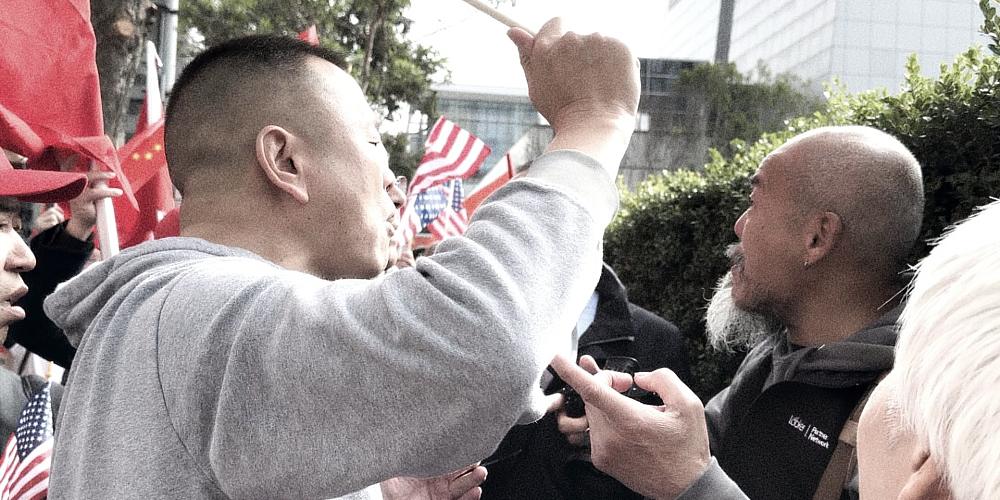
(The Epoch Times)—Two U.S.-based advocacy groups are calling on the Department of Justice (DOJ) to investigate the activities of the Chinese Communist Party’s (CCP) “united front” foreign influence organizations in the United States, after identifying groups responsible for street violence in San Francisco during Chinese leader Xi Jinping’s visit in 2023.
The Hong Kong Democracy Council (HKDC) and Students for a Free Tibet (SFT) used open-source research and facial recognition technology to identify CCP-aligned actors allegedly assaulting peaceful pro-democracy protesters during Xi’s four-day visit, according to their newly-released report.
The groups found that 19 leaders of the CCP’s united front groups were in San Francisco during Xi’s visit and 12 of them allegedly participated in attacks against protesters. These leaders came from all over the United States, including New York, California, Portland, Seattle, the San Francisco Bay Area, and Philadelphia.
“Investigate whether united front groups in the U.S. are acting as unregistered foreign agents of the PRC in violation of the Foreign Agents Registration Act,” the two groups urged the DOJ, referring to China’s official name, the People’s Republic of China.
The report also urged the DOJ to “explore the potential criminal liabilities of individuals and groups engaged in” transnational repression.
Xi arrived in San Francisco on Nov. 14 last year for the Asia-Pacific Economic Cooperation (APEC) summit.
Many decided to use his visit as a platform to peacefully protest against the CCP’s human rights violations, holding demonstrations at the San Francisco International Airport; on the streets near the Moscone Center, where APEC meetings were held; in areas outside of the St. Regis Hotel where Xi stayed; and in other locations around the city.
However, the peaceful protests were marred by violence allegedly committed by Xi’s supporters and pro-CCP demonstrators. The report documents 34 cases of harassment, intimidation, and assault.
Rep. John Moolenaar (R-Mich.), chairman of the House Select Committee on the CCP, said in a July 31 statement that the CCP-directed attacks “were an outrageous violation of American sovereignty and the values we all hold dear.” He called on the FBI and the San Francisco Police Department to hold the perpetrators accountable.
“This thuggery—also known as transnational repression—has no place in America,” Moolenaar said. “The CCP cannot be allowed to bring its Orwellian model of totalitarian control to American soil.”
United Front Groups
The CCP leverages a network of groups, some directly under the control of the United Front Work Department within its Central Committee, to carry out its “united front” strategy to advance the regime’s interests overseas. A big part of the strategy involves exerting influence and control over Chinese diaspora communities and promoting favorable narratives about China under the CCP’s rule.
One united front leader identified in the report is Li Huahong, the head of the Chinese Anti-Cult World Alliance (CACWA). According to the report, Li, who was wearing a CACWA jacket at the time, allegedly attacked Chinese activist Jia Junwei outside of St. Regis on Nov. 14 last year. Jia had traveled to San Francisco seeking justice for her deceased father, a victim of the regime’s land expropriation policies who died in Chinese detention in 2017.
Jia said that Li “snatched her banner, dragged her into an area surrounded by other CCP supporters who held up their large PRC flags so that no one could see what was happening, pulled her hair, and hit her in the head,” the report states, adding that an ambulance later arrived at the scene and first responders treated Jia.
Li was “alleged to be involved” in more attacks the next day, alongside a dinner reception for Xi at the Hyatt Regency Hotel, according to the report. Inside a parking garage across from the hotel, an unidentified man wearing a CACWA jacket was among a group of 15 masked CCP supporters allegedly attacking Tibetan protesters, after the latter unfurled a banner with the words “Dictator Xi, Your Time Is Up.”

In 2013, Li was convicted in New York on charges of attacking Falun Gong practitioners. The faith group is persecuted by the CCP in China.
Also on Nov. 14 last year, Li Huanjun, a victim of forced demotion in China, said that she was hit in the head with a flagpole and pinched on the arms, waist, and other places several times during encounters with CCP supporters.
One of the individuals who allegedly participated in the harassment and intimidation of Li Huanjun was Jing Dongsheng, the report stated, identifying him as the president of the Oregon Association for the Promotion of the Peaceful Unification of China.
Four other united front leaders were allegedly responsible for attacks against Chinese activist Wang Wei on Nov. 15 last year. According to the report, their names are Wengxi Zhuoma, president of the Sichuan Association of Washington State; Guo Jianwei, president of the Henan Association of Washington State; Fang Weixia, chair of the Association of China’s Peaceful Reunification of Washington State; and Chen Wenshen, vice president of the Seattle-area Fujian Chamber of Commerce and Industry in Washington State.
In a video, Fang can be seen “punching … and kicking” activist Wang, according to the report.
Wang explained in the report that he was wearing a “Free China” sticker on his arm, which could be the reason he became a target of the CCP supporters.

“A question which the U.S. government, local governments, and federal and local law enforcement authorities may need to confront is whether the CCP united front groups and individuals are essentially acting as unregistered foreign agents, in which case they may be in breach of the law,” the two groups wrote.
Transnational Repression
HKDC and SFT said that local authorities in San Francisco did not do enough to protect protesters.
“Despite strong awareness of CCP [transnational repression] at the federal level and a general commitment to countering it, agencies were unprepared to do so in San Francisco,” the two groups wrote.
“Local law enforcement authorities exhibited a lack of awareness of [transnational repression], were often unresponsive when alerted to the attacks, and took little and inadequate action in response to the attacks.”
The report explained that protesters had to change their protest plans several times “due to safety concerns.”
For example, Tibetan and Uyghur groups canceled their plan to march to the Hyatt Regency on Nov. 15, 2023.
“When they saw the large numbers of CCP supporters gathered outside the hotel and an absence of separate protest zones, they decided against this course of action as they feared it could lead to a potentially violent confrontation,” the report reads.
Standing Up for Liberty
The report offered recommendations to the White House, the Department of State, the DOJ, the Department of Homeland Security, the Office of the Director of National Intelligence, Congress, and state and local authorities to address the CCP’s acts of transnational repression.
It urges the State Department to impose targeted sanctions against foreign individuals who “direct or engage” in acts of transnational repression. It also asks the Department of Homeland Security to offer transnational repression-related training to state and local law enforcement.
Congress is also urged to pass legislation such as the Transnational Repression Policy Act, the Stop Transnational Repression Act (H.R.5907), the Combating Transnational Repression Act of 2024 (H.R. 7443), the Law Enforcement Support and Transnational Repression Hotline Act (H.R. 7433), and the Strengthening State and Local Efforts to Combat Transnational Repression Act (H.R. 7439).
Introduced by Rep. Seth Magaziner (D-R.I.) in February and co-sponsored by Reps. Anthony D’Esposito (R-N.Y.), August Pfluger (R-Texas), and Daniel Goldman (D-N.Y.), H.R. 7439 would require the Secretary of Homeland Security to establish a “transnational repression threat training program” for state, local, tribal, campus, and territorial law enforcement, according to a press release.
“Silence and lack of action will surely signal to the CCP that it has ‘gotten away with it’ and simply encourage it to continue to pursue its objectives to silence, intimidate, and inflict violence on those it perceives as its enemies abroad,” the report reads.
“At best, it leaves those who live in the United States and advocate for freedom and human rights in East Turkestan, Hong Kong, the PRC, and Tibet uncertain and skeptical that U.S. authorities will protect them when the CCP seeks to come after them, and, at worst, fearful and intimidated in the ‘land of the free.’”
The Epoch Times has reached out to the Department of Justice for comment.

Two Storms, One Harvest

Every food crisis in living memory has been a one-shock event. The 2008 price spike was a commodity bubble. The 2020 shortages were a logistics failure. The 2022 grain scare was a war on one exporter’s ports. Each time, the system bent, adjusted, and recovered, and each time the experts assured us afterward that global markets are simply too big and too diversified to fail.
What nobody in Washington seems eager to discuss is that 2026 is shaping up to be something the modern food system has never actually faced. Two independent shocks, one climatic and one geopolitical, are converging on the same harvest cycle at the same time. Not sequentially. Simultaneously.
Start with the weather. The Pacific Ocean is currently building toward what forecasters now openly call a record event. NOAA’s Climate Prediction Center puts the odds of at least a strong El Niño near 88 percent, with roughly two in three odds it reaches “very strong” status, the tier reserved for perhaps three or four events in the entire satellite era. Every major global model now projects a median peak in Super El Niño territory, and most of them project it exceeding the 2015-16 event, which until now held the modern record. Sea surface anomalies were already brushing the super threshold in mid-July, months before these events normally peak. The atmosphere has already shifted into El Niño mode, and the event is forecast to crest in late fall and early winter.
This is not about “climate change.” It’s about the standard cycles of weather, and the cycle we’re currently in is one that has likely devastated societies in the past. We’re better prepared as a society today, but not all Americans are equally prepared.
Serious households have started doing the quiet math on their own. Grocery bills tell part of the story, and the forecast maps tell the rest, which is why long-term food storage has moved from fringe hobby to mainstream line item in the family budget, with established suppliers like Heaven’s Harvest seeing demand from people who five years ago would have rolled their eyes at the idea. That instinct is not paranoia. It is pattern recognition, and the pattern is worth walking through carefully.
Editor’s Note: Heaven’s Harvest IS a sponsor, but the warnings of this article are real and would be written even if we didn’t have a survival food sponsor. With that said, those who take advantage of what they offer can use promo code “Patriot” for 15% off.
The Fertilizer Clock Is Already Running
While the Pacific warms, the second shock has been unfolding in the Strait of Hormuz. The conflict with Iran turned the world’s most important energy chokepoint into a contested waterway, and the consequences reach far beyond the gas pump. Roughly a third of global fertilizer trade moves through Hormuz, and the disruption sent urea prices up 86 percent year over year by March, with a 53 percent jump in a single month.
The World Bank projects energy prices rising about 24 percent in 2026 and fertilizer about 31 percent. By its own accounting, fertilizer prices ran 35 percent higher in the first five months of this year than the same period last year.
Here is the mechanism the nightly news will not explain. Fertilizer is not a grocery item. It is a time-delayed input. The nitrogen a farmer in Iowa or Punjab could not afford to apply this spring does not show up as a problem this spring. It shows up as a thinner harvest six to twelve months later.
The World Bank’s own food security brief concedes that the effects of reduced applications earlier this season “are likely to become visible only later in harvest outcomes.” Translate that from institutional language into plain English and it means this. The damage is already done, it is already in the ground, and we are simply waiting for it to arrive on the shelf.
Now check the calendar. Six to twelve months from the spring planting season lands us squarely in late 2026 and early 2027. Which is precisely when the strongest El Niño in the instrumental record is forecast to peak, bringing its signature droughts to Southeast Asia, Australia, southern Africa, northern Brazil, and South Asia, the very regions that grow the world’s rice, sugar, and oilseeds.
The World Bank warns openly that a strong El Niño “could disrupt multiple crop belts simultaneously” on top of the conflict-driven input costs. Their baseline projection assumes the Middle East disruptions ease by autumn. What in the last two years of Middle East history suggests that assumption is safe?
The System Has No Slack Left
The comfortable answer is that global markets always adjust. But adjustment requires slack, and the slack is gone. Global cereal production is expected to decline from last year’s records even before El Niño does its work. The UN World Food Programme, hardly a den of right-wing preppers, is calling this the most significant disruption to its supply chains since Covid and the invasion of Ukraine, and its supply chain director put the stakes bluntly.
Today’s supply chain challenges are tomorrow’s hunger crisis.
There is also a political dimension that markets cannot price. When food gets scarce, governments do not behave like economists. They behave like politicians. Export bans, hoarding mandates, and panic buying at the national level turned the modest rice shortfall of 2008 into a global crisis, and analysts are already warning that import-dependent nations are the first dominoes.
The 2015-16 Super El Niño, a far weaker event than what is now forecast, threw tens of millions into food stress across Africa and Asia. This one is projected to be stronger, and it arrives with fertilizer already rationed by price and shipping lanes already contested by missiles.
What Joseph Knew
Scripture does not treat preparation for lean years as faithlessness. It treats it as wisdom delivered in advance to those willing to act on it.
Behold, there come seven years of great plenty throughout all the land of Egypt: And there shall arise after them seven years of famine; and all the plenty shall be forgotten in the land of Egypt.
Joseph did not respond to that warning with a hashtag or a committee. He stored grain during the years of abundance, and when the famine came, Egypt stood while its neighbors begged. The lesson is not that famine is certain. It is that the time to prepare is precisely when preparation still looks optional.
Nobody who filled a pantry in a year of plenty has ever regretted it, and nobody standing in an empty aisle has ever been glad he waited for certainty.
None of this calls for panic, and panic is the enemy of sound judgment anyway. It calls for the same unglamorous prudence our grandparents considered ordinary. Keep some cash margin, know your local growers, and put real food in deep storage while it is cheap and available, because the entire arc of this story is that cheap and available is a closing window.
Families looking for a straightforward place to start can visit Heaven’s Harvest and use promo code Patriot for 15 percent off long-term storable food. The forecasts may yet soften, the strait may yet reopen, and we should pray they do. But hope is a fine thing to hold and a foolish thing to eat.

DoJ is a CCP outfit so that article is ludicrous, which ET has become since after 2021 they changed dramatically?!