

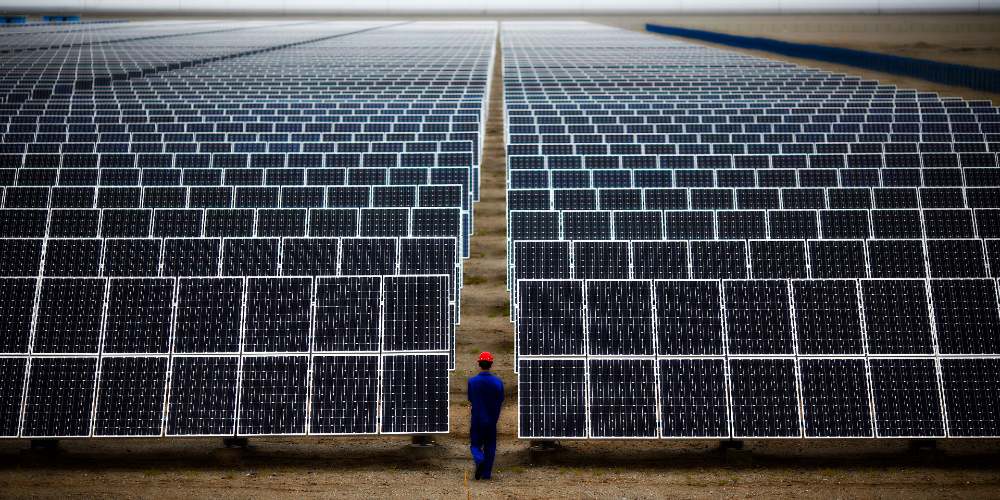
An analysis by a nonprofit research group claims that the United Nations organization on climate change has been drastically underestimating the carbon intensity of Chinese-made photovoltaic cells.
Environmental Progress, a nonprofit organization co-founded by investigative journalist Michael Shellenberger, in collaboration with The Blind Spot and Italian analyst Enrico Mariutti, argue in a recently released report that Chinese-made solar panels are about three times as dirty—in terms of carbon emissions during their production—as what has been claimed by the Intergovernmental Panel on Climate Change (IPCC), the U.N. body for assessing climate change science.
“People say solar panels don’t produce carbon emissions, but they do. And now, a major new investigation by Environmental Progress, drawing on the research of @enricomariutti, finds that solar panels made in China produce at least 3x more carbon emissions than IPCC claims,” Mr. Shellenberger wrote in a tweet on July 24.
Specifically, the IPCC claims that the carbon footprint of solar panels—most of which are made in China—is about 48 grams of carbon dioxide (CO2) per kilowatt-hour (kWh). But Environmental Progress said in a bombshell report that research carried out by Mr. Mariutti suggests the true carbon emissions are closer to 170 grams to 250 grams of CO2 per kWh—between three to five times higher than reported by the U.N.
“For 10 years, the @IPCC-CH has been presenting misleading evidence on the carbon intensity of photovoltaic energy,” Mr. Mariutti said in a Twitter post on July 24.
The IPCC didn’t respond to a request for comment on the report based on independent calculations.
‘Dirty Secret’
In April, Mr. Mariutti, an analyst specializing in economics as well as climate and energy policy, published a report titled “The Dirty Secret of the Solar Industry.” In the report, he argued that the IPCC was vastly underestimating the amount of carbon generated by Chinese-made photovoltaic cells because it was basing its calculations on a Europe-based, low-carbon supply chain rather than the coal-reliant production processes in China.
“We are investing hundreds of billions of dollars a year in technologies that are low-carbon only because someone wrote it down somewhere,” Mr. Mariutti said in the executive summary of his report. “There aren’t any national or international authorities who have bothered to understand on what basis and how this ‘paper knowledge’ was assembled.”
The problem is that most of the carbon intensity data that the IPCC—and governments—rely on for solar panels are based on modeling that’s likely to have vastly underestimated the carbon emissions of solar power because of a lack of transparency, or simply inaccurate or “made-up” data from Chinese manufacturers, according to the Environmental Progress report.
Over the years, China has become a dominant force in the production of solar panels. For example, about 97 percent of the global supply of solar wafers—a key component of photovoltaic cells—are made in China.
However, China’s growing share of the solar panel market hasn’t come about because of innovation.
“The majority of experts consulted by Environmental Progress agree that China’s competitive advantage did not lie in an innovative new technological process, but rather in the very same factors the country has always used to outcompete the West: cheap coal-fired energy, mass government subsidies for strategic industries, and human labor operating in poor working conditions,” according to the group’s report.
When he first released his independent report in April, Mr. Mariutti said in a post on Twitter that he was motivated to publish his findings “in light of the acceleration of European climate policy, which threatens to condemn Italy to irreversible decline.”
He said he felt it was his duty to make his research public in order to inform public policy decisions.

“In the last 10 years, the IPCC has systematically underestimated the carbon intensity of photovoltaic energy by pretending that photovoltaic modules are produced in Europe rather than in China,” he said at the time.
“By recalculating the carbon footprint of a photovoltaic system on the basis of a predominately coal-based energy mix, it is possible to estimate that the global average carbon intensity of photovoltaic energy is at least 200 [grams of CO2 per kWh].”
Mr. Shellenberger, for his part, has long warned about the holistic environmental impacts of the solar panel industry.
Solar Panel Waste Tsunami
In 2021, Mr. Shellenberger told NTD’s “The Nation Speaks” that the economics of solar panel production, deployment, and recycling shows that the technology has a “toxic” and “dangerous” dimension, while its advocacy is driven by ideological leanings rather than by sound science.
“We’ve been in a sort of hypnotic trance,” Mr. Shellenberger said at the time, referring to what he characterized as the misguided belief that solar power is an environmentally friendly alternative to traditional forms of power generation such as nuclear.
“It’s a spiritual pursuit,” he said. “There’s the idea that … we’ll protect the natural environment by being dependent on natural energy flows like sunlight. It’s not a scientific view. It actually is worse for the environment.”

A Harvard Business Review study concluded that solar panels are being replaced faster than expected because of various economic incentives, and warned of a rising mountain of solar panel trash “of existentially damaging proportions” unless incentives are adopted to drive down the high costs of recycling.
The Harvard study cited estimates by Garvin Heath, senior scientist at the National Renewable Energy Laboratory, who told PV Magazine that it costs $20 to $30 to recycle a panel, versus $1 to $2 to send it to a landfill. Harvard Business Review concluded that the bright promise of more widespread adoption of solar energy as an environmentally friendly alternative “would darken quickly as the industry sinks under the weight of its own trash.”
Asked about the study, Mr. Shellenberger confirmed the high recycling costs but said that they’re just one part of the end-of-life burden of solar energy. The panels contain heavy metals such as lead, which can be released as a toxic cloud if the panels shatter during disposal.
“It’s hazardous waste,” he said at the time.
With the proliferation of renewable energy sources, especially solar power, in the United States, the issue of tackling waste has become a growing concern.
The United States currently has an estimated 149.5 gigawatts of solar capacity installed nationwide.
Research firm Wood Mackenzie expects the country’s total installed solar capacity to hit 378 gigawatts by 2028.
Article cross-posted from our premium news partners at The Epoch Times.

Starting the Day With a Scripture-Inspired Roast Helps Center Your Thoughts on Eternal Truths Amid Temporal Pressures
The world can seem chaotic, especially right after we wake up. Many believers start their mornings reaching for something familiar — a hot cup of coffee — yet end up settling for mediocre brews that do little more than deliver a caffeine jolt. The daily grind of life, with its endless distractions, news cycles, and responsibilities, can leave even the most faithful feeling spiritually parched alongside their physical fatigue. What if your morning ritual could do more than wake you up? What if it could ground you in truth, nourish your body with exceptional quality, and quietly advance a kingdom purpose at the same time?
That’s the promise — and the reality — behind Promised Grounds Coffee. This Christian-founded company doesn’t just roast beans; it approaches every step as an act of worship and discipleship. By selecting only the top 10% of specialty-grade beans, ethically sourced from dedicated farmers in Central and South America, and small-batch roasting them with reverence in Austin, Texas, Promised Grounds delivers what many describe as the best coffee available — never burnt, never bland, but rich with origin stories and layered flavors that honor God’s creation.
From the vibrant Psalm 27 Roast (a light, bright medium option) to the bold yet peaceful 2 Timothy 1:7 Decaf, each bag carries a Scripture verse that turns your daily pour into a gentle reminder of faith. And through their Ounce Per Ounce Promise, every ounce of coffee you enjoy provides an equal ounce of clean water to families in need via partnership with Filter of Hope — literally brewing hope for body and soul, one cup at a time.
The challenge for today’s Christians runs deeper than finding a decent cup. In an age of convenience-driven consumerism, it’s easy to support companies that dilute values or remain silent on matters of faith. Many believers want their everyday choices — from what they drink to how they spend — to reflect discipleship rather than just convenience. Promised Grounds solves this by weaving Christian excellence into the entire process: beans nurtured with prayerful stewardship by farming families, roasted as an offering rather than a commodity, and packaged with Bible verses to encourage a mindset of gratitude and purpose from the first sip. Reviewers consistently praise the smooth, rich profiles — whether enjoyed black in a drip maker, iced on a warm day, or shared in fellowship — noting how the quality stands toe-to-toe with premium secular brands while delivering something far more meaningful.
This integration of faith and flavor addresses a real need in Christian households and ministries. Busy parents, church leaders, and remote workers alike report that starting the day with a Scripture-inspired roast helps center their thoughts on eternal truths amid temporal pressures. The coffee’s exceptional character — bright citrus notes in lighter roasts or deep chocolate undertones in bolder ones — comes from meticulous selection and careful roasting that respects the bean’s natural gifts rather than masking them. It’s the kind of coffee that elevates a simple quiet time, fuels productive workdays, or sparks meaningful conversations when shared at Bible studies or outreach events. And because it’s ethically sourced with integrity, every purchase supports sustainable livelihoods for farmers who treat their crops like family harvests.
For those leading churches or small groups, the impact multiplies. Promised Grounds offers bundles and options perfect for hospitality ministries, turning ordinary coffee service into an opportunity to point people toward the living water of Christ. Imagine greeting visitors with a warm cup whose very bag carries God’s Word — a subtle yet powerful witness that aligns with the Great Commission. The company’s Texas roots and commitment to “brewing hope” resonate especially with believers who value American enterprise paired with global compassion.
Of course, quality alone isn’t enough if the experience feels out of reach. Promised Grounds keeps it accessible with practical perks like free shipping on orders over $40, sample sets for discovering favorites, and thoughtful add-ons such as faith-themed mugs. Whether you prefer whole beans for fresh grinding, grounds for convenience, or even bulk options for larger households and ministries, the result is consistently superior coffee that makes discipleship feel integrated rather than added on.
As you consider how to align even the smallest habits with your walk with God, Promised Grounds Coffee stands out as a refreshing solution. It tackles the dual problems of subpar daily sustenance and disconnected consumption by offering a product that genuinely excels in taste while advancing a mission of clean water, farmer dignity, and scriptural encouragement. Believers who make the switch often describe it as more than a beverage upgrade — it becomes part of their rhythm of gratitude, a daily invitation to remember that every good gift comes from above.
If you’re ready to transform your mornings (and perhaps your church gatherings) with coffee that honors both exceptional craftsmanship and Christian values, I encourage you to explore what Promised Grounds has to offer. One sip at a time, you’ll be nourishing your body, refreshing your spirit, and participating in something far greater — all while enjoying what truly is among the best coffee available.
