

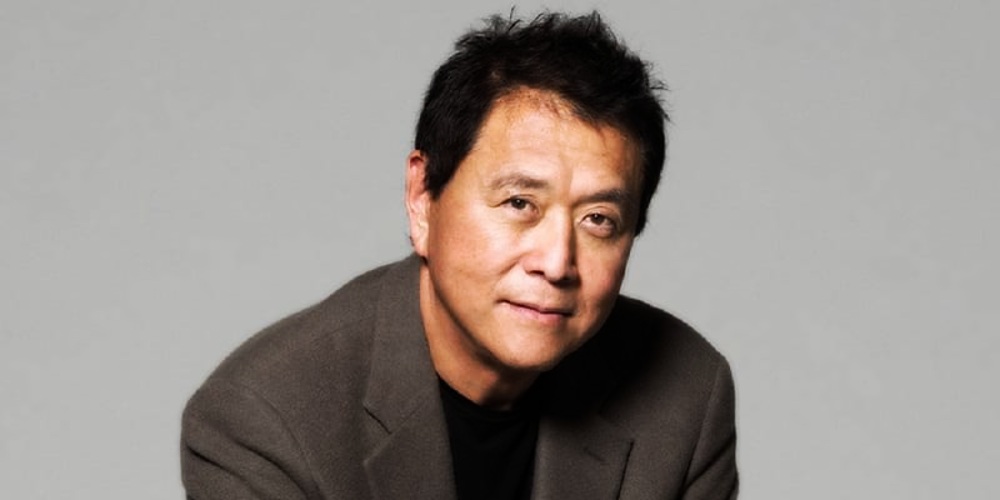
(Natural News)—For Japanese-American entrepreneur and famed author Robert Kiyosaki, Americans should veer away from being brainwashed that working for the paper dollar, saving and investing for it, would keep them afloat amid the economic collapse.
He said that since the dollar was taken off the gold standard in line with President Richard Nixon’s series of economic measures undertaken in response to increasing inflation in 1971, the U.S. dollar became debt. “Yet people are so indoctrinated into working for this (dollar), and saving this and investing this for more paper. That makes no sense to me,” the author of the no. 1 financial awareness book “Rich Dad, Poor Dad” told hosts Mike Adams and Todd Pitner during his September 26 appearance on “Decentralize.TV.”
Here is what he does, he said: “Number one, I don’t save money, I save silver and gold. I also use debt to invest.” He further recommended that the public study because when any “freaking idiot” can buy an Apple share, he just calls his stockbroker up and says, “I’ll give you $100, you get that share of Apple.” But he warned that once something “bad happens,” the money can be liquefied that fast. “But if you buy a piece of real estate for $100,000 and you make a mistake, you’re not going to write that baby down.”
He cited his friend Ken McElroy’s book “The ABCs of Real Estate Investing: The Secrets of Finding Hidden Profits Most Investors Miss,” which provided an advanced guide to real estate. “Let’s say I buy a property for a million dollars and I borrow out the $2 million. The property now is 100 percent debt and the company is still throwing cash flow,” he said pointing out that when one has cash flow from nothing, the return is infinite. “You made money out of nothing? Yeah, that’s what financial education is,” he added.
Segueing to self-custody and decentralization, Adams raised the value of gold, silver, and cryptocurrency. “Crypto is an honest ledger, right? No one can artificially inflate the supply of Bitcoin, gold and silver in inherent intrinsic value that outlast the fall of civilization throughout history. And also, you can’t just create gold out of thin air, it takes a lot of effort and energy to get it,” the Health Ranger stated.
Kiyosaki agreed saying, that crypto – Bitcoin especially – is off the grid and that is why he likes it. “But it’s blockchain technology, which has integrity. Meanwhile, the U.S. Treasury and President Joe Biden have no integrity,” the renowned author said. “So I want something you cannot print. And that’s why I like gold, silver, and Bitcoin.”
The founder of Rich Global LLC and Rich Dad Company, a private financial education company, further backed it up with the impending death of the U.S. dollar as the BRICS (Brazil, Russia, India, China, South Africa) nations have been expanding with the joining of Saudi Arabia and 41 other countries also expressed their intent to be part of the emerging economies. (Related: Robert Kiyosaki warns of impending DOLLAR DEMISE amid BRICS group’s gold-backed crypto plan.)
“With this, the world doesn’t have to use the dollars,” he said looking back in 1944 when USD became the reserve currency of the world. “It was as good as gold then because the U.S. had won World War II and all central banks had to store this in their vaults, like quadrillion dollars sitting in vaults of the Bank of Japan, Bank of Mexico, Bank of England, etc.” So, when the BRICS coin comes in perhaps quadrillions of dollars flood back to the United States, because it’s no longer money, it is going to cause hyperinflation.
How the United States lost powerful nation’s support such as Saudi Arabia
Kiyosaki, meanwhile, said that it is not just Biden’s strong push for the stupid green agenda that alienated Saudi Arabia from the United States. He said that another straw was when the current administration pulled out of Afghanistan. Also, the Bank of International Settlements made gold a tier-one asset. He said: “Up until that time, the USD was a petrodollar. When Biden pulled us out of Afghanistan, the dollar became worthless, it wasn’t worth oil anymore. So, Saudi Arabia says, ‘Why are we backing the United States?'”
Kiyosaki further expressed his observation, after providing a disclaimer that he was not a racist or xenophobic. “If you notice most of the countries that are hanging together are Christian – Canada, America, England, Australia, New Zealand – but Saudi Arabia, Iran, and Iraq, they’re Muslim, while Korea and all the other Buddhists are together. So not only is it race and money, it is by different religions as well. And I think this is going to be the biggest change in overall history.”
The finance expert also warned people of the rumor that there can be a bail-in, which for him is another level of insanity. “But I would take my money out of the bank. I won’t tell anybody where I keep it. I bought a safe someplace. I store my gold and silver in Switzerland because I don’t trust my government,” he revealed.
Adams concurred and added that the future for the American people is going to surprise them because they will find themselves living in deep impoverishment virtually overnight. “Even if they have dollars in the bank, or they think they have a pension or they think they have Social Security. Yeah, you may still get the check, but it’s not going to be able to buy much of anything,” the Brighteon and Natural News founder said.
Check out DollarDemise.com for more news about the imminent collapse of the U.S. dollar. Watch the full September 26 episode of “Decentralize.TV” with Mike Adams and Todd Pitner featuring Robert Kiyosaki below.
This video is from the Health Ranger Report channel on Brighteon.com.
Sources for this article include:
Starting the Day With a Scripture-Inspired Roast Helps Center Your Thoughts on Eternal Truths Amid Temporal Pressures
The world can seem chaotic, especially right after we wake up. Many believers start their mornings reaching for something familiar — a hot cup of coffee — yet end up settling for mediocre brews that do little more than deliver a caffeine jolt. The daily grind of life, with its endless distractions, news cycles, and responsibilities, can leave even the most faithful feeling spiritually parched alongside their physical fatigue. What if your morning ritual could do more than wake you up? What if it could ground you in truth, nourish your body with exceptional quality, and quietly advance a kingdom purpose at the same time?
That’s the promise — and the reality — behind Promised Grounds Coffee. This Christian-founded company doesn’t just roast beans; it approaches every step as an act of worship and discipleship. By selecting only the top 10% of specialty-grade beans, ethically sourced from dedicated farmers in Central and South America, and small-batch roasting them with reverence in Austin, Texas, Promised Grounds delivers what many describe as the best coffee available — never burnt, never bland, but rich with origin stories and layered flavors that honor God’s creation.
From the vibrant Psalm 27 Roast (a light, bright medium option) to the bold yet peaceful 2 Timothy 1:7 Decaf, each bag carries a Scripture verse that turns your daily pour into a gentle reminder of faith. And through their Ounce Per Ounce Promise, every ounce of coffee you enjoy provides an equal ounce of clean water to families in need via partnership with Filter of Hope — literally brewing hope for body and soul, one cup at a time.
The challenge for today’s Christians runs deeper than finding a decent cup. In an age of convenience-driven consumerism, it’s easy to support companies that dilute values or remain silent on matters of faith. Many believers want their everyday choices — from what they drink to how they spend — to reflect discipleship rather than just convenience. Promised Grounds solves this by weaving Christian excellence into the entire process: beans nurtured with prayerful stewardship by farming families, roasted as an offering rather than a commodity, and packaged with Bible verses to encourage a mindset of gratitude and purpose from the first sip. Reviewers consistently praise the smooth, rich profiles — whether enjoyed black in a drip maker, iced on a warm day, or shared in fellowship — noting how the quality stands toe-to-toe with premium secular brands while delivering something far more meaningful.
This integration of faith and flavor addresses a real need in Christian households and ministries. Busy parents, church leaders, and remote workers alike report that starting the day with a Scripture-inspired roast helps center their thoughts on eternal truths amid temporal pressures. The coffee’s exceptional character — bright citrus notes in lighter roasts or deep chocolate undertones in bolder ones — comes from meticulous selection and careful roasting that respects the bean’s natural gifts rather than masking them. It’s the kind of coffee that elevates a simple quiet time, fuels productive workdays, or sparks meaningful conversations when shared at Bible studies or outreach events. And because it’s ethically sourced with integrity, every purchase supports sustainable livelihoods for farmers who treat their crops like family harvests.
For those leading churches or small groups, the impact multiplies. Promised Grounds offers bundles and options perfect for hospitality ministries, turning ordinary coffee service into an opportunity to point people toward the living water of Christ. Imagine greeting visitors with a warm cup whose very bag carries God’s Word — a subtle yet powerful witness that aligns with the Great Commission. The company’s Texas roots and commitment to “brewing hope” resonate especially with believers who value American enterprise paired with global compassion.
Of course, quality alone isn’t enough if the experience feels out of reach. Promised Grounds keeps it accessible with practical perks like free shipping on orders over $40, sample sets for discovering favorites, and thoughtful add-ons such as faith-themed mugs. Whether you prefer whole beans for fresh grinding, grounds for convenience, or even bulk options for larger households and ministries, the result is consistently superior coffee that makes discipleship feel integrated rather than added on.
As you consider how to align even the smallest habits with your walk with God, Promised Grounds Coffee stands out as a refreshing solution. It tackles the dual problems of subpar daily sustenance and disconnected consumption by offering a product that genuinely excels in taste while advancing a mission of clean water, farmer dignity, and scriptural encouragement. Believers who make the switch often describe it as more than a beverage upgrade — it becomes part of their rhythm of gratitude, a daily invitation to remember that every good gift comes from above.
If you’re ready to transform your mornings (and perhaps your church gatherings) with coffee that honors both exceptional craftsmanship and Christian values, I encourage you to explore what Promised Grounds has to offer. One sip at a time, you’ll be nourishing your body, refreshing your spirit, and participating in something far greater — all while enjoying what truly is among the best coffee available.
