

STORY AT-A-GLANCE
- Irresponsible use of new and very advanced technologies by the military is life-threatening
- Engineered viruses can be used to edit genes in a target species, including in a heritable manner
- “Insect Allies” is a DARPA program designed to genetically modify mature plants in a live environment by releasing insects infected with genetically modified viruses
- Some scientists, although on board with genetic modification in principle, are questioning DARPA’s motives and raising concerns
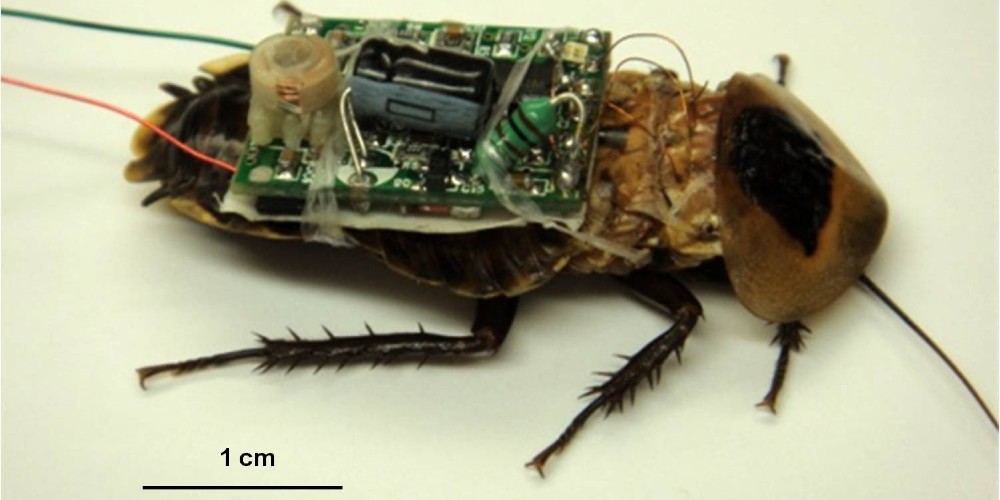
- Researchers in Singapore, as well as DARPA in the U.S. have developed “remote-controlled insects”
BREAKING NEWS: The craziest crazies have somehow escaped the asylum and installed themselves in high positions of power. Insane, they are coming up with one bad idea after another and barking orders at us, mad shine in their eyes and saliva coming out of their mouths. They are crazy — and in charge of institutions, schools, newspapers and armies.
They are running around with their high-tech pistols filled with high-tech poisons and their little sadistic CRISPR scissors. They are crazy — yes, they are crazy — and they are killing us slowly, and sometimes not so slowly. Welcome to the future where toxicity is health and the old crazy is the new normal. We are not crazy — they are crazy — and they have been from the beginning. And in 2020, they stopped pretending. What now?
Project “Insect Allies”
You may think that you have seen it all but here is a great idea. Take some insects, infect them with a genetically modified virus designed to genetically edit mature plants in real time, and release them. Release them into wild and repeat, “it’s safe and effective.”
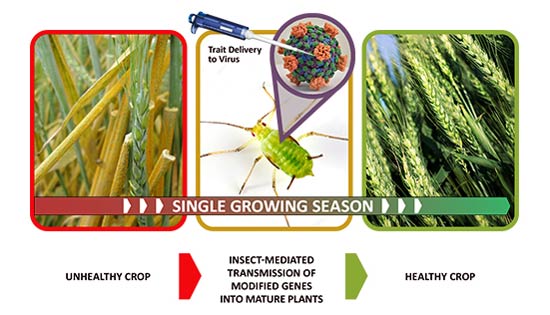
Sweet idea, right? Well, DARPA thought so, and so in 2016, they started a project called “Insect Allies” that is designed to do that. (This is a different project from Oxitec’s controversial release of GM mosquitos.) DARPA’s official story is that in the name of national security, a good way to protect the American crops from potential threats is to genetically modify them using GM viruses as genetic modifiers and insects as flying syringes. And that they just need to test it!
In a 2016 release titled, “DARPA Enlists Insects to Protect Agricultural Food Supply,” the agency stated:
“A new DARPA program is poised to provide an alternative to traditional agricultural threat response, using targeted gene therapy to protect mature plants within a single growing season.
DARPA proposes to leverage a natural and very efficient two-step delivery system to transfer modified genes to plants: insect vectors and the plant viruses they transmit. In the process, DARPA aims to transform certain insect pests into ‘Insect Allies,’ the name of the new effort.”
“‘Insect Allies’ three technical areas — trait design, insect vector optimization, and selective gene therapy in mature plants — layer together to support the goal of rapidly transforming mature plants to protect against natural or intentional agricultural disruption without the need for extensive infrastructure. The foundational knowledge and generalizable tools developed under the program could also support future agricultural innovation.”
Some suspicious peasants may foolishly wonder: What will happen in the short term and in the long term to the people who eat those plants, to the people and animals possibly bitten by those insects, to the wild insects who mate with the infected insects, and to all other life in the area and beyond that may get impacted? What ridiculous nonsense. Here is the answer, peasant: No one knows — and importantly, no one cares. Any more questions?
The first Insect Allies funded paper, titled, “Multiplexed heritable gene editing using RNA viruses and mobile single guide RNAs,” was published in 2020. Please note the word “heritable” in the headline. The paper stated:
“Mutant progeny are recovered in the next generation at frequencies ranging from 65 to 100%; up to 30% of progeny derived from plants infected with a virus expressing three sgRNAs have mutations in all three targeted loci.”
DARPA never disclosed if they tested this program outside of greenhouses.
Objections From the Scientific Community and Even the Pre-2020 Media
Actually, it turned out that a few scientists care — and at least during the pre-COVID era, they have objected.
Here is a short 2019 educational animation made by the German Max Planck Society (formerly the Max Planck Institute for the Science of Human History). Their main objection is the potential weaponization of the technology, they don’t mind the gene editing in principle.
But our standards for health and dignity are so low that this objection is better than no objection, and even this limited kind of objection and questioning DARPA takes some courage (even though it’s unknown if they would have objected in 2020).
And here is what Vice (!!) had to say in 2018 about the outcry from scientists:
“In the editorial, published on Thursday in Science Magazine, scientists from the Max Planck Institute for Evolutionary Biology and the University of Freiburg in Germany, and France’s Université de Montpellier, requested more transparency and opportunities for public discussion regarding the project and its implications.
‘Easy simplifications could be used to generate a new class of biological weapons,’ a press release reads, ‘weapons that would be extremely transmissible to susceptible crop species due to insect dispersion as the means of delivery.’”
What did DARPA say?

“In an email to Motherboard, a DARPA spokesperson rebutted the thesis of the Science Magazine piece and denied any intent to deploy technology developed through Insect Allies in an offensive setting.
‘We created Insect Allies specifically to develop technology that can deliver positive, protective traits to plants to help them survive unanticipated and/or fast-moving agricultural threats,’ the spokesperson wrote. ‘We see it as a critical addition to the national security toolkit, part of a layered strategy to preserve the security of the food supply.’”
“The Insect Allies program is a collaboration between the Defense Advanced Research Projects Agency (DARPA), Environmental Protection Agency, US Army, and other agencies. According to a DARPA slide presentation, the goal of Insect Allies is to “stably transform multiple mature crop plants in a complex, multi-species plant and insect community with enhanced trait(s) of agricultural interest” by mid-2021.”
Newsweek covered it, too. In a 2018 article, they said that “the U.S. government’s Defense Advanced Research Projects Agency (DARPA) has been accused of trying to create a new class of biological weapons that would be delivered via virus-infected insects.”
“Scientists with DARPA are looking at introducing genetically modified viruses that can edit chromosomes directly in fields — these are known as horizontal environmental genetic alteration agents (HEGAAs). The DARPA program is using the principles of HEGAAs but, unlike traditional methods of dispersal — like spraying fields with them — it wants to spread them through insects.”
The researchers raising the alarm asked specifically why, for agricultural use, it was so important to use insects as gene modification vectors, given that spraying was available. In response to Newsweek at the time, DARPA denied all allegations of military use and reiterated that the project’s aim was to protect American crops. In 2022, another paper was published where researchers expressed their concerns:
“The hazard and exposure potential of an HEGAA approach can vary greatly depending on the viruses, vector insects, target plant species, and genetic modifications selected and their effects. However, at the current stage of development, the most critical aspect is the compromised reliability of the HEGAA approach, owing mainly to its complex design with three different species …
They are a cause for concern because of the numerous effects that can increase the potential for hazard and exposure. Combined with the current inadequacy of corrective measures, it is clear that there is an urgent need for early analysis of whether HEGAA approaches can be inherently contained and controlled by their specific technology design.”
“Horizontal Environmental Genetic Alteration Agents”
What are HEGAAs? According to Wikipedia, the term “genetic alteration agent” first appears in 2016 in relation to this project, in a “work plan by DARPA describing a tender for contracts to develop genetically modified plant viruses for an approach involving their dispersion into the environment. The prefixing of ‘horizontal environmental’ to the former to generate the acronym HEGAA was first used in the [aforementioned] 2018 scientific publication.”
“Agents such as pathogens, symbionts or synthetic protein assemblages that can be acquired through horizontal transmission in the environment can potentially be engineered to become HEGAAs. This would be achieved using biotechnology methods to confer to them the capacity to alter nucleotides in the chromosomes of infected individuals through sequence-specific editing systems like CRISPR, ZFNs or TALENs.
No known infectious agent naturally has the capacity to gene edit eukaryotes in a manner that can be flexibly targeted to specific sequences (distinct from substantially random natural processes like retroviral integration).”
“By definition, HEGAA induced gene editing events are intended to occur outside of contained facilities such as laboratories or hospitals.
While genetically modified viruses with CRISPR editing have been successfully used as research tools in laboratories or for gene therapy in clinical settings, all gene editing events are intended to physically occur within contained facilities. By contrast, HEGAAs for their intended mode of action relies on inducing gene editing events that occur largely or exclusively in the environment.”
There are two types of HEGAAs: somatic and germline. Somatic HEGAAs are not inheritable, while germline ones “impact somatic cells and also cell lineages from which germline cells can be ultimately generated (e.g. sperm, oocytes, pollen, ovules, zygotes or seeds).”
When it comes to the “Insect Allies” project, it’s a gray area. The original assumption was that “Insect Allies” involved somatic HEGAAs but the aforementioned 2020 paper shows that the genetic changes in plants were heritable. Here is more detail:
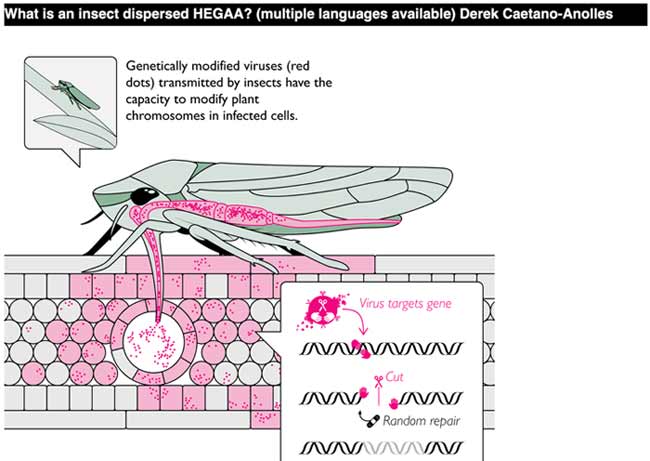
- HEGAAs are viruses which have been genetically modified to gain a capacity to edit the chromosomes of a target species (e.g. plant or animal) when intentionally released into the environment
- The word “horizontal” comes from their ability to be transmitted in the environment by infection
- The word “environmental” comes from the intention for these genetically modified viruses to be dispersed into the environment
- The words “genetic alteration agents” comes from the capacity to alter the chromosomes of a target species. This might be through causing a random mutation or introducing a new DNA sequence
- The specificity of HEGAAs is dependent on two things (1) the range of species the genetically modified virus can infect AND (2) the presence of the suitable DNA sequences in the plant chromosomes of cells that become infected
- An example of an insect dispersed viral HEGAA which disrupts a specific plant gene is illustrated in this figure below
All in all, this informational Max Planck Society affiliated website, whose purpose is “to contribute towards fostering an informed and public debate about this type of technology,” is one of the best sources of information on HEGAAs and the “Insect Allies” project. Incidentally, this particular website covers self-spreading vaccines as well. Here is a little video promo of the Euroscience Open Forum 2020:

And here it the actual 2020 panel (some of it is already outdated but very educational):
“Project Coast”
One of the panelists above mentions “Project Coast” is South Africa — and while it is not directly related to “Insect Allies,” it kind of is.
“Project Coast” was a toxin and bioweapon development project that took place in South Africa during the apartheid era. As a part of that project, scientists developed covert assassination tools and methods of covert sterilization, intended against the black population of South Africa. A warning? No really, a warning?
Back to DARPA
Here is more from the MPS-affiliated informational website:
“Even as the halfway point of the Insect Allies program approaches, DARPA has chosen not to publicly describe in its response to our Science article what is the basis of their having concluded that a developmental pathway exists that circumvents the early proliferation of biological weapons (described by the black development path in the accompanying image).
This is in addition to explaining in detail why their developmental plan is easier to develop than alternative paths (described by the red paths). As our Science article makes clear, this is central to justifying the wisdom of embarking on the development of HEGAAs, and many other types of GM viruses.
Over the next five years, only a minority of anticipated CRISPR-inspired innovations will involve intentional environmental releases (see recent NAS report). HEGAAs, and some other GM viruses, have the property of an early-stage biological weapons proliferation risk that is not shared with most other proposed techniques (including avant-garde ones like gene drive).
Choosing not to clearly address these obvious issues of global concern, as detailed in the Science article, makes their current model of develop first and explain later an especially unwise path, particularly for this insect-delivered program, that in many ways appears to be designed to get carried away.”
Living Foundries
To provide a backdrop for the “Insect Allies” project, here is a brief look at the DARPA “Living Foundries” bioengineering program, launched in 2010.
DARPA’s Living Foundries program aims to “enable adaptable, scalable, and on-demand production of critical, high-value molecules by programming the fundamental metabolic processes of biological systems to generate a vast number of complex molecules.”
“Programming Biological Systems”
In order to orient ourselves in this attempted new normal, we need to understand the mindset. Please note the use of term “engineer” all throughout this benevolent-sounding presentation:
DARPA’s Biological Technologies Office
DARPA’s Biological Technologies Office was founded in 2014. Here is an informational video on, in their own words, “DARPA’s way of thinking about biological technology to defend the homeland.”
According to DARPA’s website:
“DARPA has enjoyed a strong relationship with Silicon Valley since the early 1960s, working with innovators to lay the groundwork for new industries built around Agency investments in semiconductors, networking, artificial intelligence, user interfaces, programming, materials, microsystems, and more.
[We knew that!!!] Biotech is now emerging as a breakthrough opportunity space and it represents an area that is ripe for fresh collaboration among DARPA, the nation’s top researchers, venture capitalists, and entrepreneurs.”
Here are some of the listed topic of interests:
- Building with Biology Using Engineered Living Materials, which focused on programming DNA to grow materials to specifications at the sites where they are needed and developing living materials that are responsive to their environments and can heal when damaged;
- Staying on Target: Minimizing Off-Target Effects in Gene Editing, which focused on making personalized medicine feasible by conducting rapid, low-cost screens of an individual’s likely responses to tailored gene therapy;
- Creating a Pandemic-free World, which focused on DARPA’s vision of distributed healthcare that combines technology to detect pandemic outbreaks, rapidly identify and grow potent antibodies to fight infectious disease, and response tools for creating a pandemic firebreak;
- Immunity on Demand [emphasis mine], which focused on rapidly developing and delivering nucleic-acid-based protections against infectious disease;
- Failing Faster: De-Risking the Path to FDA Approval, which focused on using organ-on-chip technology to better predict the efficacy of new drugs in the development pipeline;
- A Real-time Window into Your Body’s Chemistry, which focused on tissue-integrating in vivo biosensors to continuously monitor physiology over the long term to predict the onset of disease;
- Reinventing Psychiatry Using Neurotechnology, which focused on using implanted, closed-loop neural systems to record and stimulate the brain to treat neuropsychiatric illness;
- MindFlight: Your Brain Will Be Your Pilot Today, which focused on direct neural control of complex physical systems;
- Memory Enhancement in Everyday Life, which focused on non-invasive electrical and auditory stimulation technology to enhance memory by facilitating the neural replay process
Is it me, or is it that the crazies are running the asylum?
Remote-Controlled Insects
If you think that you have now seen it all, well, you haven’t. Here is a video of scientists in Singapore torturing live insects and turning them into cyborgs. Horrifying.
And here is, you guessed it, DARPA:
“Through a DARPA-funded program, scientists at the University of California invented a tiny rig that connects to an insect’s brain and flight muscles. Once implanted, the device takes over the insect’s body, turning it into a remote control cyborg capable of receiving flight commands wirelessly from a nearby laptop.”
It’s all good and fun (not really, more like a horror movie), and we could close our eyes — but will it be fun if the emboldened crazies try to remote-control your children?
About the Author
To find more of Tessa Lena’s work, be sure to check out her bio, Tessa Fights Robots.

Two Storms, One Harvest

Every food crisis in living memory has been a one-shock event. The 2008 price spike was a commodity bubble. The 2020 shortages were a logistics failure. The 2022 grain scare was a war on one exporter’s ports. Each time, the system bent, adjusted, and recovered, and each time the experts assured us afterward that global markets are simply too big and too diversified to fail.
What nobody in Washington seems eager to discuss is that 2026 is shaping up to be something the modern food system has never actually faced. Two independent shocks, one climatic and one geopolitical, are converging on the same harvest cycle at the same time. Not sequentially. Simultaneously.
Start with the weather. The Pacific Ocean is currently building toward what forecasters now openly call a record event. NOAA’s Climate Prediction Center puts the odds of at least a strong El Niño near 88 percent, with roughly two in three odds it reaches “very strong” status, the tier reserved for perhaps three or four events in the entire satellite era. Every major global model now projects a median peak in Super El Niño territory, and most of them project it exceeding the 2015-16 event, which until now held the modern record. Sea surface anomalies were already brushing the super threshold in mid-July, months before these events normally peak. The atmosphere has already shifted into El Niño mode, and the event is forecast to crest in late fall and early winter.
This is not about “climate change.” It’s about the standard cycles of weather, and the cycle we’re currently in is one that has likely devastated societies in the past. We’re better prepared as a society today, but not all Americans are equally prepared.
Serious households have started doing the quiet math on their own. Grocery bills tell part of the story, and the forecast maps tell the rest, which is why long-term food storage has moved from fringe hobby to mainstream line item in the family budget, with established suppliers like Heaven’s Harvest seeing demand from people who five years ago would have rolled their eyes at the idea. That instinct is not paranoia. It is pattern recognition, and the pattern is worth walking through carefully.
Editor’s Note: Heaven’s Harvest IS a sponsor, but the warnings of this article are real and would be written even if we didn’t have a survival food sponsor. With that said, those who take advantage of what they offer can use promo code “Patriot” for 15% off.
The Fertilizer Clock Is Already Running
While the Pacific warms, the second shock has been unfolding in the Strait of Hormuz. The conflict with Iran turned the world’s most important energy chokepoint into a contested waterway, and the consequences reach far beyond the gas pump. Roughly a third of global fertilizer trade moves through Hormuz, and the disruption sent urea prices up 86 percent year over year by March, with a 53 percent jump in a single month.
The World Bank projects energy prices rising about 24 percent in 2026 and fertilizer about 31 percent. By its own accounting, fertilizer prices ran 35 percent higher in the first five months of this year than the same period last year.
Here is the mechanism the nightly news will not explain. Fertilizer is not a grocery item. It is a time-delayed input. The nitrogen a farmer in Iowa or Punjab could not afford to apply this spring does not show up as a problem this spring. It shows up as a thinner harvest six to twelve months later.
The World Bank’s own food security brief concedes that the effects of reduced applications earlier this season “are likely to become visible only later in harvest outcomes.” Translate that from institutional language into plain English and it means this. The damage is already done, it is already in the ground, and we are simply waiting for it to arrive on the shelf.
Now check the calendar. Six to twelve months from the spring planting season lands us squarely in late 2026 and early 2027. Which is precisely when the strongest El Niño in the instrumental record is forecast to peak, bringing its signature droughts to Southeast Asia, Australia, southern Africa, northern Brazil, and South Asia, the very regions that grow the world’s rice, sugar, and oilseeds.
The World Bank warns openly that a strong El Niño “could disrupt multiple crop belts simultaneously” on top of the conflict-driven input costs. Their baseline projection assumes the Middle East disruptions ease by autumn. What in the last two years of Middle East history suggests that assumption is safe?
The System Has No Slack Left
The comfortable answer is that global markets always adjust. But adjustment requires slack, and the slack is gone. Global cereal production is expected to decline from last year’s records even before El Niño does its work. The UN World Food Programme, hardly a den of right-wing preppers, is calling this the most significant disruption to its supply chains since Covid and the invasion of Ukraine, and its supply chain director put the stakes bluntly.
Today’s supply chain challenges are tomorrow’s hunger crisis.
There is also a political dimension that markets cannot price. When food gets scarce, governments do not behave like economists. They behave like politicians. Export bans, hoarding mandates, and panic buying at the national level turned the modest rice shortfall of 2008 into a global crisis, and analysts are already warning that import-dependent nations are the first dominoes.
The 2015-16 Super El Niño, a far weaker event than what is now forecast, threw tens of millions into food stress across Africa and Asia. This one is projected to be stronger, and it arrives with fertilizer already rationed by price and shipping lanes already contested by missiles.
What Joseph Knew
Scripture does not treat preparation for lean years as faithlessness. It treats it as wisdom delivered in advance to those willing to act on it.
Behold, there come seven years of great plenty throughout all the land of Egypt: And there shall arise after them seven years of famine; and all the plenty shall be forgotten in the land of Egypt.
Joseph did not respond to that warning with a hashtag or a committee. He stored grain during the years of abundance, and when the famine came, Egypt stood while its neighbors begged. The lesson is not that famine is certain. It is that the time to prepare is precisely when preparation still looks optional.
Nobody who filled a pantry in a year of plenty has ever regretted it, and nobody standing in an empty aisle has ever been glad he waited for certainty.
None of this calls for panic, and panic is the enemy of sound judgment anyway. It calls for the same unglamorous prudence our grandparents considered ordinary. Keep some cash margin, know your local growers, and put real food in deep storage while it is cheap and available, because the entire arc of this story is that cheap and available is a closing window.
Families looking for a straightforward place to start can visit Heaven’s Harvest and use promo code Patriot for 15 percent off long-term storable food. The forecasts may yet soften, the strait may yet reopen, and we should pray they do. But hope is a fine thing to hold and a foolish thing to eat.

How can we kill our bees? GM other bugs with ANOTHER VIRUS!
Monsanto created GM’d plants to include insect killers. What is happening to the bee’s? Some of you are smart enough to figure out what all this means?
Millions suffer in silence with the horrendous Morgellons’s Infection and the CDC has been covering it up for decades, instructing doctors to diagnose it as a psychosis, despite all the actual microscopic and physical evidence, pure evil.