

Doug Casey: In ancient pre-industrial societies—just like today—you became wealthy by producing more than you consume and saving the difference.
One of the best things about money is that it allows an individual to set aside capital, the product of his labor, in a form that retains value. A farmer, for instance, can’t save fruit from year to year, nor can a baker save bread. Sound money is critical for lasting gains in wealth and economic progress. Sound money is why wealthy societies become dominant, and a reason other societies are poor and ripe for conquest and domination.
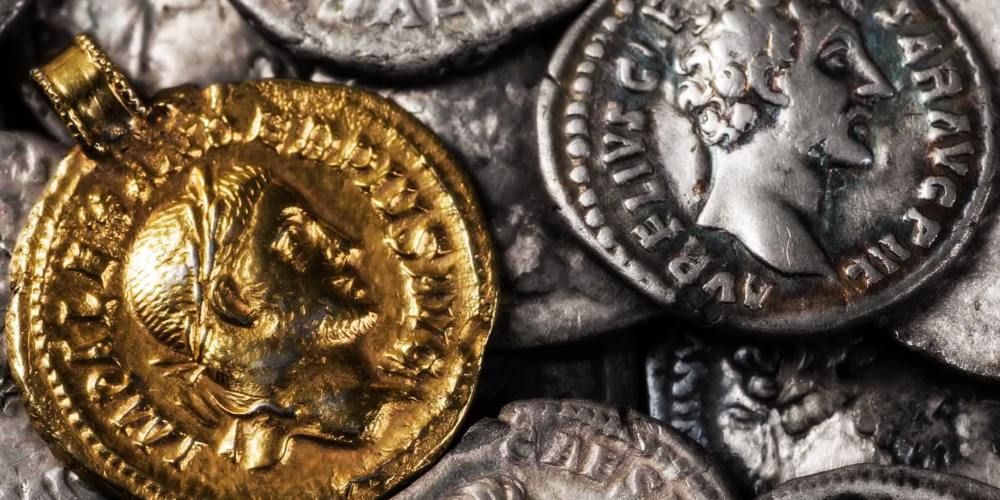
Rome provides a meaningful long-term template. The Roman government, in search of revenue, started debasing the denarius under Nero in the 1st century, taking it from 90% silver to 75%. As late as the reign of Marcus Aurelius, which ended in 180, the denarius was still about 75% silver. By the end of the 3rd century, it was pot metal that was simply plated with silver. The 3rd century was notable for numerous coups, civil wars, assassinations, and secessions. There are plenty of reasons political chaos goes hand in hand with economic chaos; they reinforce each other.
Roman coins weren’t worth saving by the middle of the 3rd century, and the collapse of the currency was a major cause of the collapse of the empire. In some ways, sound money was even more important in ancient times than it is today because they didn’t have sophisticated banking, financial markets, credit, accounting, or ways of measuring the rate of currency depreciation. Physical cash was king.
Currency inflation creates chaos, even in a relatively primitive economy like that of the Romans—where there was still a lot of barter. Once the rulers found they couldn’t depreciate the currency anymore, direct taxes went up substantially, but it became hard to collect them simply because the currency had no value. The soldiers didn’t like being paid with worthless tokens. This is why after the reign of Aurelius, the next century was a time of civil wars and general chaos. There was no new construction of roads or public buildings. Those who were able holed up at their country estates, which were internally self-sustaining. It was the beginning of feudalism, a foreshadowing of the coming Dark Ages. By the accession of Diocletian in 295, Rome had lost all touch with its republican roots and had become an oriental-style despotism.
Is Rome a distant mirror to today’s West? It’s entirely possible, even likely.
International Man: What parallels can be made today with the US in terms of monetary debasement and overall degradation?
Doug Casey: The parallels are very direct. We can just look at the pictures on the coins.
During the Roman Republic, the consuls didn’t put their images on the currency. The coins bore images of the gods, heroes, or personifications of various virtues. Julius Caesar was the first ruler who dared put his own image on a coin. It amounted to free advertising.
Caesar signed the death warrant for the Roman republic, followed by Augustus, his adopted son, who was the first actual Roman emperor. From that point until the end, all Roman coins featured the image of the current ruler.
In the US, we didn’t have a picture of a president on a coin until 1909, when Lincoln was deified and put on the penny; before that, pennies featured an Indian. All the other coins had allegorical images, as did Roman coins during its republic. After Roosevelt was elected in 1932, however, things changed. The coins all featured past presidents. Washington replaced a walking Liberty on the quarter in 1932. Jefferson replaced the Indian on the nickel in 1938. Roosevelt himself replaced the image of Mercury on the dime in 1946—that was a big step since he was so recently dead. Benjamin Franklin replaced Liberty on the half dollar in 1947.
Since Lincoln, Washington, and Jefferson were basically mythical-level presidents, I suppose an argument can be made for their images on money—but it was unwise since they were really just politicians. And Lincoln had the nerve to have his picture placed on a $1 bill in 1861.
Kennedy replaced Franklin on the half-dollar in 1964. Replacing allegorical symbols, or long-dead founding fathers, with recently deceased politicians is a sign of degradation. We haven’t yet put a current ruler on the coinage, but we’re getting close.
Of course, gold was the first to go, in 1933, with the accession of Roosevelt. Then in 1964, all silver was removed from coins. Current coins look like silver, but they aren’t. It’s a subtle fraud, symptomatic of the entire US—and world for that matter—monetary system. Technically since, then, the discs you may have in your pocket are tokens, not coins. Coins have value in themselves; tokens have no intrinsic value. Then in 1982, the penny—which had been 95% copper and 5% zinc—was changed to zinc with a copper wash on it.

The trend of money has been negative since the creation of the Federal Reserve in 1913, followed by World War I. Currency debasement and war underlie the ongoing moral and economic bankruptcy of the West.
The next step will be the removal of coins from circulation. Few are still worth enough to bother picking up from the ground. They’re no longer even useful in parking meters or video games. It costs three cents in metal to create a zinc penny and eight cents for a nickel. Both are entirely useless. But all coins are on their way out, to be replaced by digital currency.
This has interesting societal implications because kids won’t be able to collect coins anymore. It’s hard to save money digitally. Digits aren’t tangible, and kids like real stuff if they’re trying to save. Taking the physical reality out of money devalues the concept of money itself.
International Man: Much of the spectacular art, music, and architecture in recent history was created in times when the average person used gold and silver coins as money.
Do you see a relationship between the use of hard money and culture?
Doug Casey: There is a relationship. It’s perhaps not directly provable as cause and effect, but there’s a high correlation between junk money and junk culture. And it’s not just a question of arbitrarily changing taste.

During the 1950s, ’60s, and ’70s, older generations would sometimes decry rock and roll music. But the fact is, rock and roll music has stood the test of time. Why? It has melody, rhythm, and, in many cases, very poetic lyrics. Rock may be a step down from Bach, Beethoven, or Wagner, but it doesn’t make my dog leave the vicinity. But today’s popular music—metal, rap, hip-hop, and the rest—doesn’t even have a melody. It’s actively dissonant. The lyrics are almost all coarse and gross. There’s rarely any poetry or nobility of emotion.
The same is true of art. Much modern art is something that a chimpanzee can paint. In fact, a lot of it is just a scam, a private joke among galleries and critics who compete in bilking the public. The only good thing about most “performance art” is that it’s gone when the performance is over. I’m not a religious person, but it’s clearly a sign of decline when things like Serrano’s “Piss Christ” are considered art—and things have become even more degraded since. A lot of art is totally lacking not only elegance and nobility but has even less technical skill than Hunter Biden’s paintings. Of course, they don’t really count as art—that was just about overt bribery.
These things would have been met with ridicule and disgust before the 20th century. There is a correlation between the way a civilization expresses itself in art and the money that finances that art. I think it’s more than just correlation. This is even true of how people dress. It used to be that when people went out, they wore coats and a tie. Of course, styles change—but some modes of dress show respect for oneself and other people. Some don’t. Now all you see are t-shirts and torn jeans.
These are all symptoms of bad money. Crappy art, crappy music, and crappy clothes go along with a crappy culture and crappy money.
International Man: Today, countries around the world are inflating and destroying their fiat currencies at breathtaking speed with no end in sight. In countries with rampant currency debasement, we often see more lying, cheating, and stealing as people struggle to make ends meet.
Aside from the obvious financial consequences of the ongoing currency debasement, what social and cultural consequences do you see coming?
Doug Casey: As bad as debased currency was for the Roman Empire, it’s going to be even worse in our advanced industrial society, with its complex and often international supply chains.
If you don’t know what the real value of the money is that you’re selling something for, things start falling apart. The State is impinging on every area of society. Inflation may be the worst product of government, but taxes and regulations are almost as destructive.
In addition, the rewards for not working—in the form of welfare and soon guaranteed annual income—are so high that it’s going to discourage people that would otherwise be entrepreneurs or workers. It’s going to encourage them not to set up businesses and simply not to work. Frankly, it’s just one thing after another. Could the Covid and vaccine hysterias be the straws that break the camel’s back? If not, maybe the Global Warming hysteria will do the trick.
Western Civilization is being destroyed right before our very eyes, and I don’t think that trend is going to change until we reach a crisis—when things get so bad that there’s a revolution.
International Man: Let’s consider historical examples and the US today. Once currency debasement and the degradation of culture have established themselves as long-term trends, what are the chances they reverse?
Doug Casey: Trends in motion tend to stay in motion until they reach a crisis. Once they reach a crisis, it can go either way. But things usually get worse again, for at least a while.
Things might degenerate slowly into something like the Soviet Union or Mao’s China. Or maybe what’s left of capitalism and personal freedoms will be overthrown quickly. We can certainly expect no good to come out of Washington now that Americans seem to have elected genuine Bolsheviks to run their government. The old order was overthrown in France in 1789, and it got worse with Robespierre and then Napoleon. Things were terrible in Russia in 1917, but they got worse under Lenin and worse again under Stalin.
I think no matter what happens, we’re in for some really grim times
International Man: What are the investment implications?
Doug Casey: People should buy gold and silver and store them in the safest place they can think of—including in a stable political jurisdiction outside of your own. And learn to speculate because prudent investing is becoming impossible in the kind of environment that we have today.
We’re very much like Rome in the third and fourth centuries. But the decline is moving at an accelerated pace. Prudent long-term investment is no longer possible the way it was before. You have to think of everything in terms of speculation.
It’s unfortunate, but over the next 10 years, everybody is going to be forced to become a speculator just in order to survive.
Reprinted with permission from International Man.

Two Storms, One Harvest

Every food crisis in living memory has been a one-shock event. The 2008 price spike was a commodity bubble. The 2020 shortages were a logistics failure. The 2022 grain scare was a war on one exporter’s ports. Each time, the system bent, adjusted, and recovered, and each time the experts assured us afterward that global markets are simply too big and too diversified to fail.
What nobody in Washington seems eager to discuss is that 2026 is shaping up to be something the modern food system has never actually faced. Two independent shocks, one climatic and one geopolitical, are converging on the same harvest cycle at the same time. Not sequentially. Simultaneously.
Start with the weather. The Pacific Ocean is currently building toward what forecasters now openly call a record event. NOAA’s Climate Prediction Center puts the odds of at least a strong El Niño near 88 percent, with roughly two in three odds it reaches “very strong” status, the tier reserved for perhaps three or four events in the entire satellite era. Every major global model now projects a median peak in Super El Niño territory, and most of them project it exceeding the 2015-16 event, which until now held the modern record. Sea surface anomalies were already brushing the super threshold in mid-July, months before these events normally peak. The atmosphere has already shifted into El Niño mode, and the event is forecast to crest in late fall and early winter.
This is not about “climate change.” It’s about the standard cycles of weather, and the cycle we’re currently in is one that has likely devastated societies in the past. We’re better prepared as a society today, but not all Americans are equally prepared.
Serious households have started doing the quiet math on their own. Grocery bills tell part of the story, and the forecast maps tell the rest, which is why long-term food storage has moved from fringe hobby to mainstream line item in the family budget, with established suppliers like Heaven’s Harvest seeing demand from people who five years ago would have rolled their eyes at the idea. That instinct is not paranoia. It is pattern recognition, and the pattern is worth walking through carefully.
Editor’s Note: Heaven’s Harvest IS a sponsor, but the warnings of this article are real and would be written even if we didn’t have a survival food sponsor. With that said, those who take advantage of what they offer can use promo code “Patriot” for 15% off.
The Fertilizer Clock Is Already Running
While the Pacific warms, the second shock has been unfolding in the Strait of Hormuz. The conflict with Iran turned the world’s most important energy chokepoint into a contested waterway, and the consequences reach far beyond the gas pump. Roughly a third of global fertilizer trade moves through Hormuz, and the disruption sent urea prices up 86 percent year over year by March, with a 53 percent jump in a single month.
The World Bank projects energy prices rising about 24 percent in 2026 and fertilizer about 31 percent. By its own accounting, fertilizer prices ran 35 percent higher in the first five months of this year than the same period last year.
Here is the mechanism the nightly news will not explain. Fertilizer is not a grocery item. It is a time-delayed input. The nitrogen a farmer in Iowa or Punjab could not afford to apply this spring does not show up as a problem this spring. It shows up as a thinner harvest six to twelve months later.
The World Bank’s own food security brief concedes that the effects of reduced applications earlier this season “are likely to become visible only later in harvest outcomes.” Translate that from institutional language into plain English and it means this. The damage is already done, it is already in the ground, and we are simply waiting for it to arrive on the shelf.
Now check the calendar. Six to twelve months from the spring planting season lands us squarely in late 2026 and early 2027. Which is precisely when the strongest El Niño in the instrumental record is forecast to peak, bringing its signature droughts to Southeast Asia, Australia, southern Africa, northern Brazil, and South Asia, the very regions that grow the world’s rice, sugar, and oilseeds.
The World Bank warns openly that a strong El Niño “could disrupt multiple crop belts simultaneously” on top of the conflict-driven input costs. Their baseline projection assumes the Middle East disruptions ease by autumn. What in the last two years of Middle East history suggests that assumption is safe?
The System Has No Slack Left
The comfortable answer is that global markets always adjust. But adjustment requires slack, and the slack is gone. Global cereal production is expected to decline from last year’s records even before El Niño does its work. The UN World Food Programme, hardly a den of right-wing preppers, is calling this the most significant disruption to its supply chains since Covid and the invasion of Ukraine, and its supply chain director put the stakes bluntly.
Today’s supply chain challenges are tomorrow’s hunger crisis.
There is also a political dimension that markets cannot price. When food gets scarce, governments do not behave like economists. They behave like politicians. Export bans, hoarding mandates, and panic buying at the national level turned the modest rice shortfall of 2008 into a global crisis, and analysts are already warning that import-dependent nations are the first dominoes.
The 2015-16 Super El Niño, a far weaker event than what is now forecast, threw tens of millions into food stress across Africa and Asia. This one is projected to be stronger, and it arrives with fertilizer already rationed by price and shipping lanes already contested by missiles.
What Joseph Knew
Scripture does not treat preparation for lean years as faithlessness. It treats it as wisdom delivered in advance to those willing to act on it.
Behold, there come seven years of great plenty throughout all the land of Egypt: And there shall arise after them seven years of famine; and all the plenty shall be forgotten in the land of Egypt.
Joseph did not respond to that warning with a hashtag or a committee. He stored grain during the years of abundance, and when the famine came, Egypt stood while its neighbors begged. The lesson is not that famine is certain. It is that the time to prepare is precisely when preparation still looks optional.
Nobody who filled a pantry in a year of plenty has ever regretted it, and nobody standing in an empty aisle has ever been glad he waited for certainty.
None of this calls for panic, and panic is the enemy of sound judgment anyway. It calls for the same unglamorous prudence our grandparents considered ordinary. Keep some cash margin, know your local growers, and put real food in deep storage while it is cheap and available, because the entire arc of this story is that cheap and available is a closing window.
Families looking for a straightforward place to start can visit Heaven’s Harvest and use promo code Patriot for 15 percent off long-term storable food. The forecasts may yet soften, the strait may yet reopen, and we should pray they do. But hope is a fine thing to hold and a foolish thing to eat.
