

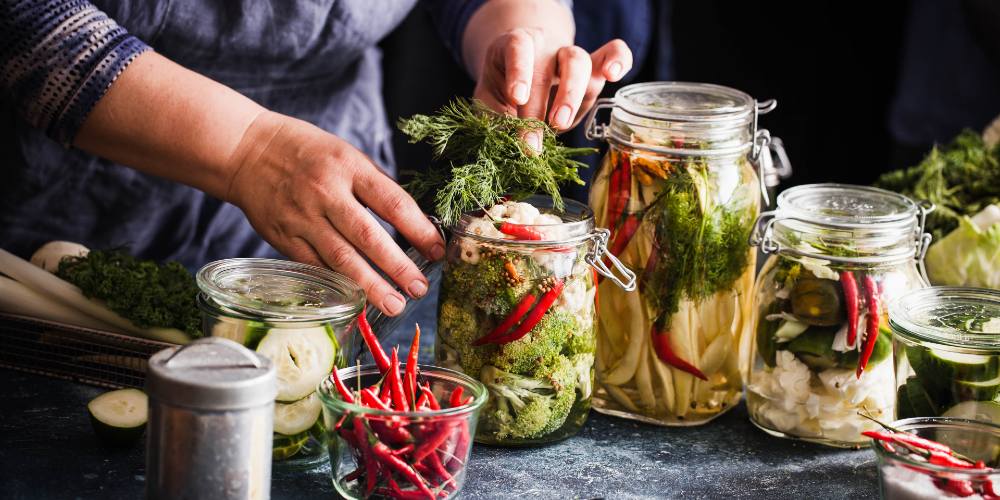
- Fermented foods like sauerkraut and kimchi “offer an affordable dietary intervention strategy” for better mental health
- Fermented foods are rich in phytochemicals and microbial metabolites that include neurotransmitters and neuromodulators
- These compounds stimulate pathways of the microbiota-gut-brain axis, including those of the immune system and neuroendocrine, enteric nervous and circulatory systems
- Fermented foods may block dysregulation of the hypothalamic-pituitary-adrenal (HPA) axis, the system responsible for the management of stress, which has also been linked to multiple neuropsychiatric disorders
- A meta-analysis of cohort studies found a significant association between consuming fermented dairy foods, including cheese and yogurt, and a decreased risk of depression
(Mercola)—Fermented foods like sauerkraut and kimchi are powerful allies to your mental health, courtesy of the neuroactive microbes and molecules they contain.1 Microbes and their metabolites, created during fermentation modulate the microbiota-gut-brain axis, which involves neural, immune, endocrine and metabolic pathways.2
Writing in Neuroscience & Biobehavioral Reviews, researchers with University College Cork (UCC) in Ireland and colleagues reasoned that fermented foods “offer an affordable dietary intervention strategy” for better mental health.3
Their review highlights how different types of fermented food not only have the potential to alter the makeup of microbiota in your gut but also influence the immune system and microbiota-gut-brain axis, with profound effects on your brain.
Fermentation — An Ancient Tool Valued for Modern-Day Mental Health
Many cultures around the world have relied on food fermentation since ancient times to increase the shelf-life of food. Fermentation also makes food more flavorful while helping to control potentially disease-causing microorganisms and improving foods’ digestibility.4
The process involves the conversion of carbohydrates into alcohol or organic acids using microorganisms like yeasts and bacteria under anaerobic conditions. This leads to the production of beneficial compounds now known to boost physical and mental health.
“Although ancient in origin, fermented foods are now seen as conduits for introducing beneficial microbes and molecules. Moreover, fermented foods are applicable therapeutics across various socioeconomic sectors given their potential affordability and cross-cultural accessibility,” the review explained.5
Fermented foods are rich in phytochemicals and microbe metabolites that include neurotransmitters and neuromodulators. These compounds stimulate pathways of the microbiota-gut-brain axis, including those of the immune system and neuroendocrine, enteric nervous and circulatory systems. When fermented foods are digested, they also produce compounds capable of modulating intestinal barrier and blood brain barrier permeability.6
Fermented foods may also help block dysregulation of the hypothalamic-pituitary-adrenal (HPA) axis, the system responsible for the management of stress, which has also been linked to multiple neuropsychiatric disorders.7
Researchers with APC Microbiome Ireland at UCC previously investigated the influence of a psychobiotic diet on the microbial profile and mental health of 45 adults.8 Participants were randomized to eat either a psychobiotic diet or a control diet for four weeks. The psychobiotic diet included fruits and vegetables high in prebiotic fiber, including onions, leeks, cabbage, apples and bananas, along with fermented foods, such as sauerkraut and kefir.9
After four weeks, those following the psychobiotic diet had a reduction in perceived stress. Those who followed the psychobiotic diet the most had the greatest decreases in stress. Further, significant changes were found in 40 different chemicals, along with subtle changes in microbial makeup. Professor John Cryan, one of the study’s lead authors who also worked on the featured Neuroscience & Biobehavioral Reviews paper, said in a UCC news release:10
“Although the microbiome has been linked to stress and behavior previously, it was unclear if by feeding these microbes demonstratable effects could be seen. Our study provides one of the first data in the interaction between diet, microbiota and feelings of stress and mood.
Using microbiota targeted diets to positively modulate gut-brain communication holds possibilities for the reduction of stress and stress-associated disorders, but additional research is warranted to investigate underlying mechanisms.”
Virtually Any Fermented Food May Improve Brain Health
In the early stages of the research, study author Ramya Balasubramanian and colleagues compared sequencing data from more than 200 fermented foods in an effort to determine which are most beneficial for the brain. Nearly all of them showed promise, according to Balasubramanian, who said in a news release:11
“I expected only a few fermented foods would show up, but out of 200 fermented foods, almost all of them showed the ability to exert some sort of potential to improve gut and brain health … Fermented sugar-based products and fermented vegetable-based products are like winning the lottery when it comes to gut and brain health.
… For all that we see on sugar-based products being demonized, fermented sugar takes the raw sugar substrate, and it converts it into a plethora of metabolites that can have a beneficial effect on the host.
So even though it has the name ‘sugar’ in it, if you do a final metabolomic screen, the sugar gets used by the microbial community that’s present in the food, and they get converted into these beautiful metabolites that are ready to be cherry picked by us for further studies.”
The Neuroscience & Biobehavioral Reviews paper outlined a wide range of fermented foods that may be beneficial. Among them:12
- Sauerkraut
- Kvass
- Kimchi
- Kefir
- Yogurt
- Cheese
- Koumiss
- Airag
- Bonito flakes
- Sourdough
- Vinegar
- Tempeh
- Natto
- Miso
- Kefir water
- Kombucha
Both food substrate and environmental conditions alter the fermented food microbiome and therefore its potential health effects. According to the review:13
“Fermented foods are diverse in their preparation, substrate category and type of fermentation. This can influence the microbiota and the molecular composition of fermented foods.
Subsequently, these components can influence the communication between the gut and the brain resulting in modulation of the intestinal barrier and blood brain barrier, peripheral and central immune system and nervous system and thereby modulating the intestinal milieu, general gut and brain health.”
Fermented Foods Help Ward Off Depression
Lactobacillus, found in fermented foods like yogurt, kefir, kimchi and sauerkraut, has been dubbed a “psychobiotic”14 because of its effects on mental health, particularly anxiety and depression. Lactobacillus bacteria help dampen stress responses and prevent depression and anxiety, in part, by modulating your immune system.15

Further, a healthy gut microbiome also depends on the consumption of fermented foods. A study assigned 36 adults to consume a diet high in fermented foods or high-fiber foods for 10 weeks. Those consuming fermented foods had an increase in microbiome diversity as well as decreases in markers of inflammation.16
In another example, Lactobacillus was found to produce gamma aminobutyric acid (GABA), a neurotransmitter that inhibits excessive neuronal firing, helping to induce a natural state of calm,17 in animal studies,18 while also reducing depression-related behavior.19
A meta-analysis of cohort studies, involving 83,533 people, also found a significant association between consuming fermented dairy foods, including cheese and yogurt, and a decreased risk of depression.20 The study suggested the gut-brain axis may explain the link between fermented dairy foods and depression, as probiotic-rich fermented foods may help:21
- Lower inflammation in the gut
- Make the gut barrier stronger
- Reduce stress responses via the HPA axis
- Alter GABA receptor expression
One study using brain scans found that consuming fermented milk containing a variety of probiotics can lessen brain activity related to seeing sad or angry faces. Another study found that women who took probiotics had lower depression scores.22
Fermented Foods May Help Preserve Mental Health
Dietary interventions based on so-called “psychobiotics” were described as a “novel nutritional approach targeting gut microbiota for managing cognitive performance and preventing memory decline across the lifespan.”23 The review, published in Food Research International, suggests that fermented foods may help preserve mental health.
Further, feeding your microbes with a psychobiotic diet — one that’s rich in prebiotic and fermented foods — can also reduce stress and possibly stress-related disorders. The study authors stressed the benefits of using whole, fermented foods:24

“Although the more traditional psychobiotic candidates, such as probiotic and prebiotic supplementation, are promising approaches, using whole dietary approaches offers a number of advantages.
This includes the benefits associated with nutritional needs met primarily through whole diet, a more accessible way due to the necessity to consume a food daily, costs of supplemental products as well as the potential synergistic effects in the microbiota that could be elicited by complex diets.”
Interestingly, they also found that tryptophan metabolism may be one underlying mechanism behind fermented foods’ stress-relieving effects. “Tryptophan metabolism has been shown to be closely regulated by the microbiota and can serve as important bioactive messengers in the microbiota-brain communication,” the researchers explained, adding that it’s also involved in many brain-related disorders.25
How to Make Fermented Foods at Home
Given the numerous mental health benefits of fermented foods, if you haven’t yet incorporated them into your diet, now is an excellent time to start. Fermented vegetables are both simple and cost-effective to prepare at home. While you can find fermented foods at supermarkets and health food stores, many commercial options, such as yogurt and kefir, are not healthy.
Many of these products contain high levels of sugar, artificial sweeteners and additives, with a relatively low content of beneficial bacteria. The pasteurization process used in commercial products to extend their shelf life actually destroys the beneficial bacteria they’re supposed to contain.
To reap the maximum health benefits, either purchase raw (unpasteurized) versions of these foods at a health food store or food co-op, or make them yourself. Consuming a diverse range of fermented foods is beneficial, as each offers a unique set of beneficial bacteria.
Fortunately, making fermented foods at home is simpler than it might seem. It doesn’t require extensive time in the kitchen. Start by getting some wide-mouth canning jars and filtered water, along with select organic vegetables of your choice for fermenting. After packing your jars, the only step left is to wait a few days for the vegetables to ferment, or “ripen.”
You can view a step-by-step guide in the video above. As demonstrated, you’ll see that culturing vegetables is simple and cost-effective. You can also make your own homemade yogurt and kefir. If you don’t eat fermented foods on a regular basis, a probiotic supplement shouldn’t be considered a replacement for whole, fermented foods.
- 1 Neuroscience & Biobehavioral Reviews March 2024, Volume 158, 105562
- 2 Scientific Reports March 31, 2023, Introduction
- 3 Neuroscience & Biobehavioral Reviews March 2024, Volume 158, 105562, Highlights
- 4, 5 Neuroscience & Biobehavioral Reviews March 2024, Volume 158, 105562, Introduction
- 6 Neuroscience & Biobehavioral Reviews March 2024, Volume 158, 105562, 2. Fermented food and the microbiota-gut-brain axis
- 7 Neuroscience & Biobehavioral Reviews March 2024, Volume 158, 105562, 2.4 Fermented food and the hypothalamic-pituitary adrenal (HPA) axis
- 8 Molecular Psychiatry October 27, 2022
- 9, 10 University College Cork October 27, 2022
- 11 Microbiology Society April 14, 2023
- 12 Neuroscience & Biobehavioral Reviews March 2024, Volume 158, 105562, Table 1
- 13 Neuroscience & Biobehavioral Reviews March 2024, Volume 158, 105562, Figure 1
- 14 Brain, Behavior and Immunity January 2024; 115: 458-469, Introduction
- 15 Brain, Behavior and Immunity January 2024; 115: 458-469
- 16 Cell July 12, 2021
- 17 The Journal of Neuroscience May 1, 2013; 33(18):7770-7
- 18, 19 Translational Psychiatry June 3, 2022, Discussion
- 20 PLoS One. 2023; 18(2): e0281346
- 21, 22 PLoS One. 2023; 18(2): e0281346., Discussion
- 23 Food Res Int. 2022 Feb:152:110892. doi: 10.1016/j.foodres.2021.110892. Epub 2021 Dec 22
- 24, 25 Molecular Psychiatry October 27, 2022, Discussion

Starting the Day With a Scripture-Inspired Roast Helps Center Your Thoughts on Eternal Truths Amid Temporal Pressures
The world can seem chaotic, especially right after we wake up. Many believers start their mornings reaching for something familiar — a hot cup of coffee — yet end up settling for mediocre brews that do little more than deliver a caffeine jolt. The daily grind of life, with its endless distractions, news cycles, and responsibilities, can leave even the most faithful feeling spiritually parched alongside their physical fatigue. What if your morning ritual could do more than wake you up? What if it could ground you in truth, nourish your body with exceptional quality, and quietly advance a kingdom purpose at the same time?
That’s the promise — and the reality — behind Promised Grounds Coffee. This Christian-founded company doesn’t just roast beans; it approaches every step as an act of worship and discipleship. By selecting only the top 10% of specialty-grade beans, ethically sourced from dedicated farmers in Central and South America, and small-batch roasting them with reverence in Austin, Texas, Promised Grounds delivers what many describe as the best coffee available — never burnt, never bland, but rich with origin stories and layered flavors that honor God’s creation.
From the vibrant Psalm 27 Roast (a light, bright medium option) to the bold yet peaceful 2 Timothy 1:7 Decaf, each bag carries a Scripture verse that turns your daily pour into a gentle reminder of faith. And through their Ounce Per Ounce Promise, every ounce of coffee you enjoy provides an equal ounce of clean water to families in need via partnership with Filter of Hope — literally brewing hope for body and soul, one cup at a time.
The challenge for today’s Christians runs deeper than finding a decent cup. In an age of convenience-driven consumerism, it’s easy to support companies that dilute values or remain silent on matters of faith. Many believers want their everyday choices — from what they drink to how they spend — to reflect discipleship rather than just convenience. Promised Grounds solves this by weaving Christian excellence into the entire process: beans nurtured with prayerful stewardship by farming families, roasted as an offering rather than a commodity, and packaged with Bible verses to encourage a mindset of gratitude and purpose from the first sip. Reviewers consistently praise the smooth, rich profiles — whether enjoyed black in a drip maker, iced on a warm day, or shared in fellowship — noting how the quality stands toe-to-toe with premium secular brands while delivering something far more meaningful.
This integration of faith and flavor addresses a real need in Christian households and ministries. Busy parents, church leaders, and remote workers alike report that starting the day with a Scripture-inspired roast helps center their thoughts on eternal truths amid temporal pressures. The coffee’s exceptional character — bright citrus notes in lighter roasts or deep chocolate undertones in bolder ones — comes from meticulous selection and careful roasting that respects the bean’s natural gifts rather than masking them. It’s the kind of coffee that elevates a simple quiet time, fuels productive workdays, or sparks meaningful conversations when shared at Bible studies or outreach events. And because it’s ethically sourced with integrity, every purchase supports sustainable livelihoods for farmers who treat their crops like family harvests.
For those leading churches or small groups, the impact multiplies. Promised Grounds offers bundles and options perfect for hospitality ministries, turning ordinary coffee service into an opportunity to point people toward the living water of Christ. Imagine greeting visitors with a warm cup whose very bag carries God’s Word — a subtle yet powerful witness that aligns with the Great Commission. The company’s Texas roots and commitment to “brewing hope” resonate especially with believers who value American enterprise paired with global compassion.
Of course, quality alone isn’t enough if the experience feels out of reach. Promised Grounds keeps it accessible with practical perks like free shipping on orders over $40, sample sets for discovering favorites, and thoughtful add-ons such as faith-themed mugs. Whether you prefer whole beans for fresh grinding, grounds for convenience, or even bulk options for larger households and ministries, the result is consistently superior coffee that makes discipleship feel integrated rather than added on.
As you consider how to align even the smallest habits with your walk with God, Promised Grounds Coffee stands out as a refreshing solution. It tackles the dual problems of subpar daily sustenance and disconnected consumption by offering a product that genuinely excels in taste while advancing a mission of clean water, farmer dignity, and scriptural encouragement. Believers who make the switch often describe it as more than a beverage upgrade — it becomes part of their rhythm of gratitude, a daily invitation to remember that every good gift comes from above.
If you’re ready to transform your mornings (and perhaps your church gatherings) with coffee that honors both exceptional craftsmanship and Christian values, I encourage you to explore what Promised Grounds has to offer. One sip at a time, you’ll be nourishing your body, refreshing your spirit, and participating in something far greater — all while enjoying what truly is among the best coffee available.
