

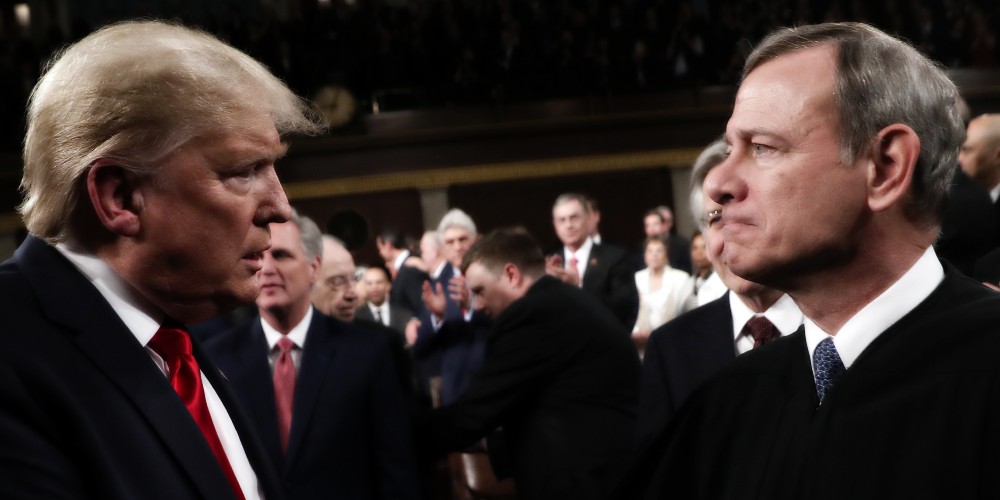
(Mises)—This week’s decision by the Colorado Supreme Court to ban — for now — Donald Trump from the state’s presidential ballot is the latest escalation in the broader theatre of deteriorating political norms in America. The four-three decision is grounded in the Court’s opinion that Trump’s actions on January 6 represent culpability in an attempted “insurrection” and therefore disqualify him under the Fourteenth Amendment.
The response to the court’s decision was predictable. On the left, political leaders in other Democrat-controlled states immediately called for their own disqualification efforts. Most amusingly, and an excellent illustration of the current state of American politics, a letter by the California Lt. Governor proclaimed: “The constitution is clear: you must be 40 years old and not be an insurrectionist.” The Constitution’s age requirement is, of course, 35.
On the right, the response was varied. While a minority of Republicans desperate for a return to a pre-2016 GOP celebrated the decision, many rank-and-file Republican voters responded with understandable anger, viewing the court’s decision as an outrageous attack on political determination and further indication of the lengths the government will go to undermine their desired political leader. Others viewed the decision as a net positive, a demonstration of the rising probability of Trump’s re-election, and ultimately a form of political theatre that would eventually backfire with voters.
This assumption, however, is predicated on the widely held belief that the Colorado decision will quickly make its way to the US Supreme Court, which will strike it down. The timing of Colorado’s decision, which has been threatened by Democrats for months now, will help clarify this process early and remove this threat from next November’s contest.
Supporting this view is one piece of precedence the Supreme Court has to work from: a Civil War-era case where a man, Caesar Griffin, challenged a criminal conviction on the basis that the presiding judge was disqualified from his position due to serving as a legislator in the Virginia Confederate government. At the time, the Court found that the relevant section of the 14th Amendment was not self-enforcing and, therefore, required an act of Congress to disqualify the judge in question.
But what if the Supreme Court does not overturn Colorado’s ruling?
Afterall the Colorado verdict engaged with the Griffin Case, arguing that the Court’s decision at the time simply reflected the unique issues regarding the particular circumstance of state secession, which maintained its pre-federal legislative bodies. In the Colorado court’s eyes, Trump’s encouragement of January 6 is a separate matter entirely. They granted their ability to judge Trump guilty of insurrection, regardless of the opinion of any other legal body.
This dynamic highlights one of the many limitations of any “constitutional order” that any legal system is ultimately only limited by the judgments of those responsible for enforcing it. As Ryan McMaken has noted, rather than some form of neutral institution charged with acting within the narrow limits of the law, “In practice, the Supreme Court is just another federal legislature, although this one decides matters of public policy based on the opinions of a mere five people, most of whom spend their time utterly divorced from the economic realities of ordinary people while cavorting with oligarchs and other elites.”
By looking beyond the romantic lens with which far too many conservatives hold regarding their assumptions about how the Constitution should function, the question is, what are the motivations of the current US Supreme Court?
Particularly in the current political environment, beginning with a simple partisan breakdown of the court is natural. This dynamic may better explain the confidence of conservative pundits more than confidence that the Constitution guarantees their desired outcome, given that six of the nine current judges were nominated by Republicans, including three from President Trump himself.
While this six-three split likely will be the favorite result on political gambling websites, the history of the modern court is more nuanced. We have “Republican” judges who frequently rule in ways that have hurt the political calculation of their associated party, from Chief Justice John Roberts’s infamous decision to uphold Obamacare to Justice Brett Kavanaugh’s vote in a voting rights decision that forced the Alabama state legislature to bend to the will of the Democrat Party and create a reliably blue voting district earlier this year. Similarly, Justice Amy Comey Barrett joined in a separate case involving voting maps in North Carolina, as well as a case challenging controversial changes to 2020 election law.
As such, partisanship alone cannot be relied upon to carry the day. Further, commentary by legal scholars at the Cato Institute, such as Ilya Somin celebrating the Colorado Court’s decision, demonstrates that the appetite of “Constitutional lawyers” to justify the logic utilized in the case is not limited simply to progressive activists.
What individuals like Somin and the Colorado majority have in common is an underlying hatred of Donald Trump individually and their belief that he is a uniquely grotesque and dangerous figure to wield the office of the presidency. In the formers’ words, he is a “menace to liberal democracy” whose “rhetoric echoes that of twentieth-century fascists.” If one holds this view, the aim to retroactively rationalize any attempt to prevent his return to power becomes internally justified, even if disqualifying political opponents violates the principles of liberal democracy in a way twentieth-century fascists would have supported.
Could nominally Republican justices hold similar views?

A potential clue could be considering the academic affiliations of the Colorado Court. While Democrats appointed all seven of the state’s Supreme Court, three of the four in the majority justices were from Ivy League products, and DC clerkships shaped their careers. The three dissenters went to the University of Denver. Of the three potential swing votes at the federal level, two are Ivy Leaguers with similar pedigrees: Roberts and Kavanaugh.
While it is overly simplistic to predict the ruling of a judge like Kavanaugh simply because he was a part of that whole Yale thing — after all, the same could be said for Clarence Thomas — his pre-Supreme Court experience was very much spent as part of the political system that views Trump as a particularly vulgar threat. Similarly, the Harvard-trained Roberts was a reliable foil to President Trump during his first term. Various Supreme Court watchers have argued that some of his decisions were made from a position of trying to defend his court’s place in history from accusations of it being a Trump Court.
What better way for these two to win historical fame from their beloved institutions than being those responsible for ending the Trump political threat once and for all? Particularly if the result is a lifeline to a potential Nikki Haley takeover of the Republican banner, a candidate who some reasonably view as “Dick Cheney in 3-inch heels.”
As Murray Rothbard identified in his classic Anatomy of the State, the best way to understand the government’s behavior is from the viewpoint of defending its legitimacy and preservation. If the principle of political self-determination must be sacrificed to preserve the regime, then so be it.
With this understanding in mind, it would be a mistake for conservatives to believe their team will bail out “their guy.” In the end, most of those wearing robes are closer to their enemies than their friends.
If the Supreme Court saves Trump, it will not be due to their rejecting the belief that Trump is guilty of insurrection, but a calculated decision that the political fallout from the right will spark a danger to the Court’s credibility — and by extension the regime as a whole — then four more years of MAGA.

For those who desire to see the regime threatened, one’s preferred outcome in this case should be shaped by which of those two threats they view as most likely to deliver.
About the Author
Tho is Editorial and Content Manager for the Mises Institute, and can assist with questions from the press. Prior to working for the Mises Institute, he served as Deputy Communications Director for the House Financial Services Committee. His articles have been featured in The Federalist, the Daily Caller, Business Insider, The Washington Times, and The Rush Limbaugh Show.

Two Storms, One Harvest

Every food crisis in living memory has been a one-shock event. The 2008 price spike was a commodity bubble. The 2020 shortages were a logistics failure. The 2022 grain scare was a war on one exporter’s ports. Each time, the system bent, adjusted, and recovered, and each time the experts assured us afterward that global markets are simply too big and too diversified to fail.
What nobody in Washington seems eager to discuss is that 2026 is shaping up to be something the modern food system has never actually faced. Two independent shocks, one climatic and one geopolitical, are converging on the same harvest cycle at the same time. Not sequentially. Simultaneously.
Start with the weather. The Pacific Ocean is currently building toward what forecasters now openly call a record event. NOAA’s Climate Prediction Center puts the odds of at least a strong El Niño near 88 percent, with roughly two in three odds it reaches “very strong” status, the tier reserved for perhaps three or four events in the entire satellite era. Every major global model now projects a median peak in Super El Niño territory, and most of them project it exceeding the 2015-16 event, which until now held the modern record. Sea surface anomalies were already brushing the super threshold in mid-July, months before these events normally peak. The atmosphere has already shifted into El Niño mode, and the event is forecast to crest in late fall and early winter.
This is not about “climate change.” It’s about the standard cycles of weather, and the cycle we’re currently in is one that has likely devastated societies in the past. We’re better prepared as a society today, but not all Americans are equally prepared.
Serious households have started doing the quiet math on their own. Grocery bills tell part of the story, and the forecast maps tell the rest, which is why long-term food storage has moved from fringe hobby to mainstream line item in the family budget, with established suppliers like Heaven’s Harvest seeing demand from people who five years ago would have rolled their eyes at the idea. That instinct is not paranoia. It is pattern recognition, and the pattern is worth walking through carefully.
Editor’s Note: Heaven’s Harvest IS a sponsor, but the warnings of this article are real and would be written even if we didn’t have a survival food sponsor. With that said, those who take advantage of what they offer can use promo code “Patriot” for 15% off.
The Fertilizer Clock Is Already Running
While the Pacific warms, the second shock has been unfolding in the Strait of Hormuz. The conflict with Iran turned the world’s most important energy chokepoint into a contested waterway, and the consequences reach far beyond the gas pump. Roughly a third of global fertilizer trade moves through Hormuz, and the disruption sent urea prices up 86 percent year over year by March, with a 53 percent jump in a single month.
The World Bank projects energy prices rising about 24 percent in 2026 and fertilizer about 31 percent. By its own accounting, fertilizer prices ran 35 percent higher in the first five months of this year than the same period last year.
Here is the mechanism the nightly news will not explain. Fertilizer is not a grocery item. It is a time-delayed input. The nitrogen a farmer in Iowa or Punjab could not afford to apply this spring does not show up as a problem this spring. It shows up as a thinner harvest six to twelve months later.
The World Bank’s own food security brief concedes that the effects of reduced applications earlier this season “are likely to become visible only later in harvest outcomes.” Translate that from institutional language into plain English and it means this. The damage is already done, it is already in the ground, and we are simply waiting for it to arrive on the shelf.
Now check the calendar. Six to twelve months from the spring planting season lands us squarely in late 2026 and early 2027. Which is precisely when the strongest El Niño in the instrumental record is forecast to peak, bringing its signature droughts to Southeast Asia, Australia, southern Africa, northern Brazil, and South Asia, the very regions that grow the world’s rice, sugar, and oilseeds.
The World Bank warns openly that a strong El Niño “could disrupt multiple crop belts simultaneously” on top of the conflict-driven input costs. Their baseline projection assumes the Middle East disruptions ease by autumn. What in the last two years of Middle East history suggests that assumption is safe?
The System Has No Slack Left
The comfortable answer is that global markets always adjust. But adjustment requires slack, and the slack is gone. Global cereal production is expected to decline from last year’s records even before El Niño does its work. The UN World Food Programme, hardly a den of right-wing preppers, is calling this the most significant disruption to its supply chains since Covid and the invasion of Ukraine, and its supply chain director put the stakes bluntly.
Today’s supply chain challenges are tomorrow’s hunger crisis.
There is also a political dimension that markets cannot price. When food gets scarce, governments do not behave like economists. They behave like politicians. Export bans, hoarding mandates, and panic buying at the national level turned the modest rice shortfall of 2008 into a global crisis, and analysts are already warning that import-dependent nations are the first dominoes.
The 2015-16 Super El Niño, a far weaker event than what is now forecast, threw tens of millions into food stress across Africa and Asia. This one is projected to be stronger, and it arrives with fertilizer already rationed by price and shipping lanes already contested by missiles.
What Joseph Knew
Scripture does not treat preparation for lean years as faithlessness. It treats it as wisdom delivered in advance to those willing to act on it.
Behold, there come seven years of great plenty throughout all the land of Egypt: And there shall arise after them seven years of famine; and all the plenty shall be forgotten in the land of Egypt.
Joseph did not respond to that warning with a hashtag or a committee. He stored grain during the years of abundance, and when the famine came, Egypt stood while its neighbors begged. The lesson is not that famine is certain. It is that the time to prepare is precisely when preparation still looks optional.
Nobody who filled a pantry in a year of plenty has ever regretted it, and nobody standing in an empty aisle has ever been glad he waited for certainty.
None of this calls for panic, and panic is the enemy of sound judgment anyway. It calls for the same unglamorous prudence our grandparents considered ordinary. Keep some cash margin, know your local growers, and put real food in deep storage while it is cheap and available, because the entire arc of this story is that cheap and available is a closing window.
Families looking for a straightforward place to start can visit Heaven’s Harvest and use promo code Patriot for 15 percent off long-term storable food. The forecasts may yet soften, the strait may yet reopen, and we should pray they do. But hope is a fine thing to hold and a foolish thing to eat.

Trump made numerous mistakes (the q–clowns who preach he’s a super–genius” always disagree with this, but they require an operators manual to operate their pants zipper) and never surrounded himself with a first–rate team; the three decent fellows he had in his administration — — Rich Higgins (RIP), Gen. Spalding and Steve Bannon — — he quickly fired (????) and his frigging transition team was essentially managed by Dïck Cheney via his Godson, DJ Gribbin IV!
The dude is paying the price for this now —- Mr. Higgins, God bless his soul, exactly described the future assault plan against Trump, but instead of paying attention he allowed him to be fired — dingaling Trump, the forever loser!
Then in 2018, Trump signed the CISA Act of 2018 and the RUBES still cannot, or will not, comprehend it!
Game over, America —– best to continue to ammo up and stay VIGILANT!!!
Well written and thoughtful article!!!