

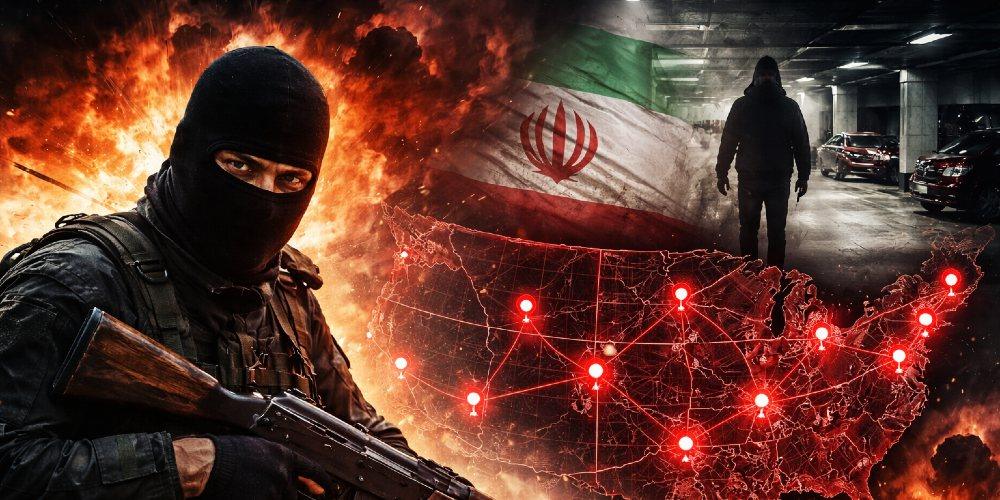
- Approximately 1,500 Iranians were intercepted at the U.S. southern border during the Biden administration, with roughly half released into the country pending court hearings.
- Officials express deep concern over the unknown number of Iranians who evaded detection entirely, known as “gotaways,” amid heightened fears of Iranian retaliation following U.S. and Israeli strikes on Iran.
- Federal alerts have warned of possible encoded communications from Iran intended as “operational triggers” for prepositioned sleeper assets on American soil.
- Senators from both parties, including Bill Hagerty, Ron Wyden, James Risch, and Rick Scott, have voiced alarms about the potential presence of sleeper cells and the need for vigilance.
- Recent incidents, such as a car attack on a Michigan synagogue and a shooting at Old Dominion University, have intensified homeland security worries even as no direct link to Iranian direction has been confirmed in every case.
- President Trump has stated that authorities are monitoring individuals who entered during the previous administration’s border policies and that most are being tracked.
- Iran remains designated as a state sponsor of terrorism, with a history of using proxies and covert networks for asymmetric attacks.
- The combination of border encounters, intercepted signals, and ongoing military conflict has prompted increased scrutiny by the FBI, CIA, and Department of Homeland Security.
Mounting concerns about potential Iranian sleeper cells inside the United States have surged in recent weeks, driven by the scale of Iranian nationals encountered at the southern border in prior years and fresh intelligence warnings tied to escalating conflict abroad.
Roughly 1,500 Iranians were stopped at the U.S.-Mexico border during the Biden administration, according to data referenced by lawmakers and border officials. Of those intercepted, about half were released into the interior of the country while awaiting immigration proceedings. The true scope of the risk, however, lies in those who were never caught.
Sen. Bill Hagerty, a Tennessee Republican and former U.S. ambassador to Japan, described the figures as deeply concerning. “We have no idea how many people got around obviously,” he told the New York Post. “The numbers are deeply concerning.”
Hagerty noted that many of the encounters involved individuals who traveled through hubs such as Sao Paulo, Brazil, a known corridor for passport fraud and irregular migration.
Customs and Border Protection data cited by the Niskanen Center indicate the number of intercepted Iranians climbed to approximately 1,650 between 2022 and 2025. These encounters occurred against the backdrop of Iran’s long-standing designation as a state sponsor of terrorism, a regime that has repeatedly demonstrated its willingness to strike through proxies, lone actors, and covert operatives rather than direct conventional confrontation.
A federal security alert issued in recent weeks warned law enforcement of possible efforts by Iran to contact “prepositioned sleeper assets” inside the United States. Intelligence officials reported detecting encoded transmissions—potentially using shortwave radio methods reminiscent of Cold War-era number stations—that could serve as operational triggers for dormant networks. Such communications are difficult to intercept and even harder to attribute in real time, leaving authorities to operate with incomplete visibility.
President Trump addressed the issue directly on March 11, acknowledging the vulnerabilities created by earlier border policies while expressing confidence in current monitoring efforts.
“A lot of people came in through Biden with his stupid open border, but we know where most of them are: We’ve got our eye on all of them, I think,” he said.
His administration has faced the challenge of sorting through legacy cases while confronting an active threat environment shaped by sustained U.S. and Israeli military actions against Iranian leadership and infrastructure.
Bipartisan voices in the Senate have echoed the gravity of the situation. Senate Intelligence Committee Vice Chair Sen. Ron Wyden, a Democrat from Oregon, noted the moment carries “a lot of safety challenges” without disclosing classified details.
Republican senators, including James Risch of Idaho and Rick Scott of Florida, stressed the need for constant vigilance. “I don’t think there’s any question they’re here,” Scott said. “We’ve got to be so vigilant … it just takes one person.”
Recent domestic incidents have added urgency to the warnings. In mid-March, a Lebanese American man drove a car packed with explosives into a synagogue in West Bloomfield, Michigan. Around the same time, an ISIS-linked gunman opened fire at Old Dominion University in Virginia, killing an ROTC instructor. While not every event has been conclusively tied to Iranian direction, the timing amid strikes on Iran has heightened scrutiny of any attack involving individuals with Middle Eastern ties or expressed sympathies.
FBI Director Kash Patel and CIA Director John Ratcliffe have engaged with lawmakers on Capitol Hill to discuss surveillance authorities and emerging threats. These briefings occur as federal agencies weigh the balance between protecting civil liberties and disrupting potential plots before they materialize. The challenge is compounded by the diffuse nature of modern terrorism, where state actors like Iran can inspire or direct lone wolves and small cells without leaving clear command-and-control footprints.
Iran’s strategy has long relied on asymmetric tools precisely because it lacks the conventional military reach of a superpower. Sleeper cells—operatives who embed quietly, often for years, maintaining normal lives until activated—represent one such tool. Historical precedents include Hezbollah-linked networks uncovered in the United States and Latin America, as well as Iran’s support for proxy militias across the Middle East that have targeted American personnel.

The unknown number of “gotaways” from the southern border during the 2021–2024 period remains a central point of contention. Even if only a small fraction of those who crossed carried hostile intent, the absolute numbers involved in special interest alien encounters from terrorism-prone regions raise legitimate questions about exposure. Law enforcement in border states, particularly Texas, has repeatedly flagged the influx of individuals from countries like Iran as requiring heightened vetting and monitoring.
President Trump’s team has moved to tighten enforcement and review prior releases, yet the reality of millions of encounters and releases under the previous administration means the work of identification and neutralization is ongoing. Officials emphasize that presence alone does not prove imminent threat, but the combination of opportunity, capability, and motivation from a cornered regime creates a risk profile that cannot be ignored.
Broader patterns reinforce the concern. Iran has a documented history of plotting attacks on U.S. soil and against American allies, ranging from assassination attempts to cyber operations. The regime’s leadership, significantly degraded by recent strikes, may calculate that domestic terrorism offers a low-cost way to impose costs on the United States without risking further direct military losses.
Americans have every reason to expect their government to treat this threat with the seriousness it demands. That means rigorous vetting at the border, robust intelligence sharing, targeted surveillance where legally justified, and swift action against any confirmed operatives or networks. Complacency is not an option when the stakes involve potential mass casualty events on home soil.
The coming months will test the nation’s ability to deter and defend against this shadow war. With Iran’s conventional power diminished but its ideological reach intact, the focus must remain on disrupting pathways of infiltration and activation before they yield tragedy. Vigilance, informed by hard lessons from the recent past, remains the surest safeguard.
Two Storms, One Harvest

Every food crisis in living memory has been a one-shock event. The 2008 price spike was a commodity bubble. The 2020 shortages were a logistics failure. The 2022 grain scare was a war on one exporter’s ports. Each time, the system bent, adjusted, and recovered, and each time the experts assured us afterward that global markets are simply too big and too diversified to fail.
What nobody in Washington seems eager to discuss is that 2026 is shaping up to be something the modern food system has never actually faced. Two independent shocks, one climatic and one geopolitical, are converging on the same harvest cycle at the same time. Not sequentially. Simultaneously.
Start with the weather. The Pacific Ocean is currently building toward what forecasters now openly call a record event. NOAA’s Climate Prediction Center puts the odds of at least a strong El Niño near 88 percent, with roughly two in three odds it reaches “very strong” status, the tier reserved for perhaps three or four events in the entire satellite era. Every major global model now projects a median peak in Super El Niño territory, and most of them project it exceeding the 2015-16 event, which until now held the modern record. Sea surface anomalies were already brushing the super threshold in mid-July, months before these events normally peak. The atmosphere has already shifted into El Niño mode, and the event is forecast to crest in late fall and early winter.
This is not about “climate change.” It’s about the standard cycles of weather, and the cycle we’re currently in is one that has likely devastated societies in the past. We’re better prepared as a society today, but not all Americans are equally prepared.
Serious households have started doing the quiet math on their own. Grocery bills tell part of the story, and the forecast maps tell the rest, which is why long-term food storage has moved from fringe hobby to mainstream line item in the family budget, with established suppliers like Heaven’s Harvest seeing demand from people who five years ago would have rolled their eyes at the idea. That instinct is not paranoia. It is pattern recognition, and the pattern is worth walking through carefully.
Editor’s Note: Heaven’s Harvest IS a sponsor, but the warnings of this article are real and would be written even if we didn’t have a survival food sponsor. With that said, those who take advantage of what they offer can use promo code “Patriot” for 15% off.
The Fertilizer Clock Is Already Running
While the Pacific warms, the second shock has been unfolding in the Strait of Hormuz. The conflict with Iran turned the world’s most important energy chokepoint into a contested waterway, and the consequences reach far beyond the gas pump. Roughly a third of global fertilizer trade moves through Hormuz, and the disruption sent urea prices up 86 percent year over year by March, with a 53 percent jump in a single month.
The World Bank projects energy prices rising about 24 percent in 2026 and fertilizer about 31 percent. By its own accounting, fertilizer prices ran 35 percent higher in the first five months of this year than the same period last year.
Here is the mechanism the nightly news will not explain. Fertilizer is not a grocery item. It is a time-delayed input. The nitrogen a farmer in Iowa or Punjab could not afford to apply this spring does not show up as a problem this spring. It shows up as a thinner harvest six to twelve months later.
The World Bank’s own food security brief concedes that the effects of reduced applications earlier this season “are likely to become visible only later in harvest outcomes.” Translate that from institutional language into plain English and it means this. The damage is already done, it is already in the ground, and we are simply waiting for it to arrive on the shelf.
Now check the calendar. Six to twelve months from the spring planting season lands us squarely in late 2026 and early 2027. Which is precisely when the strongest El Niño in the instrumental record is forecast to peak, bringing its signature droughts to Southeast Asia, Australia, southern Africa, northern Brazil, and South Asia, the very regions that grow the world’s rice, sugar, and oilseeds.
The World Bank warns openly that a strong El Niño “could disrupt multiple crop belts simultaneously” on top of the conflict-driven input costs. Their baseline projection assumes the Middle East disruptions ease by autumn. What in the last two years of Middle East history suggests that assumption is safe?
The System Has No Slack Left
The comfortable answer is that global markets always adjust. But adjustment requires slack, and the slack is gone. Global cereal production is expected to decline from last year’s records even before El Niño does its work. The UN World Food Programme, hardly a den of right-wing preppers, is calling this the most significant disruption to its supply chains since Covid and the invasion of Ukraine, and its supply chain director put the stakes bluntly.
Today’s supply chain challenges are tomorrow’s hunger crisis.
There is also a political dimension that markets cannot price. When food gets scarce, governments do not behave like economists. They behave like politicians. Export bans, hoarding mandates, and panic buying at the national level turned the modest rice shortfall of 2008 into a global crisis, and analysts are already warning that import-dependent nations are the first dominoes.
The 2015-16 Super El Niño, a far weaker event than what is now forecast, threw tens of millions into food stress across Africa and Asia. This one is projected to be stronger, and it arrives with fertilizer already rationed by price and shipping lanes already contested by missiles.
What Joseph Knew
Scripture does not treat preparation for lean years as faithlessness. It treats it as wisdom delivered in advance to those willing to act on it.
Behold, there come seven years of great plenty throughout all the land of Egypt: And there shall arise after them seven years of famine; and all the plenty shall be forgotten in the land of Egypt.
Joseph did not respond to that warning with a hashtag or a committee. He stored grain during the years of abundance, and when the famine came, Egypt stood while its neighbors begged. The lesson is not that famine is certain. It is that the time to prepare is precisely when preparation still looks optional.
Nobody who filled a pantry in a year of plenty has ever regretted it, and nobody standing in an empty aisle has ever been glad he waited for certainty.
None of this calls for panic, and panic is the enemy of sound judgment anyway. It calls for the same unglamorous prudence our grandparents considered ordinary. Keep some cash margin, know your local growers, and put real food in deep storage while it is cheap and available, because the entire arc of this story is that cheap and available is a closing window.
Families looking for a straightforward place to start can visit Heaven’s Harvest and use promo code Patriot for 15 percent off long-term storable food. The forecasts may yet soften, the strait may yet reopen, and we should pray they do. But hope is a fine thing to hold and a foolish thing to eat.
