

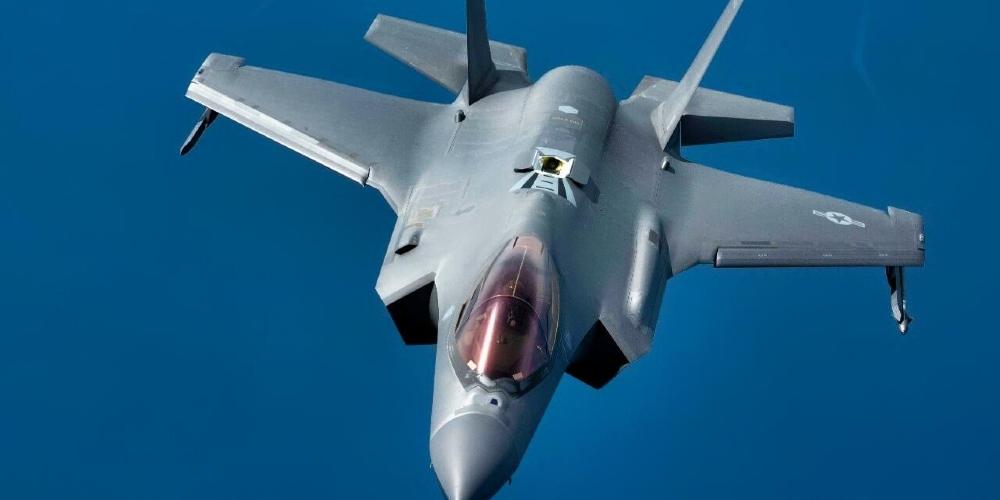
(Zero Hedge)—Every few months, a Chinese research institute announces it has found a way to see the unseeable F-35, and every few months the fine print turns out to be doing most of the work. This week’s entry: a laser.
According to the South China Morning Post, researchers at the China Airborne Missile Academy, the PLA Air Force’s main air-to-air missile house, have modeled a missile-borne single-photon lidar that could detect and track an F-35 stealth fighter at up to 61.5km (38 miles). The paper, led by Li Zhiyuan, was published in the peer-reviewed Chinese journal Aero Weaponry on September 18.
Before the “F-35 is obsolete” crowd starts celebrating, three qualifiers: that range is (1) at night, (2) “under ideal conditions” and (3) a simulation. During the day it drops to 27.7km. And as SCMP itself concedes, “the study does not establish that the system has been built, flight-tested or integrated into an operational missile.”
(Some readers may notice the SCMP’s own URL advertises “615km”; we regret to inform them the decimal point exists, and it matters.)
Radar Can’t See It? Try Counting Photons
The pitch is simple enough. Stealth jets are shaped and coated to defeat radar, and their engines are managed to reduce infrared signatures. A laser, the Chinese team argues, is a blind spot: they chose the 1,064-nanometre wavelength because stealth aircraft have “fewer dedicated countermeasures against active laser detection than against conventional radar and infrared sensing.”
Unlike radar, single-photon lidar fires laser pulses and listens for the handful of photons bouncing back. Per the SCMP summary, the model of the F-35C:
- used low-power 1.0 millijoule pulses and a compact 100mm lens, sized for a missile’s nose;
- corrected for detector “dead time” and for noise from sky background, atmospheric backscatter and dark counts;
- needed a signal-to-noise ratio of 8.8 decibels, i.e. at least 9.4 returning photons, to lock on;
- at 27.7km, resolved the target to within 20cm in depth and 50cm transversely.
In other words, a Chinese missile would, in theory, be able to tell it’s chasing an F-35 rather than a seagull by catching about ten photons. Impressive physics. Whether it survives contact with clouds, rain, a maneuvering target and a seeker strapped to a missile moving at several times the speed of sound is another matter, and one the paper doesn’t claim to address.
“I Don’t Understand It, Technically”
The skeptics didn’t need much prompting. A military analyst who asked SCMP not to be named pointed to the obvious problem with any laser: it’s a pencil, not a floodlight.
“The laser beam is so narrow, it probably couldn’t serve as an early-warning radar; in the early stages, it’s just a rangefinder.” (emphasis ours)
Translation: you have to already know roughly where the F-35 is before you can find it with this, which is precisely the problem stealth is designed to create. Another expert familiar with military equipment was even more succinct: “I don’t understand it, technically.” We appreciate the candor, rarely seen in defense punditry.
Then there’s the range math, which SCMP helpfully spells out. The F-35’s short-range AIM-9X Sidewinder reaches about 16-32km, so a 61.5km lidar would outrange it. But the jet’s long-range air-to-air missiles “can strike targets past 160km”, which is more than twice the lidar’s best-case night range and nearly six times its daytime reach. Put differently, by the time the laser sees the F-35, the F-35 may have already seen, and shot, the launch platform.

The chart also puts this week’s headline in context: it’s not even China’s most ambitious F-35 detection claim. In early 2025 researchers at the Changchun Institute of Optics, Fine Mechanics and Physics (CIOMP) simulated a stratospheric airship infrared sensor that could spot an F-35 from 1,800km from behind or the side (about 350km head-on). The common thread: the bigger the number, the more theoretical the system.
The Inconvenient Data Point: Iran Already Hit One
None of this means the F-35 is invulnerable, and the most damaging real-world evidence didn’t come from a Chinese lab. On March 19, an F-35A on a combat mission over Iran was forced into an emergency landing after taking Iranian fire, as we flagged in real time:
https://twitter.com/zerohedge/status/2034656417215349058
Days later we reported that the pilot suffered shrapnel wounds, with Air & Space Forces Magazine concluding the jet was “most likely damaged by a surface-to-air missile.” The IRGC’s own footage was shot through an infrared (FLIR) system, and Chinese analysts have spent the months since arguing that passive infrared, not exotic new radars, is the stealth jet’s soft underbelly. The PLA even ran a live-fire drill in August pairing heat-seeking MANPADS with HQ-16 missiles against stealth target drones.

Which is the point: Iran didn’t need a photon-counting laser. It needed a heat-seeker, the right geometry and some luck.
The flip side is equally instructive. When US forces went into Caracas in January, the Chinese-built “anti-stealth” radars Venezuela had bought to deter exactly that kind of raid failed to mount an effective response (Jan 8), with no US aircraft lost. Marketing brochures, meet combat.
Why Bother With Lasers When The Parts Come To You?
The lidar paper lands as Beijing has a more direct route to F-35 secrets. Last month, F-35 components shipped from Australia to the US were diverted to Hong Kong, where Chinese authorities have taken possession of them:
Senate Intelligence chair Tom Cotton has since demanded a supply-chain security review (Oct 1), warning that “we can’t afford for U.S. military equipment to fall into the hands of a foreign adversary because of vulnerabilities in commercial transportation.” It’s hard to think of a cheaper counter-stealth program than FedEx with a detour.
Meanwhile, China’s own sixth-gen programs keep moving. Shenyang’s designers recently laid out a “leapfrog” roadmap (Sep 16) for the J-50, and the J-36 and J-50 prototypes are taking shape (Sep 18). SCMP notes Shenyang has mentioned laser weapons in its design drawings for both, and the 303 Research Institute recently showed an airborne laser weapon pod in Beijing. Lasers are clearly where the PLA wants to go, for seeing and eventually shooting.
The F-35 Has Bigger Problems Than Lasers
For investors, the lidar paper changes nothing in Lockheed Martin’s near term; the bigger swing factor is Washington. As Capital Alpha’s Byron Callan noted in his “Defense Look Ahead: Air Force Factors” note (available to pro subs), a key question is “what’s Air Force thinking on the F-35A if Congress does not pass the $350 billion in mandatory funding, which includes 38 F-35As?” Export demand, on the other hand, is hardly suffering: the US just approved a possible F-35 sale to Saudi Arabia of up to $24.3 billion, and Israel promptly asked for “compensation”.
And then there’s the bill, which no Chinese laser can match for lethality:

Bottom Line
Li and his team say the next step is “optimising photon-related parameters” and developing more accurate ways to find stealth targets with missile-borne lidar. Fair enough: today’s simulation is tomorrow’s seeker head, and nobody should dismiss China’s pace in sensors.
But on the evidence so far, we side with the skeptics. A narrow-beam laser that works best at night, needs to be pointed in roughly the right direction and tops out well inside the F-35’s own missile envelope is a terminal-guidance aid at best, not a stealth killer. The real threats to the F-35 are the boring ones: passive infrared (as Iran showed in March), leaky supply chains (as Hong Kong showed last month) and a sustainment bill heading for the trillions. We warned back in 2021 that the jet was at risk of falling behind Chinese and Russian defenses (Sep 16, 2021); that risk is real, but it’s arriving through heat signatures and cargo manifests, not photon counts. Then again, if the lidar ever does work, at least it’ll be cheaper than the jet it’s chasing.
Much more in the full Capital Alpha “Defense Look Ahead: Air Force Factors” note, available to pro subs.

Two Storms, One Harvest

Every food crisis in living memory has been a one-shock event. The 2008 price spike was a commodity bubble. The 2020 shortages were a logistics failure. The 2022 grain scare was a war on one exporter’s ports. Each time, the system bent, adjusted, and recovered, and each time the experts assured us afterward that global markets are simply too big and too diversified to fail.
What nobody in Washington seems eager to discuss is that 2026 is shaping up to be something the modern food system has never actually faced. Two independent shocks, one climatic and one geopolitical, are converging on the same harvest cycle at the same time. Not sequentially. Simultaneously.
Start with the weather. The Pacific Ocean is currently building toward what forecasters now openly call a record event. NOAA’s Climate Prediction Center puts the odds of at least a strong El Niño near 88 percent, with roughly two in three odds it reaches “very strong” status, the tier reserved for perhaps three or four events in the entire satellite era. Every major global model now projects a median peak in Super El Niño territory, and most of them project it exceeding the 2015-16 event, which until now held the modern record. Sea surface anomalies were already brushing the super threshold in mid-July, months before these events normally peak. The atmosphere has already shifted into El Niño mode, and the event is forecast to crest in late fall and early winter.
This is not about “climate change.” It’s about the standard cycles of weather, and the cycle we’re currently in is one that has likely devastated societies in the past. We’re better prepared as a society today, but not all Americans are equally prepared.
Serious households have started doing the quiet math on their own. Grocery bills tell part of the story, and the forecast maps tell the rest, which is why long-term food storage has moved from fringe hobby to mainstream line item in the family budget, with established suppliers like Heaven’s Harvest seeing demand from people who five years ago would have rolled their eyes at the idea. That instinct is not paranoia. It is pattern recognition, and the pattern is worth walking through carefully.
Editor’s Note: Heaven’s Harvest IS a sponsor, but the warnings of this article are real and would be written even if we didn’t have a survival food sponsor. With that said, those who take advantage of what they offer can use promo code “Patriot” for 15% off.
The Fertilizer Clock Is Already Running
While the Pacific warms, the second shock has been unfolding in the Strait of Hormuz. The conflict with Iran turned the world’s most important energy chokepoint into a contested waterway, and the consequences reach far beyond the gas pump. Roughly a third of global fertilizer trade moves through Hormuz, and the disruption sent urea prices up 86 percent year over year by March, with a 53 percent jump in a single month.
The World Bank projects energy prices rising about 24 percent in 2026 and fertilizer about 31 percent. By its own accounting, fertilizer prices ran 35 percent higher in the first five months of this year than the same period last year.
Here is the mechanism the nightly news will not explain. Fertilizer is not a grocery item. It is a time-delayed input. The nitrogen a farmer in Iowa or Punjab could not afford to apply this spring does not show up as a problem this spring. It shows up as a thinner harvest six to twelve months later.
The World Bank’s own food security brief concedes that the effects of reduced applications earlier this season “are likely to become visible only later in harvest outcomes.” Translate that from institutional language into plain English and it means this. The damage is already done, it is already in the ground, and we are simply waiting for it to arrive on the shelf.
Now check the calendar. Six to twelve months from the spring planting season lands us squarely in late 2026 and early 2027. Which is precisely when the strongest El Niño in the instrumental record is forecast to peak, bringing its signature droughts to Southeast Asia, Australia, southern Africa, northern Brazil, and South Asia, the very regions that grow the world’s rice, sugar, and oilseeds.
The World Bank warns openly that a strong El Niño “could disrupt multiple crop belts simultaneously” on top of the conflict-driven input costs. Their baseline projection assumes the Middle East disruptions ease by autumn. What in the last two years of Middle East history suggests that assumption is safe?
The System Has No Slack Left
The comfortable answer is that global markets always adjust. But adjustment requires slack, and the slack is gone. Global cereal production is expected to decline from last year’s records even before El Niño does its work. The UN World Food Programme, hardly a den of right-wing preppers, is calling this the most significant disruption to its supply chains since Covid and the invasion of Ukraine, and its supply chain director put the stakes bluntly.
Today’s supply chain challenges are tomorrow’s hunger crisis.
There is also a political dimension that markets cannot price. When food gets scarce, governments do not behave like economists. They behave like politicians. Export bans, hoarding mandates, and panic buying at the national level turned the modest rice shortfall of 2008 into a global crisis, and analysts are already warning that import-dependent nations are the first dominoes.
The 2015-16 Super El Niño, a far weaker event than what is now forecast, threw tens of millions into food stress across Africa and Asia. This one is projected to be stronger, and it arrives with fertilizer already rationed by price and shipping lanes already contested by missiles.
What Joseph Knew
Scripture does not treat preparation for lean years as faithlessness. It treats it as wisdom delivered in advance to those willing to act on it.
Behold, there come seven years of great plenty throughout all the land of Egypt: And there shall arise after them seven years of famine; and all the plenty shall be forgotten in the land of Egypt.
Joseph did not respond to that warning with a hashtag or a committee. He stored grain during the years of abundance, and when the famine came, Egypt stood while its neighbors begged. The lesson is not that famine is certain. It is that the time to prepare is precisely when preparation still looks optional.
Nobody who filled a pantry in a year of plenty has ever regretted it, and nobody standing in an empty aisle has ever been glad he waited for certainty.
None of this calls for panic, and panic is the enemy of sound judgment anyway. It calls for the same unglamorous prudence our grandparents considered ordinary. Keep some cash margin, know your local growers, and put real food in deep storage while it is cheap and available, because the entire arc of this story is that cheap and available is a closing window.
Families looking for a straightforward place to start can visit Heaven’s Harvest and use promo code Patriot for 15 percent off long-term storable food. The forecasts may yet soften, the strait may yet reopen, and we should pray they do. But hope is a fine thing to hold and a foolish thing to eat.
