

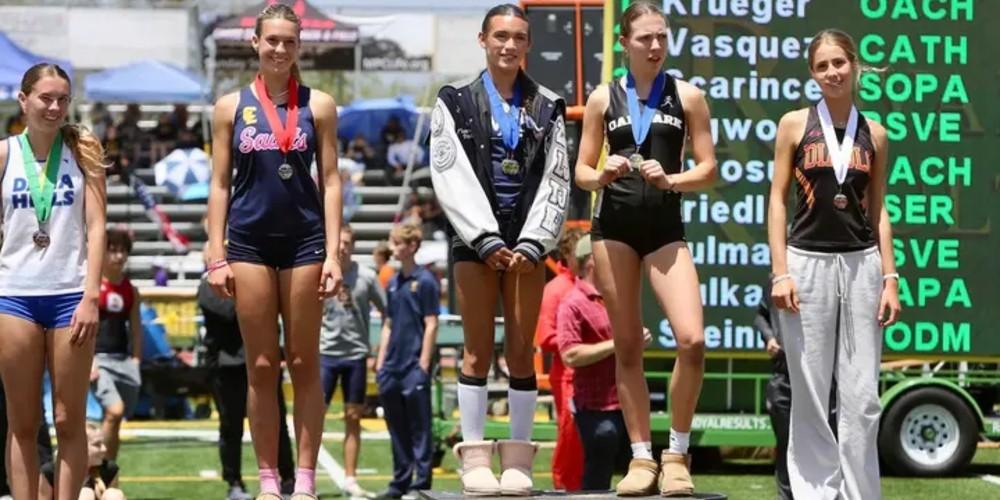
A male athlete swept the girls’ jumping events at California’s CIF Southern Section finals, claiming victories in high jump, long jump, and triple jump by margins that left no doubt about physical reality. Officials, bound by state law and ideology, responded not by restoring fairness but by engineering duplicate gold medals and shared podiums.

This spectacle—viral images of a male athlete atop the winners’ stand alongside displaced girls—exposes the predictable failure of California’s experiment in erasing sex-based categories in sports.
The episode repeats a now-familiar pattern. AB Hernandez of Jurupa Valley High School dominated once again, winning the long jump by over 16 inches and the triple jump by nearly two feet while edging out competitors in the high jump.
CIF’s awkward “pilot program,” revived for these meets, elevated biological females who finished immediately behind Hernandez to co-champion status. The result: awkward shared top spots on the podium, a bureaucratic band-aid that satisfies neither fairness nor inclusion.
Politicians and activists rightly called out the absurdity. The shared podium mocked the very concept of championship while pretending to honor all participants. Rep. Tim Burchett and others highlighted what common sense has long recognized: males retain significant physical advantages post-puberty in strength, speed, and leverage events like jumping.
Riley Gaines, a vocal defender of women’s sports, and former Nike executive Jennifer Sey amplified the images that spread rapidly across social media, forcing the issue back into national view.
California’s response remains tone-deaf. Gov. Gavin Newsom’s office framed critics as bullies while insisting on “fairness, dignity, and respect” for all kids. Yet the dignity of female athletes—those who trained, competed, and lost podium spots to biology—receives scant mention. State law since 2013 has prioritized gender identity over sex, a policy signed by then-Gov. Jerry Brown and defended despite federal pushback. President Trump’s administration previously sued under Title IX, and the underlying tensions persist.
This is not compassion; it is institutional capture by gender ideology. Sports exist as a domain where biological differences matter profoundly. Denying this reality does not advance equality—it erases the protected category of female athletics that Title IX was designed to secure. Girls who pour years into training find their records, scholarships, and opportunities diluted or displaced. The shared podium offers no victory for them, only a visual testament to policy failure.
Parents at the meet voiced frustration directly to reporters. Coaches relayed the sudden revival of the pilot program, underscoring how administrators scramble to manage optics without addressing root causes. Protests outside earlier rounds drew hundreds, reflecting broader parental revolt against rules that place male bodies in girls’ competitions.
Defenders invoke inclusion, but inclusion cannot come at the expense of fairness and safety. Biological males competing in female categories undermine the purpose of sex-segregated sports. Data from multiple studies and real-world results in swimming, weightlifting, boxing, and track consistently show retained male advantages. California’s approach—duplicate medals and rhetorical appeals to dignity—avoids this evidence while punishing the very athletes it claims to protect.
One is reminded of the ancient warning against calling good evil and evil good. As Isaiah 5:20 declares, “Woe unto them that call evil good, and good evil; that put darkness for light, and light for darkness; that put bitter for sweet, and sweet for bitter.”
Modern institutions have inverted reality in the name of progress, demanding society applaud what biology and common sense reject. True justice protects the vulnerable—here, female athletes—rather than sacrificing them on the altar of ideology.
The path forward requires courage: separate categories by biological sex, as nearly every culture and athletic governing body did until recently. Federal enforcement of Title IX, state-level protections, and parental pressure offer hope.
California’s latest controversy should serve not as a model but as a cautionary tale. When government and institutions prioritize feelings over facts, girls pay the price—on the track, on the podium, and in the broader pursuit of excellence.


Starting the Day With a Scripture-Inspired Roast Helps Center Your Thoughts on Eternal Truths Amid Temporal Pressures
The world can seem chaotic, especially right after we wake up. Many believers start their mornings reaching for something familiar — a hot cup of coffee — yet end up settling for mediocre brews that do little more than deliver a caffeine jolt. The daily grind of life, with its endless distractions, news cycles, and responsibilities, can leave even the most faithful feeling spiritually parched alongside their physical fatigue. What if your morning ritual could do more than wake you up? What if it could ground you in truth, nourish your body with exceptional quality, and quietly advance a kingdom purpose at the same time?
That’s the promise — and the reality — behind Promised Grounds Coffee. This Christian-founded company doesn’t just roast beans; it approaches every step as an act of worship and discipleship. By selecting only the top 10% of specialty-grade beans, ethically sourced from dedicated farmers in Central and South America, and small-batch roasting them with reverence in Austin, Texas, Promised Grounds delivers what many describe as the best coffee available — never burnt, never bland, but rich with origin stories and layered flavors that honor God’s creation.
From the vibrant Psalm 27 Roast (a light, bright medium option) to the bold yet peaceful 2 Timothy 1:7 Decaf, each bag carries a Scripture verse that turns your daily pour into a gentle reminder of faith. And through their Ounce Per Ounce Promise, every ounce of coffee you enjoy provides an equal ounce of clean water to families in need via partnership with Filter of Hope — literally brewing hope for body and soul, one cup at a time.
The challenge for today’s Christians runs deeper than finding a decent cup. In an age of convenience-driven consumerism, it’s easy to support companies that dilute values or remain silent on matters of faith. Many believers want their everyday choices — from what they drink to how they spend — to reflect discipleship rather than just convenience. Promised Grounds solves this by weaving Christian excellence into the entire process: beans nurtured with prayerful stewardship by farming families, roasted as an offering rather than a commodity, and packaged with Bible verses to encourage a mindset of gratitude and purpose from the first sip. Reviewers consistently praise the smooth, rich profiles — whether enjoyed black in a drip maker, iced on a warm day, or shared in fellowship — noting how the quality stands toe-to-toe with premium secular brands while delivering something far more meaningful.
This integration of faith and flavor addresses a real need in Christian households and ministries. Busy parents, church leaders, and remote workers alike report that starting the day with a Scripture-inspired roast helps center their thoughts on eternal truths amid temporal pressures. The coffee’s exceptional character — bright citrus notes in lighter roasts or deep chocolate undertones in bolder ones — comes from meticulous selection and careful roasting that respects the bean’s natural gifts rather than masking them. It’s the kind of coffee that elevates a simple quiet time, fuels productive workdays, or sparks meaningful conversations when shared at Bible studies or outreach events. And because it’s ethically sourced with integrity, every purchase supports sustainable livelihoods for farmers who treat their crops like family harvests.
For those leading churches or small groups, the impact multiplies. Promised Grounds offers bundles and options perfect for hospitality ministries, turning ordinary coffee service into an opportunity to point people toward the living water of Christ. Imagine greeting visitors with a warm cup whose very bag carries God’s Word — a subtle yet powerful witness that aligns with the Great Commission. The company’s Texas roots and commitment to “brewing hope” resonate especially with believers who value American enterprise paired with global compassion.
Of course, quality alone isn’t enough if the experience feels out of reach. Promised Grounds keeps it accessible with practical perks like free shipping on orders over $40, sample sets for discovering favorites, and thoughtful add-ons such as faith-themed mugs. Whether you prefer whole beans for fresh grinding, grounds for convenience, or even bulk options for larger households and ministries, the result is consistently superior coffee that makes discipleship feel integrated rather than added on.
As you consider how to align even the smallest habits with your walk with God, Promised Grounds Coffee stands out as a refreshing solution. It tackles the dual problems of subpar daily sustenance and disconnected consumption by offering a product that genuinely excels in taste while advancing a mission of clean water, farmer dignity, and scriptural encouragement. Believers who make the switch often describe it as more than a beverage upgrade — it becomes part of their rhythm of gratitude, a daily invitation to remember that every good gift comes from above.
If you’re ready to transform your mornings (and perhaps your church gatherings) with coffee that honors both exceptional craftsmanship and Christian values, I encourage you to explore what Promised Grounds has to offer. One sip at a time, you’ll be nourishing your body, refreshing your spirit, and participating in something far greater — all while enjoying what truly is among the best coffee available.
