

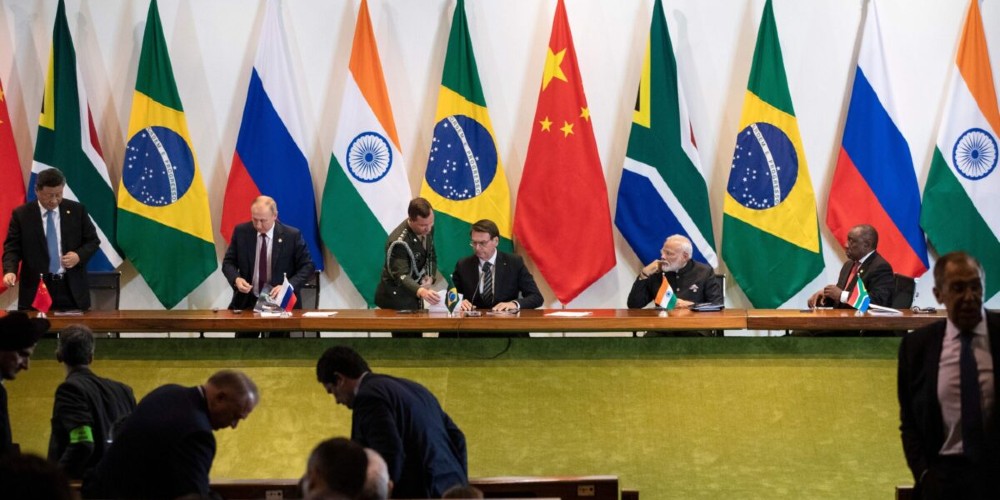
I’m old enough to remember when any discussion about BRICS was relegated to the nerdiest foreign affairs outlets. Few thought the economic alliance could grow beyond its founding member nations because the players were all too hideous in a western-dominated global society. They may have had some of the most powerful nations in the world joining together to challenge western dominance, but just because they had Brazil, Russia, India, China and South Africa, we had the United States of America.
I fondly remember foreign affairs analysts claiming it would be decades before these “backwards” or “broken” nations could compete against us. Their arguments often sounded like Tony Stark talking to Loki in Stark Towers in the first Avengers movie “I have an army,” Loki said. “We have a Hulk,” Stark replied.
The days of western bravado and dismissal of BRICS seem to be upon us, and it didn’t take decades. The architects of The Great Reset seem to be positioning BRICS to challenge American economic hegemony by both weakening western nations while propping up Russia and China. While both have economic challenges of their own, they’re plowing through it while we’re getting stuck in the dirt. The nature of their authoritarian governments gives them a stronger position to handle economic hardships. Meanwhile, many Americans are trying to time out when to hit up the Tesla Supercharger stations.
Two articles hit my radar this morning. Both bode ill for us as a rising BRICS alliance means another option may be available to the world soon. The U.S. dollar’s status as the world reserve currency exists because it exists. There have been no other options so nations have had to play ball or become North Korea. If that changes, and many nations are hoping it will, then the alternative will likely something out of BRICS. And that would spell doom for us and our $30+ trillion national debt.
Here’s the first article that’s worth a read from Great Game India:
Saudi Arabia, Egypt, Turkey May Join BRICS ‘Very Soon’, Forum Chair Anand Says
According to the president of the BRICS International Forum, Purnima Anand, Turkey, Egypt, and Saudi Arabia might “very soon” join the club of major emerging economies, which also includes Brazil, Russia, India, China, and South Africa.
According to Anand, this topic was discussed by China, Russia, and India at the 14th BRICS Summit, which virtually took place from June 23 to 24.
“All these countries have shown an interest in joining and are preparing to apply for membership. I think this is a good step, because expansion is always perceived positively; this will clearly increase the influence of BRICS in the world… I hope that the accession of countries to BRICS will happen very quickly, because now all representatives of the core of the association are interested in enlargement. So it will be very soon,” Purnima Anand stated.
According to reports, the BRICS International Forum President is sure that Saudi Arabia, Egypt, and Turkey will all join the organization soon because they have already “begun the process.” She reportedly said that they wouldn’t all sign up at once though.
Anand’s comments are consistent with those made earlier about the potential growth of BRICS by Li Kexin, head of the Department of International Economic Affairs at the Chinese Ministry of Foreign Affairs.
Li Kexin stated during a press conference following the 14th BRICS summit in Beijing that “there are several countries currently ‘at the door’ — for example, Indonesia, Turkey, Saudi Arabia, Egypt, and Argentina.”
The BRICS nations concur that the bloc needs new members while maintaining its distinctive identity, he continued.
“I believe there is a shared understanding that we need to enlarge, get ‘new faces’,” Li said.
He highlighted, however, that the growth of the BRICS is “not to create a new bloc.”

Siyabonga Cyprian Cwele, the South African ambassador to China, who spoke beside Li, emphasized that BRICS is about partnership rather than “big muscle.”
The Global Times had quoted Sabino Vaca Narvaja, Argentina’s ambassador to China, as saying that “the BRICS cooperation mechanism is of great significance for the building of a new, more multipolar and balanced world.”
“We are interested in joining BRICS because it is a cooperative mechanism composed entirely of emerging economies. There are no strings attached and all cooperation is mutually beneficial,” Vaca said.
At their 14th meeting in Beijing, China, the BRICS group of countries decided to work together to improve and change global governance while preserving international peace and security. South Africa will take up the rotational chairmanship of BRICS in 2019 from China, who currently holds the position.
Iran, Algeria, Argentina, Egypt, Indonesia, Kazakhstan, Senegal, Uzbekistan, Cambodia, Ethiopia, Fiji, Malaysia, and Thailand were among the 13 other developing countries whose leaders were invited by Beijing to the conference.
Chinese President Xi Jinping urged the world to “reject hegemony, bullying, and division” in his opening remarks at the summit. Iran made its ambition to join BRICS known in advance of the meeting, citing its “unique geographical position and its capabilities in the fields of energy, transit, and trade” as well as its potential to serve as a “golden route to connect” the East and the West.

“If Iran and other powerful countries join the grouping, it can be even stronger and challenge western policies,” Iran’s state-owned Islamic Republic News Agency (IRNA) added.
Here’s the second article on the subject by Free West Media:
BRICS Expansion on the Cards
More and more emerging countries are considering joining the BRICS group, which is seen as the major emerging countries’ counterweight to the US-led West and the G7. Especially in times like these, this is also a clear signal to Washington.
The BRICS group of states, consisting of Brazil, Russia, India, China and South Africa, are working ever more closely together on an economic and political level. Together they represent 3,26 billion people and a gross domestic product of US$27,54 trillion. According to estimates, the economic output of these five countries will account for 50 percent of total global value added by 2030.
In view of the fact that “rules-based” Western countries are experiencing serious economic problems, this prognosis does not even seem that far-fetched.
In contrast to the G7 group, the representatives of the US-led collective West, the BRICS group sees itself as an open organization that does not interfere in the internal affairs of other countries. It is therefore not surprising that membership in this group of states also arouses the interest of diverse nations.
In particular, those states that have their own problems and conflicts with the United States seem to be most interested. Argentina and Iran, for example, announced their intention to become part of the group of states. And Indonesia and the United Arab Emirates have recently expressed interest in becoming members.
The list does not end there as Saudi Arabia, Egypt and Turkey also plan to join BRICS , the President of the International BRICS Forum Purnima Anand confirmed to Russian outlet Izvestia, adding that a discussion and a possible decision on some countries will be held at the next summit of the association, which will take place in 2023, the Russian news agency TASS reported.
These countries could participate in increased resource sharing and open up air, trade and financial routes “to the new global realities”.
Notably, BRICS countries are working on establishing a new common reserve currency, similar to the IMF’s Special Drawing Rights. This would enable economic cooperation without having to resort to the US dollar or the euro – and without being threatened with having their funds confiscated by Western financial institutions.
A major Western bank, ING, has meanwhile brought up the discussion of a basket of BRICS currencies, noting that “the increasing weaponization of the dollar” could see a move into gold.
Former Russian President and Prime Minister and current Deputy Chairman of the Russian Security Council Dmitry Medvedev commented on the expansion. “The best protection against the rotting euro will be the transition to new means of payment in trade with our reliable partners, including through the use of national currencies – the Russian ruble, Chinese yuan, Indian rupee, etc,” he wrote on Telegram. “The dollar, the euro and the pound sterling are clearly not enough for the modern world.”
BRICS nations have since opted for a payment system that would be an alternative to the US-dominated SWIFT system. The main benefits highlighted were redundancy in case there were disruptions to the SWIFT system.
China has initiated the development of their own payment system called CIPS: the Cross-Border Inter-Bank Payments System (CIPS), which provides a network that enables financial institutions worldwide to send and receive information about financial transactions in a secure, and standardized system. India also has its alternative Structured Financial Messaging System (SFMS), as does Russia with its System for Transfer of Financial Messages (SPFS).
As more countries join BRICS and indirectly related organizations like the Shanghai Cooperation Organization (SOC), the Belt and Road Initiative (BRI) and so on, it becomes more difficult for the United States to exert influence economically and to put financial pressure on nations to bend to its will.
The financial war declared on countries outside the realm of the dollar, showed many countries how vulnerable they actually are as a result of a close connection to the western financial systems. Over-reliance on China may also pose dangers for many, but what other options remain?
Why It Matters
The reason the Liberal World Order secretly backs BRICS is not because they want them necessarily to succeed. They want the United States to fail, and BRICS is the most viable option to take down America’s economy from outside while they move other chess pieces in the nation, most notably the Biden-Harris regime.
We are no longer in a position to let them grow without concern of them usurping us. As noted above, they are on pace to account for half of the world’s wealth before the end of the decade. And if a shooting war starts between any of the players, most notably between the United States and China-Russia alliance, then it’s very likely we will see the shift away from the U.S. dollar accelerate quickly.
As many know, the only thing keeping us from being crushed by our national debt is that most other nations are tied to the U.S. dollar. If that changes, then we will fall. BRICS is the outside existential threat that far too few are watching. Government, media, and the people seem to be ignoring it. We need to start addressing it as soon as possible. It may already be too late.
Article originally published at my Economic Collapse Substack.

Starting the Day With a Scripture-Inspired Roast Helps Center Your Thoughts on Eternal Truths Amid Temporal Pressures
The world can seem chaotic, especially right after we wake up. Many believers start their mornings reaching for something familiar — a hot cup of coffee — yet end up settling for mediocre brews that do little more than deliver a caffeine jolt. The daily grind of life, with its endless distractions, news cycles, and responsibilities, can leave even the most faithful feeling spiritually parched alongside their physical fatigue. What if your morning ritual could do more than wake you up? What if it could ground you in truth, nourish your body with exceptional quality, and quietly advance a kingdom purpose at the same time?
That’s the promise — and the reality — behind Promised Grounds Coffee. This Christian-founded company doesn’t just roast beans; it approaches every step as an act of worship and discipleship. By selecting only the top 10% of specialty-grade beans, ethically sourced from dedicated farmers in Central and South America, and small-batch roasting them with reverence in Austin, Texas, Promised Grounds delivers what many describe as the best coffee available — never burnt, never bland, but rich with origin stories and layered flavors that honor God’s creation.
From the vibrant Psalm 27 Roast (a light, bright medium option) to the bold yet peaceful 2 Timothy 1:7 Decaf, each bag carries a Scripture verse that turns your daily pour into a gentle reminder of faith. And through their Ounce Per Ounce Promise, every ounce of coffee you enjoy provides an equal ounce of clean water to families in need via partnership with Filter of Hope — literally brewing hope for body and soul, one cup at a time.
The challenge for today’s Christians runs deeper than finding a decent cup. In an age of convenience-driven consumerism, it’s easy to support companies that dilute values or remain silent on matters of faith. Many believers want their everyday choices — from what they drink to how they spend — to reflect discipleship rather than just convenience. Promised Grounds solves this by weaving Christian excellence into the entire process: beans nurtured with prayerful stewardship by farming families, roasted as an offering rather than a commodity, and packaged with Bible verses to encourage a mindset of gratitude and purpose from the first sip. Reviewers consistently praise the smooth, rich profiles — whether enjoyed black in a drip maker, iced on a warm day, or shared in fellowship — noting how the quality stands toe-to-toe with premium secular brands while delivering something far more meaningful.
This integration of faith and flavor addresses a real need in Christian households and ministries. Busy parents, church leaders, and remote workers alike report that starting the day with a Scripture-inspired roast helps center their thoughts on eternal truths amid temporal pressures. The coffee’s exceptional character — bright citrus notes in lighter roasts or deep chocolate undertones in bolder ones — comes from meticulous selection and careful roasting that respects the bean’s natural gifts rather than masking them. It’s the kind of coffee that elevates a simple quiet time, fuels productive workdays, or sparks meaningful conversations when shared at Bible studies or outreach events. And because it’s ethically sourced with integrity, every purchase supports sustainable livelihoods for farmers who treat their crops like family harvests.
For those leading churches or small groups, the impact multiplies. Promised Grounds offers bundles and options perfect for hospitality ministries, turning ordinary coffee service into an opportunity to point people toward the living water of Christ. Imagine greeting visitors with a warm cup whose very bag carries God’s Word — a subtle yet powerful witness that aligns with the Great Commission. The company’s Texas roots and commitment to “brewing hope” resonate especially with believers who value American enterprise paired with global compassion.
Of course, quality alone isn’t enough if the experience feels out of reach. Promised Grounds keeps it accessible with practical perks like free shipping on orders over $40, sample sets for discovering favorites, and thoughtful add-ons such as faith-themed mugs. Whether you prefer whole beans for fresh grinding, grounds for convenience, or even bulk options for larger households and ministries, the result is consistently superior coffee that makes discipleship feel integrated rather than added on.
As you consider how to align even the smallest habits with your walk with God, Promised Grounds Coffee stands out as a refreshing solution. It tackles the dual problems of subpar daily sustenance and disconnected consumption by offering a product that genuinely excels in taste while advancing a mission of clean water, farmer dignity, and scriptural encouragement. Believers who make the switch often describe it as more than a beverage upgrade — it becomes part of their rhythm of gratitude, a daily invitation to remember that every good gift comes from above.
If you’re ready to transform your mornings (and perhaps your church gatherings) with coffee that honors both exceptional craftsmanship and Christian values, I encourage you to explore what Promised Grounds has to offer. One sip at a time, you’ll be nourishing your body, refreshing your spirit, and participating in something far greater — all while enjoying what truly is among the best coffee available.
