

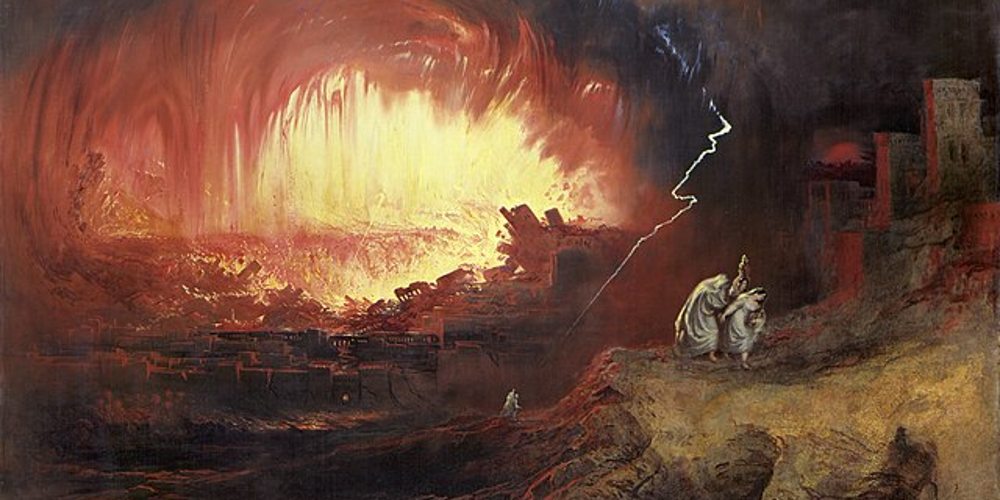
(WND News Center)—Anyone who’s ever looked deeply into the well of human sexual depravity will recognize that all deviance is measured against the standard of true normalcy: monogamous binary heterosexuality. It is a universal human norm, known in Christendom as the One-Flesh Paradigm, based on Genesis 1:27 and 2:24. Faithful Jews and Christians adhere to this standard, or at least aspire to do so.
The sinfulness/harmfulness of any given sexual act, inclination or relationship is judged by God and His law based upon its degree of its deviance from the standard. The acts, inclinations and relationships most similar to the standard are judged least harshly in the Bible. These include female concubinage (a man having a “mistress” with or without the knowledge or permission of the wife), bigamy (two wives) and polygamy. These forms of deviance are actually tolerated in the Mosaic Law in the way and for the reason divorce is tolerated there. Introducing the terms of the New Covenant about 1,300 years later, Jesus explained that those laxities were temporary accommodations to human weakness in the Old Covenant: “because of the hardness of your hearts.” Humanity wasn’t morally evolved enough to meet the higher standard in the days of Moses, and so God left some wiggle-room in the law.
Make no mistake: There are always negative consequences for violating the standard, even within the limits of the Mosaic law, because anything humans do that is “out of order” has ripple effects that compound over time (just look at the lives of most divorced people and their children). Jesus thus began his Sermon on the Mount by contrasting the letter of the old law with the spirit of the law that He now would expect humanity to faithfully embrace – at least aspirationally. Implicit in his exhortation to that higher standard was the truth that no one could actually meet that standard perfectly except Himself, which was why he explained, “I Am the Way, the Truth and the Life, no one comes to the Father except by Me.”
Now, the other end of the spectrum of deviance – the collection of most-deviant sexual sins cataloged in Leviticus 18 – was NEVER accommodated by God but in fact was always punished with death (physical and/or spiritual). That harshness was re-affirmed in the New Covenant in Paul’s treatise on Christian theology in Romans 1-8, particularly chapter 1:18-32. That remains God’s law to this day, notwithstanding the opinions of any human revisionists. Thank God for Grace and Mercy in Jesus Christ – the only path of escape from that fate.
So when you look down the well of sexual depravity you can see that all the way on the bottom are the most deviant behaviors of all: homosexuality and bestiality, in that order (Leviticus 18:22-23 – the original source of British and American sodomy laws), because they’re the farthest from the One Flesh Paradigm.
About halfway down that well is Epstein’s island, where you can see super rich and powerful adult men preying on “underage” girls collected there for their sexual pleasure. And you can see the sleazy adult women who helped facilitate that. (If you look even more carefully, you can see all the “honey-pot” hidden cameras gathering evidence for blackmail.)
We’re all rightfully scandalized by Epstein Island, but to put it in perspective, the girl victims are sexually mature and technically of marriageable age. The sex they’re involved with isn’t much different from the concubinage allowed in the Mosaic Law. It deserves condemnation, but the bigger question is where are the Epstein Islands of the more deviant kind? You know they must be out there somewhere in real life, hidden beneath the dark conspiratorial clouds of the “pizzagates” and Franklin cover-ups – because evil people of means have always pursued their lusts from time immemorial.
In my research for “The Pink Swastika: Homosexuality in the Nazi Party,” I’ve discovered one of history’s “Epstein Islands” of boys – the Island of Capri, Italy. Here is an excerpt from the 6th edition (in progress):
According to Edward Rothstein, in a July 6, 2002, New York Times editorial titled “Is There a Gay Basis to Nietzsche’s Ideas,” “Richard Wagner spread rumors that Nietzsche suffered from the side-effects of excessive masturbation and, perhaps, pederasty.” The Rothstein editorial was based primarily upon the book “Zarathustra’s Secret: The Interior Life of Friedrich Nietzsche” by Joachim Kohler. The flyleaf of that book describes its thesis: “In a revealing reinterpretation of his letters, diaries and writings, Kohler shows that Nietzsche’s suppressed homosexuality, generating a hatred of Christianity and conventional morality, was a central influence on his work.”
Kohler writes: “The hidden yearning nestling behind Nietzsche’s hatred of morality and of secrecy had as its goal the world of handsome, healthy bodies in a reborn antiquity. … In Italy he found what he had been looking for.” (Kohler:xvi). “In the work of August von Platen, who had inspired his novella ‘Capri,’ Nietzsche found what he needed…In Italy, wrote Platen, ‘love between men and men is so common that even the boldest of demands do not meet with a rejection.’ … Throughout the nineteenth century and far into the twentieth the exiles from Sodom sought a new home in the ‘warm south.’ Nietzsche joined them: ‘I flew across the sea to the south,’ he wrote.” (ibid:161)
[But those weren’t mere rumors.] … According to Macintyre in “Forgotten Fatherland: The Search For Elisabeth Nietzsche,” Frederich Nietzsche never married and had no known female sex partners, but went insane at age 44 and eventually died of syphilis. According to Sigmund Freud and Carl Jung, Nietzsche had caught the disease at a homosexual brothel in Genoa, Italy (McIntyre:91f). [But it might well have been Capri instead.]
… The German police had a secret file about highly placed homosexuals who might be liable to scandal and blackmail. It included dossiers on the armaments king, Friedrich Krupp, one of the Kaiser’s brothers, the Kaiser’s aide, Prince Eulenberg, the Kaiserin’s private secretary, Count Kuno von Moltke and others. [Krupp] was married, but he and his wife lived separately so that he could lavishly indulge his homosexual desires. At his Grotto of Fra Felice, a cave above the sea on Capri, he created a private pleasure palace where he …[became notorious for] seducing minors.
I suspect Portland, Oregon, had its own version of this and still does. In the late ’80s, my wife worked as a volunteer for the Salvation Army in a Portland program for street kids and was told that many of the teen boy street hustlers were “graduates” of a string of “floating brothels” of pre-teen boys. (Word was that once they got too old to appeal to the rich Portland pedophiles they were kicked out on the street.) I think this is much more common than people believe.
We should all treat the Epstein Island case as a tip-of-the-iceberg phenomenon and keep looking deeper to find and expose the worse scandals and rescue the victims – using everything we find as evidence that God’s standard has always been right in every respect.
For more on this topic see “The Pink Swastika” 4th Edition here.
Content created by the WND News Center is available for re-publication without charge to any eligible news publisher that can provide a large audience. For licensing opportunities of our original content, please contact [email protected].
SUPPORT TRUTHFUL JOURNALISM. MAKE A DONATION TO THE NONPROFIT WND NEWS CENTER. THANK YOU!
This article was originally published by the WND News Center.


Two Storms, One Harvest

Every food crisis in living memory has been a one-shock event. The 2008 price spike was a commodity bubble. The 2020 shortages were a logistics failure. The 2022 grain scare was a war on one exporter’s ports. Each time, the system bent, adjusted, and recovered, and each time the experts assured us afterward that global markets are simply too big and too diversified to fail.
What nobody in Washington seems eager to discuss is that 2026 is shaping up to be something the modern food system has never actually faced. Two independent shocks, one climatic and one geopolitical, are converging on the same harvest cycle at the same time. Not sequentially. Simultaneously.
Start with the weather. The Pacific Ocean is currently building toward what forecasters now openly call a record event. NOAA’s Climate Prediction Center puts the odds of at least a strong El Niño near 88 percent, with roughly two in three odds it reaches “very strong” status, the tier reserved for perhaps three or four events in the entire satellite era. Every major global model now projects a median peak in Super El Niño territory, and most of them project it exceeding the 2015-16 event, which until now held the modern record. Sea surface anomalies were already brushing the super threshold in mid-July, months before these events normally peak. The atmosphere has already shifted into El Niño mode, and the event is forecast to crest in late fall and early winter.
This is not about “climate change.” It’s about the standard cycles of weather, and the cycle we’re currently in is one that has likely devastated societies in the past. We’re better prepared as a society today, but not all Americans are equally prepared.
Serious households have started doing the quiet math on their own. Grocery bills tell part of the story, and the forecast maps tell the rest, which is why long-term food storage has moved from fringe hobby to mainstream line item in the family budget, with established suppliers like Heaven’s Harvest seeing demand from people who five years ago would have rolled their eyes at the idea. That instinct is not paranoia. It is pattern recognition, and the pattern is worth walking through carefully.
Editor’s Note: Heaven’s Harvest IS a sponsor, but the warnings of this article are real and would be written even if we didn’t have a survival food sponsor. With that said, those who take advantage of what they offer can use promo code “Patriot” for 15% off.
The Fertilizer Clock Is Already Running
While the Pacific warms, the second shock has been unfolding in the Strait of Hormuz. The conflict with Iran turned the world’s most important energy chokepoint into a contested waterway, and the consequences reach far beyond the gas pump. Roughly a third of global fertilizer trade moves through Hormuz, and the disruption sent urea prices up 86 percent year over year by March, with a 53 percent jump in a single month.
The World Bank projects energy prices rising about 24 percent in 2026 and fertilizer about 31 percent. By its own accounting, fertilizer prices ran 35 percent higher in the first five months of this year than the same period last year.
Here is the mechanism the nightly news will not explain. Fertilizer is not a grocery item. It is a time-delayed input. The nitrogen a farmer in Iowa or Punjab could not afford to apply this spring does not show up as a problem this spring. It shows up as a thinner harvest six to twelve months later.
The World Bank’s own food security brief concedes that the effects of reduced applications earlier this season “are likely to become visible only later in harvest outcomes.” Translate that from institutional language into plain English and it means this. The damage is already done, it is already in the ground, and we are simply waiting for it to arrive on the shelf.
Now check the calendar. Six to twelve months from the spring planting season lands us squarely in late 2026 and early 2027. Which is precisely when the strongest El Niño in the instrumental record is forecast to peak, bringing its signature droughts to Southeast Asia, Australia, southern Africa, northern Brazil, and South Asia, the very regions that grow the world’s rice, sugar, and oilseeds.
The World Bank warns openly that a strong El Niño “could disrupt multiple crop belts simultaneously” on top of the conflict-driven input costs. Their baseline projection assumes the Middle East disruptions ease by autumn. What in the last two years of Middle East history suggests that assumption is safe?
The System Has No Slack Left
The comfortable answer is that global markets always adjust. But adjustment requires slack, and the slack is gone. Global cereal production is expected to decline from last year’s records even before El Niño does its work. The UN World Food Programme, hardly a den of right-wing preppers, is calling this the most significant disruption to its supply chains since Covid and the invasion of Ukraine, and its supply chain director put the stakes bluntly.
Today’s supply chain challenges are tomorrow’s hunger crisis.
There is also a political dimension that markets cannot price. When food gets scarce, governments do not behave like economists. They behave like politicians. Export bans, hoarding mandates, and panic buying at the national level turned the modest rice shortfall of 2008 into a global crisis, and analysts are already warning that import-dependent nations are the first dominoes.
The 2015-16 Super El Niño, a far weaker event than what is now forecast, threw tens of millions into food stress across Africa and Asia. This one is projected to be stronger, and it arrives with fertilizer already rationed by price and shipping lanes already contested by missiles.
What Joseph Knew
Scripture does not treat preparation for lean years as faithlessness. It treats it as wisdom delivered in advance to those willing to act on it.
Behold, there come seven years of great plenty throughout all the land of Egypt: And there shall arise after them seven years of famine; and all the plenty shall be forgotten in the land of Egypt.
Joseph did not respond to that warning with a hashtag or a committee. He stored grain during the years of abundance, and when the famine came, Egypt stood while its neighbors begged. The lesson is not that famine is certain. It is that the time to prepare is precisely when preparation still looks optional.
Nobody who filled a pantry in a year of plenty has ever regretted it, and nobody standing in an empty aisle has ever been glad he waited for certainty.
None of this calls for panic, and panic is the enemy of sound judgment anyway. It calls for the same unglamorous prudence our grandparents considered ordinary. Keep some cash margin, know your local growers, and put real food in deep storage while it is cheap and available, because the entire arc of this story is that cheap and available is a closing window.
Families looking for a straightforward place to start can visit Heaven’s Harvest and use promo code Patriot for 15 percent off long-term storable food. The forecasts may yet soften, the strait may yet reopen, and we should pray they do. But hope is a fine thing to hold and a foolish thing to eat.
