

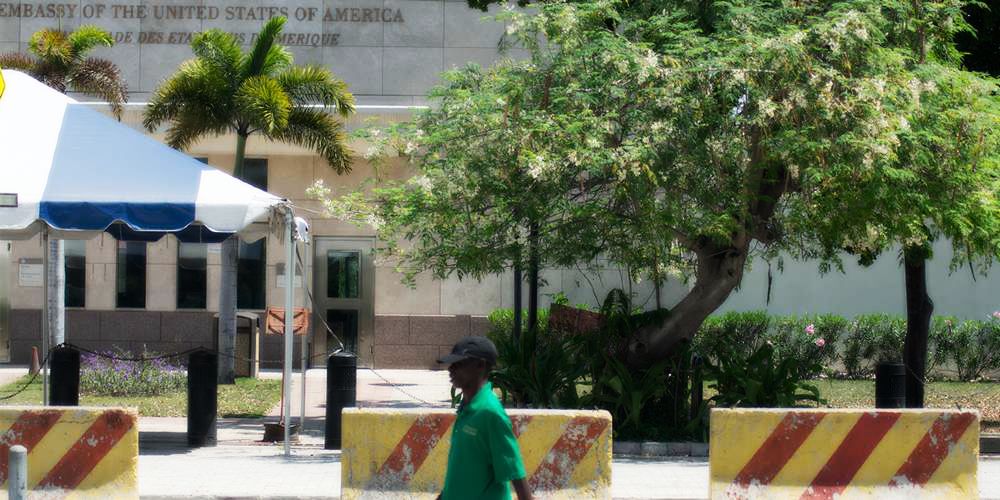
(The Daily Signal)—As a cannibalistic gang war rages through Haiti, President Joe Biden last week dispatched a Marine Corps special unit to protect the evacuation of nonemergency personnel as well as fellow Marines from the U.S. Embassy in the nation’s capital, Port-au-Prince.
With that evacuation of the embassy in Haiti, the Biden administration has presided over more evacuations of U.S. embassies—a total of 11—than any other presidential administration in U.S. history.
Since Biden took office in January 2021, his State Department has partially or fully evacuated 11 U.S. embassies via what are known as authorized or ordered departure directives.
President Barack Obama presided over the second-most embassy evacuations of any administration with a total of eight over two terms (Egypt, Libya, Iraq, Syria, Yemen, Central African Republic, and South Sudan), or about one a year. Donald Trump presided over three partial evacuations in his four years as president.
Authorized departure advisories consist of the State Department suggesting that diplomats, their families, and other Americans leave the country in question—often through special travel arrangements made by the department.
Ordered departures are directives from the State Department for all Americans and nonessential embassy staff to leave the country in question immediately.
Military protection was required to ensure that Americans were escorted safely in the evacuations of America’s embassies in Kabul, Afghanistan; Port-au-Prince, Haiti; and Khartoum, Sudan.
Here are some details:
Burma, 2021
On March 30, 2021, the State Department ordered its first embassy evacuation during the 2-month-old Biden administration.
The agency ordered the departure of “non-essential diplomatic personnel and all personnel family members” over two months after a military coup in Burma, also called Myanmar.
In the year following Biden’s threat to sanction the military junta there, a series of improvised explosive devices were detonated within a mile of the U.S. Embassy in the capital of Rangoon. No American casualties or injuries were reported.
Chad, 2021
In April 2021, the U.S. Embassy in Chad issued a statement that the “reported death of the Chadian president” likely would result in unrest, ordered staff to “shelter in place,” and predicted that no evacuation would be necessary.
The following November, however, the State Department ordered nonessential staff to leave Chad as rebel fighters approached the capital, N’Djamena.
Afghanistan, 2021
Biden’s July 8, 2021, announcement that the U.S. was going to suspend all military operations in Afghanistan was met with chaos inside the war-torn country.

The telegraphed U.S. evacuation gave antagonists, including the Taliban and other fundamentalist, radical Muslim groups, time to prepare a triumphant march through Afghanistan’s capital, Kabul.
Photos and videos from the U.S. Embassy evacuation in Kabul evoked painful memories of the botched 1975 evacuation of the U.S. Embassy in the South Vietnamese capital of Saigon. Some Afghan civilians clung to the final planes’ landing equipment in a desperate move to escape the incoming Taliban.
Thirteen American service members died in a terrorist bombing outside the airport during the final evacuation Aug. 26, 2021, along with over 150 Afghan civilians.
Biden promised to retaliate for the terrorist attack, but did not.
Ethiopia, 2021
Threats from rebel forces in Ethiopia’s civil war, known as the Tigray War, led the State Department in November 2021 to create a special task force to evacuate “nonemergency government personnel” from the country and the U.S. Embassy in Addis Ababa.
The Ethiopian government criticized the State Department’s decision as “playing into rebel propaganda.”

Rebels didn’t enter Addis Ababa, and although a tenuous peace deal was signed a year later, the region remains in conflict.
Ukraine, 2022
On Feb. 12, 2022, the State Department issued “Do Not Travel” notifications to American citizens for Ukraine. It also closed the U.S. Embassy in Kyiv on Feb. 14, evacuating most staff.
The department relocated a small team to operate from Poland 10 days before Russia invaded Ukraine, when 30,000 Russian troops were conducting a staging drill on the Ukrainian/Belarusian border.
The U.S. Embassy reopened in Kyiv on May 18, 2022, after the Russian advance toward Ukraine’s capital stalled.
Belarus, 2022
Four days after Russia’s invasion of Ukraine on Feb. 24, 2022, largely using Belarus’ border with Ukraine as a staging ground, the State Department ordered Americans to evacuate Belarus.
The State Department also closed the U.S. Embassy in Minsk on Feb. 28. It has not reopened.
Russia, 2022
On the same day as its Belarus announcement, the State Department issued an authorized departure for “non-emergency employees and family members” from the U.S. Embassy in Moscow.
American citizens also were encouraged to leave Russia “immediately” on commercial flights before airlines quit operating in Russian airspace.
Unlike the U.S. Embassy in Minsk, the U.S. Embassy in Moscow is still open and has issued warnings to the Russian government concerning threats of terrorism.
Nigeria, 2022
The State Department issued an ordered departure for nonemergency U.S. government employees and family members in the Nigerian capital of Abuja on Oct. 27, 2022, citing an “elevated risk of terror attacks.”
In May 2023, “unknown attackers” fired on an American convoy, killing four, including two staffers at the U.S. consulate. The bodies were set on fire.
Two staffers from the U.S. mission to Nigeria also were kidnapped, but it appears that the State Department chose not to report the kidnappings to the media or the public.
According to State Department statements to CNN and the department’s official website, the two hostages weren’t mentioned until they were rescued two days later.
Sudan, 2023
Following an April 18, 2023, attack on an American convoy in Khartoum, Sudan, the situation at the U.S. Embassy there deteriorated rapidly.
The U.S. Defense Department deployed over 100 special operations forces to escort diplomatic staff and their families as well as the Marine Corps detachment assigned to guard the embassy.
Two Americans were killed in terrorist attacks in the Sudanese civil war before other Americans were evacuated successfully.
Niger, 2023
In August 2023, the State Department issued an ordered departure to “non-emergency U.S. government personnel” of the U.S. Embassy in Niamey, the capital of Niger.
The department coordinated evacuation of staff via military flights, since commercial flights were limited.
Although violent demonstrations had occurred for two years near the U.S. Embassy without sparking departure directives, violent attacks on the nearby French embassy and an attempted coup led the State Department to issue the ordered departure.
Haiti, 2024
In Biden’s last presidential campaign, he paid special attention to Haiti, promising in 2019 that he would “press for dialogue to prevent further violence and instability.”
Since the Biden administration began in January 2021, Haiti has fallen into further disarray as prison gangs broke out and laid waste to the Caribbean nation.
U.S. embassies elsewhere were evacuated only once during the Biden administration. But the State Department ordered the partial “authorized departure” or “ordered departure” evacuation of the U.S. Embassy in Port-au-Prince four times: in 2021, 2022, 2023, and 2024.
The department issued an alert for embassy staff to “avoid demonstrations and any large gatherings of people” in early February.
With Haiti’s prime minister under U.S. protection in Puerto Rico, a gang leader and cannibal nicknamed Barbecue has taken leadership over the country. On March 10, nonessential U.S. Embassy staff were airlifted out by the Marine Corps in a nighttime operation.
Hundreds of Americans remain trapped in Haiti as the situation deteriorates further. But the Biden administration hasn’t mentioned Americans trapped on the island or announced any plans for their rescue. It has announced, however, that the U.S. will provide support for a U.N. mission based in Kenya.
The world stage doesn’t appear to be calming down anytime soon. Over 110 armed conflicts are in progress around the globe, and over 30 consist of civil wars and coups that flared up in the past four years.
Simon Hankinson, a senior research fellow in the Border Security and Immigration Center of The Heritage Foundation, argues that many of these evacuations of U.S. embassies were stoked by “weakness and indecision.” (The Daily Signal is the news and commentary outlet of The Heritage Foundation.)
“World events are unpredictable, and no U.S. administration can be blamed for each and every wild-card coup in Africa or blowout in the Middle East,” Hankinson said, adding:
But the Biden administration has projected weakness and indecision from the beginning to both allies and enemies. From the botched Afghanistan pullout, which cost unnecessary American lives and left equipment and people in the lurch, to the current attempt to balance domestic political constituencies with heretofore bipartisan historical support of Israel, the pattern is one of hedging and hoping.
The Daily Signal sought comment from the White House. Although deputy press secretary Andrew Bates responded to the inquiry, he refused to answer any questions and referred The Daily Signal to the White House Office of Public Engagement.
Have an opinion about this article? To sound off, please email [email protected] and we’ll consider publishing your edited remarks in our regular “We Hear You” feature. Remember to include the URL or headline of the article plus your name and town and/or state.

Two Storms, One Harvest

Every food crisis in living memory has been a one-shock event. The 2008 price spike was a commodity bubble. The 2020 shortages were a logistics failure. The 2022 grain scare was a war on one exporter’s ports. Each time, the system bent, adjusted, and recovered, and each time the experts assured us afterward that global markets are simply too big and too diversified to fail.
What nobody in Washington seems eager to discuss is that 2026 is shaping up to be something the modern food system has never actually faced. Two independent shocks, one climatic and one geopolitical, are converging on the same harvest cycle at the same time. Not sequentially. Simultaneously.
Start with the weather. The Pacific Ocean is currently building toward what forecasters now openly call a record event. NOAA’s Climate Prediction Center puts the odds of at least a strong El Niño near 88 percent, with roughly two in three odds it reaches “very strong” status, the tier reserved for perhaps three or four events in the entire satellite era. Every major global model now projects a median peak in Super El Niño territory, and most of them project it exceeding the 2015-16 event, which until now held the modern record. Sea surface anomalies were already brushing the super threshold in mid-July, months before these events normally peak. The atmosphere has already shifted into El Niño mode, and the event is forecast to crest in late fall and early winter.
This is not about “climate change.” It’s about the standard cycles of weather, and the cycle we’re currently in is one that has likely devastated societies in the past. We’re better prepared as a society today, but not all Americans are equally prepared.
Serious households have started doing the quiet math on their own. Grocery bills tell part of the story, and the forecast maps tell the rest, which is why long-term food storage has moved from fringe hobby to mainstream line item in the family budget, with established suppliers like Heaven’s Harvest seeing demand from people who five years ago would have rolled their eyes at the idea. That instinct is not paranoia. It is pattern recognition, and the pattern is worth walking through carefully.
Editor’s Note: Heaven’s Harvest IS a sponsor, but the warnings of this article are real and would be written even if we didn’t have a survival food sponsor. With that said, those who take advantage of what they offer can use promo code “Patriot” for 15% off.
The Fertilizer Clock Is Already Running
While the Pacific warms, the second shock has been unfolding in the Strait of Hormuz. The conflict with Iran turned the world’s most important energy chokepoint into a contested waterway, and the consequences reach far beyond the gas pump. Roughly a third of global fertilizer trade moves through Hormuz, and the disruption sent urea prices up 86 percent year over year by March, with a 53 percent jump in a single month.
The World Bank projects energy prices rising about 24 percent in 2026 and fertilizer about 31 percent. By its own accounting, fertilizer prices ran 35 percent higher in the first five months of this year than the same period last year.
Here is the mechanism the nightly news will not explain. Fertilizer is not a grocery item. It is a time-delayed input. The nitrogen a farmer in Iowa or Punjab could not afford to apply this spring does not show up as a problem this spring. It shows up as a thinner harvest six to twelve months later.
The World Bank’s own food security brief concedes that the effects of reduced applications earlier this season “are likely to become visible only later in harvest outcomes.” Translate that from institutional language into plain English and it means this. The damage is already done, it is already in the ground, and we are simply waiting for it to arrive on the shelf.
Now check the calendar. Six to twelve months from the spring planting season lands us squarely in late 2026 and early 2027. Which is precisely when the strongest El Niño in the instrumental record is forecast to peak, bringing its signature droughts to Southeast Asia, Australia, southern Africa, northern Brazil, and South Asia, the very regions that grow the world’s rice, sugar, and oilseeds.
The World Bank warns openly that a strong El Niño “could disrupt multiple crop belts simultaneously” on top of the conflict-driven input costs. Their baseline projection assumes the Middle East disruptions ease by autumn. What in the last two years of Middle East history suggests that assumption is safe?
The System Has No Slack Left
The comfortable answer is that global markets always adjust. But adjustment requires slack, and the slack is gone. Global cereal production is expected to decline from last year’s records even before El Niño does its work. The UN World Food Programme, hardly a den of right-wing preppers, is calling this the most significant disruption to its supply chains since Covid and the invasion of Ukraine, and its supply chain director put the stakes bluntly.
Today’s supply chain challenges are tomorrow’s hunger crisis.
There is also a political dimension that markets cannot price. When food gets scarce, governments do not behave like economists. They behave like politicians. Export bans, hoarding mandates, and panic buying at the national level turned the modest rice shortfall of 2008 into a global crisis, and analysts are already warning that import-dependent nations are the first dominoes.
The 2015-16 Super El Niño, a far weaker event than what is now forecast, threw tens of millions into food stress across Africa and Asia. This one is projected to be stronger, and it arrives with fertilizer already rationed by price and shipping lanes already contested by missiles.
What Joseph Knew
Scripture does not treat preparation for lean years as faithlessness. It treats it as wisdom delivered in advance to those willing to act on it.
Behold, there come seven years of great plenty throughout all the land of Egypt: And there shall arise after them seven years of famine; and all the plenty shall be forgotten in the land of Egypt.
Joseph did not respond to that warning with a hashtag or a committee. He stored grain during the years of abundance, and when the famine came, Egypt stood while its neighbors begged. The lesson is not that famine is certain. It is that the time to prepare is precisely when preparation still looks optional.
Nobody who filled a pantry in a year of plenty has ever regretted it, and nobody standing in an empty aisle has ever been glad he waited for certainty.
None of this calls for panic, and panic is the enemy of sound judgment anyway. It calls for the same unglamorous prudence our grandparents considered ordinary. Keep some cash margin, know your local growers, and put real food in deep storage while it is cheap and available, because the entire arc of this story is that cheap and available is a closing window.
Families looking for a straightforward place to start can visit Heaven’s Harvest and use promo code Patriot for 15 percent off long-term storable food. The forecasts may yet soften, the strait may yet reopen, and we should pray they do. But hope is a fine thing to hold and a foolish thing to eat.
