

(ZeroHedge)—In March 2024, Morgan McBride stood in her half-renovated kitchen posing for a photo shoot. The images were for a new Google ad campaign, a celebration of the ways the search engine had empowered her family’s do-it-yourself home improvement site, Charleston Crafted, to flourish. Just weeks later, she said, traffic from Google dropped more than 70%.
McBride had weathered Google algorithm changes before. But this time, the recovery never came. She suspects that more of her readers are getting advice from Google’s AI-generated summaries, which now appear prominently atop many search results – sometimes giving renovation tips that she says are incorrect or potentially unsafe. “You can’t just sit around waiting for things to turn around,” she said. Advertising revenue on her site has since dropped by 65%, costing her tens of thousands of dollars.
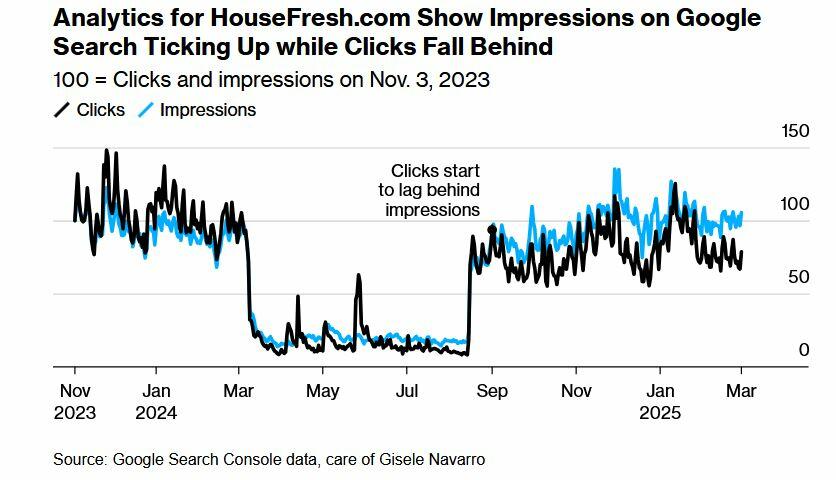
These summaries often draw directly from websites – like Charleston Crafted – but don’t send users to them, according to a report by Bloomberg. That’s left publishers like Gisele Navarro, managing editor of HouseFresh, watching as her content appears in summaries without translating into clicks or revenue. Internal analytics, which she shared with Bloomberg, show a growing share of impressions without traffic.
Across the web, independent publishers are reporting similar experiences. The rise of Google’s AI Overviews – which deliver synthesized answers from across the internet – along with a series of search algorithm changes, has upended the traffic patterns many small websites once relied on. Bloomberg, which conducted interviews with 25 publishers and digital experts, found widespread concern that Google’s shifting strategy is unraveling a symbiotic relationship that has powered the internet for years: websites provide helpful content, and Google delivers the audience.
Now, many creators say they’re being cut out of the equation entirely.
According to SEO expert and digital marketer Pritam Ghosh (citing a recent study by BrightEdge), Google’s AI overviews dominate 74% of problem-solving queries.
Key Insights by Query Category
Analyzing over 100,000 keywords, BrightEdge categorized searches into four types and tracked AI Overviews’ presence:
- Problem-Solving Queries: 74% (e.g., “how to fix a leaky faucet”)
- Informational Queries: 63% (e.g., “what causes climate change”)
- Navigational Queries: 13% (e.g., “Facebook login”)
- Transactional Queries: 5% (e.g., “buy running shoes”)
The data suggests Google prioritizes AI-generated answers for complex, research-based searches, while minimally using them for navigational or commercial intent queries.
Impact on Click-Through Rates (CTR)
AI Overviews significantly alter user engagement:
- When AI Overviews appear in position #1, organic CTR drops by 25% compared to traditional “blue link” results.
- These AI-driven responses dominate visibility, appearing in the top five positions for 87% of queries where they’re triggered.
A Fractured Compact
Google has denied that AI Overviews is the root cause of these sharp traffic declines, saying it is “misleading to make generalizations about the causes” based on individual cases. The company attributes changes in web traffic to seasonal trends, evolving user preferences, and its regular search updates.
Still, evidence of broader disruption is mounting. An analysis by the data firm Similarweb – conducted at Bloomberg’s request – found consistent declines across 67 small publisher sites in categories including lifestyle, travel, DIY, and cooking. Travel sites saw the sharpest losses, coinciding with Google’s introduction of robust AI-generated content in that domain.
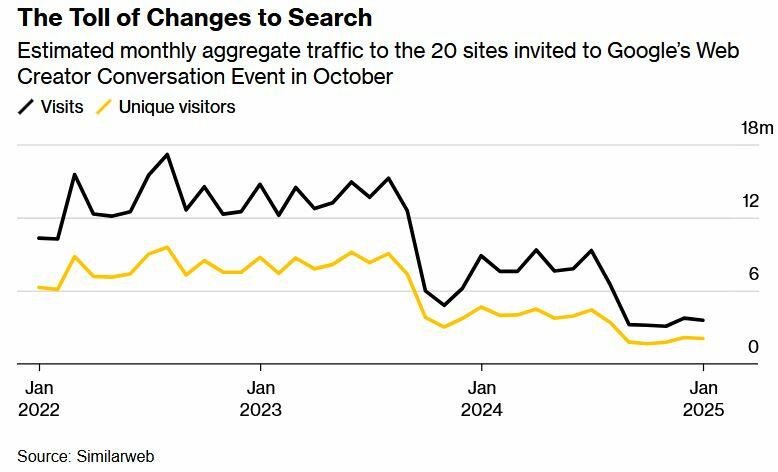
Privately, Google has acknowledged the challenges. In October, the company invited about 20 web creators to its headquarters in Mountain View, Calif., for a closed-door meeting. There, according to attendees, Google’s search team apologized and said the sites represented the kind of high-quality content it wanted to highlight. But officials also admitted they could not guarantee a return to previous traffic levels — the search experience had fundamentally changed.
Mike Hardaker, who runs Mountain Weekly News, shared during that meeting that his site had once generated $250,000 in revenue. By late 2024, he was relying on a food bank. “I need to know as a business owner, and personally, if you think there’s a chance that some of our sites have the ability to recover,” he asked at the time. Google’s chief search scientist, Pandu Nayak, apologized – but offered no assurances.
Digital marketing firm Semrush reports the same pattern: more content visibility within Google, but fewer visits to the actual websites.

Raptive, a media company representing over 5,000 creators, estimates publishers could ultimately lose up to 25% of their traffic to AI Overviews. Google, for its part, says it is delivering “high-quality clicks,” but hasn’t released detailed data. BrightEdge, a data firm, found that the top beneficiaries of AI Overviews traffic are giants like Wikipedia, TripAdvisor, and YouTube — the latter being owned by Google itself.
Other changes – such as recipe summaries Google is piloting – are also raising alarms. While some participating food bloggers are receiving compensation, Raptive estimates that overall traffic to food sites could fall by half if the feature is rolled out more broadly.
“The big fear,” said Lisa Bryan, creator of the food site Downshiftology, speaking on behalf of fellow bloggers, “is that Google is severing the relationship that we have with our communities and our audiences.”
The power dynamic between Google and publishers has always been unequal. But some creators say the balance has tipped into unsustainable territory.
“I don’t understand how Google thinks this is sustainable,” said Jake Boly, founder of That Fit Friend, a site that reviews training shoes. “If you drive away all enthusiasts and small publishers, then we’re going to be overrun by spam and the few players who can afford to pay to play.”
The results, critics say, are already showing. Some AI-generated summaries have surfaced bad or bizarre advice. Laura Longwell of Travel Addicts said Google is recommending places to go to the beach near Philadelphia based on advice from a luggage storage company and a driving school. “The idea that any of that is based on experience or expertise is laughable,” she said.

Google continues to push its EEAT framework — emphasizing Experience, Expertise, Authoritativeness, and Trustworthiness — but even sites that align with those principles say they are being punished. “For years, Google has had the audacity to gaslight us, saying, ‘Don’t write for search,’” said Hardaker. “Well, then, who am I writing for?”
‘Betrayed, That’s the Word’
For some creators, the damage is already irreversible.
Toronto-based couple Dave Bouskill and Debra Corbeil launched their travel blog The Planet D in 2008. For years, Google Search was their lifeblood, eventually driving 90% of their traffic. When AI Overviews rolled out, traffic dropped by half. It kept falling. Revenue plummeted. They laid off staff. Eventually, they stopped updating the blog.
They’ve since pivoted to YouTube, another Google property, to try and rebuild their audience. But the sting remains.
“I do feel betrayed by Google,” Bouskill said. Corbeil cut in: “Betrayed, that’s the word.”

Two Storms, One Harvest

Every food crisis in living memory has been a one-shock event. The 2008 price spike was a commodity bubble. The 2020 shortages were a logistics failure. The 2022 grain scare was a war on one exporter’s ports. Each time, the system bent, adjusted, and recovered, and each time the experts assured us afterward that global markets are simply too big and too diversified to fail.
What nobody in Washington seems eager to discuss is that 2026 is shaping up to be something the modern food system has never actually faced. Two independent shocks, one climatic and one geopolitical, are converging on the same harvest cycle at the same time. Not sequentially. Simultaneously.
Start with the weather. The Pacific Ocean is currently building toward what forecasters now openly call a record event. NOAA’s Climate Prediction Center puts the odds of at least a strong El Niño near 88 percent, with roughly two in three odds it reaches “very strong” status, the tier reserved for perhaps three or four events in the entire satellite era. Every major global model now projects a median peak in Super El Niño territory, and most of them project it exceeding the 2015-16 event, which until now held the modern record. Sea surface anomalies were already brushing the super threshold in mid-July, months before these events normally peak. The atmosphere has already shifted into El Niño mode, and the event is forecast to crest in late fall and early winter.
This is not about “climate change.” It’s about the standard cycles of weather, and the cycle we’re currently in is one that has likely devastated societies in the past. We’re better prepared as a society today, but not all Americans are equally prepared.
Serious households have started doing the quiet math on their own. Grocery bills tell part of the story, and the forecast maps tell the rest, which is why long-term food storage has moved from fringe hobby to mainstream line item in the family budget, with established suppliers like Heaven’s Harvest seeing demand from people who five years ago would have rolled their eyes at the idea. That instinct is not paranoia. It is pattern recognition, and the pattern is worth walking through carefully.
Editor’s Note: Heaven’s Harvest IS a sponsor, but the warnings of this article are real and would be written even if we didn’t have a survival food sponsor. With that said, those who take advantage of what they offer can use promo code “Patriot” for 15% off.
The Fertilizer Clock Is Already Running
While the Pacific warms, the second shock has been unfolding in the Strait of Hormuz. The conflict with Iran turned the world’s most important energy chokepoint into a contested waterway, and the consequences reach far beyond the gas pump. Roughly a third of global fertilizer trade moves through Hormuz, and the disruption sent urea prices up 86 percent year over year by March, with a 53 percent jump in a single month.
The World Bank projects energy prices rising about 24 percent in 2026 and fertilizer about 31 percent. By its own accounting, fertilizer prices ran 35 percent higher in the first five months of this year than the same period last year.
Here is the mechanism the nightly news will not explain. Fertilizer is not a grocery item. It is a time-delayed input. The nitrogen a farmer in Iowa or Punjab could not afford to apply this spring does not show up as a problem this spring. It shows up as a thinner harvest six to twelve months later.
The World Bank’s own food security brief concedes that the effects of reduced applications earlier this season “are likely to become visible only later in harvest outcomes.” Translate that from institutional language into plain English and it means this. The damage is already done, it is already in the ground, and we are simply waiting for it to arrive on the shelf.
Now check the calendar. Six to twelve months from the spring planting season lands us squarely in late 2026 and early 2027. Which is precisely when the strongest El Niño in the instrumental record is forecast to peak, bringing its signature droughts to Southeast Asia, Australia, southern Africa, northern Brazil, and South Asia, the very regions that grow the world’s rice, sugar, and oilseeds.
The World Bank warns openly that a strong El Niño “could disrupt multiple crop belts simultaneously” on top of the conflict-driven input costs. Their baseline projection assumes the Middle East disruptions ease by autumn. What in the last two years of Middle East history suggests that assumption is safe?
The System Has No Slack Left
The comfortable answer is that global markets always adjust. But adjustment requires slack, and the slack is gone. Global cereal production is expected to decline from last year’s records even before El Niño does its work. The UN World Food Programme, hardly a den of right-wing preppers, is calling this the most significant disruption to its supply chains since Covid and the invasion of Ukraine, and its supply chain director put the stakes bluntly.
Today’s supply chain challenges are tomorrow’s hunger crisis.
There is also a political dimension that markets cannot price. When food gets scarce, governments do not behave like economists. They behave like politicians. Export bans, hoarding mandates, and panic buying at the national level turned the modest rice shortfall of 2008 into a global crisis, and analysts are already warning that import-dependent nations are the first dominoes.
The 2015-16 Super El Niño, a far weaker event than what is now forecast, threw tens of millions into food stress across Africa and Asia. This one is projected to be stronger, and it arrives with fertilizer already rationed by price and shipping lanes already contested by missiles.
What Joseph Knew
Scripture does not treat preparation for lean years as faithlessness. It treats it as wisdom delivered in advance to those willing to act on it.
Behold, there come seven years of great plenty throughout all the land of Egypt: And there shall arise after them seven years of famine; and all the plenty shall be forgotten in the land of Egypt.
Joseph did not respond to that warning with a hashtag or a committee. He stored grain during the years of abundance, and when the famine came, Egypt stood while its neighbors begged. The lesson is not that famine is certain. It is that the time to prepare is precisely when preparation still looks optional.
Nobody who filled a pantry in a year of plenty has ever regretted it, and nobody standing in an empty aisle has ever been glad he waited for certainty.
None of this calls for panic, and panic is the enemy of sound judgment anyway. It calls for the same unglamorous prudence our grandparents considered ordinary. Keep some cash margin, know your local growers, and put real food in deep storage while it is cheap and available, because the entire arc of this story is that cheap and available is a closing window.
Families looking for a straightforward place to start can visit Heaven’s Harvest and use promo code Patriot for 15 percent off long-term storable food. The forecasts may yet soften, the strait may yet reopen, and we should pray they do. But hope is a fine thing to hold and a foolish thing to eat.
