

You might rightfully wonder: How can a bank, like the neighborhood bank down the street, “create money out of thin air”?
To answer that question, we must enter the magical kingdom of “fractional-reserve banking,” where deposits are turned into loans, loans are turned into money, and so on. For every old dollar that goes in, nine new dollars come out, created with the stroke of a pen or the click of a mouse. As you may be aware, general deposits are loans by the bank depositor to the bank. However, banks can spin new loans out of old loans, creating a wheel of fortune by lending the same dollar to nine different customers—a feat that, to the uninitiated, is equally quite amazing and frightening!
This financial alchemy is perfectly legal and is in fact carried out with the aid and assistance of central banks everywhere, including our own Federal Reserve. If this wheel of fortune should hit a bump in the road and suddenly fall off its axle, causing the bank to crash, don’t worry because a central bank can do what no one else can legally do: counterfeit new money to set things right, a feat that “all the king’s horses and all the king’s men” cannot do!
Let’s take a closer look at how fractional-reserve banking works. Customer A deposits $10,000 in a checking account at First Bank. First Bank records the cash in its books and credits customer A’s account. The cash is an asset of the bank (a credit), which is offset by the liability to customer A (a debit). First Bank now has cash to lend, subject to government reserve requirements. Reserve requirements, which are established by the Fed, specify the amount (expressed as a percentage of deposits) that a lending institution must hold in reserve, either as vault cash or on deposit with a Federal Reserve bank, in order to guarantee payment of customers’ deposits. The reserve requirement for “reservable” deposits greater than $36.1 million (as of January 3, 2023) at any lending institution has been traditionally 10 percent. As a result, First Bank is free to lend $9,000 of the deposited money, keeping $1,000 in reserve.
Customer B comes into First Bank seeking a car loan. First Bank agrees to lend customer B $9,000. First Bank credits customer B’s checking account for $9,000 and debits an asset account called “loans receivable.” As you will recall, bank loans to customers are “investments” and, therefore, are assets—not liabilities.
At the completion of these two transactions, First Bank’s statement of financial condition would look like this (for simplicity, I have assumed no other transactions).
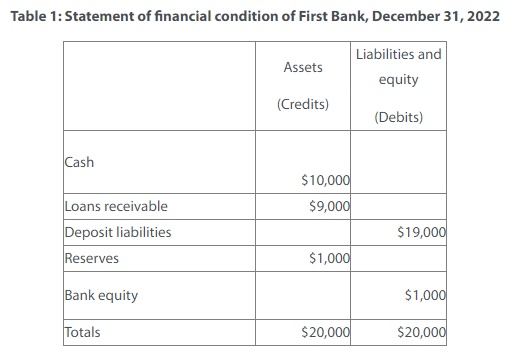
Notice that the bank has deposit liabilities of $19,000 and cash on hand of $10,000. Let’s assume that the loan to customer B is for three years, payable with interest in monthly installments. The demand deposits (checking account balances) include the original deposit of $10,000 from customer A plus the proceeds of the loan to customer B of $9,000. Presumably, customer B will spend the loan money on a car in the next few days. Where did the loan money credited to customer B’s checking account come from? Out of thin air!
The wheel turns again when the car dealer deposits the $9,000 proceeds in his bank, Second Bank. Now Second Bank, like First Bank, is free to make loans, subject to the 10 percent reserve requirement. When the wheel finally stops turning, loans of $90,000 have been created on a cash base of just $10,000. As we have seen, that cash is itself a chimera—nothing more than debt wrapped inside more debt.

The table above demonstrates that banks can expand the money supply by a factor of ten when the reserve requirement is 10 percent. Historically, the United States reserve requirement has been 10 percent on transaction deposits, such as checking and negotiable order of withdrawal accounts (M1) deposits, and 0 percent on time deposits, such as deposits into savings accounts and certificates of deposit. The 0 percent reserve requirement on time deposits enables banks to expand the money supply by more than a factor of ten.
Some would argue that banks are not really “insolvent,” just at times illiquid—not always having ready cash when needed. However, that’s true only if we consider just one or a few banks at a time. Any bank having a temporary shortage of cash could always borrow the needed funds to make up for the temporary cash shortage. The problem, however, is that all banks are illiquid and, when pricked by some general financial shock, can easily slip into insolvency.
When the reserve ratio is 10 percent, total deposits are reduced by ten dollars for every dollar withdrawn from the banking system. Banks then have to call in loans or sell securities to cover their depositor’s demands for money. This “liquidity crisis” is the reason behind most financial “panics,” bank runs, and similar economic disturbances. It’s “debt on the way down,” but this time on a grand scale!
Effective March 26, 2020, the Federal Reserve reduced bank reserve requirements, get this, to zero! Even prior to this change, reserve requirements only applied to transaction accounts, nonpersonal time deposits, and Eurocurrency liabilities. Everything else was “jokers are wild.” Thus, banks could create as much funny money as the traffic would bear. When reserve requirements are zero, the ability to create money is infinite!
The Fed’s money manipulation is the root cause of our economic problems. Bubbles in housing prices, United States Treasury notes and bonds, and cryptocurrencies—to give but a few examples—and the recent failures of the Silicon Valley, Republic, and Signature banks can all be traced to our monetary policies.
The fundamental issue for most banks is that they are forced to invest “long” but borrow “short,” something no prudent finance manager would ever do. Checking and other demand deposits are short-term liabilities of the bank. Bank loans, such as car loans, are intermediate-term investments. Mortgage loans are long-term investments. Banks also invest in government securities to balance their investment loan portfolio. Investing “long,” however, subjects the bank to interest-rate risks because the value of their investment loan portfolio is inversely related to changes in interest rates. A thirty-year mortgage loan yielding 2 percent is only worth a fraction of a similar loan yielding 6 percent. To be more precise, a $100,000 investment in such an instrument would be worth only $44,280 if interest rates were to rise to 6 percent. If interest rates rise to 8 percent, the value would fall to $31,768, according to the bond price calculator.

Therein lies the trap that Silicon Valley Bank (SVB) fell into—with disastrous results. It’s the trap set by the very nature of fractional-reserve banking:
Over a period of just two days in March 2023, the bank went from solvent to broke as depositors rushed to SVB to withdraw their funds, resulting in federal regulators closing the bank for good on March 10, 2023.
SVB’s collapse marked the second largest bank failure in U.S. history after Washington Mutual’s in 2008.
That money created out of thin air should one day evaporate before our eyes should surprise no one, except perhaps Paul Krugman and his fellow court jesters at the New York Times. The endless cycles of boom and bust are a direct result of government manipulation of the money supply. It’s really that profound and that simple.
About the Author
Stephen Apolito is a CPA living in Bronxville, New York. A veteran of the US Air Force, Apolito is a graduate of Washington and Lee University and has taught in the New York City public schools.
Article cross-posted from Mises.

Two Storms, One Harvest

Every food crisis in living memory has been a one-shock event. The 2008 price spike was a commodity bubble. The 2020 shortages were a logistics failure. The 2022 grain scare was a war on one exporter’s ports. Each time, the system bent, adjusted, and recovered, and each time the experts assured us afterward that global markets are simply too big and too diversified to fail.
What nobody in Washington seems eager to discuss is that 2026 is shaping up to be something the modern food system has never actually faced. Two independent shocks, one climatic and one geopolitical, are converging on the same harvest cycle at the same time. Not sequentially. Simultaneously.
Start with the weather. The Pacific Ocean is currently building toward what forecasters now openly call a record event. NOAA’s Climate Prediction Center puts the odds of at least a strong El Niño near 88 percent, with roughly two in three odds it reaches “very strong” status, the tier reserved for perhaps three or four events in the entire satellite era. Every major global model now projects a median peak in Super El Niño territory, and most of them project it exceeding the 2015-16 event, which until now held the modern record. Sea surface anomalies were already brushing the super threshold in mid-July, months before these events normally peak. The atmosphere has already shifted into El Niño mode, and the event is forecast to crest in late fall and early winter.
This is not about “climate change.” It’s about the standard cycles of weather, and the cycle we’re currently in is one that has likely devastated societies in the past. We’re better prepared as a society today, but not all Americans are equally prepared.
Serious households have started doing the quiet math on their own. Grocery bills tell part of the story, and the forecast maps tell the rest, which is why long-term food storage has moved from fringe hobby to mainstream line item in the family budget, with established suppliers like Heaven’s Harvest seeing demand from people who five years ago would have rolled their eyes at the idea. That instinct is not paranoia. It is pattern recognition, and the pattern is worth walking through carefully.
Editor’s Note: Heaven’s Harvest IS a sponsor, but the warnings of this article are real and would be written even if we didn’t have a survival food sponsor. With that said, those who take advantage of what they offer can use promo code “Patriot” for 15% off.
The Fertilizer Clock Is Already Running
While the Pacific warms, the second shock has been unfolding in the Strait of Hormuz. The conflict with Iran turned the world’s most important energy chokepoint into a contested waterway, and the consequences reach far beyond the gas pump. Roughly a third of global fertilizer trade moves through Hormuz, and the disruption sent urea prices up 86 percent year over year by March, with a 53 percent jump in a single month.
The World Bank projects energy prices rising about 24 percent in 2026 and fertilizer about 31 percent. By its own accounting, fertilizer prices ran 35 percent higher in the first five months of this year than the same period last year.
Here is the mechanism the nightly news will not explain. Fertilizer is not a grocery item. It is a time-delayed input. The nitrogen a farmer in Iowa or Punjab could not afford to apply this spring does not show up as a problem this spring. It shows up as a thinner harvest six to twelve months later.
The World Bank’s own food security brief concedes that the effects of reduced applications earlier this season “are likely to become visible only later in harvest outcomes.” Translate that from institutional language into plain English and it means this. The damage is already done, it is already in the ground, and we are simply waiting for it to arrive on the shelf.
Now check the calendar. Six to twelve months from the spring planting season lands us squarely in late 2026 and early 2027. Which is precisely when the strongest El Niño in the instrumental record is forecast to peak, bringing its signature droughts to Southeast Asia, Australia, southern Africa, northern Brazil, and South Asia, the very regions that grow the world’s rice, sugar, and oilseeds.
The World Bank warns openly that a strong El Niño “could disrupt multiple crop belts simultaneously” on top of the conflict-driven input costs. Their baseline projection assumes the Middle East disruptions ease by autumn. What in the last two years of Middle East history suggests that assumption is safe?
The System Has No Slack Left
The comfortable answer is that global markets always adjust. But adjustment requires slack, and the slack is gone. Global cereal production is expected to decline from last year’s records even before El Niño does its work. The UN World Food Programme, hardly a den of right-wing preppers, is calling this the most significant disruption to its supply chains since Covid and the invasion of Ukraine, and its supply chain director put the stakes bluntly.
Today’s supply chain challenges are tomorrow’s hunger crisis.
There is also a political dimension that markets cannot price. When food gets scarce, governments do not behave like economists. They behave like politicians. Export bans, hoarding mandates, and panic buying at the national level turned the modest rice shortfall of 2008 into a global crisis, and analysts are already warning that import-dependent nations are the first dominoes.
The 2015-16 Super El Niño, a far weaker event than what is now forecast, threw tens of millions into food stress across Africa and Asia. This one is projected to be stronger, and it arrives with fertilizer already rationed by price and shipping lanes already contested by missiles.
What Joseph Knew
Scripture does not treat preparation for lean years as faithlessness. It treats it as wisdom delivered in advance to those willing to act on it.
Behold, there come seven years of great plenty throughout all the land of Egypt: And there shall arise after them seven years of famine; and all the plenty shall be forgotten in the land of Egypt.
Joseph did not respond to that warning with a hashtag or a committee. He stored grain during the years of abundance, and when the famine came, Egypt stood while its neighbors begged. The lesson is not that famine is certain. It is that the time to prepare is precisely when preparation still looks optional.
Nobody who filled a pantry in a year of plenty has ever regretted it, and nobody standing in an empty aisle has ever been glad he waited for certainty.
None of this calls for panic, and panic is the enemy of sound judgment anyway. It calls for the same unglamorous prudence our grandparents considered ordinary. Keep some cash margin, know your local growers, and put real food in deep storage while it is cheap and available, because the entire arc of this story is that cheap and available is a closing window.
Families looking for a straightforward place to start can visit Heaven’s Harvest and use promo code Patriot for 15 percent off long-term storable food. The forecasts may yet soften, the strait may yet reopen, and we should pray they do. But hope is a fine thing to hold and a foolish thing to eat.
