

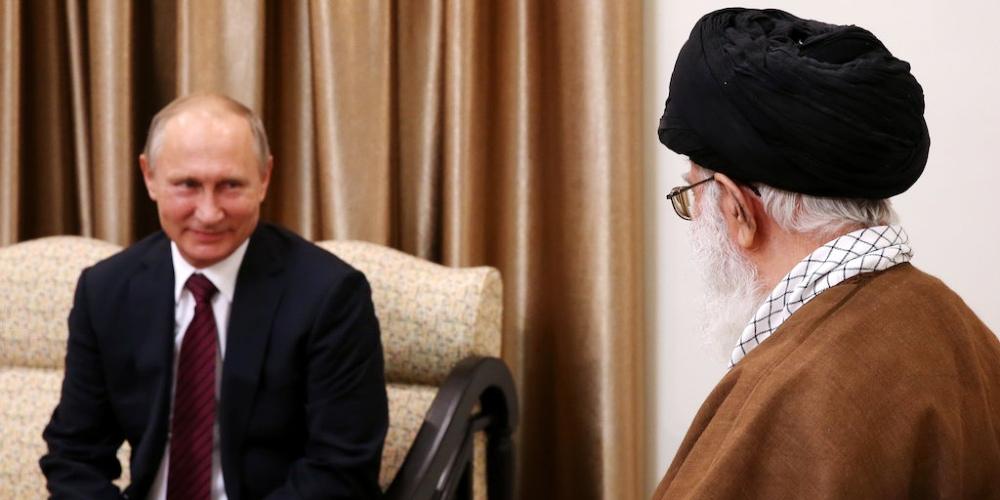
Iran’s Supreme Leader, Ayatollah Ali Khamenei, has reportedly drawn up a secret escape route to Moscow should the ongoing protests overwhelm his regime’s grip on power. According to an intelligence report cited by The Times of London, the 86-year-old ruler would depart Tehran with a small entourage of up to 20 family members and aides, including his son and heir apparent, Mojtaba Khamenei. This contingency mirrors the recent flight of Syrian dictator Bashar al-Assad, who sought refuge in Russia after his downfall in December 2024.
The plan involves stockpiling assets abroad, drawing from Khamenei’s control over vast holdings estimated at $95 billion through opaque foundations like Setad. Intelligence sources indicate that many in his inner circle already have relatives settled in places like the United States, Canada, and Dubai, facilitating a smooth exit. Khamenei’s choice of Moscow is obvious with Tehran’s deepening alliance with Vladimir Putin’s Russia, a partnership that has supplied drones and missiles for conflicts in Ukraine and against Israel.
Protests have swept Iran for over a week, fueled by crippling economic woes, including skyrocketing inflation and shortages exacerbated by last year’s brief but devastating war with Israel. Demonstrators, facing brutal crackdowns by the Islamic Revolutionary Guard Corps, have clashed with security forces, resulting in at least 41 deaths so far, as reported by human rights groups. Khamenei, who has rarely appeared in public since the unrest began, broke his silence on January 3, vowing that rioters “must be put in their place” and refusing to back down.
President Donald Trump issued a stark warning to Tehran over the weekend, threatening to strike Iran “very hard” if the regime continues its violent suppression of protesters. This comes amid reports that U.S. intelligence is monitoring the situation closely, with some analysts suggesting American support could tip the scales toward regime change. Trump’s stance contrasts sharply with past administrations’ approaches, which critics argue emboldened Iran’s aggression through deals like the 2015 nuclear agreement.
The regime’s fragility exposes cracks in what was once portrayed as an unshakeable theocracy. Khamenei’s paranoia, as described in a Western psychological profile, drives his pragmatic yet ideological decisions, balancing short-term compromises with long-term ambitions. Yet, with security forces showing signs of strain—desertions and defections reported in isolated incidents—the Supreme Leader’s hold appears more tenuous than ever.
Russia’s role as a potential safe haven raises questions about broader geopolitical machinations. Moscow’s support for Iran, including military aid, aligns with a pattern of propping up anti-Western dictatorships. Some observers speculate this axis could be part of a coordinated effort to destabilize global order, echoing alliances that have long troubled free nations. Iran’s backing of terrorist groups like Hezbollah and Hamas further cements this view, as the regime funnels resources to proxies while its own people suffer.
In the face of such oppression, the Iranian people’s resolve stands out. Protesters, many risking their lives for basic freedoms, draw from a deep well of perseverance. This struggle resonates with timeless principles of justice and human dignity, values that have inspired movements throughout history. As one demonstrator told Reuters, “We are tired of living in fear; it’s time for real change.”
If Khamenei’s escape plan activates, it could signal the end of nearly five decades of clerical rule since the 1979 revolution. With assets abroad and allies in Moscow ready, the Supreme Leader seems prepared to abandon the ship he has steered into crisis. Meanwhile, the world watches, hoping for a future where Iran rejoins the community of nations committed to peace and prosperity.
For now, the streets of Tehran remain a battleground, with no clear resolution in sight. The coming days will test whether Khamenei’s regime can quell the dissent or if history repeats itself, as it did in Syria. Either way, the implications for the Middle East—and beyond—are profound.

Starting the Day With a Scripture-Inspired Roast Helps Center Your Thoughts on Eternal Truths Amid Temporal Pressures
The world can seem chaotic, especially right after we wake up. Many believers start their mornings reaching for something familiar — a hot cup of coffee — yet end up settling for mediocre brews that do little more than deliver a caffeine jolt. The daily grind of life, with its endless distractions, news cycles, and responsibilities, can leave even the most faithful feeling spiritually parched alongside their physical fatigue. What if your morning ritual could do more than wake you up? What if it could ground you in truth, nourish your body with exceptional quality, and quietly advance a kingdom purpose at the same time?
That’s the promise — and the reality — behind Promised Grounds Coffee. This Christian-founded company doesn’t just roast beans; it approaches every step as an act of worship and discipleship. By selecting only the top 10% of specialty-grade beans, ethically sourced from dedicated farmers in Central and South America, and small-batch roasting them with reverence in Austin, Texas, Promised Grounds delivers what many describe as the best coffee available — never burnt, never bland, but rich with origin stories and layered flavors that honor God’s creation.
From the vibrant Psalm 27 Roast (a light, bright medium option) to the bold yet peaceful 2 Timothy 1:7 Decaf, each bag carries a Scripture verse that turns your daily pour into a gentle reminder of faith. And through their Ounce Per Ounce Promise, every ounce of coffee you enjoy provides an equal ounce of clean water to families in need via partnership with Filter of Hope — literally brewing hope for body and soul, one cup at a time.
The challenge for today’s Christians runs deeper than finding a decent cup. In an age of convenience-driven consumerism, it’s easy to support companies that dilute values or remain silent on matters of faith. Many believers want their everyday choices — from what they drink to how they spend — to reflect discipleship rather than just convenience. Promised Grounds solves this by weaving Christian excellence into the entire process: beans nurtured with prayerful stewardship by farming families, roasted as an offering rather than a commodity, and packaged with Bible verses to encourage a mindset of gratitude and purpose from the first sip. Reviewers consistently praise the smooth, rich profiles — whether enjoyed black in a drip maker, iced on a warm day, or shared in fellowship — noting how the quality stands toe-to-toe with premium secular brands while delivering something far more meaningful.
This integration of faith and flavor addresses a real need in Christian households and ministries. Busy parents, church leaders, and remote workers alike report that starting the day with a Scripture-inspired roast helps center their thoughts on eternal truths amid temporal pressures. The coffee’s exceptional character — bright citrus notes in lighter roasts or deep chocolate undertones in bolder ones — comes from meticulous selection and careful roasting that respects the bean’s natural gifts rather than masking them. It’s the kind of coffee that elevates a simple quiet time, fuels productive workdays, or sparks meaningful conversations when shared at Bible studies or outreach events. And because it’s ethically sourced with integrity, every purchase supports sustainable livelihoods for farmers who treat their crops like family harvests.
For those leading churches or small groups, the impact multiplies. Promised Grounds offers bundles and options perfect for hospitality ministries, turning ordinary coffee service into an opportunity to point people toward the living water of Christ. Imagine greeting visitors with a warm cup whose very bag carries God’s Word — a subtle yet powerful witness that aligns with the Great Commission. The company’s Texas roots and commitment to “brewing hope” resonate especially with believers who value American enterprise paired with global compassion.
Of course, quality alone isn’t enough if the experience feels out of reach. Promised Grounds keeps it accessible with practical perks like free shipping on orders over $40, sample sets for discovering favorites, and thoughtful add-ons such as faith-themed mugs. Whether you prefer whole beans for fresh grinding, grounds for convenience, or even bulk options for larger households and ministries, the result is consistently superior coffee that makes discipleship feel integrated rather than added on.
As you consider how to align even the smallest habits with your walk with God, Promised Grounds Coffee stands out as a refreshing solution. It tackles the dual problems of subpar daily sustenance and disconnected consumption by offering a product that genuinely excels in taste while advancing a mission of clean water, farmer dignity, and scriptural encouragement. Believers who make the switch often describe it as more than a beverage upgrade — it becomes part of their rhythm of gratitude, a daily invitation to remember that every good gift comes from above.
If you’re ready to transform your mornings (and perhaps your church gatherings) with coffee that honors both exceptional craftsmanship and Christian values, I encourage you to explore what Promised Grounds has to offer. One sip at a time, you’ll be nourishing your body, refreshing your spirit, and participating in something far greater — all while enjoying what truly is among the best coffee available.
Welcome,
I am Tony Soprano. I speak of myself as Tony Soprano. Tony has his eyes on the world. Better behave. There is a new Capo in town. Now, good news is he will protect you. Tony loves the neighborhood. You may get a welcome visit from one of his “lieutenants” to give you a gift basket and a hug and to set time for weekly chats on your finances and health, which Tony cares about a lot. So, thank you for your support of Tony, his family, his lieutenants, his medical staff (very good with orthopedics). Tony is glad to have you on his team.
Be Safe,
Tony
Typical of muslim “leaders”. They’re all for martyrdom, as long as they’re not the martyr. If he truly believed all that wicked mess he’s been imposing on others, funding and supporting, all these years, with all the death he has caused, then he would stay and, himself, face the prospect of death …
And before the muzzie reaches Russian airspace, it will mysteriously go down, with no survivors.
Putin wanted their oil, coming to Russia, not their cult.
Do you think Vlad does this for free? Oh no, he extracted something from them very big.