

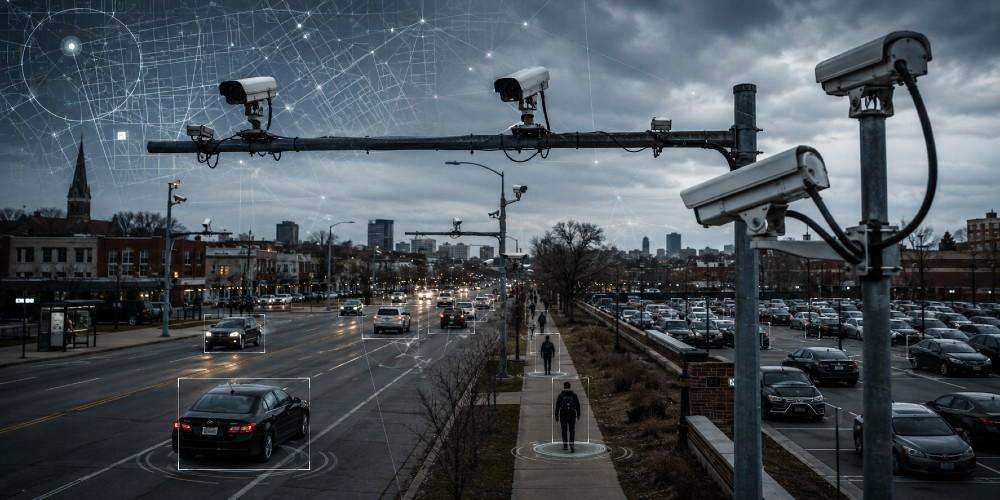
In a year stuffed with war talk, a collapsing dollar, and a political class that acts like all of the damage from the Biden regime has been fixed, a lot of Americans have decided the great villain of 2026 is a traffic camera. That sounds small until you realize what the camera actually is.
It is not a cop on a corner who happens to notice a stolen Buick. It is a private contractor building a searchable map of every car that rolls past a pole. Connor O’Keeffe put it cleanly. The government would never get away with dropping a GPS tracker in every glove box. So it rented the next best thing and called it public safety.
Flock Safety’s automated license plate readers photograph the plate, the make, the model, the dents, even the bumper sticker. That record goes into a national database other agencies can query. The company now runs about 120,000 cameras across 49 states. Sen. Josh Hawley says those boxes produce more than 20 billion vehicle scans a month. If you drive, you are in there. Your church run. Your doctor’s office. The house you visit after dark.
The sales pitch is always the same. Stolen cars. Missing kids. Bad guys. Nobody wants a kidnapper to get a head start. The problem is that the machine does not stay pointed at kidnappers. It stays pointed at everybody, and then a bored officer with a password decides what “everybody” means.
The Public Stopped Buying the Safety Sermon
That is why the backlash has been so raw. It did not come from a think tank. It came from Facebook groups, city council meetings, and, in more than a few towns, men with saws. Cameras have been painted, cut, and yanked off poles in dozens of communities. Flock tried to brand the people mapping those cameras as terrorists. The public laughed. Then it kept mapping them.
More than fifty jurisdictions have already walked away. Arizona’s Tempe and Cave Creek, one blue and one red, killed their contracts on the same day. Texas cities are peeling off. Gov. Greg Abbott has moved to freeze state money for the devices. Florida’s Ron DeSantis, who once helped fund them, now says the readers are “out of control” and that he does not want a surveillance state. Hawley has given CEO Garrett Langley until September 8 to explain who can search the pile and why Congress never authorized a national driving diary.
When a vendor that never sells a product to ordinary people starts rewriting its rules because ordinary people are furious, something real is happening.
The Misuse Was Not a Glitch
Flock’s defenders want this framed as a few bad apples. The apples keep falling.
The Institute for Justice has documented officers using plate readers to stalk romantic partners and exes. A Florida cop allegedly ran his estranged wife hundreds of times. A Milwaukee officer looked up his partner more than a hundred times. A civilian employee in St. Charles County, Missouri, ran personal searches until the department dumped the contract. Innocent drivers have been chased and held at gunpoint after the software picked the wrong car.
That is not a “tool” problem. That is a power problem. Give a man a warrantless window into a woman’s movements and some men will use it. Give a future administration a national movement log and it will use it for whatever moral panic is fashionable that year. Stay-at-home orders. Political enemies. Church parking lots. Take your pick.
Last month Flock announced it would cut default data retention from 30 days to 7, force case codes on searches, and make internal audits mandatory. Langley told the New York Post communities needed his help. Fine. Shorter memory is better than a month-long dossier. It is not the same thing as refusing to build the dossier in the first place. Emergency overrides still exist. Evidence mode still freezes records. The network is still national. The cameras are still going up faster than towns can tear them down.
Put not your trust in princes, nor in the son of man, in whom there is no help.
That is the whole argument, and it is older than any Atlanta startup. Americans used to fall for the line that the people in charge were gathering this power for our own good. The Patriot Act. The banker bailouts. The lockdowns. Each time the public was told to sit still and trust the experts. Each time the experts kept the new machinery after the emergency expired.
O’Keeffe’s point is the healthiest thing in this whole fight. People are no longer comforted by promises about how the system “will” be used. They are asking how it could be used by the next crew they cannot stand. That is not paranoia. That is adult citizenship. You do not hand your political enemies a loaded camera grid and hope they remain sportsmanlike.
This Is Not About One Brand
Flock is simply the name on the box. The real issue is a government-adjacent surveillance layer that treats driving as probable cause for a permanent file. Rep. Greg Steube said it without the usual Beltway throat-clearing. Americans have rights. This is not the CCP. If law enforcement can watch the comings and goings of citizens who have done nothing wrong, the Fourth Amendment is a brochure.

Crime is real. Stolen trucks are real. A sheriff who wants a tool to find a killer is not the devil. The devil is the claim that the only people who should mind a national plate archive are people with something to hide. Law-abiding families have plenty to hide from a state that has already shown it will freeze bank accounts, deplatform dissent, and rewrite rules mid-crisis.
The revolt is messy. Some of it is legal pressure. Some of it is a mask and a saw. The propaganda that used to smother this kind of fight is not working. Officials say “safety.” Voters say “papers, please.” That gap is not a communications failure. It is a verdict.
Do not unlearn it. A people who still flinch when the government maps their every mile is a people that has not fully surrendered. The cameras can be sold as neighbors watching out for neighbors. They are not. They are a contractor selling the state a memory it did not earn and a reach the Constitution never gave it. Feeling good about the fight against that is not crankish. It is the first sane civic instinct this country has shown in a long time.
The Surveillance State Can Only Be Stopped When Flock Cameras Are Completely Taken Down
The fight over Flock Safety is being waged on ground the surveillance state chose, and conservatives are losing it without realizing they’ve been maneuvered. Every city council debating retention limits, warrant requirements, and audit logs has already conceded the only point that matters: that the cameras stay. They cannot stay. The poles have to come down, the hardware has to be hauled away, and nothing may take its place.
The grievances driving the current backlash are real enough. The Institute for Justice has catalogued at least 26 cases since 2018 of innocent motorists detained at gunpoint or jailed because an automated plate reader guessed wrong.
In Sherwood, Arkansas, officers pulled a couple out of an SUV at gunpoint while their six-week-old baby sat alone in the back seat. The camera had misread a single character. In Waukesha County, Wisconsin, a driver was surrounded on I-94 by cruisers with weapons drawn because the system tied his car to a Milwaukee homicide. Wrong car, wrong man.

Randomized testing in Vallejo, California found that a stunning share of stationary reader hits were simply errors. Americans are right to be furious about this. They are also being encouraged to stay furious about the wrong thing, because a false positive can be blamed on a vendor’s software and fixed with a patch.
Consider what happens when the rules are actually written. Illinois passed a law barring the use of plate data for immigration and abortion investigations. An audit later found that Customs and Border Protection had a pipeline into the data anyway.
Cities that voted to shut cameras off discovered them still running. Cambridge, Massachusetts terminated its contract after technicians installed new units following a council-ordered shutdown. Littleton had to order its cameras powered down a second time. Evanston caught units coming back online. And in a number of towns that congratulated themselves on canceling Flock, the council simply signed with a competitor, so residents lost the brand and kept the surveillance.
Roughly 120,000 of these readers now operate across 49 states. A statute is a piece of paper. The network is a physical fact, and physical facts outlast the politicians who promise to govern them.
That is the whole argument, and it does not depend on any particular administration being wicked. It depends only on the certainty that some future administration will face something it calls an emergency. Pandemic, cyberattack, domestic unrest, a war footing, take your pick. Emergency powers are never invented from scratch in the moment of crisis. They are drawn from capacity that was quietly built during ordinary times for ordinary reasons.
A government that can reconstruct where 200 million vehicles have traveled for the past year does not need to round anyone up. It needs only to know who attended which church, which rally, which meeting, and who visited whom.
The satraps in Babylon understood the sequence perfectly. They could find no fault in Daniel’s administration of the kingdom, so they watched his private habits first and drafted the law afterward: “Then these men assembled, and found Daniel praying and making supplication before his God” (Daniel 6:11).
Surveillance came before the crime. It always does.
So the standard for victory has to be raised, and raised now, while public opinion is still hot and city councils are still nervous. Not oversight boards. Not 7-day retention. Not “local control,” which the national lookup feature already made a fiction. Cameras off the poles, contracts void, data purged, and no replacement vendor waiting in the wings.
A free people can absorb the cost of solving a few more crimes the slow, constitutional way. What they cannot absorb is handing the next generation a country already wired for the emergency that hasn’t been declared yet.

Two Storms, One Harvest

Every food crisis in living memory has been a one-shock event. The 2008 price spike was a commodity bubble. The 2020 shortages were a logistics failure. The 2022 grain scare was a war on one exporter’s ports. Each time, the system bent, adjusted, and recovered, and each time the experts assured us afterward that global markets are simply too big and too diversified to fail.
What nobody in Washington seems eager to discuss is that 2026 is shaping up to be something the modern food system has never actually faced. Two independent shocks, one climatic and one geopolitical, are converging on the same harvest cycle at the same time. Not sequentially. Simultaneously.
Start with the weather. The Pacific Ocean is currently building toward what forecasters now openly call a record event. NOAA’s Climate Prediction Center puts the odds of at least a strong El Niño near 88 percent, with roughly two in three odds it reaches “very strong” status, the tier reserved for perhaps three or four events in the entire satellite era. Every major global model now projects a median peak in Super El Niño territory, and most of them project it exceeding the 2015-16 event, which until now held the modern record. Sea surface anomalies were already brushing the super threshold in mid-July, months before these events normally peak. The atmosphere has already shifted into El Niño mode, and the event is forecast to crest in late fall and early winter.
This is not about “climate change.” It’s about the standard cycles of weather, and the cycle we’re currently in is one that has likely devastated societies in the past. We’re better prepared as a society today, but not all Americans are equally prepared.
Serious households have started doing the quiet math on their own. Grocery bills tell part of the story, and the forecast maps tell the rest, which is why long-term food storage has moved from fringe hobby to mainstream line item in the family budget, with established suppliers like Heaven’s Harvest seeing demand from people who five years ago would have rolled their eyes at the idea. That instinct is not paranoia. It is pattern recognition, and the pattern is worth walking through carefully.
Editor’s Note: Heaven’s Harvest IS a sponsor, but the warnings of this article are real and would be written even if we didn’t have a survival food sponsor. With that said, those who take advantage of what they offer can use promo code “Patriot” for 15% off.
The Fertilizer Clock Is Already Running
While the Pacific warms, the second shock has been unfolding in the Strait of Hormuz. The conflict with Iran turned the world’s most important energy chokepoint into a contested waterway, and the consequences reach far beyond the gas pump. Roughly a third of global fertilizer trade moves through Hormuz, and the disruption sent urea prices up 86 percent year over year by March, with a 53 percent jump in a single month.
The World Bank projects energy prices rising about 24 percent in 2026 and fertilizer about 31 percent. By its own accounting, fertilizer prices ran 35 percent higher in the first five months of this year than the same period last year.
Here is the mechanism the nightly news will not explain. Fertilizer is not a grocery item. It is a time-delayed input. The nitrogen a farmer in Iowa or Punjab could not afford to apply this spring does not show up as a problem this spring. It shows up as a thinner harvest six to twelve months later.
The World Bank’s own food security brief concedes that the effects of reduced applications earlier this season “are likely to become visible only later in harvest outcomes.” Translate that from institutional language into plain English and it means this. The damage is already done, it is already in the ground, and we are simply waiting for it to arrive on the shelf.
Now check the calendar. Six to twelve months from the spring planting season lands us squarely in late 2026 and early 2027. Which is precisely when the strongest El Niño in the instrumental record is forecast to peak, bringing its signature droughts to Southeast Asia, Australia, southern Africa, northern Brazil, and South Asia, the very regions that grow the world’s rice, sugar, and oilseeds.
The World Bank warns openly that a strong El Niño “could disrupt multiple crop belts simultaneously” on top of the conflict-driven input costs. Their baseline projection assumes the Middle East disruptions ease by autumn. What in the last two years of Middle East history suggests that assumption is safe?
The System Has No Slack Left
The comfortable answer is that global markets always adjust. But adjustment requires slack, and the slack is gone. Global cereal production is expected to decline from last year’s records even before El Niño does its work. The UN World Food Programme, hardly a den of right-wing preppers, is calling this the most significant disruption to its supply chains since Covid and the invasion of Ukraine, and its supply chain director put the stakes bluntly.
Today’s supply chain challenges are tomorrow’s hunger crisis.
There is also a political dimension that markets cannot price. When food gets scarce, governments do not behave like economists. They behave like politicians. Export bans, hoarding mandates, and panic buying at the national level turned the modest rice shortfall of 2008 into a global crisis, and analysts are already warning that import-dependent nations are the first dominoes.
The 2015-16 Super El Niño, a far weaker event than what is now forecast, threw tens of millions into food stress across Africa and Asia. This one is projected to be stronger, and it arrives with fertilizer already rationed by price and shipping lanes already contested by missiles.
What Joseph Knew
Scripture does not treat preparation for lean years as faithlessness. It treats it as wisdom delivered in advance to those willing to act on it.
Behold, there come seven years of great plenty throughout all the land of Egypt: And there shall arise after them seven years of famine; and all the plenty shall be forgotten in the land of Egypt.
Joseph did not respond to that warning with a hashtag or a committee. He stored grain during the years of abundance, and when the famine came, Egypt stood while its neighbors begged. The lesson is not that famine is certain. It is that the time to prepare is precisely when preparation still looks optional.
Nobody who filled a pantry in a year of plenty has ever regretted it, and nobody standing in an empty aisle has ever been glad he waited for certainty.
None of this calls for panic, and panic is the enemy of sound judgment anyway. It calls for the same unglamorous prudence our grandparents considered ordinary. Keep some cash margin, know your local growers, and put real food in deep storage while it is cheap and available, because the entire arc of this story is that cheap and available is a closing window.
Families looking for a straightforward place to start can visit Heaven’s Harvest and use promo code Patriot for 15 percent off long-term storable food. The forecasts may yet soften, the strait may yet reopen, and we should pray they do. But hope is a fine thing to hold and a foolish thing to eat.
