

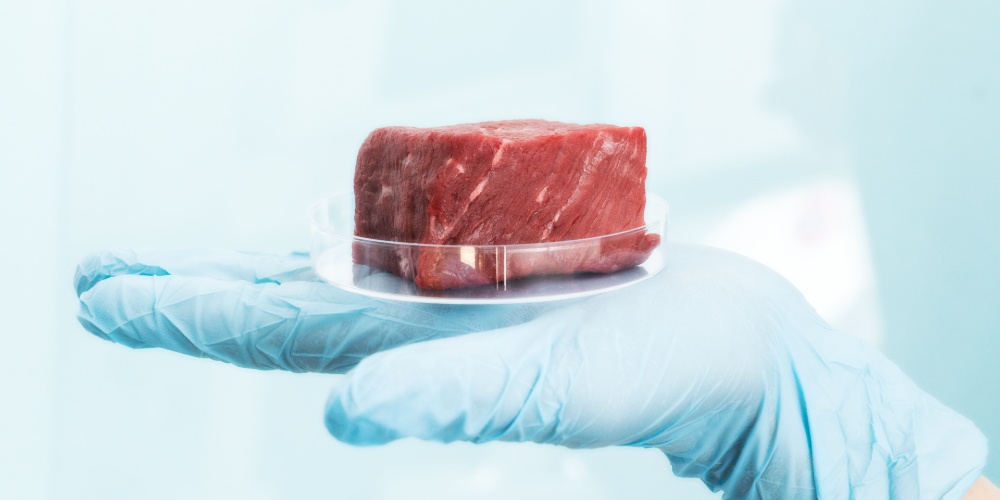

(The Organic Prepper)—COP28 is wrapping up, and I’m never going to eat a chicken nugget again. Why? Because of the relentless drive toward getting “novel protein” (insects and cultured meat) into the food supply.
This year’s climate summit was the first to extensively address food production. There was a Food Systems Pavilion with eight thematic days, and one of those days was exclusively about how to “Advance Protein Diversification.”
In other words, how to get people to eat stuff they don’t want to.
The publishing industry is getting into this, too. You can find dozens of books that have been recently brought to market, earnestly promoting insects as food to save the planet. These are not to be outdone by books swearing that lab-grown meat will revolutionize food.
They discussed how to “push” consumers toward novel protein.
Discussions highlighted innovations in Israel, Brazil, Singapore, Denmark, and the Netherlands, all countries that have pioneered research in either insect farming or cultured meat. The folks at the climate summit discussed “how we can push others toward the tipping point in protein diversification.”
One discussion focused on circular agrifood and biomass. “Circular agrifood” sounds high-tech but really boils down to waste processing. For example, a farm may be perfectly circular if livestock exclusively consumes vegetation on the farm, their poop is spread around the pastures, they get processed on-farm, and the waste materials are buried, fed to dogs, or otherwise kept on the property. Two hundred years ago, most farms were “circular agrifood systems.”
So, are they promoting the traditional closed-loop, locally-owned, independently operated farms?
Not quite. This discussion was chaired by an expert in waste management and a representative of an innovative food processing company, not managers of closed-loop farms.
In fact, if you live in a wealthy country, these people may see your local farmer as the problem, not the solution. Speakers at COP28 summits blame overconsumption in wealthy countries for food instability in poorer ones.
This is a gross simplification of an incredibly complex set of problems.
Overconsumption of food isn’t just a “rich people problem.” It’s the opposite.
For starters, overconsumption of food is not necessarily related to overall wealth. You don’t see overweight people walking around elite enclaves like Malibu or Aspen. They’re in the poorer parts of major cities, and throughout rural America.
I spent much of my childhood in a low-income household. People at the bottom of the socioeconomic food chain are not overconsuming pastured steaks and Kerrygold butter. They’re overconsuming the stuff their SNAP benefits pay for at Dollar Tree, foods like Doritos and Mountain Dew. These foods are artificially cheap because they are made of processed corn, which is heavily subsidized by the government.
US Agriculture Secretary Tom Vilsack is aware of this. He was less militant about eliminating meat from American diets than his European counterparts. His talks during “Food Day” emphasized less food wastage rather than eliminating meat and dairy. However, the Intergovernmental Panel on Climate Change (IPCC) insists that affluent Westerners need to reduce meat and dairy consumption by 35-50% to achieve climate goals.
Climate change is being blamed for food shortages in developing countries. However, you cannot ignore the role distribution problems play. These might be related to war or to internal problems such as corruption. They are not necessarily affected by the actions of wealthier countries.

Solving the problem of low-income, overweight Americans would involve massive cultural changes. It would involve fixing the subsidy system that makes junk food so cheap. It would involve a huge push to re-introduce home economics classes, empowering people to prepare their own food. And it would involve a change in cultural expectations. When working multiple part-time jobs is the norm, it’s really hard to find time to prepare healthy meals.
Food scarcity in developing countries isn’t because of “rich Westerners,” either.
Solving the problem of food scarcity in less developed countries is no small feat either. It would involve better infrastructure, such as roads and refrigeration facilities. It would also require accountability at the local level in terms of ensuring corrupt officials do not keep donated goods for themselves.
All of these solutions involve increasing local control and self-empowerment for individuals to make better decisions for themselves.
So, is that what the food giants and the attendees of summits like COP28 are working toward?
These summits promote consolidation and processed foods.
No, they’re going to keep moving toward consolidating food companies and putting more highly processed junk food on the market.
The “Big Four” meatpackers (JBS, Cargill, Tyson, and National Beef Packing) control more than 80% of the market. Of these four, JBS, Cargill, and Tyson have invested in cultured (lab-grown) meat.

They are beginning to see themselves as in the protein business rather than the meat business. Also, it doesn’t hurt that investing in alternative proteins helps companies’ ESG scores.
They are not just investing in cultured meat. Cargill and Tyson have also been investing in insect production.
In 2022, Cargill partnered with Innovafeed, an insect meal producer. They feed livestock waste to black soldier flies, which then are in turn fed to farmed fish, chicks, and piglets.
Now Tyson’s getting in on the game. In October, Tyson purchased a minority stake in Dutch insect farming company Protix. They plan to build a black soldier fly facility in the US for use in pet foods and livestock feed. Tyson says they do not plan to add insects to human food “at this time.”
Fish, chicks, and piglets do naturally consume insects. But I still think this drive toward partnerships between giants in the traditional livestock industry and insect producers is worth our attention.
In a previous article about eating bugs, I referenced studies finding that putting the infrastructure in place for insect protein production is not as climate-neutral as it pretends to be. Constructing the facilities required for a substantial amount of protein production would require a significant amount of space and energy. A whole new infrastructure would need to be built, and in a more freely functioning market, investors would need to see demand before making those kinds of commitments.
As we noted in another previous article, the demand for novel proteins has not been developing organically, and a huge infrastructure for conventional meat processing already exists. Consumers are not choosing novel proteins. They’re being pushed on us by people who seem religiously convinced that eating insects is good for the planet.
Tyson may not be planning to put insect meal into their meat products “at this time,” but they’re investing in the infrastructure that could make that happen when they think the time is right. With all the talk about how good eating insects is for the environment, it’s reasonable to assume that companies will start looking at how to incorporate insect protein into their food products.
How to really improve the agricultural system
There are absolutely ways in which the agricultural system could improve. But the real solutions lie in working toward fewer middlemen. This would make locally produced food more affordable, wherever “local” is for you, and more profitable for the farmers. Customers need more transparency to make better dietary choices, and building connections with local farmers and custom processors is a great way to achieve that.
I have eaten crickets that still look like crickets. I am not interested in processed foods with hidden ingredients. As the food giants move toward novel proteins, it will be more important than ever to know where your meat comes from. Unless, of course, insect nuggets sound delicious to you.
What are your thoughts, though? If you could save money, would you eat lab-grown meat or insects? Do you think this type of “food” production is good for the planet? Are you interested in trying these products?
Let’s discuss it in the comments section.
About Marie Hawthorne
A lover of novels and cultivator of superb apple pie recipes, Marie spends her free time writing about the world around her.

You eat that Schmidt and die
i will abandon any stores that put lab meat on their shelves.
DITTO
Anything that you freeze is going to require electricity, when that goes out, you lose it all. I have had that problem many times. My little house has a little fridge,, so I don’t keep much long term for that reason. I depend on and I support local stores privately owned.
Please let the lab-grown meat and bugs be REQUIRED AT ALL COLLEGES, SCHOOLS, AND OTHER LIBERAL HELL HOLES.
Thanks for your cooperation.