

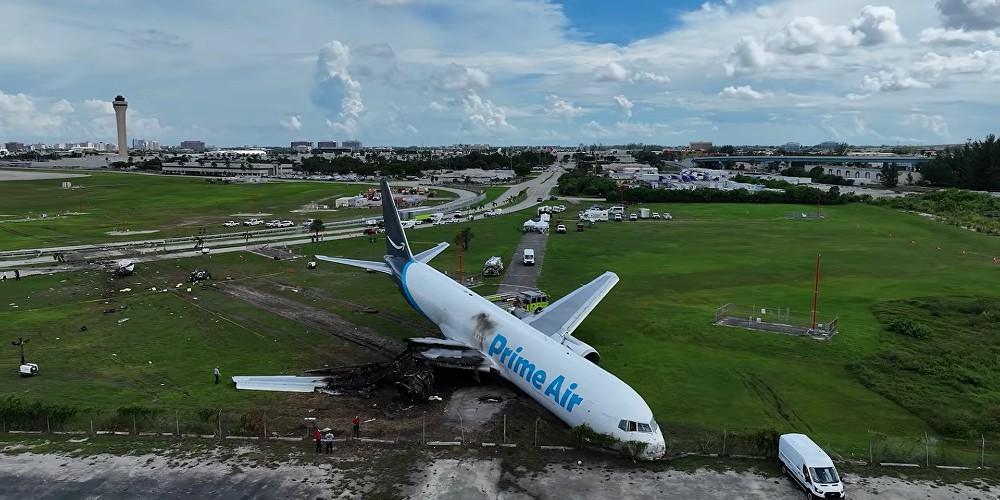
An Amazon Prime Air Boeing 767 did not merely miss a landing in Miami on Sunday. It came in high and fast, bounced one gear off the pavement, aborted the go-around too late, never deployed the reversers or the speed brakes, and then rolled a 32-year-old freighter through a cleaning crew’s van and a public road. Five men who clocked in to wipe down airplanes never clocked out. The pilots walked away. One of them, shaking, told a bystander his career was over.
That is the crash. The story underneath it is older, uglier, and not a rumor invented on social media. The airplane was flown for Amazon by 21 Air, a Greensboro-based cargo outfit with an operations shop in Miami and a nickname in pilot forums that should have been a flashing light.
They called it 21 Scare.
What the Recorders Already Show
The NTSB has not issued a probable cause. It does not need five years to describe the last half minute. Nose and right main gear touched at about 158 knots. The left main stayed in the air for another eleven seconds. Brakes on. Brakes off. Throttles shoved toward go-around power. Throttles pulled back to idle. Brakes on again. No thrust reversers. No speed brakes.
Then a 767 that should have been a stopped truck became a blunt instrument and killed Rolando Aleman Leon, 55; Yoel Rodriguez Naranjo, 53; Julio C. Pineda, 75; Carlos Acosta Fajardo, 53; and Javierkys Reyes Quevedo, 47. All of them were in a Ford van belonging to Professional Ocean Service Corp.
The flight was the airplane’s third of the day, San Juan back to Miami after Cincinnati-Miami and Miami-San Juan. Thunderstorms were in the area. A tailwind gust near 30 mph has been mentioned. Weather is not an excuse for leaving the airplane in the air for a third of a 9,000-foot runway and then changing your mind twice about whether you are landing or leaving.
Captain Joseph Carroll, 55, had 7,145 hours and received his 767 type rating in May, four months before this landing. First Officer Jaime Felipe Silva Molina, 37, had 2,655 hours, a 767 rating from April 2025, and an aeronautical engineering degree from Colombia. Both were treated and released. Investigators planned to sit them down Wednesday before releasing the cockpit voice recorder.
The Company Amazon Hired
Matt Walsh put the hiring question on the table Monday, and he did not invent it. 21 Air is controlled through an LLC by Houston Astros owner Jim Crane. It is one of Amazon Air’s contract carriers. The pilot group, according to engineer Nick Plumb’s public-resume review that Walsh cited, ballooned from roughly 20 in 2021 to about 135 as Amazon shifted additional 767s over from Atlas Air. Those résumés show prior flying in Venezuela, Colombia, Peru, Central America, Ethiopia, and India, plus permanent residents and other work-authorized noncitizens.
That is not a conspiracy theory. It is a staffing pattern. Cargo outfits live on thin margins. Amazon pits contractors against each other. The cheap way to grow a roster is to take the pilots the majors and the better cargo shops already washed out.
Forum veterans on Airline Pilot Central have been saying that out loud for years. Almost every pilot who left ABX for 21 Air, one wrote, was asked to resign because of how poorly they did in training. Another described a Newark taxi incident in which a Cargo South 767 crew never turned on the beacon, blew a 2,500-foot clearance, and drew livid ATC while struggling with English and a low-altitude capture.
“Amazing they haven’t bent up a 767 yet,” one jumpseater wrote, after listing terrain warnings, high-altitude stalls, and automation messes. They bent one up on Sunday.
A May 2023 FAA letter, which Walsh published, allowed 21 Air to substitute its own check airman for an FAA inspector on at least one takeoff-and-landing leg of initial or upgrade training. Honor system. The same federal instinct that let Boeing grade its own homework.
Ye shall know them by their fruits. Do men gather grapes of thorns, or figs of thistles?
Matthew 7:16 is not a weather briefing. It is a hiring standard. A company that grows that fast, on that kind of paper, with that kind of reputation, will eventually put its fruit on a runway in front of other people’s families.
The Whistleblowers Were Not Anonymous Trolls
Before Walsh touched the microphone, CBS News and the Miami Herald had already laid out a paper trail. Former 21 Air pilot Karl Seuring, more than thirty years in the cockpit, says he raised safety concerns and a manager told him, “It’s not going to change.”
He filed a retaliation complaint. OSHA rejected it. He appealed to a Department of Labor tribunal that was still pending when the 767 left the pavement. His lawyer described pressure to fly with rest periods too short to be legal.
Former chief pilot Bruce Joseph testified that people were discouraged, “on numerous occasions,” from logging problems in the safety-management software. The then-director of safety, he said, told him not to put anything in the system before talking to then-CEO Mike Mendez. Most reports, Joseph said, never got filed unless he pushed.

Retired fighter pilot Don Helmig lasted three months. In a June 12, 2021, resignation email to Crane he wrote that everywhere he looked there were issues, and that the company paid “lip service” to Safety Management Systems and then did “exactly nothing.”
Retired pilot Tony Bless, who also testified, told CBS the Miami crash did not come out of the blue. He cited maintenance deferrals on converted passenger jets, pressure from the chief pilot’s office, and “the quality of pilots they would hire.”
Those same former pilots alleged the company staffed men who could not communicate safely in English. That is the piece the respectable press wants to treat as impolite. It is also the piece that matches the radio work Walsh played and the Newark story from the forums. English is not a diversity accessory in a cockpit. It is how two men and a controller keep a hundred-ton machine from becoming a weapon.
21 Air has denied the retaliation claims. The company said Seuring was fired for misrepresenting his history, not for talking. Mendez testified that his job was to run a safe airline, “not to hurt people and not to hide anything.”
After Sunday, 21 Air CEO Keith Winters offered condolences and cooperation. Amazon offered the same and pointed at the NTSB. Nobody offered an explanation for why a contractor with that file was still wearing the Prime Air paint.
What This Is and What It Is Not
It is not established that Carroll or Silva Molina were illegal aliens, visa frauds, or men who failed every checkride they ever sat. Carroll holds FAA ratings across multi-engine jets and helicopters. Silva Molina’s public profile is a Colombian engineering degree and a 21 Air first-officer job. Work-authorized foreign pilots are legal.

Competence is a different question. So is the company that selects them, trains them, schedules their third flight of a stormy Sunday, and then lets them fly an unstable approach into a city.
It is also not “just DEI,” as if a slogan in a United recruiting ad explains every bad landing in America. What it is, is the same cheap-labor instinct this country already learned the hard way with CDLs, hospital night shifts, and meat plants.
When the payroll shrinks and the roster has to grow, standards become a cost center. Forums fill up with warnings. Regulators write exemption letters. A contractor gets the Amazon contract. Then five men in a van become a statistic, and the network waits for the final NTSB report the way a man waits for a gravestone to tell him what he already saw.
Pilots on that outfit predicted a bent 767. Bless said a lot of the ex-captains had been anticipating it. Walsh said the footage made pilot error obvious and the remaining questions were who hired them, how they were trained, and what the FAA was doing instead of watching.
Those are still the questions. The recorders will fill in the last twenty seconds. They will not explain why a company with a scare for a nickname was trusted with other people’s lives in the first place.

Two Storms, One Harvest

Every food crisis in living memory has been a one-shock event. The 2008 price spike was a commodity bubble. The 2020 shortages were a logistics failure. The 2022 grain scare was a war on one exporter’s ports. Each time, the system bent, adjusted, and recovered, and each time the experts assured us afterward that global markets are simply too big and too diversified to fail.
What nobody in Washington seems eager to discuss is that 2026 is shaping up to be something the modern food system has never actually faced. Two independent shocks, one climatic and one geopolitical, are converging on the same harvest cycle at the same time. Not sequentially. Simultaneously.
Start with the weather. The Pacific Ocean is currently building toward what forecasters now openly call a record event. NOAA’s Climate Prediction Center puts the odds of at least a strong El Niño near 88 percent, with roughly two in three odds it reaches “very strong” status, the tier reserved for perhaps three or four events in the entire satellite era. Every major global model now projects a median peak in Super El Niño territory, and most of them project it exceeding the 2015-16 event, which until now held the modern record. Sea surface anomalies were already brushing the super threshold in mid-July, months before these events normally peak. The atmosphere has already shifted into El Niño mode, and the event is forecast to crest in late fall and early winter.
This is not about “climate change.” It’s about the standard cycles of weather, and the cycle we’re currently in is one that has likely devastated societies in the past. We’re better prepared as a society today, but not all Americans are equally prepared.
Serious households have started doing the quiet math on their own. Grocery bills tell part of the story, and the forecast maps tell the rest, which is why long-term food storage has moved from fringe hobby to mainstream line item in the family budget, with established suppliers like Heaven’s Harvest seeing demand from people who five years ago would have rolled their eyes at the idea. That instinct is not paranoia. It is pattern recognition, and the pattern is worth walking through carefully.
Editor’s Note: Heaven’s Harvest IS a sponsor, but the warnings of this article are real and would be written even if we didn’t have a survival food sponsor. With that said, those who take advantage of what they offer can use promo code “Patriot” for 15% off.
The Fertilizer Clock Is Already Running
While the Pacific warms, the second shock has been unfolding in the Strait of Hormuz. The conflict with Iran turned the world’s most important energy chokepoint into a contested waterway, and the consequences reach far beyond the gas pump. Roughly a third of global fertilizer trade moves through Hormuz, and the disruption sent urea prices up 86 percent year over year by March, with a 53 percent jump in a single month.
The World Bank projects energy prices rising about 24 percent in 2026 and fertilizer about 31 percent. By its own accounting, fertilizer prices ran 35 percent higher in the first five months of this year than the same period last year.
Here is the mechanism the nightly news will not explain. Fertilizer is not a grocery item. It is a time-delayed input. The nitrogen a farmer in Iowa or Punjab could not afford to apply this spring does not show up as a problem this spring. It shows up as a thinner harvest six to twelve months later.
The World Bank’s own food security brief concedes that the effects of reduced applications earlier this season “are likely to become visible only later in harvest outcomes.” Translate that from institutional language into plain English and it means this. The damage is already done, it is already in the ground, and we are simply waiting for it to arrive on the shelf.
Now check the calendar. Six to twelve months from the spring planting season lands us squarely in late 2026 and early 2027. Which is precisely when the strongest El Niño in the instrumental record is forecast to peak, bringing its signature droughts to Southeast Asia, Australia, southern Africa, northern Brazil, and South Asia, the very regions that grow the world’s rice, sugar, and oilseeds.
The World Bank warns openly that a strong El Niño “could disrupt multiple crop belts simultaneously” on top of the conflict-driven input costs. Their baseline projection assumes the Middle East disruptions ease by autumn. What in the last two years of Middle East history suggests that assumption is safe?
The System Has No Slack Left
The comfortable answer is that global markets always adjust. But adjustment requires slack, and the slack is gone. Global cereal production is expected to decline from last year’s records even before El Niño does its work. The UN World Food Programme, hardly a den of right-wing preppers, is calling this the most significant disruption to its supply chains since Covid and the invasion of Ukraine, and its supply chain director put the stakes bluntly.
Today’s supply chain challenges are tomorrow’s hunger crisis.
There is also a political dimension that markets cannot price. When food gets scarce, governments do not behave like economists. They behave like politicians. Export bans, hoarding mandates, and panic buying at the national level turned the modest rice shortfall of 2008 into a global crisis, and analysts are already warning that import-dependent nations are the first dominoes.
The 2015-16 Super El Niño, a far weaker event than what is now forecast, threw tens of millions into food stress across Africa and Asia. This one is projected to be stronger, and it arrives with fertilizer already rationed by price and shipping lanes already contested by missiles.
What Joseph Knew
Scripture does not treat preparation for lean years as faithlessness. It treats it as wisdom delivered in advance to those willing to act on it.
Behold, there come seven years of great plenty throughout all the land of Egypt: And there shall arise after them seven years of famine; and all the plenty shall be forgotten in the land of Egypt.
Joseph did not respond to that warning with a hashtag or a committee. He stored grain during the years of abundance, and when the famine came, Egypt stood while its neighbors begged. The lesson is not that famine is certain. It is that the time to prepare is precisely when preparation still looks optional.
Nobody who filled a pantry in a year of plenty has ever regretted it, and nobody standing in an empty aisle has ever been glad he waited for certainty.
None of this calls for panic, and panic is the enemy of sound judgment anyway. It calls for the same unglamorous prudence our grandparents considered ordinary. Keep some cash margin, know your local growers, and put real food in deep storage while it is cheap and available, because the entire arc of this story is that cheap and available is a closing window.
Families looking for a straightforward place to start can visit Heaven’s Harvest and use promo code Patriot for 15 percent off long-term storable food. The forecasts may yet soften, the strait may yet reopen, and we should pray they do. But hope is a fine thing to hold and a foolish thing to eat.
